The moral roots of liberals and conservatives … socialists and capitalists

Jonathan Haidt: The moral roots of liberals and conservatives (TED Video)

“If you take the greatest insights from Asian philosophies and religions and combine them with the latest research on moral psychology, I think you come to these conclusions:

  • Our Righteous Minds were “designed” to …
    • unite us into teams,
    • divide us against other teams, and
    • blind us to the truth

Haidt posits the theory that “stories” help “un-blind” us from the truth and will lead to better outcomes.   Haidt’s theory is supported by the works of W. Edwards Deming – one of the foremost authorities on quality management who concluded that everyone benefits through optimization, e.g., that actions should result in outcomes where everyone gains or at least, are not any worse off in the long-term.

Haidt and Deming’s philosophies are supported by the “stakeholder” theory which is discussed in Haidt’s talk about the “Three Stories of Capitalism.

The five foundations (channels) of morality – The Moral Mind:

  1. Care/Harm
  2. Fairness/Reciprocity
  3. Ingroup/Loyalty
  4. Authority/Respect
  5. Purity/Sanctity

Liberals use two channels (1&2), conservatives five.

  • Per Haidt,  “Self-described “progressives” he notes places a high value on care/harm and fairness and largely disregard the rest. Self-described “conservatives” by contrast, value all five — although they define both care/harm and fairness in different ways. The upshot of this difference Haidt suggests is that conservatives are generally good with empathizing with the political opinions of their adversaries where progressive, on average, are not.”
  • ” … if you believe that the priorities of the progressives are valuable in and of themselves but they do not represent the who story, then you will likely consider the progressive world view to be well-intentioned but far too narrow.
  • “But  if,  like the progressive in Haidt’s tests, you consider three of the five of the variables that conservatives hold dear to be orally worthless, you will consider your opponents to be charlatans who spurn what really matters in favor os useless ideals such as tradition and upright behavior.”
  • Reference: Conservatarian Manifesto, by Charles C.W. Cooke , pg. 92.)

A sixth channel is Liberty which is associated with Libertarians.  Paper: Understanding Libertarian Morality.  YouTube Presentation

  • Libertarians value liberty more, and most other moral values less, than liberals or conservatives.
  • Libertarians rely upon reason more – and less on emotion  – than either liberals or conservatives.
  • Libertarians are more individualist, less connected to other people than liberals or conservatives

Comparison – Libertarian and Conservative:  Libertarians and conservatives are a very odd couple. Very different personalities. United by a shared commitment to economic liberty; opposition to government enforcement of “positive liberty” via the welfare state.

 Jonathan Haidt: Three Stories About Capitalism (TED Video)

Johnathon Haidt is a social psychologist that works to bridge the gap between liberals, conservatives, socialists, and capitalists. In his talk – “Three Stories About Capitalism ” he reinforces how stories drive the narrative and concludes his talk by reinforcing the need for cooperative competition through the application of the “stakeholder” theory as opposed to the “shareholder” theory.

My career background is in the area of quality management. Quality Mangement supports the shareholder theory that is backed up by data, academic, and scientific studies.  If you want to read the stories of application success, “google” the winners of the Malcolm Baldrige Award.

Brown County IN “Stories”  The intent of including these descriptions of future scenarios is to reinforce the relevance of the perspectives shared by a sample of community  “stakeholders.”

  • Brown County Matters – Facebook Posts “If you were to describe what you think the county will be like in 10 years, what would you say?   
  • HCI Meeting Notes August 13 – Includes 10-year projections on the future possibilities — includes the best case and worst case.  Future reality will fall somewhere in-between.  A needed step is to identify the data that will be used to assess and monitor the trends.
Book and Interview: The Righteous Mind’: Why Liberals and Conservatives Can’t Get Along, Jonathon Haidt. (TED Video)

When he started his book, he considered himself as a  “partisan liberal.”   The process of writing the book led to a new perspective that both liberals and conservatives can be right.

  • Number one priority? Political reform. (see nolabels.org)
  • Educationally:  “… kill all the math classes beyond Algebra” – not useful and not helpful and replace with civics – political ideology and history;  replace calculus with basic statistics, Universities should be places of debate. People are concerned with their reputation that may create conditions that lead to more ethical behavior;
  • Emotions Rule.  Emotions (stories) influence reasoning as opposed to reasoning (the facts) influencing emotions.

My article and its relevance to national policy: Working with idiots and getting better results – Published at FedSmith.com

  • “Haidt’s research indicates that moral responses are instinctual—human beings are born preloaded with basic moral values. He believes that political attitudes are an extension of our moral reasoning, which accounts for much of the vitriol that surrounds liberal and conservative ideology.
  • According to Haidt, an individual’s beliefs and actions are influenced through a filter of values that include caring, fairness, loyalty, authority, sanctity, and liberty. These values provide a foundation that is needed for a society to function. He believes that liberals focus more on caring and fairness and undervalue the importance of loyalty, authority, sanctity, and liberty. Conservatives also value caring and fairness, but not at the exclusion of loyalty, authority, sanctity, and liberty.”


2018 County Election Results

Unofficial Results by Precinct – 2018 General

Brown County Democrat (BCD) – Articles

“Straight-ticket voting was more popular in this election than in the past 10 years. This year, 56.7 percent of voters automatically voted for everyone on the ballot for their chosen party, and the majority — 65.5 percent of them — were Republicans. However, straight-party voters had to manually choose winners of some races separately, such as nonpartisan offices.”

Turnout for this election was 56.7 percent — not a record, but on par with turnouts for elections since 2008. The record in that time period was 64 percent for the 2016 presidential election.

BCD Website – All Offices

Our vote history – From Democrat sweeps to Republican

In the late ‘80s and early ‘90s, results were almost the exact opposite of what we saw last week. …  The post-election paper in 1992 read: “Democrats dominate county election.” The only local Republican to win an office at the county level was Juanita Bainter, a four-term council member. … The story was similar in 1988, 30 years ago. All Democrats won their local offices, even though the county voted strongly for Republicans George Bush as president and Richard Lugar for senator.

The local Republican wave began to roll in 1996, the year of the Bob Dole-Bill Clinton presidential election. The top headline read “Voters sweep Republicans into offices’; the GOP won four of six contested races locally.

In 2000, it was more of the same. The top headline read “BLOWOUT: GOP loses only one contest.” That one holdout was Brown Circuit Court Judge Judith Stewart, a Democrat incumbent seeking her second term.

For the most part since then, Brown County has continued to trend red, following the majority of the state.

The 2008 election — with the Barack Obama/John McCain presidential race on the ballot — was the most balanced the results have been since then. Votes were nearly evenly split up and down the ballot, with seven Republicans and eight Democrats winning this county among national, state and local offices. Obama, of course, won the presidency that year; McCain won Brown County, but only by 208 votes.

Democrat Party Chair: “… And there, I think, is the problem: People that are not learning who the people are that are running for office.”

History Straight-Party Voting

Over the past 10 years, straight-ticket voting — automatically voting for all members of a particular party — has been on a fairly steady upward march.

In 2008, 18 percent of Brown County voters voted straight-ticket; 55 percent of them were Republican, 43 percent Democrat and 2 percent Libertarian.

This year, 56.7 percent of voters chose to vote strictly along party lines. Republican ballots were 65.6 percent of that total, 33.3 percent were Democrat and 1.1 percent were Libertarian.

Even as a party chairman, Bowman said he doesn’t like to see so many voters choosing the straight-party option. To him, that shows voters lack knowledge about the candidates. The choice listed from one’s own party isn’t always automatically the best choice for the job, he said.

Republican Party Chair:  “We need to protect the community with the best people, not just because you have a favoritism towards a certain party,” he said. “I view local elections totally separate. Obviously, you want your voters to vote for the best person even statewide and nationally too, but locally, it really affects us all.”

Democrat Party Chair: “Bond said that if straight-ticket would have gone the way of the Democrats, he would have been fine with it, “because I would have put up the best candidates. I believe I had the best candidates.”

Additional Articles:

Maple Leaf – Hexagon Design

Nov 6, 2018. BCD By Suzanna Couch  Maple Leaf taking shape: Amid construction, contracts also being hammered out …  The county has borrowed $12.5 million to build the performing arts center. The loan is to be paid back first by operating revenue, then by the innkeeper’s tax revenue if more is needed. Brown County visitors pay the innkeepers tax on room and cabin rentals.  (Facebook Post of the article and comments)

A  hexagon (6-sides) design is incorporated in the building of the government-owned Maple Leaf Performing Arts Center (MLPAC) in Nashville, Indiana.

hexagram is a six-pointed geometric star figure used to refer to the compound figure of two equilateral triangles. The intersection is a regular hexagon.

Famous Hexagonal Buildings

Hexagram – Wikipedia   Hexagrams have been historically used in religious and cultural contexts and as decorative motifs; by medieval MuslimsJudaism and occultism … as a decorative motif in medieval Christian churches,  and as a religious symbol by Arabs in the medieval period.

Of local interest, a hexagram is also used in Freemasonry.  The Nashville Indiana Lodge #135 Free and Accepted Masons started in 1851

Usage in Freemasonry (Wikipedia)

  • The hexagram is featured within and on the outside of many Masonic temples as a decoration. It may have been found within the structures of King Solomon‘s temple, from which Freemasons are inspired in their philosophies and studies. Like many other symbols in Freemasonry, the deciphering of the hexagram is non-dogmatic and left to the interpretation of the individual.
  • “The interlacing triangles or deltas symbolize the union of the two principles or forces, the active and passive, male and female, pervading the universe … The two triangles, one white and the other black, interlacing, typify the mingling of apparent opposites in nature, darkness and light, error and truth, ignorance and wisdom, evil and good, throughout human life.” – Albert G. Mackey: Encyclopedia of Freemasonry

Septic Condemnation – 10 Year Battle

Brown County Matters – Facebook Posts

Background Information  Septic Issue Hayworths 

Drained: Intricacies of septic condemnation confuse, frustrate residents, By Ben Skirvin, Brown County Democrat (Nashville)

Seventeen days before Christmas 2008, at the order of the Brown County Health Department, Brown County Water Utility shut off service to the Hayworth household.

On Aug. 13, 2008, Lowell Hayworth and his wife, Amanda, had bought a new mobile home to replace an existing dwelling at 7143 Oak Ridge Road.

On Aug. 15, environmental health specialist John Kennard appeared on their property with a stop-work order alleging that removing and replacing the mobile home was illegal without an additional septic permit from the health department.

And so started a six-year legal battle, which continues to this day.

West of the Hayworth property, on a plot northeast of Lake Lemon in the mostly abandoned, flood-damaged hamlet of Trevlac, sits the meeting hall for a now-defunct American Legion post.

The owner, Daniel Smith, faces jail time after being convicted of two counts of failure to vacate a condemned property – a Class B misdemeanor with a maximum penalty of 180 days in jail.

County health officials alleged he was living there after the property had been condemned. Investigative notes say sewage was leaking into the basement of a nearby property.

Smith’s Aug. 13 trial was the culmination of a decade of legal battles sparked by a condemnation letter Kennard signed.

Documents released by the Brown County Health Department as part of a September 2012 public records request show 20 other properties in Brown County have been condemned in the past five years, although it’s unclear how many of those were for failed septic systems.

Kennard claims to have had as many as 160 open septic investigations at one time. He said he currently is reviewing about 100.

How does it happen?

The process by which properties get condemned for septic failure has been questioned and debated in recent years by several property owners, attorneys and health department representatives like Kennard.

Even area counties don’t agree on a specific procedure.

The circumstances under which a health department employee can enter a property is one point of debate.

Link Fulp, Bartholomew County assistant director of environmental health, said his office will enter property uninvited only in order to get permission from the owner to conduct an inspection.

Monroe County Health Department septic inspector Randy Raines said he will enter property to conduct an inspection without getting a warrant or permission only if no other option exists.

At least two sections of state law – regular and administrative code – discuss the investigatory powers of health officers.

In short, a health officer or a designee can enter a property at any reasonable time to determine compliance with health laws – with the permission of the owner.

But if the officer or designee does not need permission if he or she has a court order; if an emergency condition exists that could result in a greater public health threat or individual health risk; if the place is public or in plain view; or if the owner has requested a license of some sort through the health department.

Brown County Clerk Beth Mulry could not produce any warrant requests from the Brown County Health Department regarding the Smith or Hayworth cases. In her eight years in office, she said the health department has never requested a warrant.

‘We’re selective’

The attorney for the Hayworth family holds a file of photographs of Kennard entering their property on numerous occasions, as evidenced by changes in weather and time stamps. “No trespassing” signs are posted along the roadside edge of the property.

“We never gave him permission to enter our property,” Amanda Hayworth said. “We never saw a court order.”

Kennard was granted permission to enter once, she clarified, under the supervision of her lawyer. That visit was to observe a septic system inspection conducted by Ed Brown.

“At one point, he would stop here every three or four days,” Amanda Hayworth said about Kennard. “We found out from neighbors that he was walking around while we weren’t here.”

A single search warrant was mentioned by police officers during Smith’s trial. However, it was not introduced as evidence by the prosecutor or the defense. It was requested by the prosecutor in association with an arrest warrant for failure to vacate a condemned dwelling.

Officers attempted to serve it July 18, 2013, eight years after the initial complaint was levied against Smith.

The name of the person who filed the initial complaint was not included in the investigative notes.

Other curiosities exist in those notes related to the Smith case. In an entry dated Oct. 31, 2011, either Kennard or the health department’s other investigator, April Reeves, claimed that during a drive-by inspection, insulation and drywall installation in progress was observed inside the former Legion building.

The property is gated, and the building is set back at least 15 feet from the road, according to photos entered into evidence. Nashville Police Officer Paul Henderson testified to needing a bolt cutter to open the gate to the property.

On four occasions in the investigative log in 2012, a health department employee entered the Smith property to the extent of recording readings on the electric meter and entering the building while Smith was not present.

None of these entries notes that permission was obtained, a warrant or court order was issued, an imminent health hazard was recorded or a permit was requested.

Procedures, however, have recently changed, Kennard said.

He said he now obtains search warrants through the county prosecutor whenever he sets out to conduct an investigation.

“The average citizen thinks I’ve got nothing to do on a Thursday afternoon, so I’m gonna go pillage and plunder,” Kennard said.

“If I knock on the door and the property owner says I can’t enter, I get a search warrant. We’re selective when we decide to proceed. I can’t just arbitrarily pick someone.”

Prosecutor Jim Oliver said per Indiana code and local policy, a search warrant is required only when investigating criminal charges, such as failure to vacate. If the health department is investigating civil matters like compliance or public safety, then no warrant is required.

Who can sign?

Questions about procedure extend beyond when or how to enter a property.

On May 5, 2006, Kennard sent the order to Smith to vacate his property.

It was not signed by any officer of any court nor by then-County Attorney Kurt Young, then-Brown County Health Officer Paul Page or any member of the Brown County Board of Health.

“All they (Brown County Health Department) had to do was issue an order?” public defender Andy Szakaly asked. “That’s part of my problem. How can I defend this case without approaching the validity of the order itself?”

During the Smith trial, Szakaly said, the court would not allow him to present evidence attacking the way the condemnation order was issued. Judge Judith Stewart ruled that Smith missed his opportunity by failing to file suit against the health department within the time limit specified in the order.

Szakaly said the condemnation letter did not specify the procedure for challenging the order.

“It’s like Miranda rights,” he said. “How can Daniel Smith be expected to know his rights if he was never informed what those rights are?”

Szakaly plans to appeal the convictions against Smith on those grounds.

Raines said all condemnations in Monroe County require a court order and a hearing at which the owner is given a chance to object.

Fulp said his office almost never condemns property because of septic failure, as condemnations fail to address the health hazard and may make the situation worse when the property is later neglected.

More signature issues

Signatures are a point of contention in the Hayworth case, too.

Kennard’s signature is the only one on several enforcement actions against the Hayworths, including an Oct. 28, 2008, water disconnection order and an Aug. 29, 2011, condemnation order.

While Monroe and Bartholomew county officials disagree on whether a court order is required to condemn a property, both agree authority is not granted directly to the environmental health specialist.

Fulp said all condemnation orders issued in Bartholomew County are conducted under the authority of the local health officer, under advisement of the county attorney.

A county ordinance from 1995 granted condemnation power to agents of the health officer, Kennard said.

Kennard said the decision to attach his name, rather than then-health officer Page’s, to condemnation orders came out of meetings among himself, Page, prosecutor Oliver and former county attorney Young.

For at least part of the period covering the Smith and Hayworth cases, Page was suffering from late-stage terminal cancer.

Kennard said the local policy has recently changed on the sign-off procedure, too.

The prosecutor’s office has never pursued condemnation charges against anyone owning property that was condemned solely on Kennard’s authority. For example, Smith was charged based on incidents related to condemnation orders that Page signed.

Records and memories

Health department recordkeeping questions have surfaced as well.

Kennard claimed to have identified surface evidence of a septic failure sometime between Aug. 13, 2008, and Sept. 8, 2008. He identifies the location as the southeast corner of the property. He said he discovered it “probably” by seeing and smelling sewage, although he could not recall exactly when or where.

Four septic inspectors, two of whom are licensed with the health department, have since provided inspection reports that found no septic system in that area. The reports say the septic system is 20 to 30 yards away, largely on the opposite side of the house.

Pictures show Kennard was present at one of these inspections, and court documents show that results of the other inspections were forwarded to his office.

Yet, Kennard testified under oath as recently as 2013 to having evidence of surface leakage in the southeast corner of the property. When asked to provide evidence of this failure, he was able to recall that a soil sample had been taken, but he was unable to produce the results or remember what they were.

Last week, he continued to maintain that the Hayworths were once operating an illegal septic system. He contends that portions of a separate failing system were covered over in order to mask noncompliance.

However, in Kennard’s opinion, this is irrelevant, because he believes, failing or otherwise, the existing 1,000-gallon septic tank is too small for the home.

Septic inspectors Marvin “Junior” Cody and Ed Brown, in separate phone interviews, confirmed that the tank was 1,000 gallons, but both said that was more than sufficient for a house that size. Neither could recall any evidence of septic failure at the property.

In limbo

Along State Road 135 South, another property sits vacant. This one is not yet condemned, although no one is allowed to live there.

“I used to defend John (Kennard),” property owner Susan Showalter said. “We worked together teaching environmentally friendly septic practices. I’m the last person to pollute.”

She said Kennard appeared on her rental property after receiving a complaint from a tenant about a failing septic system. According to Showalter, he found standing water in a hole downhill from the dwelling. Based on this, Kennard declared the septic system to be failing.

Kennard disagrees. He said it wasn’t just water.

“There is a 4-foot (expletive) hole in her back yard,” Kennard said. “We can drive out there and look at it.”

That disagreement kicked off correspondence between health department employees and Showalter that demonstrates how confusing interactions with the agency can be.

In an email dated Nov. 22, 2011, environmental health specialist Reeves told Showalter that she could use an alternative septic method called “pump and haul.” An alarm notifies property owners when the septic tank is full, so a contractor can pump the tank.

As evidenced by receipts from Reed Excavating, Showalter immediately implemented this method.

On Feb. 8, 2012, Kennard testified against Showalter in a small-claims hearing related to a rental disagreement. He claimed that Showalter’s septic system was failing and that she had ignored all orders to rectify the situation.

“She had not paid her bill, so the alarm had been removed,” Kennard said.

Showalter said payment was delayed when the bill was misplaced in a file related to the case. Receipts show that the issue was resolved within a few days of the hearing.

A month later, an email from Reeves said Showalter could return to using the pump and haul method, but per an order from Kennard, she had to totally replace her septic system immediately.

Showalter responded with a request for a specific timeline. About a month later, she sent another message demanding a response. An email from Reeves then stated that Kennard will no longer allow the pump-and-haul method.

The property has been vacant since 2010.

According to the final email in the series, as long as it is not occupied and Showalter does nothing, it will not be officially condemned.

She said the health department has refused to approve proposed changes to the property.

The Hayworths remain in a similarly confusing situation. The family sued the health department, demanding a reversal of the condemnation order.

On June 24, 2013, Judge Joseph Meek ruled that the family had no standing to bring suit because the county had not actually taken the land nor deprived the family of its value.

However, the health department has since contacted the family about leaving the house. The Hayworths have once again filed suit.

Since Aug. 15, 2011, the family has spent more than $20,000 in legal fees and inspection costs.

All they really want to do is live in their home, Amanda Hayworth said.

“We’ll spend every dollar that we have fighting this,” Lowell Hayworth said.

HCI Capstone Project: Brown County Leader Network

Updated Dec 17, 2021

Updated Name: Brown County Leader Network (BCLN) – Presentation – Overview of the Concept 

    • Guiding Principle: On a change/improvement inititiave, those that may have opposing political and cultural  perspectives regarding options and solutions can choose to agree to disagree. They can agree on facts, ideals, and can find common causes on issues that they can then work together to resolve.
      • This concept is similar to the the Justice system. The ideals are Truth and Justice. The process starts with facts and evidence and the decision that an action is needed. The prosecution and defense (along with their witnesses and subject matter experts)  represent and present opposing perspectives, points, and counterpoints.  The Jury (individuals/team) considers all availabe information, options presented and make a decision.  In Quality Management (QM), proven and acceptable practices offer a standard  for performance (the Judge/Court role). Once a course of action is selected, the next steps are to implement and then follow-up to assess results and take any needed next steps.
      • In deciding to work with a group, Stephen Covey, author of The Seven Habits of Highly Effective People, reinforced that Win-Win is the ideal option. In QM, this is translated as a choice that can produce an optimal outcome where everyone benefits, or at least, are not any worse off in the long-term. This option is supported by identifying all the stakeholders effected by the change and identifying the information they need in assessing results.
        • Other options Covey identifed are Win-Lose and Lose-Lose. In QM, these options are considered suboptimal that increases the cost and risk to the customer and society.
        • Covey also identified the “No-Deal” option where people can choose to refuse to work to find the common ground. This seems to be the current political situation in America and has been referred to as “canceling” and representing a Cold Civil War.
      • The concepts supporting the bell-shaped curve help reinforce the variation principle. On a controversial topic, some will be for, some against, and most everyone else somewhere in-between.

Dec 8, 2021.

2019-2021.

Update July 23, 2019 – Covid related example

Meetings: We meet every second and fourth Monday of the month, Library, 6-8 pm.

July thru October 2019.  Priorities:  Application support – Jackson Township, program and website design, by-laws.  Application Example – Jackson Township

June 10, 2019Meeting Highlights

  • Legal  Name: Brown County Leaders Connecting Leaders.
  • DBA “Brown County Leader Network”
  • We will be establishing a 501c3.
  • We approved a proposal for the development and maintenance of a website.

June 3, 2019. Program Presentation – League of Women Voters – Annual Meeting

May 31, 2019 Memorial Day 2019 – Post – Leader Cooperation

May 14, 2019 Project Update – Brown County Leadership Cooperative  (1)

(1) We are in the process of reviewing the name and governance strategies with the various group in the county to help ensure unity of effort.

Previously Approved Pathway Project 20180104 HCIBC Leadership Coop RevisedApp_Jan4Final

  • Changes:  Postponed a Food Summit until next year. Guide – Hosting a Food Summit DRAFT
  • Shifted the primary focus to immediate support for a variety of projects that can include one or more food-related projects.
  • Identified the need to develop a separate 501c3

Updated BCLC Strategic Plan 2019_05_10 BCLC Strategic Plan

Revised Draft BCLC Guide – Support Services 2019_05_07 BCLC Guide

Capstone Project Deliverables

  • New Organization – BC Leadership Cooperative – 501c3.
  • Website – to contain directory and success stories
  • Support Guide
  • Mentors and Coaches
  • Improved Leadership Capabilities
Concept:  Powerpoint Presentation of the Concept.  version 2019_03_07

Current Timeline

Project Application Requirements

A Capstone Project is a project (s) approved for an investment of up to $10,000.  The Office of Community and Rural Affairs (OCRA) – HCI  Program contributed $5,000 and the Brown County Redevelopment Commission provides another $5,000.

“Among” the current project proposals is the development of a Leadership Co-Operative.

  • A cooperative (also known as co-operative, co-op, or coop) is an autonomous association of persons united voluntarily to meet their common economic, social, and cultural needs and aspirations. (Wikipedia)

Leadership reduces the gap between the desired and current situation.  This is done through an assessment, a strategy, and an action plan.

Purpose:  Support a shared vision, promote and communicate the successes of existing and new organizations and initiatives, raise awareness of community needs and accomplishments, identify opportunities for volunteers, and provide ongoing support for improvement.  The Leadership Co-Op Process includes the following:

  1. Stakeholder Assessments of Strengths, Weaknesses, Opportunities, and Threats (SWOT)
  2. Strategic Planning with Stakeholders
  3. Project Management. A project has a beginning and an end and produces a specific result

The “Capstone Project” is to validate a proof of concept by providing examples of successful applications:  Successes can include:

  1. A Leadership Co-Op Program and a successful project (s).  Demonstrate and document how the process was applied and led to the identification and application of the Co-Op Program to a project (s) in a Food related category.
  2. Development of a new program and project proposal (s) in a Food related category.
    1. Food Council?
    2. School Gardens?
    3. Other?
  3. Application examples developed by HCI Team members could include an existing or new program/project or initiative.


Salt Creek Trail and Bridges – For The Record

Last updated: Aug 23, 2022

“The principle that the end justifies the means is in individualist ethics regarded as the denial of all morals.”
– F.A. Hayek

At the beginning of this project, the County Commissioners at the time reportedly expressed support for the Salt Creek Trail project that included the stipulation that eminent domain would not be used to acquire the land.  However, once the State (and federal money) got involved, the commissioners relinquished their power to prevent this option.  The capability of  the State to evoke eminent domain resulted in negotiations that led to higher land prices for property owners.

Under Commissioner Biddle’s initiative,  the commissioners voted to accept the Two-span truss bridge over Eel River on IN 46  for use on the Salt Creek Trail.  The bridges are to be dismantled, repaired, and moved to Brown County at no cost to county taxpayers.  The county will be responsible for maintenance.

May 4, 2022.  Brown County Board of Commissioners  – a lawsuit over the contract award by John Simpon, dba Monrol LLC.

Sep 28, 2021.  Taking the next step: Commissioners award bid for Eagle Park portion of Salt Creek Trail By Suzannah Couch –

Sept 2, 2021. Salt Creek Trail paving bids being examined By   Suzannah Couch

    • Phase 1 ends at the YMCA, and Phase 2 is the section being worked on now, beginning at the state park pool area and ending at the RedBarn Jamboree, going around the back of the Eagle Park property.
    • Phase 3 will be the middle section, between the RedBarn Jamboree and the YMCA. The route and timetable for that section are not yet known.

Apr 30 , 2020. BCD. Looking Up: Long-awaited Phase 2 of Salt Creek Trail to be finished this year, by Suzannah Couch. Facebook posts of the article:

Sep 2, 2020. Commissioners Meeting. Mike Magnor stated that the funding and project management responsibilities related to the installation of the Clay County (highway) bridges is the responsibility of DNR. The county has no financial liability.  County will have the responsibility for maintenance.

Aug 11, 2020.  BCD. Progress underway on Salt Creek Trail extensions By Suzannah Couch

  • The bridge trusses are going up for the second phase of the Salt Creek Trail, and some movement is now happening on the third phase to connect it to the Brown County YMCA.
  • At the moment, there are no definite plans for other trail sections, but there could be in the future, Magner said. Earlier plans showed a spur from the YMCA to the Brown County Schools campus in Nashville and an extension to the county-owned Deer Run Park.

Legal Notices of Planned Improvements

May 28, 2020. BCD. County News. Bridge going up on Salt Creek Trail, bids rejected

May 5, 2020, Democrat, Pieces of Salt Creek Trail bridge delivered By

Mar 17, 2020. Democrat. Salt Creek Trail extension and maintenance: New bridge deliveries, mud problems discussed at board meetings By Suzannah Couch

Oct 16, 2019. BCD. Bridge up for work: Temporary Salt Creek Trail bridge visible from State Road 46… By Suzannah Couch. Drivers on their way to and from Nashville on State Road 46 East may have noticed some Salt Creek Trail construction happening near the RedBarn Jamboree.

Apr 9, 2019.  Trail project on the move: Bridges not here, but some work done on park phase.  Earth-movers have arrived at Brown County Schools’ Eagle Park to prepare to build another segment of the Salt Creek Trail.

  • Since 2013, planned expansions of the trail to connect downtown Nashville with Brown County State Park have been on hold while the Indiana Department of Transportation worked to secure easements from property owners in the path.
  • The necessary agreements have now been made with owners in the section that will run from the state park to Parkview Road, in the area of the former RedBarn Jamboree and Hesitation Point bicycle shop.

Mar 5, 2019.  BCD, … SCHOOL NEWS: ,,,  land sale for Salt Creek Trail approved

  • On Feb. 7, the Brown County Schools Board of Trustees approved the sale of real estate interests at Eagle Park to the Indiana Department of Transportation so that a bridge can be built for the Salt Creek Trail.
  •  The board voted to accept $161,000 for all real estate interests that INDOT needed for bridge construction, including land and easements.  INDOT had originally offered the school district $13,700 for easements and right-of-way on a little less than 3 acres on the northwest corner of Eagle Park spanning over to the Parkview area.

Oct 23-Nov 2018 Brown County Matters – Facebook Posts on the Topic

Oct 25, 2018BCD Facebook Posts – Partial Salt Creek Trail Access

Recently, a landowner who was originally offered $7,500 for .259 acres by the State, settled for $175, 920.52.  The money for land acquisitions is provided by federal and state taxpayers via “grants.”  Commissioner Biddle’s decision to accept “free” and massive Highway Bridges for use as a pedestrian trail contributed to the high acquisition costs of the affected properties.

Salt Creek Trail – History

Oct 23, 2018.  Partial Salt Creek Trail access acquired for $481K By Sara Sara Clifford, BCD

  • Olivers. The Olivers agreed to a sum of $175,920.52, with $35,793.02 of that for land and improvements and $139,127.50 for damages. They signed a warranty deed, which makes INDOT the new owner of 0.259 acres of their property.
  • RedBarn Jamboree.  Watson, owner of the RedBarn Jamboree property along State Road 46 East near Parkview Road, received $2,950 for a temporary easement across 0.143 acres of her land. …. She also received $297,050 for a perpetual easement, with $158,025 for the value of the land and $139,025 for “damages,” according to documents filed with the recorder’s office. That was for a total of 0.461 acres.
  • Brown County Democrat – Facebook Post and Comments

Oct 19, 2018Salt Creek Trail negotiations continue By Sara Clifford –The Indiana Department of Transportation has offered Brown County Schools $13,700 for an easement that would allow the placement of two bridges on either end of Eagle Park as part of the Salt Creek Trail.

2017

  1. People like the trail — even those who spoke against the process to build it. They use the three-quarter-mile, paved section between the Brown County YMCA and the Nashville CVS, and they’d like to see more of it.
  2. People want opportunities to be involved in decisions that are made about the trail.

Oct 24, 2017. BCD Salt Creek Trail to house historic 2-span bridge By Sara Clifford

Oct 24, 2017 Letter: Keep promises related to trail, eminent domain by Ken Birkemeier

  • Over 13 years ago a group of citizens loosely formed the self-named Salt Creek Trail Committee. The president, Kevin Allen, spoke at a Brown County Commissioners meeting in 2004 and stated that eminent domain would never be used for the proposed trail.

Oct 24, 2017Meeting planned on Salt Creek Trail On Oct. 4, multiple key players in the development of the Salt Creek Trail will get together to discuss trail and bridge placement.

The Brown County Commissioners, Nashville Town Manager Scott Rudd, Brown County Parks and Recreation Director Mark Shields, the Brown County Schools Board of Trustees, Superintendent Laura Hammack, the engineering firm of Butler, Fairman & Seufert, and Gary and Sheila Oliver have been invited to attend a meeting at 6 p.m. in the Goldberg Room at Brown County High School. … The route of the Salt Creek Trail has been discussed since the early 2000s.

Oct 24, 2017.   Letter: Trail debate: ‘Beauty is in the eye of the beholder’ To the editor: Recent meetings I’ve attended on the Salt Creek Trail have left me confused, bewildered and definitely frustrated. A project which has been discussed…
  • Note: The Olivers stated that were not notified that their property was needed for the Salt Creek Trail. Further, they were not contacted regarding the placement and size of the Highway Bridge. The State concluded the Bridge damaged their property values – thus the higher settlement amount.   

Oct 24, 2017.  BCD Commissioners vote against eminent domain use for trail , Staff Reports

  • County Attorney Jake German said that doesn’t exclude INDOT from taking action.”
  • This was a symbolic vote – the State makes the decision.

Oct 24, 2017. BCD, Letter: Keep promises related to trail, eminent domain By Ken Birkemeier.

Oct 24, 2017 BCD,  Public trail, private land: Owners question rights, Staff Reports

  •  “If you do not accept this offer, and we cannot come to an agreement on the acquisition of your property, the Indiana Department of Transportation has the right to file suit to condemn, and acquire the property in the county in which the real estate is located,” the letter said.

No solution yet on Salt Creek Trail Suzannah Couch – Progress on the Salt Creek Trail is at a standstill, as key players plan another community meeting about its future.  On Oct. 4, the Goldberg Room at Brown County High School was filled with concerned taxpayers, school staff, government officials and trail committee members to discuss the phase of the trail that will go through Brown County Schools’ Eagle Park.The trail, a project in the making for more than 10 years, is planned to connect the state park and downtown Nashville. Between the state park and the existing trailhead at the Brown County YMCA are Eagle Park and several pieces of private property.

Sep 20, 2017. Channel 13, WTHR Brown County couple fights eminent domain.    Let’s say you bought a 2.5-acre property in Brown County and restored the home only to find out the state and the county are exploring the use of eminent domain to take part of it. You wouldn’t be happy …  Gary and Sheila Oliver have decided to fight it.

The Olivers story was picked up by the Associated Press and shared throughout the county:  

  • Sep 18, 2017. The Seattle Times  Indiana man, wife fight land seizure for bridge, trail The state Transportation Department offered the couple $7,800 for their land three months ago. The Olivers said they aren’t interested in selling and are fighting the proposed use of eminent domain to acquire their land.
Aug 3, 2017.  Public trail, private land: Owners question rights Gary and Sheila Oliver sculpted a private retreat out of a property that used to be the party place.
  • They weren’t even sure where it might go until about a month ago, when the stakes appeared in the lawn.
  • Planning for the Salt Creek Trail began in 2002 with a committee of volunteers, a mix of public officials and private individuals.

Apr 9, 2019Trail project on the move: Bridges not here, but some work done on park phase.  Earth-movers have arrived at Brown County Schools’ Eagle Park to prepare to build another segment of the Salt Creek Trail.

  • Since 2013, planned expansions of the trail to connect downtown Nashville with Brown County State Park have been on hold while the Indiana Department of Transportation worked to secure easements from property owners in the path.
  • The necessary agreements have now been made with owners in the section that will run from the state park to Parkview Road, in the area of the former RedBarn Jamboree and Hesitation Point bicycle shop.

Mar 5, 2019.  BCD, … SCHOOL NEWS: ,,,  land sale for Salt Creek Trail approved

  • On Feb. 7, the Brown County Schools Board of Trustees approved the sale of real estate interests at Eagle Park to the Indiana Department of Transportation so that a bridge can be built for the Salt Creek Trail.
  •  The board voted to accept $161,000 for all real estate interests that INDOT needed for bridge construction, including land and easements.  INDOT had originally offered the school district $13,700 for easements and right-of-way on a little less than 3 acres on the northwest corner of Eagle Park spanning over to the Parkview area.

Oct 23-Nov 2018 Brown County Matters – Facebook Posts on the Topic

Oct 25, 2018. BCD Facebook Posts – Partial Salt Creek Trail Access

Recently, a landowner who was originally offered $7,500 for .259 acres by the State, settled for $175, 920.52.  The money for land acquisitions is provided by federal and state taxpayers via “grants.”  Commissioner Biddle’s decision to accept “free” and massive Highway Bridges for use as a pedestrian trail contributed to the high acquisition costs of the affected properties.

Salt Creek Trail – History

Oct 23, 2018Partial Salt Creek Trail access acquired for $481K By Sara Sara Clifford, BCD

  • Olivers. The Olivers agreed to a sum of $175,920.52, with $35,793.02 of that for land and improvements and $139,127.50 for damages. They signed a warranty deed, which makes INDOT the new owner of 0.259 acres of their property.
  • RedBarn Jamboree.  Watson, owner of the RedBarn Jamboree property along State Road 46 East near Parkview Road, received $2,950 for a temporary easement across 0.143 acres of her land. …. She also received $297,050 for a perpetual easement, with $158,025 for the value of the land and $139,025 for “damages,” according to documents filed with the recorder’s office. That was for a total of 0.461 acres.
  • Brown County Democrat – Facebook Post and Comments

Oct 19, 2018Salt Creek Trail negotiations continue By Sara Clifford –The Indiana Department of Transportation has offered Brown County Schools $13,700 for an easement that would allow the placement of two bridges on either end of Eagle Park as part of the Salt Creek Trail.

2017

  1. People like the trail — even those who spoke against the process to build it. They use the three-quarter-mile, paved section between the Brown County YMCA and the Nashville CVS, and they’d like to see more of it.
  2. People want opportunities to be involved in decisions that are made about the trail.

Oct 24, 2017INDOT to use bridge for Salt Creek Trail By

  • NOTICE OF PROJECT ADVANCEMENT. The Indiana Department of Transportation (INDOT) held a public information meeting in January 2015 and a public hearing in August 2015 at the Bowling Green Community Center and Center Point United Methodist Church respectively, … The proposed project included a preferred alternative involving bridge replacement in addition to relocating the existing bridge to a location in Brown County as part of the Salt Creek Trail network.
Oct 24, 2017. Meeting planned on Salt Creek Trail On Oct. 4, multiple key players in the development of the Salt Creek Trail will get together to discuss trail and bridge placement.

The Brown County Commissioners, Nashville Town Manager Scott Rudd, Brown County Parks and Recreation Director Mark Shields, the Brown County Schools Board of Trustees, Superintendent Laura Hammack, the engineering firm of Butler, Fairman & Seufert, and Gary and Sheila Oliver have been invited to attend a meeting at 6 p.m. in the Goldberg Room at Brown County High School. … The route of the Salt Creek Trail has been discussed since the early 2000s.

Oct 24, 2017. Democrat, Salt Creek Trail extension ‘getting closer’ By Sara Clifford

  • About $3 million from the state has been spent or promised.
  • About $400,000 has been donated.

Oct 24, 2017.   Letter: Trail debate: ‘Beauty is in the eye of the beholder’ To the editor: Recent meetings I’ve attended on the Salt Creek Trail have left me confused, bewildered and definitely frustrated. A project which has been discussed…

  • Note: The Olivers stated that were not notified that their property was needed for the Salt Creek Trail. Further, they were not contacted regarding the placement and size of the Highway Bridge. The State concluded the Bridge damaged their property values – thus the higher settlement amount.   

Oct 24, 2017.  BCD, Letter: Concerns brought up over possible trail route.  To the editor: We would like to thank county commissioner Diana Biddle for taking a few minutes out of her busy schedule to personally answer…

No solution yet on Salt Creek Trail Suzannah Couch – Progress on the Salt Creek Trail is at a standstill, as key players plan another community meeting about its future.  On Oct. 4, the Goldberg Room at Brown County High School was filled with concerned taxpayers, school staff, government officials and trail committee members to discuss the phase of the trail that will go through Brown County Schools’ Eagle Park.The trail, a project in the making for more than 10 years, is planned to connect the state park and downtown Nashville. Between the state park and the existing trailhead at the Brown County YMCA are Eagle Park and several pieces of private property.

Sep 20, 2017. Channel 13, WTHR Brown County couple fights eminent domain.    Let’s say you bought a 2.5-acre property in Brown County and restored the home only to find out the state and the county are exploring the use of eminent domain to take part of it. You wouldn’t be happy …  Gary and Sheila Oliver have decided to fight it.

The Olivers story was picked up by the Associated Press and shared throughout the county:  

  • Sep 18, 2017. The Seattle Times  Indiana man, wife fight land seizure for bridge, trail The state Transportation Department offered the couple $7,800 for their land three months ago. The Olivers said they aren’t interested in selling and are fighting the proposed use of eminent domain to acquire their land.
Aug 3, 2017.  Public trail, private land: Owners question rights Gary and Sheila Oliver sculpted a private retreat out of a property that used to be the party place.
  • They weren’t even sure where it might go until about a month ago, when the stakes appeared in the lawn.
  • Planning for the Salt Creek Trail began in 2002 with a committee of volunteers, a mix of public officials and private individuals.

Apr 5, 2017.  BCD Salt Creek Trail extension ‘getting closer’ By Sara Clifford   About $3 million from the state has been spent or promised. About $400,000 has been donated. Two historic bridges are on their way, eventually.

Jan 26, 2017. Salt Creek Trail – Agreement – Span B.

2016

Jan 26, 2016. Historic bridge yanked away from Brown County after tug-of-war By Laura Lane, Bloomington Herald Times.
  • It looks as if supporters of Brown County’s Salt Creek Trail are back in the market for a bridge after a state historic preservation board’s decision to ax plans that would have relocated an 80-year-old double-span steel truss bridge from Clay County’s Eel River to the pedestrian trail being …
  • Salt Creek Trail backers were thrilled at the prospect of saving $1 million to construct bridges over the creek. 

2015

Dec 16, 2015.  Democrat. Salt Creek Trail to house historic 2-span bridge By Sara Clifford –Brown County will be getting bridges for the Salt Creek Trail after all, bringing it one step closer to expanding the pedestrian path toward the state park.

  • Earlier this fall, Salt Creek Trail Committee members were starting to get discouraged that INDOT might decide keeping it in Clay County was the best course. That would have meant raising hundreds of thousands more dollars to build bridges on the trail from the ground up.

Dec 25, 2015, Brown Co. wins tug-of-war over bridge  By Laura Lane Bloomington Herald-Times

2013

  • “The first, three-quarter-mile length of the paved trail opened in November 2013 between the Brown County YMCA and Nashville CVS. ” Ref: Democrat

Taxpayer funding and the role of government

What is the role of government at the county level and what should the priorities be on spending?
The 2018 elections may be a good time to consider candidates positions regarding the role of government to include spending priorities.  The county has recently entered into the music business by approving funding to build and operate a music venue – Maple Leaf. The local government has also been asked to provide funding for the Playhouse – an independent non-profit (501c3).

Should the revenue collected from your income and property taxes ever be used to support funding for the Playhouse or the Maple Leaf Performing Arts Center? 

Further, should the Maple Leaf Management Group go on record with a documented policy that they will never ask the county taxpayers or their elected representatives for a loan or taxpayer funds to support this venue?   

Background Information

Brown County Matters – Link to Facebook Post and comments

Playhouse. A member of the county council recently asked the county  Redevelopment Commission (RDC) to provide $5,000 to the independently operated and non-profit (501c3) Playhouse.  See article – Brown County Democrat:  Brown County Democrat: Playhouse in need of financial help

Maple Leaf Performing Arts Center.  The collateral for the Maple Leaf loan ($12.5) is future profits and revenue generated from the innkeeper’s tax.  Commissioner Diana Biddle has stated that no taxpayer funds (other than $30K the county has already incurred for legal fees), would be used for Maple Leaf.  The President of the County Council Dave Critser, prior to approving this project, was adamant that no taxpayer money would be used to fund or bailout this project.  In a follow-up conversation on the funding topic, Critser remarked that he has been known to change his mind on funding issues.

For details and a history on this project, see Maple Leaf – For the Record.

2018 Elections – Candidate Positions 

At the recent candidate forum when County Council candidates were asked if tax money should be used to support funding for Maple Leaf, candidate Dave Redding  who is running for the seat vacated by the current President of the County Council, Keith Baker, responded that he would not rule out a “loan.”   The other council candidates did not express support for county funding if this should ever be needed.

Keith Baker is the leading supporter and advocates for Maple Leaf on behalf of the county council.

Commissioner Candidate Kyle Birkemeier has stated that he does not and will not support the use of county taxpayer funds to support Maple Leaf.

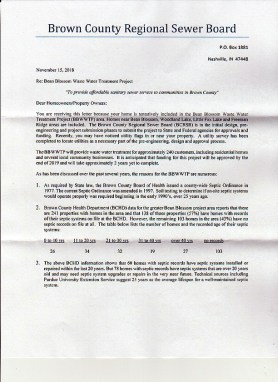
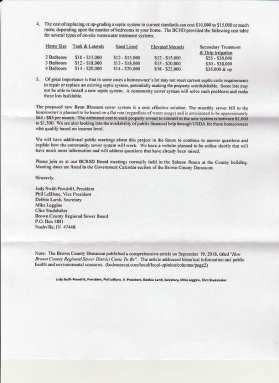
Regional Sewer Board – Bean Blossom Sewer Project – For the Record

CANCELLED.  The project to build a new sewer plant in Bean Blossom was abandoned.  The BCRSD was unable to acquire land for a plant.  The decision was then made to acquire service from Helmsburg.

SUMMARY of Key Points including current events associated with the transfer of land deeded to Parks and Recreation

Everyone wants a safe and healthy environment. We deserve transparency and facts and not “spin” when it comes to proposing a change.  Due diligence requires that you identify the process that will be used to identify the problem and solutions  and be “radically transparent.”  This is referred to as good government.  As you work through the process, provide monthly updates to the citizenry,  listen, and address concerns and questions.

The Bean Blossom and Helmsburg RSDs decided in Aug 2019 to support a regionalization study.  Info: RAP – Regionalization Study  for Helmsburg and Bean Blossom

Outline:
o. Information
o. Identification of Decision Makers
o. Frequently Asked Questions
o. Project Timeline – July 28, 2016 to Present

Information

Decision Makers

  •  2018 Brown County Regional Sewer District Board members:  Judy Swift Powdrill, (President)* Phil LeBlanc, Debbie Larsh, Mike Leggins, Clint Studabaker.
    • *Ms. Powdrill resigned Dec 11, 2018.
  • 2020 Board Members: Mike Leggins (President), Clint Studabaker (Vice President), Phil LeBlanc (Treasurer), Debrah Larsh (Secretary ), Richard Hall.

2018/2019 Elected officials that appoint Board Members:

  • Commissioners: Dave Anderson, Diana Biddle, Jerry Pittman.
  • 2018 County Council Members who appoint Board members and also approved a $270K budget for the board: Keith Baker (President) David Critser, John Price, Glenda Stogsdill, Debbie Guffey,  Art Knight, Darren Byrd.  Approximately 70K was spent in 2018.
  • 2019 – Bill Hamilton replaces Guffey and Dave Redding replaces Baker. Council unanimously and quickly approves the continuation of the funding (approximately $228,000) for the project.
  • 2019. Benjamin Gold recruited by BCRSD members Clint Studabaker and appointed by the council to fill a board vacancy.
  • Other vocal supporters for the project:
    • Redevelopment Commission (RDC) – President Jim Kemp
    • Local Republican Party Chairman – Mark Bowman.

Funding Source: Indiana Finance Authority.  State Revolving Fund.  The State Revolving Fund (SRF) Loan Programs provide low-interest loans to Indiana communities for projects that improve wastewater and drinking water infrastructure. The Program’s mission is to provide eligible entities with the lowest interest rates possible on the financing of such projects while protecting public health and the environment. SRF also funds non-point source projects that are tied to a wastewater loan.

Regional District Users Guide For Citizens And Governments

  • Citizens’ Frequently Asked Questions.
    • What if my septic system works fine or if I want to keep my private well and not hook up to the system?  A regional district has the authority to require or waive sewer connection. These decisions are made locally by the regional district board and are on a case-by-case basis – and are temporary.  However, if everyone in the service area connects at the same time, it can help control the cost of the project.  Under current State law, waivers are temporary.
  • A citizens review of “waivers”:
    • Bandy Russell .… If the line comes by your property (300 feet), State requires you to hook up. If you have a new system under 10 years, you can submit paperwork to get an extension to not hook up. 5 years later, similar process. 5 years again you can avoid hook up. At the 20 year age, you are required to hook up and likely to pay the cost to run the line, install the holding tank or grinder system. If your system is 11 years old when they start, you will have to destroy your system and hook on to the sewer. May become responsible for maintaining the line from home to road and for destroying your working system. It is unclear how they will handle the payment while construction takes place for those seeking exemptions. Previous talk is during construction, each will pay 1/2 the presumed $70 per month bill. That’s an overview from the meetings I have attended.
  • Impact of policies?  Information to consider before buying (selling) a home in Brown County.
  • State laws governing financial decisions. In 2018/2019, the BCRSD authorized  the oblgation of expenses before their funds were appropriated by the county council.
    • IC 5-22-17-5 on contracting states:  IC 5-22-17-5Funds not appropriated or not available; cancellation of the contract (As added by P.L.49-1997, SEC.1).:
      1. Sec. 5. (a) When the fiscal body of the governmental body makes a written determination that funds are not appropriated or otherwise available to support the continuation of the performance of a contract, the contract is considered canceled.  (b) A determination by the fiscal body that funds are not appropriated or otherwise available to support the continuation of performance is final and conclusive.
      2. Regarding the governance of RSD Boards:  IC 13-26-5-8Limitations on contracts:
        • Sec. 8. A district may make contracts or incur obligations only if the contracts or obligations are payable solely from: (1) the money provided under this article; or (2) federal, state, or other grants or contributions. [Pre-1996 Recodification Citation: 13-3-2-16(a) part.] As added by P.L.1-1996, SEC.16.
PROJECT TIMELINE

Key Points on the Project to include issues with the transfer of land deeded to Parks and Rec 

May 26, 2020, GUEST OPINION: Human waste or animal? Study under way, By CLINT STUDABAKER, guest columnist

Mar 12, 2020. Requested and received the report on how the State Revolving Fund scored the proposed Bean Blossom Project.

Mar 11, 2020. FB – Brown County Matters. BCRSD Board Meeting. Presentation from Lake Lemon citizens requesting sewer service.

Mar 10, 2020. BCRSD Board Meeting.  Included presetnation from Lake Lemon residents  requesting sewer service.

Feb 26, 2020. BCD. The Bean Blossom-Helmsburg sewer regionalization report is out. Here’s what it said.  By Sara Clifford

Jan 28, 2020.  BCD, STREAM SAMPLING: Where’s the contamination coming from? By Sara Clifford –

 Jan 28, 2020. BCD. Sewer board earns $100,000+ grant to do wastewater plan by Sara Clifford.

Dec 20, 2019.   ROI awards $1.86 million in Ready Communities implementation grants

  • Brown County Regional Sewer District for a wastewater strategic management plan. – This grant will fund an engineering evaluation of existing septic treatment systems and study the technical and economic feasibility of regional wastewater collection and treatment options in Brown County.

Dec 19, 2019. BCD. Vote taken on Bean Blossom sewer plant land By Sara Clifford. A sewer plant to serve Bean Blossom is now allowed to go on land at the base of Bean Blossom hill off State Road 135 North. Board of Zoning Appeals (BZA) approved a special exception.

  • Parks and Rec still have to hold a public meeting and vote on a transfer. If this parcel was developed as parkland (biking, hiking, picnicking, etc.), the sewer plant takes up some prime space. Other options for sewer service include Bean Blossom and maybe Helmsburg (depending on study results).  But when the project manager and board member (Clint Studabaker) is already talking about the view from his office, on the number of employees needed and the BCRSD with the commissioner and council support has spent $200K on plans without acquiring land, the pressure is for “New.”

Nov 25, 2019Closed meeting announcement – BCRSD and Parks and Rec.  Comments by made during the Nov 20, 2019, Parks and Rec meeting to include “speculation” on capacity and the condition of the Nashville plant.

Nov 20, 2019. Parks and Rec Board Meeting.

Nov 18, 2019. BCRSD Letter to Park and Rec Board – Land Acquisition

Nov 12, 2019. BCRSD Monthly Meeting.  Of the $270K provided by the county council to fund the project, the current budget balance is $84,356.60.  Land has not been acquired.

  • I asked and received a vague response — “looking at all options”, can’ talk about ongoing discussions, etc. Gary Ladd was authorized to do more work on the “site”.
    BCRSD had an executive session with the Park and Rec Board on Nov 5 to talk about land acquisition.  They sent a letter and attended the Parks and Rec meeting on the 20th to push their case. 

Oct 23, 2019. Commissioner Meeting. Wednesday,  A “HOT” topic: Conflict between the county, BCRSD and HRSD.

  • Sewer Issue – Cordry Sweetwater Conservancy.  The conservancy is not under county control or control by an RSD.
    • Josh Hawley: Sewers were discussed up here at the Lakes about a decade or more ago and the CSCD Board decided against them. There are about 1310 homes around the two lakes, if sewers were allowed in the District than all 1600 lots become build-able and the Lakes become even more crowded than they currently all. We average about 1 to 2 new homes built a year. It is an interesting time in the CSCD as several “pioneers” if you will are either passing away or leaving the area, so there is some new money coming into the area and that new money usually likes to upgrade the older homes which can mean upgrading the septic which with the new rules going into effect on January 1 could make it very difficult with our small lot sizes. It’s possible that someday, sooner than later, the new money will win out and the development of sewers might be the desired outcome. Time will tell.

Oct 21, 2019. Helmsburg RSD Meeting.

  • The HRSD is stull pursuing their intent to change how its board members are appointed. They are pursuing a valid and available option of an election vs appointment by the commissioners. The commissioners do not support this option and have vowed to take any legal action necessary. Approval of the change is made by IDEM – not the county.

Oct 8, 2019. BCRSD Meeting Notes. BCM Facebook Post

Sep 3, 2019. Septic System Summit – Education

    • Panelists reinforced the importance of maintaining your system. Better maintenance equals a longer life of the septic system.
    • A failed and failing septic system can have an impact on the environment and health but any “spin” to create a perception that we have a high percentage of failures and health-related issues is not supported by the facts and evidence.
    • How long does a system last? The correct answer confirmed by two panelists is “indefinite.” The are many variables that factor into an estimate of useful life. These include type, design, age, water usage, maintenance, and soil types to name a few. Note that the “indefinite” conclusion is supported by the EPA and Presby systems. Indefinite defined as: “not definite, unclear; vague, lacking precise limits.
    • Scientific based studies applying valid statistical methods could be conducted in Brown County to develop a more accurate estimate as to the useful life of systems. (See indications of a septic system failures below.)
    • Ernie Reed (Health Dept) reinforced that the “average” life expectancy was “estimated” at 25-30 years. Alice Quinn from the state department of health remarked that she expected her system to last longer than this.
    • Given a system can fail within one year, the upper range for the “average” could be in the 50-60 year range. Several people have told me that they have functioning systems that are within this age range.
    • Indicators of a septic system failure? Can’t flush toilets and standing (smelly) water over the drain field. This water can pollute surface and groundwater. Streaking – the grass is greener over the septic field, is not necessarily a sign of failure if the drain tiles are within 16 inches of the surface.
    • High E-coli Levels in the Bean Blossom Watershed. Tests from the state indicate high e-coli levels. Tests for determining if E-coli is a result of animal (most likely) or human are not reliable at this time (per Alice Quinn, SDOH). IF one day it is determined that a certain percent is human-caused as a result of a failed septic system, the next step would be to determine the system or the number and location of systems that may be causing the contamination.

Aug 27, 2019. BCD. Guest Opinion: Septics and Sewers – major changes proposed By Tim J. Clark 

  • BCD Facebook Post of the article
  • BCM Facebook Post
  • Aug 27, 2019. BCD,  Sewer project delayed due to lack of land By
    Facebook Post of the article
  • Aug 14, 2019.  RAP – Regionalization Study – Helmsburg and Bean Blossom
  • Aug 13, 2019. BCD.  GUEST OPINION: What you can learn at the county’s Septic Summit  By Clint Studabaker
  • Aug 13, 2019. BCD,  No resolution yet to Helmsburg sewer board questions By 
  • Jun/Jul 2019 – Grant Applications 
  • BCRSD Monthly Meetings – key points posted at Brown County Matters.
  • July 30, 2019Board goes back on vote to sell land The board (Parks and Rec) voted to rescind the initial vote at the July 17 board meeting. Member John Kennard abstained from voting. He also works for the health department. …   Board President Jim Hahn said that the letter parks and rec had received from Ladd Engineering on behalf of BCRSD was “non-friendly” and that it was a directive on how to take the park land for the wastewater treatment plant …
  • July 19, 2019.  BCRSD cancels their request for a special exception to the BZA for a zoning change.  They have no approved contract to acquire land.
  • July 17, 2019. Parks and Rec Board Meeting.  Approval to transfer land to the BCRSD rescinded.
  • Letter from Ladd Engineering on behalf of the BCRSD  requesting land from the Parks and Rec Board stipulating conditions including the threat of an eminent domain action under the Unifrom Relocation Act of 1970.  20190509 BCRSD Proposed WWTP
    • Uniform Relocation Act of 1970. URA Brochure:  When a Public Agency Acquires Your Property
      • The Federal Government and every State government have certain powers which are necessary .for them to operate effectively.  .. includes the power to acquire private property for public purposes. This is known as the power of eminent domain.
      • If you are unable to reach an agreement through negotiations, the Agency may file a suit in court to acquire your property through an eminent domain proceeding. Eminent domain proceedings
        are often called condemnations. If your property is to be acquired by condemnation, the Agency will file the condemnation suit without unreasonable delay.
    • 135N Property Deed
  • July 9, 2019. BCRSD Board meeting. BCM Facebook Post. Topics: Land for a Treatment Plant, Easements, Three KEY Meetings Next Week. (1) Parks and Rec, (2) County Council the and (3) Commissioners, Customer Surveys, Study/Planning Grants – RAP and ROI, Budget, Water Samples, Application Update – Preliminary Engineering Report (PER) , Funding Cycle, Billing, Indiana Gateway Financial Information.
  • July 24, 2019. Board of Zoning Appeals, 6:00 PM. Special Exception – Sewage Disposal Plant.  The land that is deeded to the Parks and Rec Department.  Parks and Rec have yet to respond to the request for the land (approximately 5 acres) by the BCRSD.
  • The purpose of the meeting is to consider a petition by the Brown County Regional Sewer District for a Special Exception to allow a public sewage disposal plant. The property is located at 4687 State Road 135 North in Jackson Township.
  • July 9, 2019. Legal Notice Special Exception – Wastewater Treatment Plant
  • July 9, 2019 BCD. Sewer district seeks property for treatment plant from parks and rec By Suzannah Cou
  •  July 9, 2019. BCD.  Helmsburg sewer board votes for study, with conditions by Sarah Clifford.
  • June 25, 2019. BCD, Helmsburg board considering ‘study’ of sewer partnership; update on other community projects  By Sara Clifford.
  • Discussion at Brown County Matters.  Includes information on a request to use land controlled by Parks and Rec for a  wastewater treatment plant. (Note that if private landowners are not willing to sell a property for a wastewater treatment plant, it may also be just as difficult to acquire the needed easements).
    • A review of the BCRSD board at the direction of the commissioners and county council may be helpful at this time. This could include an immediate order for the board to stop incurring any further expenses. 
    • The Bean Blossom Sewer Project is a year over schedule from what was initially projected. Of the 270K budgeted by the county council, they have spent $133,000 and still have no land for a plant. 
    • Helmsburg and Lake Lemon residents have identified a compelling need for support that has not been incorporated into any current plans. Such a plan – once developed, could have a significant impact on what is being considered for Bean Blossom. Unlike Bean Blossom, Helmsburg has developed an economic plan and a Community Development Corp formed by citizens to support needed change.
    • The BCRSD board started spending money this year before the county council approved their budget. At the last board meeting, the treasurer mentioned that once they received a budget, he recently learned that they were required to submit monthly reports to the state that they have not been doing.
    • I filed a formal complaint this month with the Public Access Counselor. My documented requests for information (with the exception of minutes) have been ignored. The BCRSD board attorney responded to my follow-up request in March asking for additional information, which I immediately provided. He has yet to provide me the information. Further, he invoiced the board over $1,000 for services connected with my request but as of last months meeting, has yet to cash the check.
    • A copy of the invoice for the services he provided has been included in the information I have requested. From my perspective, a 15-minute phone call would have been sufficient for me to answer any questions that he may have had regarding my request. I am curious as to the scope of the services he was asked to provide. 
    • I also asked for the mailing list of the potential customers, but per law, they only have to provide the names which they have yet to do. The addresses would be available through the county GIS. This information can be used by concerned citizens to keep potential customers informed of their rights, options, and links to additional information.
    • Additional information on this project – current and historical, is available via the link below. “Regional Sewer Board – Bean Blossom Sewer Project – For the Record” https://wp.me/p9vJtr-jZ
  • Other articles of note in the June 26, 2019  issue of the Democrat (yet to be posted):
  • Lake Lemon – “Homeowners investigating wastewater options”
  • BCRSD – “Still gathering info from property owners”
  • Letter: “Local resident sharing research on septic systems”
  • June 20, 2019. BCMHelmsburg RSD – Issues – Tradeoffs in supporting a regionalization study.
  • June 11, 2019. Monthly Meeting.
  • They have yet to acquire land for a plant.
  • May 26, 2019. Blog Post.  Information to consider before purchasing a home in Brown County?  
  • May 24, 2019. Brown County Matters. A long post. Thinking through the life-cycle of a decision – Septic and Sewer Topic. – Unintended consequences ...
  • May 14, 2019. BCRSD Meeting. BCM Facebook Post
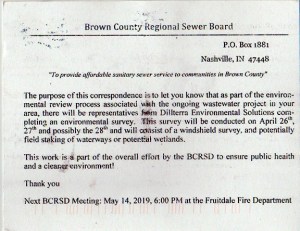
  • April 24, 2019.  Notice of Environmental Survey
  • April 15, 2019. A joint meeting today of the Helmsburg RSD and BCRSD was canceled.  Per the BCD:  UPDATE: This meeting has been CANCELED due to a lack of participation by primary parties,” commissioner Jerry Pittman told board members in an email on Sunday.
  • Reference:  BCD Facebook Post. 
  • Apr 9, 2019 BCRSD Monthly Meeting.  Bill Austin from Helmsburg presented options as to how the Helmsburg RSD can support Bean Blossom RSD and vice versa.  These options will be discussed between the two boards following the monthly HRSD Board meeting on April 15, 2019, at the library. The regular meeting starts at 5:30 and expected to be over by 6:30.
  • Mar 12, 2019. COUNTY NEWS: … Sewer board business: Budget, new member OK’d The Brown County Regional Sewer District Board has a new member and $200,000 to spend after the Brown County Council approved both at their meeting last month.
  • March 12, 2019. BCRSD Board Meeting.
  • Mar 7, 2019. RDC Meeting — Notes with a focus on Sewers, Septics and Economic Impacts
  • Brown County Matters – Facebook Post
  • Feb 27, 2019. Update on Council Meeting – Sewer and Septic Issue. — Useful life of septic systems, required hook-ups to sewers.
  • Feb 25. 2019. County Council Meeting – Approved funding to the BCRSD.
  • Facebook Post – Brown County Matters – Sherrie Mitchell
  • Facebook Post – Brown County Matters – Paul Nelson
  • Handout – 20190225 BCRSD Council Presentation Dec 17. 2018
    • Page 1 – 2 Initial Budget and to-date summary
    • Page 3 –  5 Health Department File Review Summary
    • Page 6 – 7 BCRSD Project Summary Sheet June 2018 Bean Blossom Sewers
    • Page 8 – Reasons Why Sanitary Sewer Building is Integral for Community Growth
    • Response to a comment regarding  need:
      • Regarding the need for sewers in Bean Blossom, the two past BCRSD board presidents have stated that there was no evidence of a valid need.
      • The Health Department (with the exception of Brownies) has not disclosed that they have any reports of failed systems in the area. The Health Department has stated that when they receive reports of failed or inadequate systems, they work with residences to fix the problems.
      • Of the 240 potential customers, how many have expressed interest or a need for a sewer hook-up? How many current letters of support have been submitted?
      • What documentation is available that identifies the reasons for the failure of Brownie’s septic system? If it was a Presby, the company has stated that “If the system is designed, installed and maintained properly, there is no limit to the life expectancy of Enviro-Septic® Technology. In the event that the System malfunctions due to abuse, AES or Enviro-Septic® may be rejuvenated in as little as 72 hours, eliminating the need for a replacement.”
      • The EPA has identified that “Conventional septic systems are designed to operate indefinitely if properly maintained.”
      • What are the documented septic system problems in Bean Blossom that justify a $7.3 million dollar taxpayer funded solution?
  • Feb 6, 2019. BCD.  Residents question sewer board about project basics, Suzannah Couch
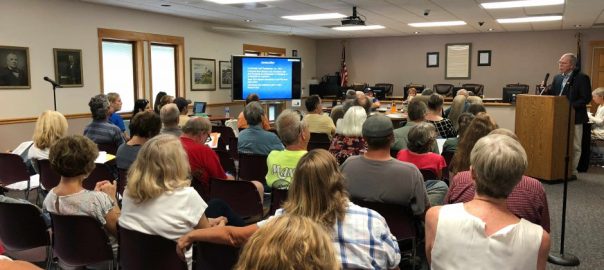
  •  Almost every seat was taken and more Bean Blossom residents stood along the walls to hear what the Brown County Regional Sewer District was planning for their area.
  • Jan 24, 2019. Brown County Matters – Facebook:  Council Meeting – Notes from the discussion on Sewers and Septics
  • UPDATE: Jan 24 Council Meeting – Septic and Sewer Issue. The Regional Sewer District (RSD) Board did not follow the process needed to place their funding request on the council calendar. They will formally be making their request for approximately $200,000 at February’s council meeting.
  • Jan 22, 2019. BCD. Sewer project spending, ‘proof of need’ reviewed, by Sara Clifford.
  • “Again, I do feel that there is a need; however, I also feel that as a taxpayer and the person who went before the county council and made this presentation … I feel like that we need to put some of our future movement on pause. … I cannot see us continuing to spend money without absolute proof that there is this need and want.”
  • Jan 22, 2019. BCD. GUEST OPINION: Sewers and septic systems: What’s the problem? By Tim Clark
  • ” … two key questions as an integral part of a countywide strategy: To what extent should residences located near a wastewater treatment facility be required to hook up to sewers? To what extent should all residences — 90 percent of which utilize septic systems — be required to have their septic systems inspected on a recurring basis?
  • Data provided by the BCRSD identified that there are approximately 8,400 households in Brown County, and only about 700, or 8 percent, have sewer access. … Out of the approximate 7,700 residences with septic systems, about 4,000 of those systems were installed before the state code was developed. As a result, many of them might not be in compliance with current codes.
  • BCD – Brown County Democrat’ See also “Additional Information” at the bottom of the post.  Includes more information on the technology.
  • Jan 17, 2019. Facebook Posts – Brown County Matters – Forced connections – Indianapolis example.
  • Jan 12, 2019. Facebook Posts – Brown County Matters.  Key Topics:
  • A regional district has the authority to require or waive sewer connection.
  • A waiver by Indiana Code can be provided if you live in a “municipality”  “… Subject to subsections (e) through (k), a property owner is exempt from the requirement to connect to a municipality’s sewer system”
  • Jan 11, 2019. Facebook Post – Brown County MattersAppreciate the information, responses, and feedback provided regarding the proposed changes regarding Sewers and Septic Systems. This issue affects almost EVERY property owner and residence in the county. 
  • Of the 240 potential customers, no information has been collected to identify how many support sewers, how many will want waivers (if granted by the Sewer Board), how many will want compensation for granting easements, how many will need financial aid, how many may have failed systems, and how many may need perimeter drains (if they do not have the 24 inches between the water table and the field). 
  • The Trailer Park, Bill Monroe and Brownies (commercial property owners) have all expressed support. The current Sewer Board President – Mike Leggins, who has rental units with inadequate septics has also expressed support. Commissioner Biddle whose family owns property in the area has also expressed support. The 30 or so letters of support included in the application submitted in June 2018 were from “1998.” 
  • And, $70,000 of the 270K budgeted has been spent on designs and consulting services for a new plant. 
  •  We are told that our soils are bad for septics yet septics are approved after the required soil testing is conducted. We are also told that useful life of a septic is “estimated” to be an “average” of 25 years but no reference to scientifically based studies that validate this allegation. The inference that failed septic systems (no documentation on file) is a leading cause of the high e.coli in streams and creeks (2006 samples) adds to the drama but there is no evidence to back up this inference. Further, no idea on where the major source of the e.coli may be originating. And oh by the way, if the e.coli is due to animal contamination, what then? 
  • Suggestion? Identify the scope and extent of the problem in the county before spending any more money on “solutions.”
  • Jan 22, 2019. Guest Opinion column submitted to the Brown County Democrat. Sewers and Septic Systems – What Is the Problem? 
  • Jan 8, 2019. RSD Board Meeting.  This and future meetings will be held at the Fruitdale VFD.  No recorder was available but a recorder will be obtained to record future meetings.
  • 20190108 rsd meeting agenda
  • 20190109 rsd dec 4 2018 meeting minutes
  • Questions and Answers – 20190108 questions and answers 
  • Facebook Post – Brown County Matters
  • Jan 3, 2019Facebook Post – Brown County Matters.
  • For Residents and Property Owners. Among two of the most important public meetings this year: (1) The Jan 8 meeting of the Regional Sewer Board that will be meeting at 6:00 p.m. at the Fruitdale Fire Department and (2) County Council meeting (date and time not yet on the government calendar). Council will be voting on funding for the Sewer Board.
    • Questions that need to addressed: To what extent should residences located near a current or proposed wastewater treatment facility be required to hook-up to sewers? To what extent should all residences – 90% of which utilize septic systems, be required to have their septic systems inspected on a reoccurring basis?
    • And, “if” it is “proven” that there are environmental issues linked to septic systems, animals, agricultural runoffs, what could be the impact on the county’s reputation/image and property values in the near, mid, and long-term?
  • Dec 31, 2018. BCDTop 10 stories of 2018Number 5. Waste disposal talks continue
  • BCD Facebook Post – Selecting Top Stories – 18 comments/votes
  • Dec 21, 2018Facebook Post at Brown County MattersHonest questions, honest replies.
  • Includes the following questions to representatives of the council, Sewer Board and RDC.  1) Does a regional sewer board have the power by itself, to force people on sewers?; (2) Can the RSD take action that will force inspections of septic systems with outdated records – especially ones installed before 1977? (approximately 4,000 homes); (3) Can the RSD with IDEMs support, take over the Helmsburg Sewer District?; (4) Do any of the Sewer Districts (Nashville, Gnaw Bone, Helmsburg), have the power to force people on sewers or pay for services not rendered?; (5) Other than appointments, do the commissioners and council have any authority over the RSD or is the governing authority IDEM? If IDEM, why aren’t they providing the funding for the RSD?; (6) What funding is available to assist people to meet RSD requirements for sewer hook-ups, septic inspections, and possibly septic repairs/replacement?
  • Jan 8, 2018, Meeting Announcement – Brown County Regional Sewer District.
  • Dec 19, 2018Facebook Post at Brown County Matters. My understanding is that easements on private property will be needed for Brown County Regional Sewer. Everyone should charge the sewer district for the right to cross their land.
  • Dec 18, 2018.  Example – The power of regional sewer districts in Indiana – Twin Lakes Regional Sewer District, Monticello, IN.
  • Dec 17, 2018. County Council.  Facebook Post at Brown County Matters. Presentation by Regional Sewer Board Member Clint Studabaker.  Studabaker provided a presentation to the council that covered water quality, review of septic system records, a septic ordinance update, and the status on the proposed Bean Blossom Treatment Plant. The FACTS do not support a case for change.
  • Audio – Council Meeting.
    • Sewer Board Presentation –
      • Part 1 @ 31:20 – Environmental Issues
      • Part 2 @ 52:00 – Status on the project and on spending
    • Public Comments on Presentation
      • Tim Clark – @1:40
      • Paul Nelson @ 1:43 – given 30 seconds
  • PowerPoint Presentation presented by Clint Studabaker
  • Dec 15, 2018Facebook Post – Brown Couty Matters PROCESS vs PROJECT  – $7.3+ million Bean Blossom Sewer Project. A comment I often hear regarding the content of my guest columns or Letters in the Democrat is that it is often perceived that I am “against” a respective project (Maple Leaf, Bean Blossom Sewers, Justice Center, et.al.). cont ….
  • Dec 13, 2018. Facebook Post – Brown Couty Matters Minutes from the RDC meeting that included further discussions on the Bean Blossom Sewer Project.
  • Dec 11, 2018RSB Meeting Notes – Facebook Post.  The President of the Board – Judy  Swift Powdrill resigned from the board. Mike Leggins was elected the new president.  At their last meeting, Ms. Powdrill recommended the project be delayed until there was a validated need and want.  The previous President of the Board, Evan Werling, also resigned from the RSB stating that there were no facts to support the need for the project.
  • Dec 6, 2018BCDWaste disposal ‘first and foremost’ in development decisions by Sara Clifford – Every flush at the Bill Monroe Memorial Music Park costs Ben and Rex Voils about 20 cents. As they evaluate their plans for the landmark...
  • Dec 5, 2018, RSB Meeting Notes – Facebook Post – Key Point
  • The President of the Board (Judy Swift Powdrill) acknowledged citizen concerns with this project. She made a motion that they put the project on hold to gather the data needed to validate proof of need and want. Despite that there are no facts to justify the need, the board voted unanimously to go forward with the project. (at a cost to taxpayers of $7.3 million). The previous RSB President – Evan Werling also concluded that they could not identify a need.
  • Audio Recording of the Meeting
  • Comments from Paul Navarro
  • Dec 4, 2018. BCD  Waste disposal ‘first and foremost’ in development decisions, by Sara Clifford.  The Brown County Regional Sewer District is in the process of applying for a combination of grants and loans to build a sewer system in the Bean Blossom area which would replace more than 200 individual home and business septic systems. It’s a project that’s been in the works in some form or another for 20 years. …   
  • Nov 27, 2018BCD, GUEST OPINION: Brown County soils as they relate to a septic system by Phil LeBlanc, BCRSD Board member
  • A soil test is required before a septic system drain field site is approved to determine the soil’s ability to accept wastewater. 
  • A drain field can have a long and successful life (usually about 25 years) — if it is taken care of.
  • Regarding indicators of a failed systemWhen the soil system slows down or stops breaking down the waste, the soil can become clogged, and if the “out of balance” is allowed to continue, the septic system fails. The soil can no longer accept the wastewater, the drain field starts to flood, odor starts to occur and the wastewater backs up into the tank. You then have a septic system failure.
  • Nov 16, 2018. Letter to Residents – Posted at Brown County Matters. Does not identify that there are any failed septic systems in the area to be served.  
  • In their letter to residents, their justification included a need based on the “age” of a system and using an “opinion” by Purdue Extension Service that “suggests “an ” average” lifespan of a maintained system is 25 years. (Quote: “Technical sources including Purdue University Extension suggests 25 years as the average lifespan for a well-maintained septic system.”
    • An effective and maintained system could last longer than 25 years. AND it’s very likely that this could be proven by working systems in the county that are older than 25 years. The letter also draws the conclusion that $65.00 to $85.00 a month forever (a price that will rise over time) is more cost-effective than a septic system. Interesting math.


  • Nov 6, 2018. BCD Is a regional sewer partnership possible? By At a couple public meetings this fall, Brown County Redevelopment Commission President Jim Kemp suggested another idea: rolling the Gnaw Bone and Helmsburg regional sewer districts into the Brown County Regional Sewage District.
  • Nov 6, 2018. BCD  Groups gathering data for Bean Blossom sewer project Location in Bean Blossom not identified.  A decision on where the plant will go will probably need to be made by this spring, he said. In the meantime, the board, its hired engineer and other parties are still working on other aspects of the sewer plan so it can be submitted for funding to state and federal agencies. Part of that work is gathering data on why and where sewers are needed.
  • Oct  9, 2018  RSD Meeting.  Brown County Matters – Facebook Posts  
  • Sept 21, 2018. BCD  GUEST OPINION: How the Brown County Regional Sewer District came to be Editor’s note: This guest column was written with input from Brown County Regional Sewer District Board members Judy Swift Powdrill, Phil LeBlanc, Debbie Larsh, Mike Leggins and Clint Studabaker. Studabaker submitted it for publication.
    • History and an anecdotal case for change.
  • June 27, 2018.  Town, sewer district come to agreement on ‘buffer zone
  • Anyone who doesn’t currently have sewer service and owns property within a certain radius of Nashville will be able to petition the town to get sewer service if they want it.
  • That doesn’t necessarily mean that the town will be able to serve them; however, the town will have that legal option — something it hasn’t had for five years.
  • June 26, 2018. BCD. Bean Blossom sewer project details discussed by Sara Clifford 
    • Mike Leggins bought six lots on Old Settlers Road in 1988. He razed the vacant, condemned or burned-out homes that stood on them and put up five new ones — family homes, with three or four bedrooms. .
    • The septic systems that served them soon failed, even though the systems were new. Leggins said the high water table was to blame; waste was hitting the groundwater before it had been sufficiently filtered and cleaned.
    • Now, Leggins, the landlord, has to use those homes as if they were two-bedroom homes in order to not put strain on the septic systems — and even that doesn’t prevent them from sending waste downhill, he said.
  • June 6, 2018. Preliminary Engineering Report (PER). Received copy (thumb drive) from the RSB President on June 6, 2018.
  • June 20, 2018Regional Sewer District One Step Closer To Offering Service By BROCK TURNER .  PDF Regional Sewer District One Step Closer To Offering Service _ news-2018 – Indiana Public Media
    • Some residents say they’ve lost trust in the Brown County Regional Sewer District Board. The board Tuesday night allocated $270,000 for an environmental study the State of Indiana requires for …
    • Facebook Post: Our finest hour?
  • May 30, 2018.  Federal assistance for new wastewater treatment plant to be requested by B.C. Regional Sewer District NOTICE OF INTENT TO FILE APPLICATION
  • The Brown County Regional Sewer District intends to file an application for federal assistance with the U.S. Department of Agriculture, Rural Development, Rural Utilities Service.  The project includes construction of a new wastewater treatment plant. Any comments regarding this application should be submitted to the Brown County Regional Sewer District, PO Box 1881, Nashville, IN, 47448
  • May 9, 2017. BCD  Resigning sewer board volunteers claim project obstruction,  Sara Clifford – Three of the five members of the Brown County Regional Sewer District Board have resigned amid allegations that the Brown County Health Department has been derailing the Bean Blossom sewer project and disparaging the current sewer board along the way.

    April 11, 2017Sewer district reviewing options for waste disposal

    • Four representatives of state funding and assistance agencies attended a special meeting Monday morning, April 3 about financing for the project. So did about 15 members of the public. … But after asking for an update on what the project is, Jim McGoff from the Indiana Finance Authority said Brown County isn’t ready for the financing step.
    • “At this point in time it sounds like the project has not been finally defined from a standalone plant versus other regional options, being either to Nashville or to another neighboring utility,” McGoff said.

    March 14, 2017Septic system add-on discussed at sewer meeting

  • Feb 21, 2017.  Report: Cheaper to build wastewater plant in Bean Blossom
  • Evan Werling, the sewer board’s president, told the audience that the alternative option — piping the wastewater to Nashville’s treatment plant on the western edge of town — would cost about $800,000 more than building a stand-alone plant.
  • At the Feb. 7 meeting, Werling said he did not consider the town’s proposal an attempt to negotiate. Wanda Jones, the lawyer for the sewer board, said she did not consider it in the board’s best interest to sign it. 
  • This is not the first time the sewer effort has come this far.  Perry said the USDA rejected a prior application for grant money by what was known then as the Bean Blossom Regional Sewer District because the cost per sewer customer would have been too high.
  • Jan 25, 2017New group steps in on sewer project
  • The Brown County Redevelopment Commission has agreed to take a direct role in attempts to bring a sewer system to the Bean Blossom area.
  • However, in a Jan. 9 interview, Werling said that without proof of environmental threats, and in light of rumors that most residents of Woodland Lake do not want the sewer, he will not allow the board — comprised of five members of equal voting power — to implement the sewer. … “Ethically and morally, I won’t do that to someone else,” he said.
  • If the project is successful, it would serve as a concrete example of Brown County’s ability to complete a multi-million-dollar, multi-year project, Redding said.    would be a great confidence builder. It would be something that we would point to for the next big project that we engage in,” he said.
  • Dec 14, 2016  Town, sewer district continue contract negotiations
  • At the Dec. 6 meeting of the sewer district, Werling said the contract was not the response he had anticipated. 
  • “We got this huge, massive, eight-page contract with exhibits,” he said. “Not only was it approved by the town, it was also signed and notarized, waiting for my signature — a contract that we’ve never seen before.”
  • There are things in there that, if we discussed them, there’d be some pretty angry people in the room. I can tell you, those things are not going to fly,” he said.
  • In addition, under the contract, anyone connecting to the district’s system within three miles of Nashville would have to sign away the ability to protest future annexation by the town.
  • August 24, 2016.  Sewer board meets with affected residents
  • Ladd estimated a $65 monthly charge. That’s the best-case scenario.
  • If the grants the board is expecting didn’t pan out, the monthly cost would be more like $225.
  • The board said it would not pursue the project if monthly rates reached that high.
  • This is the second time the board has reached the grant proposal stage.
  • Last time, the plan was halted because of not having enough customers, said Vicki Perry, state director of the Indiana Rural Community Assistance Program.
  • July 27, 2016.  Bean Blossom sewer question continues (Includes list of properties)
  • About 200 Bean Blossom and Woodland Lake property owners may receive a letter from the Brown County Regional Sewer District before the end of the month.
  • It will invite them to a meeting Tuesday, Aug. 2 to learn about a proposed route for a new sewer system and how it will affect them, said Evan Werling, president of the district board.
  • The letters are the latest step in a nearly two-decade effort to bring sewer service to the area.

July 28, 2016, BCD, SEWER DISTRICT: Bean Blossom area businesses, residents waiting on the line  By Ben Kibbey  When work first began almost 20 years ago to get a sewer in Bean Blossom, 

Additional Information

Guest Column: Indpls Star – Faith and values section

October 7, 2018.  Sunday Edition – Faith and values:  Guest Column

People working together can make a more perfect union

Your Turn
Tim J. Clark Guest columnist

Addressing the spiritual, economic and social challenges of our times may be as simple as recognizing that, although we may share a common desire for improvement, we have different ideas on the changes that need to be made to bring about that improvement.

But how do you determine when a change results in an improvement?

Faith-inspired philosophies, such as Christianity, can help answer this question. These philosophies acknowledge that human beings will always be imperfect but can improve by leveraging the potential of the human spirit. Changes motivated by love, compassion and the application of better methods can result in outcomes where everyone can benefit or at least not be any worse off in the long-term.

Philosophies that also align with the aim of the U.S. Constitution can provide a frame of reference for determining when a change results in an improvement. The aim of the American system of government is to enable “We the People” to work together to make progress – not toward a “perfect” union, which would be impossible – but rather toward a “more perfect” union.

The Founding Fathers of the United States provided us with the Bill of Rights, so that we may work toward a more perfect or better union. What the founders left up to future generations was to develop and apply better methods for determining when a change results in an improvement.

Walter Shewhart discovered one of those methods – the variation principle – in 1924. This principle is rooted in the fact that actions are accomplished through a process and everything involved in a process or system varies, including people. The type of variation (common cause or special cause) in a process or system helps identify the type of action needed to improve it. Continuous improvement by reducing variation results in better quality and less imperfection.

W. Edwards Deming, a student and colleague of Shewhart, developed methods that support the application of Shewhart’s variation principle to improve the quality of products and services. Deming’s contributions were recognized by Fortune magazine as being among the 20 that have shaped the modern world of business and by U.S. News and World Report as one of nine turning points in history.

The top turning point was identified as “The Apostle Paul, whose preaching and eloquent writings led to mass acceptance of Christianity.”

Deming once said that if he was to reduce his message to just a few words, it all had to do with individuals working together to make things more perfect by reducing variation.

I had the opportunity to attend a four-day seminar conducted by Deming in the late 1980s. Since then, I’ve successfully applied his methods to many areas of my life, including personal, family, community and career. For example, I had the opportunity to apply them while supporting the development of military and national defense related strategies. In 1986, Deming, estimated that it would take another 50 years before awareness of Shewhart’s contributions were more commonly known.

I hope that in some small way I have at least raised awareness of a new method that can be applied to leverage the potential of the human spirit that supports progress toward a more perfect community and union.

Tim J. Clark is a senior member of the American Society for Quality, past chairman of the Indianapolis Section and an exponent of an improved standard for quality leadership that supplements faith-based philosophies with the scientific method.

PDF Version Indianapolis_Star_20181007_A008_2 More Perfect Union

W. Edwards Deming – Religious Background


Brown County Broadband

Key Dates:

Sept 18, 2018.  Phase 2 of high-speed internet project announced,  By  – More of Brown County will receive high-speed fiber internet next year through power company SCI REMC. Phase 2 of the company’s fiber-to-the-home project will serve…  

July 27, 2018. Internet expansions under way in Brown County By Sara Clifford –Two rural electric membership co-ops are taking advantage of local tax breaks to expand high-speed internet in Brown County. Representatives from SCI-REMC and Jackson County…

April 10, 2018SCI-REMC bringing fiber internet to Brown County  Phase 1 of the project, announced in April, is under construction now in Brown, Morgan and Monroe counties. It will reach about 1,700 customers in Brown County, including the Lake Lemon area; western Jackson Township; Lanam Ridge and Oak Grove roads; Yellowwood Lake Road north of the lake; and areas west and southwest of Nashville around State Road 46 West.

March 27, 2018,  Efforts aimed at internet access: County seeks to establish infrastructure development zone The Brown County Commissioners approved an ordinance March 21, that would declare the entire county an infrastructure development zone, using a state law created in 2013.