All posts by Tim J. Clark

Common Fallacies – Excerpts

american thinker uncle sam

Updated Sep 23, 2022

Critical Thinking – Arguments, Fallacies, Rhetoric – Independent Voters of Brown County IN

Classical Rhetoric 101: Logical Fallacies, Brett & Kate McKay • May 26, 2011 • Last updated: September 25, 2021, : CharacterFeaturedKnowledge of Men

Excerpts: Reference: LOGOS: CRITICAL THINKING, ARGUMENTS, AND FALLACIES Heather Wilburn

Fallacies:

Some arguments are faulty, not necessarily because of the truth or falsity of the premises, but because they rely on psychological and emotional ploys. These are bad arguments because people shouldn’t accept your conclusion if you are using scare tactics or distracting and manipulating reasoning. Arguments that have this issue are called fallacies. There are a lot of fallacies, so, again, if you want to know more a web search will be useful. We are going to look at several that seem to be the most relevant for our day-to-day experiences.

  1. Inappropriate Appeal to Authority: We are definitely going to use authority figures in our lives (e.g. doctors, lawyers, mechanics, financial advisors, etc.), but we need to make sure that the authority figure is a reliable one.

Things to look for here might include: reputation in the field, not holding widely controversial views, experience, education, and the like. So, if we take an authority figure’s word and they’re not legit, we’ve committed the fallacy of appeal to authority.

Example 5: I think I am going to take my investments to Voya. After all, Steven Adams advocates for Voya in an advertisement I recently saw.

If we look at the criteria for evaluating arguments that appeal to authority figures, it is pretty easy to see that Adams is not an expert in the finance field. Thus, this is an inappropropriate appeal to authority.

  1. Slippery Slope Arguments: Slippery slope arguments are found everywhere it seems. The essential characteristic of a slippery slope argument is that it uses problematic premises to argue that doing ‘x’ will ultimately lead to other actions that are extreme, unlikely, and disastrous. You can think of this type of argument as a faulty chain of events or domino effect type of argument.

Example 6: If you don’t study for your philosophy exam you will not do well on the exam. This will lead to you failing the class. The next thing you know you will have lost your scholarship, dropped out of school, and will be living on the streets without any chance of getting a job.

While you should certainly study for your philosophy exam, if you don’t it is unlikely that this will lead to your full economic demise.

One challenge to evaluating slippery slope arguments is that they are predictions, so we cannot be certain about what will or will not actually happen. But this chain of events type of argument should be assessed in terms of whether the outcome will likely follow if action ‘x” is pursued.

  1. Faulty Analogy: We often make arguments based on analogy and these can be good arguments. But we often use faulty reasoning with analogies and this is what we want to learn how to avoid.

When evaluating an argument that is based on an analogy here are a few things to keep in mind: you want to look at the relevant similarities and the relevant differences between the things that are being compared. As a general rule, if there are more differences than similarities the argument is likely weak.

Example 7: Alcohol is legal. Therefore, we should legalize marijuana too.

So, the first step here is to identify the two things being compared, which are alcohol and marijuana. Next, note relevant similarities and differences. These might include effects on health, community safety, economic factors, criminal justice factors, and the like.

This is probably not the best argument in support for marijuana legalization. It would seem that one could just as easily conclude that since marijuana is illegal, alcohol should be too. In fact, one might find that alcohol is an often abused and highly problematic drug for many people, so it is too risky to legalize marijuana if it is similar to alcohol.

  1. Appeal to Emotion: Arguments should be based on reason and evidence, not emotional tactics. When we use an emotional tactic, we are essentially trying to manipulate someone into accepting our position by evoking pity or fear, when our positions should actually be backed by reasonable and justifiable evidence.

Example 8: Officer please don’t give me a speeding ticket. My girlfriend broke up with me last night, my alarm didn’t go off this morning, and I’m late for class.

While this is a really horrible start to one’s day, being broken up with and an alarm malfunctioning is not a justifiable reason for speeding.

Example 9: Professor, I’d like you to remember that my mother is a dean here at TCC. I’m sure that she will be very disappointed if I don’t receive an A in your class.

This is a scare tactic and is not a good way to make an argument. Scare tactics can come in the form of psychological or physical threats; both forms are to be avoided.

  1. Appeal to Ignorance: This fallacy occurs when our argument relies on lack of evidence when evidence is actually needed to support a position.

Example 10: No one has proven that sasquatch doesn’t exist; therefore it does exist.

Example 11: No one has proven God exists; therefore God doesn’t exist.

The key here is that lack of evidence against something cannot be an argument for something. Lack of evidence can only show that we are ignorant of the facts.

  1. Straw Man: A straw man argument is a specific type of argument that is intended to weaken an opponent’s position so that it is easier to refute. So, we create a weaker version of the original argument (i.e. a straw man argument), so when we present it everyone will agree with us and denounce the original position.

Example 12: Women are crazy arguing for equal treatment. No one wants women hanging around men’s locker rooms or saunas.

This is a misrepresentation of arguments for equal treatment. Women (and others arguing for equal treatment) are not trying to obtain equal access to men’s locker rooms or saunas.

The best way to avoid this fallacy is to make sure that you are not oversimplifying or misrepresenting others’ positions. Even if we don’t agree with a position, we want to make the strongest case against it and this can only be accomplished if we can refute the actual argument, not a weakened version of it. So, let’s all bring the strongest arguments we have to the table!

  1. Red Herring: A red herring is a distraction or a change in subject matter. Sometimes this is subtle, but if you find yourself feeling lost in the argument, take a close look and make sure there is not an attempt to distract you.

Example 13: Can you believe that so many people are concerned with global warming? The real threat to our country is terrorism.

It could be the case that both global warming and terrorism are concerns for us. But the red herring fallacy is committed when someone tries to distract you from the argument at hand by bringing up another issue or side-stepping a question. Politicians are masters at this, by the way.

  1. Appeal to the Person: This fallacy is also referred to as the ad hominem fallacy. We commit this fallacy when we dismiss someone’s argument or position by attacking them instead of refuting the premises or support for their argument.

Example 14: I am not going to listen to what Professor ‘X’ has to say about the history of religion. He told one of his previous classes he wasn’t religious.

The problem here is that the student is dismissing course material based on the professor’s religious views and not evaluating the course content on its own ground.

To avoid this fallacy, make sure that you target the argument or their claims and not the person making the argument in your rebuttal.

  1. Hasty Generalization: We make and use generalizations on a regular basis and in all types of decisions. We rely on generalizations when trying to decide which schools to apply to, which phone is the best for us, which neighborhood we want to live in, what type of job we want, and so on. Generalizations can be strong and reliable, but they can also be fallacious. There are three main ways in which a generalization can commit a fallacy: your sample size is too small, your sample size is not representative of the group you are making a generalization about, or your data could be outdated.

Example 15: I had horrible customer service at the last Starbucks I was at. It is clear that Starbucks employees do not care about their customers. I will never visit another Starbucks again.

The problem with this generalization is that the claim made about all Starbucks is based on one experience. While it is tempting to not spend your money where people are rude to their customers, this is only one employee and presumably doesn’t reflect all employees or the company as a whole. So, to make this a stronger generalization we would want to have a larger sample size (multiple horrible experiences) to support the claim. Let’s look at a second hasty generalization:

Example 16: I had horrible customer service at the Starbucks on 81st street. It is clear that Starbucks employees do not care about their customers. I will never visit another Starbucks again.

The problem with this generalization mirrors the previous problem in that the claim is based on only one experience. But there’s an additional issue here as well, which is that the claim is based off of an experience at one location. To make a claim about the whole company, our sample group needs to be larger than one and it needs to come from a variety of locations.

  1. Begging the Question: An argument begs the question when the argument’s premises assume the conclusion, instead of providing support for the conclusion. One common form of begging the question is referred to as circular reasoning.

Example 17: Of course, everyone wants to see the new Marvel movie is because it is the most popular movie right now!

The conclusion here is that everyone wants to see the new Marvel movie, but the premise simply assumes that is the case by claiming it is the most popular movie. Remember the premise should give reasons for the conclusion, not merely assume it to be true.

  1. Equivocation: In the English language there are many words that have different meanings (e.g. bank, good, right, steal, etc.). When we use the same word but shift the meaning without explaining this move to your audience, we equivocate the word and this is a fallacy. So, if you must use the same word more than once and with more than one meaning you need to explain that you’re shifting the meaning you intend. Although, most of the time it is just easier to use a different word.

Example 18: Yes, philosophy helps people argue better, but should we really encourage people to argue? There is enough hostility in the world.

Here, argue is used in two different senses. The meaning of the first refers to the philosophical meaning of argument (i.e. premises and a conclusion), whereas the second sense is in line with the common use of argument (i.e. yelling between two or more people, etc.).


BCMC Management and Oversight

bcmc

Brown County Music Center (BCMC)

History of the BCMC and Current Events

Citizen Requirements

  • Commissioners, Council and BCMC management group pledged that NO county tax dollars would be used to subsidize this venue.  if the venue was not successful, it would be sold and/or returned to the bank.
    • A $239K subsidy including some rent payments was provided to the BCMC by the county.  Details associated with the transaction:
      • Feb 17, 2021. Letter: BCD. GUEST OPINION: What’s been happening with your county’s finances by Kevin Fleming.  Includes the details regarding the lack of transparency and oversight of Commissioner Biddle’s actions regarding the $239,000 “Rent” payment to the BCMC.  Commissioner Biddle also serves on the Music Center’s management group.

  • Revenue from the innkeeper’s tax was used as collateral for the loan to build the venue and can be used for operating expenses. 

Questions:

  • What is the management relationship (roles and responsibilities) between the commissioners, council, BCMC management group, and the BCMC Building Corp?
  • What are the requirement for reporting revenues and expenses, assets and liabilities associated with the venue?
  • In addition to the Convention Visitors Commission (CVC) budget, what information does the council need to consider in reviewing the CVC budget  as well as the efficient and effective use of the revenue from the innkeepers tax?
    • Balance Sheet?
    • Profit and Loss Statements?
    • Income Statements?
    • Cash Flow Analysis? 
    • Budget Approved by Council?
    • Addendum to the loan agreement with the bank?
  • What are the policies and internal controls for ensuring the effective and efficient use of revenue from the innkeepers tax ?  How often are these reviewed?
  • Are the BCMC Financial statements audited by an independent and objective company? 

Additional Information

2011 Indiana Code TITLE 6. TAXATION ARTICLE 9. INNKEEPER’S TAXES; OTHER LOCAL TAXES
CHAPTER 14. BROWN COUNTY INNKEEPER’S TAX

  • IC 6-9-14-4
    Payment of expenses; budget; expenditures
    Sec. 4. All expenses of the commission shall be paid from the fund required by section 7 of this chapter. The commission shall annually prepare a budget taking into consideration the recommendations made by a not-for-profit corporation qualifying under section 3 of this chapter and shall submit it to the county council for its review and approval. No expenditure shall be made unless it is pursuant to an appropriation made by the county council in the manner provided by law.
    As added by Acts 1981, P.L.100, SEC.1.

School Board – Opposing ESAs and Vouchers

bc schools

Originally posted Aug 1, 2021. Last updated Aug 9, 2022.

2022 Brown County Schools Referendum – for the Record

The 2021/2022 State Budget – Schools. School funding increased to include teacher compensation. This did not prevent the perceived need to pass another referendum. Vouchers were expanded and the policy was made a local issue. 

The last two Brown County Superintendents (David Shaffer, Laura Hammack) publically came out against voucher expansion as did the School Board.

Apr 23, 2021. Indiana expands school voucher program to include most middle-class families By Margaret Menge | The Center Square

    • The move was hailed by Republicans, who have supermajorities in both chambers, and assailed by Democrats, who were unable to stop it as it sailed through the House and then the Senate tucked inside the budget bill that will fund the state government for the next two years.
    • A decade ago, Indiana decided to be a school choice state and we followed that along,” said Sen. Jeff Raatz, R-Richmond, chairman of the Senate education committee, “We’re never going to agree on the concept, I suppose…but we have done a historic effort here…We fund students and not systems, essentially. That’s what the state decided a decade ago.”
    • Indiana was called a leader in school choice 10 years ago when it passed one of the strongest school choice laws in the country, introducing the Indiana Choice Scholarship Program – commonly known as the state’s “school voucher program.”   
    • Under the new law, a family of four can have a total household income up to about $145,000. A family of three can have an income up to $120,500 and a single-parent, single-child household can have an income up to about $95,700 and still qualify.
    • The budget bill containing the school voucher language and ESAs passed the House 96-2 and the Senate 46-3, and is now headed to the desk of Republican Gov. Eric Holcomb, who is expected to sign it into law before the end of the month.

April 20, 2021. New Indiana budget proposal increases funding for teacher pay and voucher expansion By  Stephanie Wang

    • Indiana lawmakers plan to boost funding to K-12 schools to fulfill a recommendation to add $600 million by 2023 to increase teacher pay.

      With about $2 billion more than they initially anticipated in the state revenue forecast, lawmakers proposed Tuesday to hike per-student spending by 4.6% in 2021-22 and 4.3% in 2022-23. Both increases exceed what legislators previously had planned.

April 8, 2021. SUPERINTENDENT’S CORNER: Why local school leaders oppose more voucher funding,  By LAURA HAMMACK, guest columnist. One of our recent school board meetings realized the passing of a resolution authored by both our Brown County Schools Board of Trustees and the Brown County Educators’ Association. This resolution affirmed their position of opposing education savings accounts and voucher expansion bills currently being considered by the Indiana General Assembly.

April 6, 2021School board formally opposes voucher expansion, education savings accounts by Suzannah Couch – The Brown County Schools Board of Trustees has joined more than 170 other public school boards in Indiana in opposing legislation that expands funding for private schools.

    • Aug 20, 2021 Letter: GOP legislators shirking responsibility to education by David Shaffer, former superintendent, Brown County Schools. I read with interest Suzannah Couch’s article of April 7, 2021, on the Brown County school board’s Resolution to Oppose the Expansion of the Indiana Voucher Program and to Oppose the Creation of Education Savings Accounts, two actions currently being supported by the Republican supermajority in this session of the Indiana General Assembly. Both actions are likely to pass as a part of the new two-year budget for Indiana.

Apr 6, 2021. Letter: The case against expanding the school voucher program by Terry Spradlin, executive director, Indiana School Boards Association (submitted by Adam VanOsdol, ISBA communications specialist/content strategist)

Mar 10, 2021. School boards push back against Indiana voucher expansions  IBJ, — Local school leaders across Indiana are lining up against a Republican-backed school funding plan over concerns it would give private schools a big financial boost at the detriment of traditional public schools.

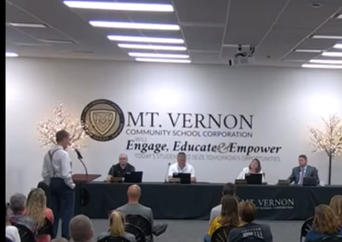
Dr. Dan Stock addressed the Mt. Vernon School Board in Indiana – Follow-up

Dr Stock

On Friday, August 7th, 2021 Dr. Dan Stock addressed the Mt. Vernon School Board in Indiana over the futility of mask mandates and Covid-19 protocols in most schools. In his presentation, he references a flash drive he gave the school board members to review with all of the scientific literature he referenced.

Link to the Video

Follow-Up
  • Oct 7, 2021. Indiana Doctor Concerned About Vaccine Safety, By Margaret Menge
    • Nine months to a year after getting them, many people are going to get sick and many will die, he says. The word he used to describe what is likely to happen is “holocaust.” …. Could he be right? … Stock lists three reasons
    • Oct 13, 2021. CORRECTIONS to the article”
      • Dr. Stock:  Bell’s Palsy isn’t an autoimmune disease, but rather a “disease of recurrent herpesvirus infection.”
      • Dr. Stock:  measles vaccine do not cause ADE and that it’s the viral vaccine for Dengue that caused ADE in humans.

Criticisms:

Aug 10, 2021. WND News Center.  Actually contrary to all rules of science’: Watch doctor destroy CDC’s messaging

Aug 7, 2021. Daily Reporter.  Mt. Vernon mulling COVID-19 protocols after feedback

  • Dr. Dan Stock, a McCordsville resident and family medicine physician, said the measures Mt. Vernon has implemented and is considering adding are not useful. He added Indiana Department of Health and CDC recommendations are “contrary to the rules of science.” Coronavirus and other respiratory virus particles are small enough to go through masks, Stock continued, adding vaccines will not be effective against COVID-19. He noted the virus is on the rise in the middle of summer, a time when respiratory viral syndromes are typically at their lowest. Stock also pointed to the COVID-19 outbreak last month in Provincetown, Massachusetts, the majority of which included vaccinated individuals. Vaccines don’t prevent infection, just symptoms, Stock said. “So you cannot stop spread, you cannot make these numbers that you’ve planned on get better by doing any of the things that you’re doing,” he said. “Because that is the nature of viral respiratory pathogens. And you can’t prevent it with a vaccine because they don’t do the very thing you’re wanting them to do. And you will be chasing this through the remainder of your life until you recognize the Centers for Disease Control and the Indiana State Board of Health are giving you very bad scientific guidance.”
  • “Mt. Vernon schools officials tabled a proposed update to its health and safety protocols and will contemplate other parts of the existing plan after receiving feedback from parents and a physician.”  
  • The next Mt. Vernon School Board meeting is Monday, August 16th at 7:00pm.

July 13, 2021. Daily Reporter. Parents pressure school boards to do away with COVID restrictions  (Greenfield-Central School Board)

  • Dr. Dan Stock, owner of PureHealth Functional Medicine in Noblesville, told the board that masks don’t work to prevent the spread of COVID-19, a claim that contradicts the guidance issued by the Centers for Disease Control and Prevention and state and local health departments.

Click on the links below to access the following studies referenced by Dr. Stock:

1. SARS-CoV2-Transmission Among Marine Recruits during Quarantine.

2. Longitudinal analysis shows durable and broad immune memory after SARS-CoV-2 infection with persisting antibody responses and memory B and T cells.

3. Vitamin D for prevention of respiratory tract infections: A systematic review and meta-analysis.

4. Facemasks in the COVID-19 era: A health hypothesis

5. CDC assessment of non-pharmaceutical influenza methods.

6. Federalist cases/mortality mask comparison

7. Heritage Foundation Study – In fact, mask use during the pandemic has been recommended by The Heritage Foundation’s Coronavirus Commission guidelines. However, our findings do suggest that public health strategies relying predominantly on mask mandates are inadequate, and thus other initiatives, in addition to mask wearing, should have been a component of policies aimed to limit the spread of the disease.

8. Declaration of Great Barrington– The Great Barrington Declaration- As infectious disease epidemiologists and public health scientists we have grave concerns about the damaging physical and mental health impacts of the prevailing COVID-19 policies, and recommend an approach we call Focused Protection. Over 60,000 medical experts have signed this declaration.

9. Covid-19 Breakthrough Infections in Vaccinated Health Care Workers.

10. Calcifediol Treatment and Hospital Mortality Due to COVID-19: A Cohort Study

11. Experimental Assessment of Carbon Dioxide Content in Inhaled Air With or Without Face Masks in Healthy Children.

12. Calcifediol treatment and COVID-19-related outcomes

13. “Effect of calcifediol treatment and best available therapy versus best available therapy on intensive care unit admission and mortality among patients hospitalized for COVID-19: A pilot randomized clinical study.

14. Effectiveness of Adding a Mask Recommendation to Other Public Health Measures to Prevent SARS-CoV-2 Infection in Danish Mask Wearers

15. Community Use Of Face Masks And COVID-19: Evidence From A Natural Experiment Of State Mandates In The US

16. Face-Masks in the COVID-19 era: A health hypothesis

17. Infection Fatality Ratios for COVID-19 Among Non-Institutionalized Persons 12 and Older: Results of a Random-Sample Prevalence Study

18. Open Schools, COVID-19, and Child and Teacher Morbidity in Sweden.

19. Face-Masks to prevent transmission of influenza virus: a systematic review

20. Outbreak of SARS-CoV-2 Infections, Including COVID-19 Vaccine Breakthrough Infections, Associated with Large Public Gathering- Barnstable County, Massachusetts, July 2021

21. Short term, high-dose vitamin D supplementation for COVID-19 disease: a randomized, placebo-controlled, study

22. Rapid Expert Consultation on the Effectiveness of Fabric Masks for the COVID-19 Pandemic (April 8, 2020)

Who benefits? County decision-making

decision making The Challenge.  Brown County has one-party monopoly (Republican) on political power.  This results in decisions that can benefit  the few with little to no consideration on the best interests of ALL county residents.  In essence, less than a dozen people can make decisions that effect everyone.  Little chance of repercussions at the ballot box for poor decisions. Good Things. County has sustained development of a County Comprehensive Financial Plan. It It appears the new ambulance contract is less expensive with less risk than the previous contract.  There is more interest expressed by the Commissioners for development and maintenance of a Capital Improvement Plan to better manage infrastructure related costs. Road Paving can also be considered a positive but the lack of a published plan is frustrating for citizens. Tax Policy.  Given the influx of retirees and people that could work from home, or chose to live in the county but commute to other counties for the better paying jobs, the decision was made by the county council to rely on income tax increases (vice property) to fund spending. The income tax rate doubled in 10 years and the county recently shifted to relying on increases in property taxes.  (The county is primarily funded by income and property taxes).

  • Brown County has the 4th highest debt per capita in the State (See Debt Comparison Report, Indiana Gateway).
  • On the income tax rate, Brown County among the highest.
  • Brown County does have one of the lowest property tax rates that is expected to continually increase.
Music Center. A $12.5 million+ expense for a  government owned and operated music venue. This project was driven by less than a dozen people.  Commissioner Biddle recently provided a $239K subsidy for “rent” — no details on what exactly county taxpayers received in services.  The Council approved the payment but were caught by surprise by the last minute request. No public meetings held to discuss the subsidy. Indiana Hill Road. Commissioners approved closing the crossing without notifying ANY of the residents effected and allowing for public input.   Hard to believe that negotiation with the Railroad would not have resulted in mitigating needed risks.  What were the alternatives considered? Overlook – Clear-Cut.  Commissioner Biddle led the effort to conduct minor logging on the western side of the Overlook on 135 to allow for better views.  A project that was well received by the community.  She provided no oversight on the project to clear the view on the eastern side of the overlook that resulted in a devastation.  Salt Creek Trail.  The commitment by the commissioners at the time for this project was no county tax money would be used nor would eminent domain. Commissioner Biddle was a commissioner when the commissioners voted to accept state money for this project. This granted the “State” the right to acquire property through the threat of eminent domain.  Commissioner Biddle also led efforts to acquire “free bridges” without involving the community on how well these bridges fit within the historical culture and aesthetics of the county.  The bridges were not “free” – state taxpayer money used to repair, paint and re-locate. Perpetual loans.  County renews a 2-3 million dollar loan ever 2-3 years to fund infrastructure projects and overspending that serves as a relatively expensive line of credit. Why not just make the tax increase (used to payoff the loan) permanent?
  • The state has limits on tax increases.  Does a loan supplement the budget when we have reached our spending limit?
Brown County Regional Sewer District (BCRSD) and Bean Blossom Sewer Project.  The BCRSD has spent $220,000 of the $270K provided by the county council to support a new plant in Bean Blossom.  The project started in June 2018. No land has been acquired and less expensive options have been identified. Septic Ordinance.  A lack of justification for supporting county unique requirements. The two commissioners that voted for this ordinance (Biddle, Braden) refused to address citizens comments and questions.  commissioner Pittman wrote two Letters in the Democrat opposing the ordinance. Bigoted and racist post on Facebook by the local Republican Party.  This issued was covered in the Brown County Democrat  — “Post on GOP Facebook page prompts questions” by Sara Clifford.  Community reaction in Letters to the Editor. Health Insurance.  County Health insurance is self-insured and has resulted in higher costs and risks. Despite attempts to improve, costs have  continually exceeded budget. In contrast, Brown County Schools adopted a different model that results in savings and less risk. The county recently approved a three year contract for the high risk and cost option. Ambulance Contract. After years of increasing costs, a new contract resulted in lowering cost without a loss of service.  Time will tell if costs continue to be stable. READI Grant. Stay tuned. 60% of funding for “projects” from the private sector, 20% from the county, 20% from the State (READI).

Elections.

Jun 5, 2020. BREAKING: 122 local ballots won’t count; they are evidence  By  –

Sep 25, 2018. Special prosecutor to investigate election complaints By Sara Clifford

  • A special prosecutor from Jackson County has been appointed to investigate allegations that a county commissioner candidate and a member of the Brown County Election Board violated an election law during the May primary.
  • Biddle told the election board that the inspector had car trouble and she was making sure he had a way back to the courthouse that night. She also said that she had entered the polling place from the side and she didn’t see the first set of prohibition signs that were further from the building. If she had seen them, she wouldn’t have crossed them, she told the board.

Brown County RDC Community Invest Corp (Landbank) – For the Record


community investment home 2

BC Community Investment (Landbank) Charter (Draft)

RDC Website – Choose Brown County – Link to Google Docs and Zoom Meetings

July 27 2021.  One down, one up’: New entity proposed to reuse vacant home sites By Sara Clifford 


July 22, 2021. RDC Meeting.

  • The RDC will meet at Brown County Middle School (formerly known as the junior high) at 6 p.m.  Available on Zoom

Jul 21, 2021,  Mechanism for reusing vacant home sites to be discussed this week By  

  • BCM Facebook Post of the Article and Comments
    • Justin Schwenk …  The idea is not so much to create a specific size but rather a specific price of home that is attainable by first-time homebuyers, younger families, and residents looking to move upward. The problem with the market is that over the last thirty years, the market has driven home prices up so dramatically that a specific and needed demographic (20-40 yr olds) is priced well out of the market. This plan would kill a few birds with one stone. Using properties that the market has largely left behind, we can mitigate distressed homes and support attainably priced homes without disturbing the natural market trends. The only people who stand to benefit financially are local business owners who would be doing the maintenance, demolition, and rebuilding of the homes on properties–largely after they have been resold back to private ownership.
    • QUESTIONS:
      • What would the the needed income level for the respective 20-40 year demographic?
      • Potential buyers cannot would have to include all age groups.  

Feb 9, 2021. GUEST OPINION: Survey process starting to address housing challenges by Sara Clifford 

  •  The Building Community Initiative is focused on the redevelopment and rehabilitation of underutilized areas of the county. 
  • The Building Community Initiative is a three-phase project designed by the redevelopment commission to be a community-driven effort to identify vacant and abandoned homes, rehabilitate them, and return them to productive use — specifically as affordable starter homes that will be accessible to a greater number of people interested in locating to Brown County.

Sep 20, 2020.  Redevelopment commission planning land survey by Sara Clifford 

  • When the leaves drop, the Brown County Redevelopment Commission wants to be ready to load up and go for a drive with a specific purpose. …. Members are planning to survey all the land parcels they can see from public roads, recording certain details about them in a cellphone-based app. … The RDC discussed this concept at length during several public meetings in 2019. 

2022 County Budget

Nov 03, 2021. Budget, loan to cover insurance expenses OK’d

  • BCM Facebook Post of the article:
    Kudo’s to Councilman Scott Rudd. The shell game needs to stop.
    “He said he could not support a budget that was not “structurally balanced,” or one where the expenses exceeded the revenue coming in. … “I will continue to try to balance this budget before the end of my term, which would take another three years “

Aug 31, 2021. More cuts to come to 2022 county budget: Hiring freeze, restructuring benefits among changes council considering By Suzannah Couch

Schedule – Budget Hearings 2022 Budget Schedule

  • Aug 17-19, 5:00 pm to 7:00 p.m.

Aug 9, 2021. County Council meeting – Baker-Tilley Report. Assumptions and projections of revenues and costs.  These will be adjusted after the 2022 budget is complete.

Aug 2, 2021. Joint Meeting – 6:00 p.m. Council and Commissioners – Loan Approval

July 27, 2021 Council, residents debate need, planning for another loan By  –

2021 County Loan – 3 Million

erasing debt, hand written word on blackboard being erased concept


Aug 24, 2021County OKs borrowing for roads, other projects by Suzannah Couch

  • After multiple meetings and comments, the Brown County Council approved an ordinance last week allowing the county to take out a $3 million bond to pay for various projects and road work over the next three years.

    The anticipated impact on tax rates for residents is expected to be minimal to none, but the exact impact will not be known until the bond is finalized next month.

    The borrowing was approved on a 5-2 vote with council members Darren Byrd and Scott Rudd voting no.

Aug 20, 2021. FB Post – Kevin Fleming

  • The authorizing ordinance for the $3 mil loan passed by the county council cites that the loan is made according to IN Code 36-2-6-18. I’ve highlighted portions of the statute which seems to apply to the loan.

Aug 15, 2021. County loan priorities, need under discussion by Sara Clifford – A decision could come sometime this week on whether or not the Brown County Council will agree to take out a $3 million loan…

Complaint submitted by Sherrie Mitchell to the Public Access Counselor – Violation of Open Meeting Laws: PAC Complaint – Bond Resolution 2021_08_03 

8/9/2021 PROPOSED Ordinance Authorizing Issuance of Notes.pdf  (Council website).

 July 27, 2021. Council, residents debate need, planning for another loan By  

  • “How is that a capital improvement?” resident Tim Clark asked about the contracts. Typically, “capital” items are tangible things, not services.

    “The capital improvement loan is simply unfunded items we cannot pay for any other way. They just call it a capital improvement loan in terms of how it’s established through getting the bonding,” Biddle said.


July 19, 2021, County Council Meeting

Legal Notices for Week of July 6, 2021.

NOTICE OF PUBLIC HEARING CONCERNING APPROPRIATION
OF THE PROCEEDS OF THE BROWN COUNTY, INDIANA
GENERAL OBLIGATION NOTES, SERIES 2021
The residents and taxpayers of Brown County, Indiana (the “County”), are hereby notified that the County Council will hold a public hearing on Monday, July 19, 2021 at 6:30 p.m., local time, in the Salmon Room on the second floor of the Brown County Office Building, located at 201 Locust Lane, Nashville, Indiana, on the matter of appropriating the proceeds of the Brown County, Indiana General Obligation Notes, Series 2021 (the “Notes”), in an amount not to exceed Three Million Dollars ($3,000,000), together with all interest earnings thereon. The proceeds of the Notes will be issued for the purpose of paying the costs of various capital projects for the County, and related incidental expenses to be incurred in connection therewith, and the costs of issuing the Notes.
Said appropriation is in addition to any appropriations provided for in the existing budget and tax levy. Funds to cover said appropriation are to be provided from the proceeds of the Notes. At said public hearing, all persons shall have the right to appear and be heard on the necessity of said appropriation.
Dated: July 7, 2021

June 29, 2021. County council approves first step in loan process By Suzannah Couch – 6/29/21 

  • The Brown County Council has approved the first step in the process to borrow up to $3 million for road work, county-owned buildings and other capital projects.
  • County commissioner Diana Biddle presented the resolution to the council on June 21. 
  • An ordinance approving borrowing the money will be presented to the council next month. The council will meet at 6:30 p.m. Monday, July 19 and public input will be accepted about the loan at that time.
  • “We’re not approving $3 million. We’re just saying get it started,” said county council President Dave Redding.
  • Council member Scott Rudd expressed concern about approving the resolution allowing the commissioners to further finalize the details of the loan since it was not listed on the agenda shared with the public ahead of time. … “It also went from $2 million to $3 million,” Rudd said. … “I’m leaning towards just pushing this back. I am reacting to the extra million as we speak. … It’s a lot of changes without a lot of notice.”

County Council Agenda June 21 2021   Bond Resolution not on agenda

June 22, 2021. Legal notices for week of June 23 By  –

  • NOTICE TO TAXPAYERS  REGARDING DETERMINATION TO ISSUE NOTES OF BROWN COUNTY, INDIANA The taxpayers of Brown County, Indiana (the “County”), are hereby given notice that the Brown County Council, at its meeting held June 21, 2021, determined to issue notes of the County in an original aggregate principal amount not to exceed $3,000,000 (the “Notes”). The proceeds of the Notes will be used to finance the costs of capital projects in the County, and to pay related and incidental expenses to be incurred in connection therewith and on account of the issuance of the Notes.
  • The proposed Notes will have a maximum term ending no later than January 1, 2025, and will bear interest at a rate or rates not exceeding 3.00% per annum. The Notes will be payable from ad valorem taxes levied on all taxable property in the County.
    • Dated this 23rd day of June, 2021. BROWN COUNTY, INDIANA 60079179, 6/23/21, 6/30/21, hspaxlp, 21-116

Government calendar for week of June 16   – LOAN NOT NOT ON AGENDA

  • June 21, 2021. Brown County Council — 6:30 p.m., Salmon Room, County Office Building, 201 Locust Lane, and virtually on Zoom. Agenda includes reappropriations of all appropriations that have been approved since Jan. 1; update on job description initiative; report on 2021 voluntary wellness program; Purdue Extension, Kara Hammes, job description for part-time employee; 2022 budget filing update; and other business. Join virtually at https://us06web.zoom.us/j/7390919708, meeting ID 739 091 9708.

 What Is a Capital Improvement?

  • A capital improvement is the addition of a permanent structural change or the restoration of some aspect of a property that will either enhance the property’s overall value, prolongs its useful life, or adapt it to new uses. Individuals, businesses, and cities can make capital improvements to the property they own. Often capital improvements are given favorable tax treatment and may be exempted from sales tax in certain jurisdictions. (Investopia)

Indiana Code 36-9-16-3. Cumulative capital improvement fund; additional purposes

Sec. 3. A unit may establish cumulative capital improvement funds to provide money for one (1) or more of the following purposes:
  1. (1) To acquire land or rights-of-way to be used for public ways or sidewalks.
  2. (2) To construct and maintain public ways or sidewalks.


Remonstrance not possible on a “Note” with a duration of less than 10 years

Remonstrance Flowchart and Process 181210 – Flow Chart – Petition and Remonstrance Process — 30 Days to file after First Hearing

  • Publish notice of preliminary determination hearing at least 10 days before the hearing. *Taxing units with appointed boards, such as libraries, must first receive approval of city, town or county fiscal body (whichever is applicable) before issuance of bond or lease rental agreements. The city, town or county fiscal body approval would occur prior to the preliminary determination hearing in these cases.
  • Hold at least two (2) preliminary determination public hearings before adoption of a
    resolution/ordinance to issue bonds or enter lease to finance project.

Indiana Code 6-1.1-20-3.1. Procedures to be completed by political subdivision before imposing property taxes for bonds or lease for certain projects; thresholds

WatchList – BCRSD

Presentation1

Website: The Brown County Regional Sewer District (BCRSD) 

Updated Feb 23, 2023 

In 2021, the Board consisted of Clint Studabaker, Richard Hall, Mike Leggins, Deborah Larsh, and Phil LeBlanc.  For 2022, Deborah Larsh is not continuing and her vacancy was filed by Matt Hanlon.   Per the commissioners, this is a council appointment and the council meetings Jan 17, 2022.

Past Posts:

Feb 16, 2023BCRSD Board Meeting Notes, Tues Feb 14, 2023 County Sewer Plan with audio.

    • Soils. Clint Studabaker (Board VP/Project Lead) contradicts the state policy on Soils. He stated that 100% of soils in Brown County are not conducive to septic systems- thus a justification for the expansion of sewers county-wide. The state has identified the criteria for assessing soils, and soil testing is required in order to obtain a septic system permit from the county.
    • The BCRSD has also identified that there is a limited life on a septic system. This is contradicted by the EPA and Presby that reinforce that “there is an indefinite life If the system is designed, installed and maintained properly.”
    • Wastewater Strategic Plan and Water Quality Study. Studabaker decided not to have a public presentation of the plan where citizens can ask questions of the authors of the plan and study. Any questions are to be directed to him.
    • Preliminary Engineering Report (PER). The target date for completion is March 31. The presentation of this PER WILL require public hearings. The Date TBD. This should be a lively meeting.

Mar 23, 2022. Commissioner Meeting – BCRSD Request for additional funding. – “Public Hearing” on the issues

Brown County Regional Sewer District (BCRSD).  Good time to transition the BCRSD to an Advisory and Support Committee?

A review is needed on the continued need for the BCRSD including their scope, roles and responsibilities. A delay is suggested for any new board appointments and support for any additional funding such as from the ARP pending a review.  Options could include eliminating the BCRSD and converting it to an Advisory Committee on wastewater management and to support the Helmsburg RSD.  The HRSD Board can be expanded to include a representative from Bean Blossom and Lake Lemon.

Future Joint Meeting. The Commissioners have asked for a joint meeting with the HRSD and the BCRSD boards to discuss their requests for ARP funds. The BCRSD has requested $300K and the HRSD has requested $515K (25K of which has been approved). The Council should also be represented at this meeting.

RSDs – American Rescue Plan (ARP) Funding. The proposal for funding was submitted by the Brown County Regional Sewer District (BCRSD) with a copy to the Helmsburg Regional Sewer District (HRSD). The BCRSD is currently requesting $300,000 from the ARP funds.

    • Copy of the BCRSD Proposal to the Commissioners: Cover-letter-and-proposal-to-brown-county-commissioners.  Areas covered range from Lake Lemon to Bean Blossom.  Bean Blossom includes but not limited to Brownies, Bill Monroe, Staley’s Mobile Home Park, greater Bean Blossom, Little Fox and Woodland Lakes, and Freeman Ridge.
    • Helmsburg (HRSD) Proposal for APR funding. HRSD identifed the need for $515,000 (has since been increased). Commissioners did approve the 25K needed to acquire more land to support a plant expansion.  Dec 6, 2021, HRSD_BCRSD Joint Proposal to Commissioners. Commissioners also approved $40,000 to hook up two customers (Mar 22, 2022 meeting.)

Current plans. The proposed bean Blossom sewer plant project is on “pause.” The current plan for the area is to justify an expansion of the Helmsburg Plant to potentially serve the Lake Lemon and Bean Blossom areas. This project has a higher likelihood of receiving federal and state money. There is a valid and documented need in the Lake Lemon area whose residents also support sewer service. Helmsburg has an aging plant that needs upgrades. The Helmsburg RSD (HRSD) Board can be expanded to include representation from Bean Blossom and Lake Lemon. State and Federal officials have both reinforced that the fewer RSDs the better.

History and Background: The BCRSD (Formerly the Bean Blossom RSD) was created to acquire sewer service for Bean Blossom.

For “20+ years”, there has been some interest in Bean Blossom for sewer service. A common position by those I’ve talked to within the county, state and federal level, (to include articles in the Democrat) has been that it made the most sense for Helmsburg to provide the service.

Conflicts between individuals in Helmsburg and Bean Blossom prevented support. One of the barriers was the perceived potential risk to Helmsburg customers for paying more per month to cover the expansion to Bean Blossom. County elected leaders at the time refused to get involved.

Bean Blossom then created an RSD (BBRSD) and needed to expand their customer base (despite documented evidence of need) to justify sewers. The Bean Blossom RSD was converted to the Brown County RSD (BCRSD). When Evan Werling was president of the BCRSD, he asked the state to provide a “boots on the ground” assessment as to need. The Health Department did not support this assessment. Given the lack of a documented need and lack of support from the Health Department, Werling and two other board members resigned from the Board. Evan Werling was replaced by Judy Swift who was elected as president. She was also in support of documenting the need that was not supported by the rest of the board. She resigned from the board. She was replaced by Mike Leggins who still is serving as president of the board.

Under the leadership of Mike Leggins with technical support provided by Clint Studabaker, a “need” was derived based on the speculated “age” of systems and lack of records.  The BCRSD submitted an application for funding  through a Preliminary Engineering Report (PER) in June of 2018 and later received tentative project approval from the State.  The PER included Letters of Support for this project from “1998.”   Without support from the current customer base, it would might be difficult to acquire the estimated 190 easements.

Additional Information:

Property – Bean Blossom Sewer Plant. The BCRSD was not able to acquire property from private landowners and asked Parks and Rec for five acres which they provided. The DNR refused to support the transfer due to deed restrictions. The Bean Blossom sewer plant project is on “pause.”  It has not been officially canceled and removed from the state’s pending project list.

A new sewer plant in Bean Blossom appears highly unlikely at this point. The council provided $270k to the BCRSD. Over $200K has been spent on planning. No land has been identified. BCRSD has no customers and the justification used to create the RSD is no longer valid.

Nashville Support of Sewer Service. Nashville offered to extend sewer service. Evan Werling and the board at the time unanimously rejected their offer due to cost and an annexation requirement. An assessment by the Redevelopment Commission (RDC) at the time identified that service from Helmsburg would likely be more cost effective.

Nashville has recently identified their interest in providing support at less cost than building a new plant without an annexation requirement.

    • Oct 15, 2021. Nashville Sanitary Sewer Master Plan. The justification of need to support expansion to outlying areas are based on anecdotes and hearsay. The plan also includes an estimate for supporting an expansion to Bean Blossom.

Consideration —  BCRSD Transitioned to an Advisory and Support Committee

As mentioned, the HRSD Board can be expanded to include a representative from Bean Blossom and Lake Lemon. The BCRSD is an unnecessary redundancy.

The BCRSD received funding from ROI to develop a needed  study – Brown County Wastewater Infrastructure Strategic Planning Study. This study is near completion (84%) and can serve as an addendum to the County Comprehensive Plan (CCP). The CCP is managed by the Planning Department. The Area Plan Commission (APC) has identified an intent to update the current 14-page plan. The Wastewater Plan can be managed by an Advisory Committee.

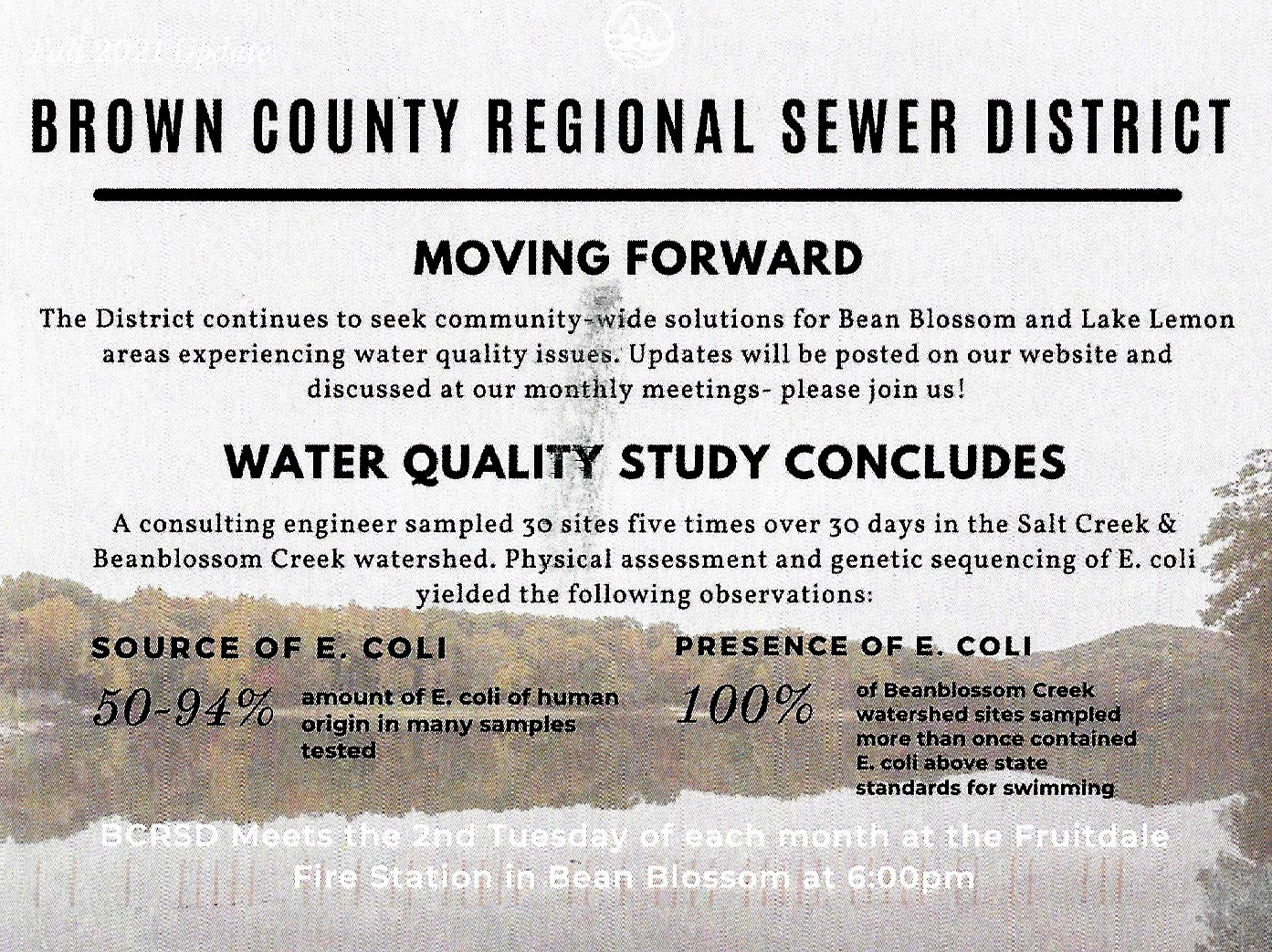
Preliminary water sampling indicates some human caused e-coli. This information was shared with about 600 people via a postcard. Unknown at this time the extent and scope of the problem.

BCRSD Water Quality Card Notice

Finding and Potential Solutions? Who is in charge? What control would county elected officials have over any potential findings and “solutions” from the wastewater strategy?  Does the BCRSD have the power to act independently?   The BCRSD as an Advisory Committee would make recommendations to the county elected officials who would then decide on the appropriate courses of action.

Potential Abuse of Power. An RSD can wield a significant amount of power. They can force “mandates” for sewer service. Any waivers are temporary. They can charge potential customers a monthly fee to support construction costs. They can borrow money. The ONLY control county elected official have is on appointments to the board and choosing to provide funding.

Balancing Power – Elected vs Appointed Board Members. The Gnaw Bone RSD opted for board members to be elected by the customers as opposed to being appointed by the Commissioners and Council.  This can lead to more transparency and accountability.

Dec 8, 2021. ARP Funding – Commissioners – Decision Criteria Needed

BCRSD – Cover memo and funding request for American Rescue r Plan (ARP).  County receiving about 1.4 million.  BCRSD is asking for $300,000.  The priority for the county is and has been Helmsburg, Trevlac, and Lake Lemon Areas.   The need (as opposed to want) for the Bean Blossom area has not been validated and lacks evidence of community wide support.

Since 2018, the BCRSD spent over 200K of the 270K they received from the county council on plans for a new plant in Bean Blossom. They determined this was the highest priority in the county. After 3 years, they have been unable to acquire land.

July 16, 2022.  Justification for placement on a “Watch List”
  • TOO MUCH POWER WITH NO COUNTY OVERSIGHT. A Regional Sewer District has the power to force everyone within 300 feet of a sewer line to pay the hook up fees and monthly utility charges for service. Charges could range from $65.00 a month. Any waivers for customers with functional septic systems are temporary and at the discretion of the RSD. The only power county elected officials have over this board is appointments and re-appointments. They can also choose NOT to provide any local funding. The BCRSD could still receive funding from other sources. Power always corrupts. Oversight and transparency are antidotes.
  • Lack of Transparency.  No frequent updates on their recently developed (2021) website to include agenda, minutes, reports, contact information for Board members, and recordings of their meetings. The promise of development of a website and support for communication and transparency were made at their “June 2018” meeting. This was the meeting where they announced submission of an application for funding for a new sewer plant in Bean Blossom.
  • Mismanagement and Lack of Oversight by County Officials. The BCRSD applied for funding for a new plant in Bean Blossom in June 2018. They spent over $220,000 of the 270K provided to them by the County Council. They have not acquired land and their attempt to acquire county parkland was rejected by DNR. They have not validated a need. Nashville has identified that they can provide service to Bean Blossom at less cost that building a new plant. And it is becoming more apparent to all that a regional plant in Helsmburg may be the best option for the area.  They have yet to publicly comments on the status of the Bean Blossom Sewer Plan other that to say “all options are being considered.”
    • An independent audit on the efficiency and effectiveness of the BCRSD should be initiated by county officials.
  • Overstatements.  In this week’s Democrat, Mr. Studabaker stated they had $30 million worth of projects. This is an overstatement. He was basing the “estimate” on findings from a regionalization study that identified rough estimates for a variety of projects IF a NEED could be validated. Further analysis is needed to determine the most feasible of options. Further, Studebaker claimed human causes e-coli contamination that could be due to failed septic systems.  He was referring to a water samples containing pharmaceutical waste – which per the Democrat, cannot be filtered by septic systems OR wastewater treatment systems.
  • Plans and Strategies.  The BCRSD initiatives that led to the acquisition of grants for the development of a Regionalization Study and Wastewater Strategic Plan are value added. These “Plans” and strategies can be maintained by the county planning office. The current planning director is retiring within a year and a new director with the required skills can provide the oversight on ALL projects  that involve county resources and infrastructure.
  • Dissolve the BCRSDThe Platform for the 2020 County Democrat candidates for office included the objective of dissolving the BCRSD. This should remain a consideration.
    • We believe there is no useful purpose served by the existence of the Brown County Regional Sewer District, and it should be dissolved. No proof supported by observation of empirical evidence shows good cause to force county homes and businesses off of septic systems already installed. The Hometown Engineering report determined that no new sanitary sewer system is economically feasible without wide-scale hookup.
  • False Premise.  The BCRSD was established based on a false premise of an “environmental nightmare” in the Bean Blossom area due to failed septic systems. This has never been validated. Current possible projects supporting Helmsburg and Lake Lemon can be administered by an expanded Helmsburg RSD with contracting support.

IF water sampling does indicate human caused contamination, next steps would be to confirm the scope and extent of the problem. 

READI Grant Funding – For the Record

Updated Dec 16, 2022

What are the risks  to the taxpayers?

readi iedc

Funding by the State for the READI grants was provided by the Federal American Rescue Plan.

Dec 16, 2022. Indiana Uplands announces READI commitments totaling more than $24.6 million

Dec 21, 2021. County’s READI region receives $30 million to help fund select projects By Suzannah Couch

    • FB Post – Brown County Matters. Unknown how much if any taxpayer money will be expected to contribute. “Indiana Economic Development Corporation will host a READI kickoff meeting on Tuesday, Jan. 11 when organizers hope they will learn projects will receive READI funding. Until then, the IEDC will work through a grant agreement with each region.”
    • FB Post – Brown County Democrat

Dec 14, 2021. Inside Indiana Business. $500M in READI grant funding dished out to all 17 applicants|

20211214 BC Readi Projects – Hard Truth Hills (HTH) and RDC Land Bank

    • Indiana Uplands – 30 million. Includes Brown County.
    • The grant program also requires each region to provide at least $4 in matching funds for every $1 awarded by the state.
    • Facebook Announcement – Gov Holcolm

Oct 13, 2021.  Completed Plan – Indiana Uplands READI Development Plan: “A Region on the Rise”   

Due: July 30, 2021.  Indiana Uplands READI Plan: Call for Projects and Programs

July 13, 2021READI group meeting weekly to discuss possible grant-funded projects By  

An informal steering committee is now meeting every Thursday at noon to discuss which local projects might be put into an application for up to $50 million in grant funding.

The grant opportunity is called READI, and Brown County has committed to try for it with the 11-county Indiana Uplands region.

The local steering committee has been asked to come up with a list of approximately five projects to contribute to the Indiana Uplands’ grant application. Whether or not those projects will actually make it into the application remains to be seen, as the 10 other counties in the region also will be contributing ideas.


July 6, 2021. The Indiana Uplands is READI to Go Posted on 

  • On July 1, ROI notified the Indiana Economic Development Corporation of its intent to seek funding, alongside its partner organizations, through READI on behalf of the Indiana Uplands region, comprised of Brown, Crawford, Daviess, Dubois, Greene, Lawrence, Martin, Monroe, Orange, Owen, and Washington counties.

July 6, 2021. Commissioners OK resolution for READI opportunity By  

  • It is not clear what would be required of Brown County financially in the future or how Brown County would benefit from applying for READI with Indiana Uplands, as no grant application or project plan has been written yet.
 

June 28, 2021. The Brown County Commissioners will have a special meeting at 2 p.m. Monday, June 28 at the County Office Building to discuss a resolution of commitment to the READI grant initiative.

June 25, 2021. BCD. Brown County likely to join region for try at grant funding By  –

June 16, 2021. BCD.   Groups to vie for up to $50M in READI funding  Sara Clifford –


  •  Up to $50 million in grants is becoming available to regions of Indiana to build their future economies, workforces and populations. Next week, a broad…

Indiana Economic Development Corp (IEDC), Regional Economic Acceleration &  Development Initiative (READI) READI-Informational-Revised-June7 (1)

  • Objective: Accelerate Indiana’s population growth through increased domestic and international migration by supporting the implementation of regional economic development strategies focused on making Indiana cities and towns magnets for talent. To achieve this objective, the state will invest in financial partnerships with regions across the state that demonstrate the potential to attract people and accelerate the state’s economic growth.

Regional  Development

  • Invest in quality of place and talent initiatives included in regional development plans
    ► Award funding for projects in each region that are included in a region’s plan.
    ► IEDC will expect its $500 million investment to be matched by the private sector and local community.
    At least 80% of the investment must come from private or local sources.
    • Not more than 20% of the investment in the plan can originate from state funds.
    • A majority of the investment in the plan should come from private sources.
Stellar – Another Grant Opportunity requiring taxpayer funding?

June 18, 2019. BCD. Another shot at Stellar? Town, county starting to talk about funding opportunity By  –

  •  Nashville-Brown County unsuccessfully tried for a Stellar Communities designation from the state in 2014.
  • At the time, being named “Stellar” would have given the town and county access to a pool of millions of dollars in funding for projects for about a five-year period, supplemented by local money. Only Stellar Communities designees can apply for that pool of state and federal funding.
  • On the day in July 2014 when the local Stellar committee made its pitch to the state Stellar selection committee, protesters holding signs which read “No Stellar — Not This Year” were visible at nearly every project site and some also spoke during the presentation.

May 23, 2020.  Town redevelopment discusses TIF, Stellar, Creekside By Abigail Youmans

  • The Nashville Redevelopment Commission discussed ongoing projects such as TIF, Stellar and a potential property within town limits in a virtual meeting on Tuesday, May 12. 

May 4, 2017. What are best bets for future of local economy? by   

  • Brown County’s greatest potential for economic growth is as a bedroom community, according to economists with the Center for Business and Economic Research at Ball State University.

    But local leaders had a different viewpoint; they perceived recreation as the area with the biggest potential, and to them, housing ranked No. 3.

  • According to the state and federal data the Ball State researchers studied, retail is the least promising sector among the five studied. Nos. 2, 3 and 4 are recreation, wholesale and production, in that order, the data said.