
2022 County Budget

Nov 03, 2021. Budget, loan to cover insurance expenses OK’d

  • BCM Facebook Post of the article:
    Kudo’s to Councilman Scott Rudd. The shell game needs to stop.
    “He said he could not support a budget that was not “structurally balanced,” or one where the expenses exceeded the revenue coming in. … “I will continue to try to balance this budget before the end of my term, which would take another three years “

Aug 31, 2021. More cuts to come to 2022 county budget: Hiring freeze, restructuring benefits among changes council considering By Suzannah Couch

Schedule – Budget Hearings 2022 Budget Schedule

  • Aug 17-19, 5:00 pm to 7:00 p.m.

Aug 9, 2021. County Council meeting – Baker-Tilley Report. Assumptions and projections of revenues and costs.  These will be adjusted after the 2022 budget is complete.

Aug 2, 2021. Joint Meeting – 6:00 p.m. Council and Commissioners – Loan Approval

July 27, 2021 Council, residents debate need, planning for another loan By  –

2021 County Loan – 3 Million

erasing debt, hand written word on blackboard being erased concept


Aug 24, 2021County OKs borrowing for roads, other projects by Suzannah Couch

  • After multiple meetings and comments, the Brown County Council approved an ordinance last week allowing the county to take out a $3 million bond to pay for various projects and road work over the next three years.

    The anticipated impact on tax rates for residents is expected to be minimal to none, but the exact impact will not be known until the bond is finalized next month.

    The borrowing was approved on a 5-2 vote with council members Darren Byrd and Scott Rudd voting no.

Aug 20, 2021. FB Post – Kevin Fleming

  • The authorizing ordinance for the $3 mil loan passed by the county council cites that the loan is made according to IN Code 36-2-6-18. I’ve highlighted portions of the statute which seems to apply to the loan.

Aug 15, 2021. County loan priorities, need under discussion by Sara Clifford – A decision could come sometime this week on whether or not the Brown County Council will agree to take out a $3 million loan…

Complaint submitted by Sherrie Mitchell to the Public Access Counselor – Violation of Open Meeting Laws: PAC Complaint – Bond Resolution 2021_08_03 

8/9/2021 PROPOSED Ordinance Authorizing Issuance of Notes.pdf  (Council website).

 July 27, 2021. Council, residents debate need, planning for another loan By  

  • “How is that a capital improvement?” resident Tim Clark asked about the contracts. Typically, “capital” items are tangible things, not services.

    “The capital improvement loan is simply unfunded items we cannot pay for any other way. They just call it a capital improvement loan in terms of how it’s established through getting the bonding,” Biddle said.


July 19, 2021, County Council Meeting

Legal Notices for Week of July 6, 2021.

NOTICE OF PUBLIC HEARING CONCERNING APPROPRIATION
OF THE PROCEEDS OF THE BROWN COUNTY, INDIANA
GENERAL OBLIGATION NOTES, SERIES 2021
The residents and taxpayers of Brown County, Indiana (the “County”), are hereby notified that the County Council will hold a public hearing on Monday, July 19, 2021 at 6:30 p.m., local time, in the Salmon Room on the second floor of the Brown County Office Building, located at 201 Locust Lane, Nashville, Indiana, on the matter of appropriating the proceeds of the Brown County, Indiana General Obligation Notes, Series 2021 (the “Notes”), in an amount not to exceed Three Million Dollars ($3,000,000), together with all interest earnings thereon. The proceeds of the Notes will be issued for the purpose of paying the costs of various capital projects for the County, and related incidental expenses to be incurred in connection therewith, and the costs of issuing the Notes.
Said appropriation is in addition to any appropriations provided for in the existing budget and tax levy. Funds to cover said appropriation are to be provided from the proceeds of the Notes. At said public hearing, all persons shall have the right to appear and be heard on the necessity of said appropriation.
Dated: July 7, 2021

June 29, 2021. County council approves first step in loan process By Suzannah Couch – 6/29/21 

  • The Brown County Council has approved the first step in the process to borrow up to $3 million for road work, county-owned buildings and other capital projects.
  • County commissioner Diana Biddle presented the resolution to the council on June 21. 
  • An ordinance approving borrowing the money will be presented to the council next month. The council will meet at 6:30 p.m. Monday, July 19 and public input will be accepted about the loan at that time.
  • “We’re not approving $3 million. We’re just saying get it started,” said county council President Dave Redding.
  • Council member Scott Rudd expressed concern about approving the resolution allowing the commissioners to further finalize the details of the loan since it was not listed on the agenda shared with the public ahead of time. … “It also went from $2 million to $3 million,” Rudd said. … “I’m leaning towards just pushing this back. I am reacting to the extra million as we speak. … It’s a lot of changes without a lot of notice.”

County Council Agenda June 21 2021   Bond Resolution not on agenda

June 22, 2021. Legal notices for week of June 23 By  –

  • NOTICE TO TAXPAYERS  REGARDING DETERMINATION TO ISSUE NOTES OF BROWN COUNTY, INDIANA The taxpayers of Brown County, Indiana (the “County”), are hereby given notice that the Brown County Council, at its meeting held June 21, 2021, determined to issue notes of the County in an original aggregate principal amount not to exceed $3,000,000 (the “Notes”). The proceeds of the Notes will be used to finance the costs of capital projects in the County, and to pay related and incidental expenses to be incurred in connection therewith and on account of the issuance of the Notes.
  • The proposed Notes will have a maximum term ending no later than January 1, 2025, and will bear interest at a rate or rates not exceeding 3.00% per annum. The Notes will be payable from ad valorem taxes levied on all taxable property in the County.
    • Dated this 23rd day of June, 2021. BROWN COUNTY, INDIANA 60079179, 6/23/21, 6/30/21, hspaxlp, 21-116

Government calendar for week of June 16   – LOAN NOT NOT ON AGENDA

  • June 21, 2021. Brown County Council — 6:30 p.m., Salmon Room, County Office Building, 201 Locust Lane, and virtually on Zoom. Agenda includes reappropriations of all appropriations that have been approved since Jan. 1; update on job description initiative; report on 2021 voluntary wellness program; Purdue Extension, Kara Hammes, job description for part-time employee; 2022 budget filing update; and other business. Join virtually at https://us06web.zoom.us/j/7390919708, meeting ID 739 091 9708.

 What Is a Capital Improvement?

  • A capital improvement is the addition of a permanent structural change or the restoration of some aspect of a property that will either enhance the property’s overall value, prolongs its useful life, or adapt it to new uses. Individuals, businesses, and cities can make capital improvements to the property they own. Often capital improvements are given favorable tax treatment and may be exempted from sales tax in certain jurisdictions. (Investopia)

Indiana Code 36-9-16-3. Cumulative capital improvement fund; additional purposes

Sec. 3. A unit may establish cumulative capital improvement funds to provide money for one (1) or more of the following purposes:
  1. (1) To acquire land or rights-of-way to be used for public ways or sidewalks.
  2. (2) To construct and maintain public ways or sidewalks.


Remonstrance not possible on a “Note” with a duration of less than 10 years

Remonstrance Flowchart and Process 181210 – Flow Chart – Petition and Remonstrance Process — 30 Days to file after First Hearing

  • Publish notice of preliminary determination hearing at least 10 days before the hearing. *Taxing units with appointed boards, such as libraries, must first receive approval of city, town or county fiscal body (whichever is applicable) before issuance of bond or lease rental agreements. The city, town or county fiscal body approval would occur prior to the preliminary determination hearing in these cases.
  • Hold at least two (2) preliminary determination public hearings before adoption of a
    resolution/ordinance to issue bonds or enter lease to finance project.

Indiana Code 6-1.1-20-3.1. Procedures to be completed by political subdivision before imposing property taxes for bonds or lease for certain projects; thresholds

WatchList – BCRSD

Presentation1

Website: The Brown County Regional Sewer District (BCRSD) 

Updated Feb 23, 2023 

In 2021, the Board consisted of Clint Studabaker, Richard Hall, Mike Leggins, Deborah Larsh, and Phil LeBlanc.  For 2022, Deborah Larsh is not continuing and her vacancy was filed by Matt Hanlon.   Per the commissioners, this is a council appointment and the council meetings Jan 17, 2022.

Past Posts:

Feb 16, 2023BCRSD Board Meeting Notes, Tues Feb 14, 2023 County Sewer Plan with audio.

    • Soils. Clint Studabaker (Board VP/Project Lead) contradicts the state policy on Soils. He stated that 100% of soils in Brown County are not conducive to septic systems- thus a justification for the expansion of sewers county-wide. The state has identified the criteria for assessing soils, and soil testing is required in order to obtain a septic system permit from the county.
    • The BCRSD has also identified that there is a limited life on a septic system. This is contradicted by the EPA and Presby that reinforce that “there is an indefinite life If the system is designed, installed and maintained properly.”
    • Wastewater Strategic Plan and Water Quality Study. Studabaker decided not to have a public presentation of the plan where citizens can ask questions of the authors of the plan and study. Any questions are to be directed to him.
    • Preliminary Engineering Report (PER). The target date for completion is March 31. The presentation of this PER WILL require public hearings. The Date TBD. This should be a lively meeting.

Mar 23, 2022. Commissioner Meeting – BCRSD Request for additional funding. – “Public Hearing” on the issues

Brown County Regional Sewer District (BCRSD).  Good time to transition the BCRSD to an Advisory and Support Committee?

A review is needed on the continued need for the BCRSD including their scope, roles and responsibilities. A delay is suggested for any new board appointments and support for any additional funding such as from the ARP pending a review.  Options could include eliminating the BCRSD and converting it to an Advisory Committee on wastewater management and to support the Helmsburg RSD.  The HRSD Board can be expanded to include a representative from Bean Blossom and Lake Lemon.

Future Joint Meeting. The Commissioners have asked for a joint meeting with the HRSD and the BCRSD boards to discuss their requests for ARP funds. The BCRSD has requested $300K and the HRSD has requested $515K (25K of which has been approved). The Council should also be represented at this meeting.

RSDs – American Rescue Plan (ARP) Funding. The proposal for funding was submitted by the Brown County Regional Sewer District (BCRSD) with a copy to the Helmsburg Regional Sewer District (HRSD). The BCRSD is currently requesting $300,000 from the ARP funds.

    • Copy of the BCRSD Proposal to the Commissioners: Cover-letter-and-proposal-to-brown-county-commissioners.  Areas covered range from Lake Lemon to Bean Blossom.  Bean Blossom includes but not limited to Brownies, Bill Monroe, Staley’s Mobile Home Park, greater Bean Blossom, Little Fox and Woodland Lakes, and Freeman Ridge.
    • Helmsburg (HRSD) Proposal for APR funding. HRSD identifed the need for $515,000 (has since been increased). Commissioners did approve the 25K needed to acquire more land to support a plant expansion.  Dec 6, 2021, HRSD_BCRSD Joint Proposal to Commissioners. Commissioners also approved $40,000 to hook up two customers (Mar 22, 2022 meeting.)

Current plans. The proposed bean Blossom sewer plant project is on “pause.” The current plan for the area is to justify an expansion of the Helmsburg Plant to potentially serve the Lake Lemon and Bean Blossom areas. This project has a higher likelihood of receiving federal and state money. There is a valid and documented need in the Lake Lemon area whose residents also support sewer service. Helmsburg has an aging plant that needs upgrades. The Helmsburg RSD (HRSD) Board can be expanded to include representation from Bean Blossom and Lake Lemon. State and Federal officials have both reinforced that the fewer RSDs the better.

History and Background: The BCRSD (Formerly the Bean Blossom RSD) was created to acquire sewer service for Bean Blossom.

For “20+ years”, there has been some interest in Bean Blossom for sewer service. A common position by those I’ve talked to within the county, state and federal level, (to include articles in the Democrat) has been that it made the most sense for Helmsburg to provide the service.

Conflicts between individuals in Helmsburg and Bean Blossom prevented support. One of the barriers was the perceived potential risk to Helmsburg customers for paying more per month to cover the expansion to Bean Blossom. County elected leaders at the time refused to get involved.

Bean Blossom then created an RSD (BBRSD) and needed to expand their customer base (despite documented evidence of need) to justify sewers. The Bean Blossom RSD was converted to the Brown County RSD (BCRSD). When Evan Werling was president of the BCRSD, he asked the state to provide a “boots on the ground” assessment as to need. The Health Department did not support this assessment. Given the lack of a documented need and lack of support from the Health Department, Werling and two other board members resigned from the Board. Evan Werling was replaced by Judy Swift who was elected as president. She was also in support of documenting the need that was not supported by the rest of the board. She resigned from the board. She was replaced by Mike Leggins who still is serving as president of the board.

Under the leadership of Mike Leggins with technical support provided by Clint Studabaker, a “need” was derived based on the speculated “age” of systems and lack of records.  The BCRSD submitted an application for funding  through a Preliminary Engineering Report (PER) in June of 2018 and later received tentative project approval from the State.  The PER included Letters of Support for this project from “1998.”   Without support from the current customer base, it would might be difficult to acquire the estimated 190 easements.

Additional Information:

Property – Bean Blossom Sewer Plant. The BCRSD was not able to acquire property from private landowners and asked Parks and Rec for five acres which they provided. The DNR refused to support the transfer due to deed restrictions. The Bean Blossom sewer plant project is on “pause.”  It has not been officially canceled and removed from the state’s pending project list.

A new sewer plant in Bean Blossom appears highly unlikely at this point. The council provided $270k to the BCRSD. Over $200K has been spent on planning. No land has been identified. BCRSD has no customers and the justification used to create the RSD is no longer valid.

Nashville Support of Sewer Service. Nashville offered to extend sewer service. Evan Werling and the board at the time unanimously rejected their offer due to cost and an annexation requirement. An assessment by the Redevelopment Commission (RDC) at the time identified that service from Helmsburg would likely be more cost effective.

Nashville has recently identified their interest in providing support at less cost than building a new plant without an annexation requirement.

    • Oct 15, 2021. Nashville Sanitary Sewer Master Plan. The justification of need to support expansion to outlying areas are based on anecdotes and hearsay. The plan also includes an estimate for supporting an expansion to Bean Blossom.

Consideration —  BCRSD Transitioned to an Advisory and Support Committee

As mentioned, the HRSD Board can be expanded to include a representative from Bean Blossom and Lake Lemon. The BCRSD is an unnecessary redundancy.

The BCRSD received funding from ROI to develop a needed  study – Brown County Wastewater Infrastructure Strategic Planning Study. This study is near completion (84%) and can serve as an addendum to the County Comprehensive Plan (CCP). The CCP is managed by the Planning Department. The Area Plan Commission (APC) has identified an intent to update the current 14-page plan. The Wastewater Plan can be managed by an Advisory Committee.

Preliminary water sampling indicates some human caused e-coli. This information was shared with about 600 people via a postcard. Unknown at this time the extent and scope of the problem.
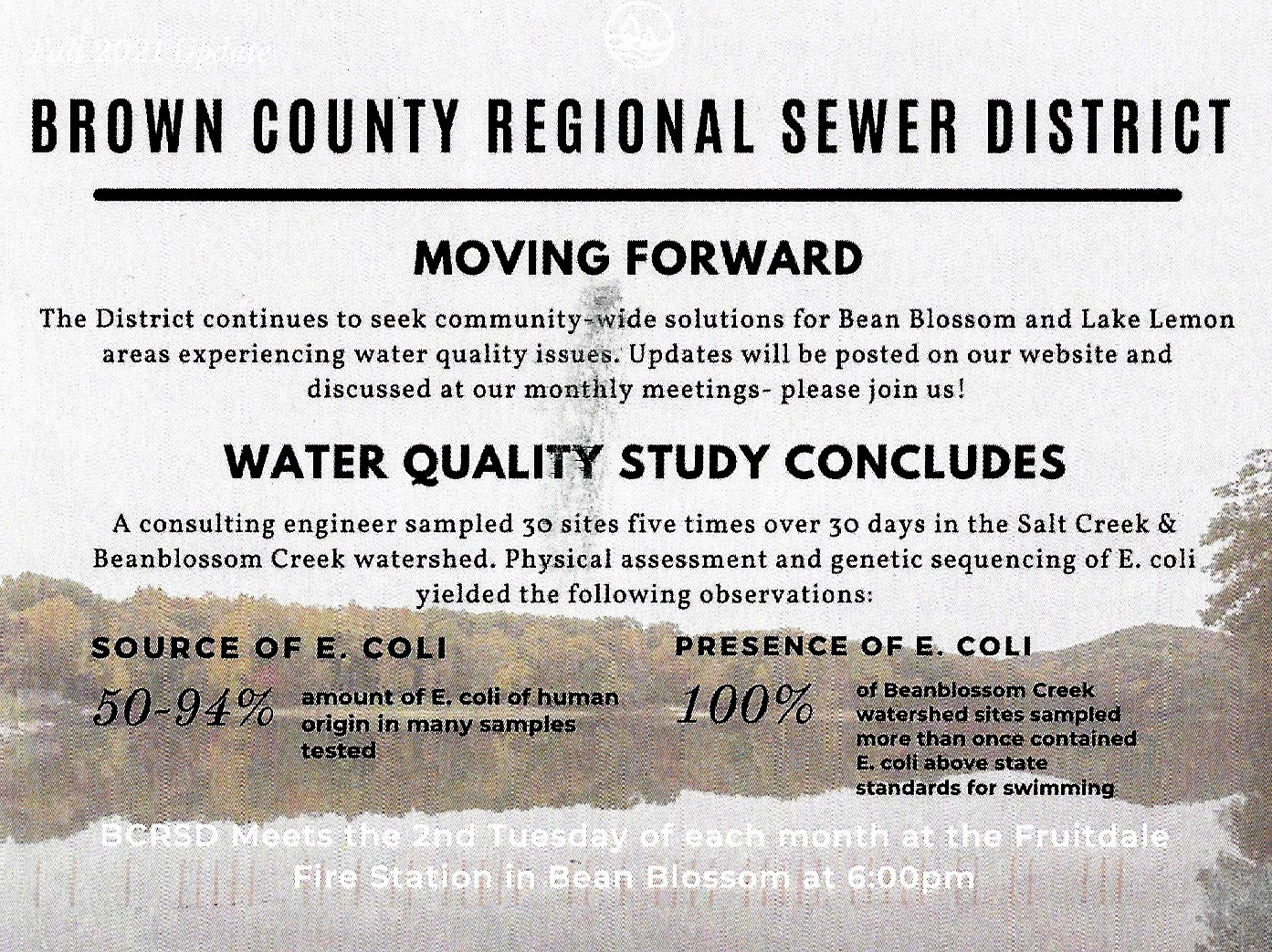
BCRSD Water Quality Card Notice

Finding and Potential Solutions? Who is in charge? What control would county elected officials have over any potential findings and “solutions” from the wastewater strategy?  Does the BCRSD have the power to act independently?   The BCRSD as an Advisory Committee would make recommendations to the county elected officials who would then decide on the appropriate courses of action.

Potential Abuse of Power. An RSD can wield a significant amount of power. They can force “mandates” for sewer service. Any waivers are temporary. They can charge potential customers a monthly fee to support construction costs. They can borrow money. The ONLY control county elected official have is on appointments to the board and choosing to provide funding.

Balancing Power – Elected vs Appointed Board Members. The Gnaw Bone RSD opted for board members to be elected by the customers as opposed to being appointed by the Commissioners and Council.  This can lead to more transparency and accountability.

Dec 8, 2021. ARP Funding – Commissioners – Decision Criteria Needed

BCRSD – Cover memo and funding request for American Rescue r Plan (ARP).  County receiving about 1.4 million.  BCRSD is asking for $300,000.  The priority for the county is and has been Helmsburg, Trevlac, and Lake Lemon Areas.   The need (as opposed to want) for the Bean Blossom area has not been validated and lacks evidence of community wide support.

Since 2018, the BCRSD spent over 200K of the 270K they received from the county council on plans for a new plant in Bean Blossom. They determined this was the highest priority in the county. After 3 years, they have been unable to acquire land.

July 16, 2022.  Justification for placement on a “Watch List”
  • TOO MUCH POWER WITH NO COUNTY OVERSIGHT. A Regional Sewer District has the power to force everyone within 300 feet of a sewer line to pay the hook up fees and monthly utility charges for service. Charges could range from $65.00 a month. Any waivers for customers with functional septic systems are temporary and at the discretion of the RSD. The only power county elected officials have over this board is appointments and re-appointments. They can also choose NOT to provide any local funding. The BCRSD could still receive funding from other sources. Power always corrupts. Oversight and transparency are antidotes.
  • Lack of Transparency.  No frequent updates on their recently developed (2021) website to include agenda, minutes, reports, contact information for Board members, and recordings of their meetings. The promise of development of a website and support for communication and transparency were made at their “June 2018” meeting. This was the meeting where they announced submission of an application for funding for a new sewer plant in Bean Blossom.
  • Mismanagement and Lack of Oversight by County Officials. The BCRSD applied for funding for a new plant in Bean Blossom in June 2018. They spent over $220,000 of the 270K provided to them by the County Council. They have not acquired land and their attempt to acquire county parkland was rejected by DNR. They have not validated a need. Nashville has identified that they can provide service to Bean Blossom at less cost that building a new plant. And it is becoming more apparent to all that a regional plant in Helsmburg may be the best option for the area.  They have yet to publicly comments on the status of the Bean Blossom Sewer Plan other that to say “all options are being considered.”
    • An independent audit on the efficiency and effectiveness of the BCRSD should be initiated by county officials.
  • Overstatements.  In this week’s Democrat, Mr. Studabaker stated they had $30 million worth of projects. This is an overstatement. He was basing the “estimate” on findings from a regionalization study that identified rough estimates for a variety of projects IF a NEED could be validated. Further analysis is needed to determine the most feasible of options. Further, Studebaker claimed human causes e-coli contamination that could be due to failed septic systems.  He was referring to a water samples containing pharmaceutical waste – which per the Democrat, cannot be filtered by septic systems OR wastewater treatment systems.
  • Plans and Strategies.  The BCRSD initiatives that led to the acquisition of grants for the development of a Regionalization Study and Wastewater Strategic Plan are value added. These “Plans” and strategies can be maintained by the county planning office. The current planning director is retiring within a year and a new director with the required skills can provide the oversight on ALL projects  that involve county resources and infrastructure.
  • Dissolve the BCRSDThe Platform for the 2020 County Democrat candidates for office included the objective of dissolving the BCRSD. This should remain a consideration.
    • We believe there is no useful purpose served by the existence of the Brown County Regional Sewer District, and it should be dissolved. No proof supported by observation of empirical evidence shows good cause to force county homes and businesses off of septic systems already installed. The Hometown Engineering report determined that no new sanitary sewer system is economically feasible without wide-scale hookup.
  • False Premise.  The BCRSD was established based on a false premise of an “environmental nightmare” in the Bean Blossom area due to failed septic systems. This has never been validated. Current possible projects supporting Helmsburg and Lake Lemon can be administered by an expanded Helmsburg RSD with contracting support.

IF water sampling does indicate human caused contamination, next steps would be to confirm the scope and extent of the problem. 

READI Grant Funding – For the Record

Updated Dec 16, 2022

What are the risks  to the taxpayers?

readi iedc

Funding by the State for the READI grants was provided by the Federal American Rescue Plan.

Dec 16, 2022. Indiana Uplands announces READI commitments totaling more than $24.6 million

Dec 21, 2021. County’s READI region receives $30 million to help fund select projects By Suzannah Couch

    • FB Post – Brown County Matters. Unknown how much if any taxpayer money will be expected to contribute. “Indiana Economic Development Corporation will host a READI kickoff meeting on Tuesday, Jan. 11 when organizers hope they will learn projects will receive READI funding. Until then, the IEDC will work through a grant agreement with each region.”
    • FB Post – Brown County Democrat

Dec 14, 2021. Inside Indiana Business. $500M in READI grant funding dished out to all 17 applicants|

20211214 BC Readi Projects – Hard Truth Hills (HTH) and RDC Land Bank

    • Indiana Uplands – 30 million. Includes Brown County.
    • The grant program also requires each region to provide at least $4 in matching funds for every $1 awarded by the state.
    • Facebook Announcement – Gov Holcolm

Oct 13, 2021.  Completed Plan – Indiana Uplands READI Development Plan: “A Region on the Rise”   

Due: July 30, 2021.  Indiana Uplands READI Plan: Call for Projects and Programs

July 13, 2021READI group meeting weekly to discuss possible grant-funded projects By  

An informal steering committee is now meeting every Thursday at noon to discuss which local projects might be put into an application for up to $50 million in grant funding.

The grant opportunity is called READI, and Brown County has committed to try for it with the 11-county Indiana Uplands region.

The local steering committee has been asked to come up with a list of approximately five projects to contribute to the Indiana Uplands’ grant application. Whether or not those projects will actually make it into the application remains to be seen, as the 10 other counties in the region also will be contributing ideas.


July 6, 2021. The Indiana Uplands is READI to Go Posted on 

  • On July 1, ROI notified the Indiana Economic Development Corporation of its intent to seek funding, alongside its partner organizations, through READI on behalf of the Indiana Uplands region, comprised of Brown, Crawford, Daviess, Dubois, Greene, Lawrence, Martin, Monroe, Orange, Owen, and Washington counties.

July 6, 2021. Commissioners OK resolution for READI opportunity By  

  • It is not clear what would be required of Brown County financially in the future or how Brown County would benefit from applying for READI with Indiana Uplands, as no grant application or project plan has been written yet.
 

June 28, 2021. The Brown County Commissioners will have a special meeting at 2 p.m. Monday, June 28 at the County Office Building to discuss a resolution of commitment to the READI grant initiative.

June 25, 2021. BCD. Brown County likely to join region for try at grant funding By  –

June 16, 2021. BCD.   Groups to vie for up to $50M in READI funding  Sara Clifford –


  •  Up to $50 million in grants is becoming available to regions of Indiana to build their future economies, workforces and populations. Next week, a broad…

Indiana Economic Development Corp (IEDC), Regional Economic Acceleration &  Development Initiative (READI) READI-Informational-Revised-June7 (1)

  • Objective: Accelerate Indiana’s population growth through increased domestic and international migration by supporting the implementation of regional economic development strategies focused on making Indiana cities and towns magnets for talent. To achieve this objective, the state will invest in financial partnerships with regions across the state that demonstrate the potential to attract people and accelerate the state’s economic growth.

Regional  Development

  • Invest in quality of place and talent initiatives included in regional development plans
    ► Award funding for projects in each region that are included in a region’s plan.
    ► IEDC will expect its $500 million investment to be matched by the private sector and local community.
    At least 80% of the investment must come from private or local sources.
    • Not more than 20% of the investment in the plan can originate from state funds.
    • A majority of the investment in the plan should come from private sources.
Stellar – Another Grant Opportunity requiring taxpayer funding?

June 18, 2019. BCD. Another shot at Stellar? Town, county starting to talk about funding opportunity By  –

  •  Nashville-Brown County unsuccessfully tried for a Stellar Communities designation from the state in 2014.
  • At the time, being named “Stellar” would have given the town and county access to a pool of millions of dollars in funding for projects for about a five-year period, supplemented by local money. Only Stellar Communities designees can apply for that pool of state and federal funding.
  • On the day in July 2014 when the local Stellar committee made its pitch to the state Stellar selection committee, protesters holding signs which read “No Stellar — Not This Year” were visible at nearly every project site and some also spoke during the presentation.

May 23, 2020.  Town redevelopment discusses TIF, Stellar, Creekside By Abigail Youmans

  • The Nashville Redevelopment Commission discussed ongoing projects such as TIF, Stellar and a potential property within town limits in a virtual meeting on Tuesday, May 12. 

May 4, 2017. What are best bets for future of local economy? by   

  • Brown County’s greatest potential for economic growth is as a bedroom community, according to economists with the Center for Business and Economic Research at Ball State University.

    But local leaders had a different viewpoint; they perceived recreation as the area with the biggest potential, and to them, housing ranked No. 3.

  • According to the state and federal data the Ball State researchers studied, retail is the least promising sector among the five studied. Nos. 2, 3 and 4 are recreation, wholesale and production, in that order, the data said.

Govt Meetings and Supreme Court

Viral school board speech: ‘It is my constitutional right to critique your fascism’ Past board member rips his former colleagues By WND News Services Published June 26, 2021 at 1:05pm

  • “I’m quoting you from the U.S. Supreme Court. The judges wrote: ‘This nation is founded on the profound national commitment to the principle that debate of public issues shall be uninhibited, robust, and wide open. And that it may well include vehement, caustic, and sometimes unpleasantly sharp attacks on government and public officials.’ That’s constitutional case law in this nation. I don’t have to be nice to you. Nobody behind me has to be nice to you.”

Critical Race Theory (CRT)

Updated July 26, 2022

Conservative Perspective

THE TRUTH ABOUT CRITICAL RACE THEORY Trump is right. Training sessions for government employees amounted to political indoctrination. Christopher Rufo

  • Video. This video-essay explores the intellectual history of critical race theory, how it’s devouring America’s public institutions, and what you can do to fight back. 
  • Outline
    • 0:00 – Introduction
    • 0:25 – The Origins of Critical Race Theory
    • 3:30 – Enter Critical Race Theory
    • 6:15 – Critical Race Theory as Public Policy
    • 8:41 – Why Critical Race Theory is Ascendant 13:12 – Winning the Fight Against Critical Race Theory
    • 16:12 – The Future of Our Country

PragerU. Critical Race Theory,  James Lindsay. “Critical Race Theory holds that the most important thing about you is your race …  You are either a victim or an opressor.

    • What I Can Teach You About Racism, Dr. Carol Swain

    • Is America racist? Larry Elder. Is it — as President Barack Obama said — “part of our DNA”? Author and talk-show host Larry Elder examines America’s legacy of racism, whether it’s one we can ever escape, and in the process offers a different way of looking at things like Ferguson, crime, police and racial profiling.
    • How to End Systemic Racism, ⋅  Amala Ekpunobi  ⋅  here is systemic racism in America, and people of color are paying a terrible price because of it. It’s time to shine a bright light on the source of this regressive idea. PragerU’s own Amala Ekpunobi does just that.

It’s Not Critical Race Theory, It’s Racism Tucker Carlson, FOX News

Teacher retaliates after CRT banned in Iowa schools Diatribe illustrates why ideology must be completely eradicated By Elizabeth Stauffer, The Western Journal Published June 25, 2021 at 10:03pm

  • In a chart obtained by Benny Johnson of Newsmax and Turning Point USA, items such as support for the “Make America Great Again” movement, denial of white privilege and denial of racism are listed as examples of overt racism and white supremacy.
  • Although polls showed then-President Donald Trump trailing President Joe Biden by a significant margin in the final stretch of the 2020 campaign in the state, he managed to top Biden by 8.2 percent. As Johnson points out, that would mean 53.1 percent of Iowans fall into the category of “overt racists.”
  • Keep in mind this figure could be higher still if any individuals who did not vote for Trump deny their white privilege, deny they are racist, celebrate Columbus Day or check any of the other boxes identified on the chart.

The Other Problem With Critical Race Theory  by Rob Natelson, June 24, 2021 Updated: June 24, 2021

  • Properly speaking, CRT is not a “theory” at all. Theories are based on controlled experiments and testing, or, in the social sciences, on empirical research. CRT is at most a tentative hypothesis. It relies unduly on anecdotes, and its “conclusions” seem dictated by its proponents’ political biases.

    Moreover, like some other fads, it’s a product of cultural ignorance. This is not surprising, when you learn that CRT originated in law schools, where cultural ignorance is common.

“White Rage” 

  • Dr. Carol Anderson, who wrote the book, White Rage: The Unspoken Truth of Our Racial Divide. Anderson told Vox in a January 27, 2021 interview that “white rage is a response to African Americans’ political advancement.”

    She told Vox, “White rage is the operational function of white supremacy. It is the fear of a multicultural democracy. It is predicated on a sense that only whites are legitimate Americans.”

Leftist/Liberal Perspective

Ibram X. Kendi. Book: How to Be an Antiracist

What the Hysteria Over Critical Race Theory Is Really All About Fabiola Cineas, Vox

Critical Race Theory: The Right’s New Bogeyman Cas Mudde, The Guardian

More evidence needed that sewers necessary

Guest option article submitted to the Democrat – publication June 22, 2021. GUEST OPINION: More evidence needed that sewers necessary

In my guest opinion column, Change vs. improvement — who decides and how? (Brown County Democrat, June 8, 2021), I introduced the need to start with an assessment of stakeholders to help identify the scope and extent of any problem before implementing a solution such as the new septic ordinance. A stakeholder assessment is supported with analysis to help identify the problems and arrive at the best decisions.

In public meetings over the past few years where changes to the septic ordinance were discussed, one of the main themes was the belief that the county may have a significant number of inadequate septic systems contributing to creek and stream contamination. This assessment dates back to 2013, and no definitive evidence has been submitted to support this claim. On water quality, water sampling is being done to help identify whether E. coli levels are because of humans or animals. If there is some percent that is caused by humans, the next challenge is to identify the number of systems that could be contributing to the problem. This would include developing mitigation strategies.

The other theme derived from a speculation of failing systems used to support the justification to expand sewer service was that an expansion would also support economic development and increase property values. The county’s population is expected to decline, and an expansion of sewer service requires customers. Customers with functional septic systems that are within 300 feet of a sewer line can be forced to pay for a connection along with a monthly service charge. Waivers are possible, but only temporary.

The Nashville Wastewater Strategic Plan approved in 2020 identified areas that could be serviced with sewers and speculated, without surveying any of the residents, that there is support for expansion. Nashville has also identified an expansion of sewers to support their vision for further development — likely including more tourism-oriented endeavors. A member of the Nashville Utility Services Board also mentioned an old Nashville policy to require annexation if sewer service is provided. This is no longer a requirement, but is an option if the town council wished. Annexation increases Nashville’s tax base through the collection of new taxes from the annexed residents. Adding more customers for sewer service may also help reduce increases in the life-cycle maintenance costs of existing customers.

What was not discussed or reinforced was that septic systems are a viable and proven technology. A report by the Environmental Protection Agency concluded that “conventional septic systems are designed to operate indefinitely if properly maintained.” (EPA 932-F-99-075). The Presby Corporation has also identified a similar finding: “If the system is designed, installed and maintained properly, there is no limit to the life expectancy of Enviro-Septic® Technology.” This was confirmed by a health department employee who reinforced that “a properly installed, well maintained system that has not been abused should last the life of a home.” New permits for septic systems continue to be approved by the health department.

An industry report and assessment as to potential issues with septic systems was developed approximately 20 years ago and is referenced by the health department. The assessment identified an estimate that the average lifespan of a septic system was 25 years. This assumption was also referenced by the Brown County Regional Sewer District (BCRSD) to justify the need for a new sewer plant in Bean Blossom. A copy of the study was not made available to allow for a review of the methodology, sampling plan, analysis of variance, and feedback from any peer reviews.

Speculation as to failed systems supported the application for funding for the proposed new sewer plant in Bean Blossom. This project offers another example that reinforces the need for the application of better decision-making processes. The application by the BCRSD was submitted in June 2018. Approximately $220,000 of the $270,000 provided by the county council for planning has been spent. Land has yet to be acquired. Nashville has identified that they can provide service at less cost than building a new plant. A possible upgraded plant in Helmsburg may also be an option to provide service to Bean Blossom as well as to Lake Lemon residents. Residents from Lake Lemon — not the health department or BCRSD — identified failing systems and mobilized residents to pursue options for sewer service.

Regarding the potential for failed systems: For the sake of argument, if you assume that a certain percent of septic systems throughout the county could be inadequate, what are the next steps? Would the residents acknowledge their systems are inadequate? And specifically, how will the new ordinance address this issue?  Is the operating assumption that older systems are failing and should be immediately repaired, replaced, or converted to pump and haul? Should residents be forced to connect to sewers if available? Has the ordinance made changes that will result in less competition and higher costs for repairs and replacements? Will the financial penalties in the new ordinance be used to intimidate residents to make the desired changes?

What are the problems? A few were referenced and implied above. The expected result from a change such as the new septic ordinance should be outcomes where all stakeholders benefit or, at least, are not any worse off in the long term. Citizens can choose to expect the application of better and proven methods for identifying stakeholder needs, assessing problems, and supporting better decisions. A few basic tools were introduced through the Brown County Leader Network. Citizens can also identify their expectations and elect and support candidates who are committed to continual improvement and learning. The start of a nonpartisan political platform is provided at the website Independent Voters of Brown County IN.

Tim Clark of Brown County is a quality improvement practitioner, educator and author who specializes in the public sector. He is a senior member of the American Society for Quality, a volunteer with the Brown County Leader Network, and an admin for the Facebook group Brown County Matters. He has served on the Brown County Redevelopment Commission and on the Brown County Schools Strategic Planning Committee. He can be reached at tjclark36@gmail.com.

2024 County Elections – Non Partisan Platform – WIP

Updated July 25, 2023 

Those who expect to reap the blessings of freedom must, like men,
undergo the fatigue of supporting it. –– Thomas Paine

Vision:  Support actions that result in a more perfect County.   

    • Actions include (1) sustaining/maintaining what is working, (2) incremental improvement or (3) major (radical) improvement.  The more the degree of change, the higher the risk of failure. The $50.5+ million dollar phase 1 sewer project an example.
    • How do citizens describe “more perfect” or better? What feedback is needed to assess results?  What is the plan of action and milestones for the improvement? 

Purpose:  Identify criteria for selecting,  electing, and supporting candidates in the 2024 County Elections. 

  1. Brown County Comprehensive Plan (PDF) – 2011.  Update and revise to reflect local area and county needs and desires.  This plan is required by statute, and “should always” represent the voice of the citizenry as to what they want and do not want in terms of infrastructure, development, zoning, and cultural change.   The current plan is vague and outdated. Good arguments can be made for or against a proposed project.   
    1. Example – Helmsburg Revitalization. Citizens developed their own economic development plan and a Community Development Corp (CDC) (501c.3).
    2. The Brown County Regional Sewer District (BCRSD).  Re-examine the BCRSD purpose and role.  The BCRSD board consists of officials appointed by commissioners and council and report to the Indiana Department of Environmental Management (IDEM). The BCRSD developed a county-wide wastewater strategic plan without ANY public meetings to obtain citizen input. They then refused to hold public meetings to present “their” final plan. This plan was used to justify an expansion of sewers in the county that represents the most expensive project in Brown County history.  BCRSD Sewer Expansion Project
  2. County Elected and Appointed Officials:  Report on accomplishments at least annually. This includes all offices, boards, and commissions. One-page minimum.
  3. Publish the current Five-Year Plan for Roads and Bridges:
  4. Publish a Five-Year Capital Improvement Plan (CIP) for County Infrastructure – Buildings and Grounds.  Identifies priorities for funding which helps prevent frivolous spending.
  5. Financial Plan. Update the County’s Comprehensive Financial Plan at least semi-annually. (The value is following the trends on spending and revenue and comparing actual to planned spending.  Out-of-control spending leads to tax increases and borrowing more money.  
  6. Transparency:
    1. Publish Agendas, Minutes, and Recordings, from all government meetings on the county website. 
    2. Publish the mission and functions of all offices and departments. Include references to the state code that establishes the legal requirements for the respective office.
    3. As part of the budget process, each office should include its list of accomplishments from the previous budget year.
    4. Continue to allow citizens to speak/ask questions PRIOR to a vote or decision being made. Voters expect elected officials to represent them – not their own personal agendas or pet projects.
  7. Septic Ordinance.  UPDATE: Support a revision that supports compliance with the state code and eliminates all county-unique requirements that cannot be justified. The revised county septic ordinance was approved in 2021.  Update: The State declared all county septic ordinances that exceed state standards (including Brown County), as VOID effective July 1, 2023. 
  8. Application of better methods for assessing the extent and scope of problems, recognizing opportunities, and selecting the best solutions. Ref: Brown County Leader Network – Self-Help Support Guide.
    1. We the People (Citizens) are responsible for serving in the role of Jurists. When considering a change, expect that both sides of the argument to be represented, researched, debated, and documented.
  9. Voluntary Term Limits.   Would two 4-year  terms be sufficient to build on lessons learned from previous officeholders, make a positive difference, and add to the lessons learned that can be shared with the new officeholders?  
  10. Citizens:  When identifying a problem or opportunity that may be shared on social media, take action to lead a change.  At a minimum, prepare a one-page SWOT assessment.  And, when proposing a solution, identify the scope and extent of the problem.  Ref: see BCLN Self-Help Support Guide
Additional information:

Brown County has a one-party monopoly on political power – rarely if ever, a good thing. Additional information: Brown County Republican Party (GOP) – Organization and Governance

2020 County Elections – Platform of candidates from the Democrat Party.

The Brown County Republican Party does not have a local party platform; it follows the state and national platforms” – Mark Bowman. Reference: “Post on GOP Facebook page prompts questions, by Sara Clifford -April 27, 2021. Brown County Democrat,

Change vs Improvement — Who Decides and How?

GUEST OPINION: Change vs. improvement — who decides and how?  Submitted to the Democrat as  a Guest Opinion column –   published for  the June 8, 2021 edition

In my guest opinion column, Challenges and opportunities with new septic ordinance, Brown County Democrat, May 25, 2021, I reinforced the need for the application of better principles and methods that will lead to a higher probability of producing an outcome where everyone benefits, or at least everyone will not be any worse off in the long term. Meeting this objective requires there be a process in place that captures how citizens define the more perfect or ideal outcome, along with the feedback they will require for assessing results.

For context, the U.S. government system at all levels was designed to enable We the People to work together in making progress toward a more perfect Union, county, and community. Changes are made through amendments, new laws, ordinances, and better day-to-day decisions. What is often missing in the process is assessing results — verifying that the change resulted in better outcomes. Once legislation (new ordinance) is passed, it becomes accepted, forgotten, and problems can be ignored or are slow to be resolved.

Many of the U.S. founders were students of human nature, history, philosophy, and the Bible. Lessons of history identify that centralization of political power in the hands of the few (be it at a local or national level) is never good and produces suboptimal results. The reference to more perfect was influenced by a biblical worldview where only God is perfect and man is imperfect and expected to improve. In a secular approach to improvement, man identifies the ideal, or more perfect. In a quality management context, the customer defines the ideal.

To support continuous quality improvement, new processes and technologies for improving any system and in any area (profit, non-profit) started to emerge in the 1920s. In 1924, Dr. Walter Shewhart of Bell Labs developed a new method for managing variability that helps determine when change results in improvement. This knowledge increases the probability that change in any aspect of life will result in the expected improvement.

Variation represents the gap between the ideal or more perfect outcome and the actual situation. These methods were classified during WWII and applied to improve the quality and quantity of war materials. They were declassified after the war and shared worldwide beginning in Japan. Application of the new technologies helped companies grow — like Toyota, which became one of the largest and most profitable automobile manufacturers in the world.

At one time, it was believed that quality costs more. It is now an accepted fact among the world’s quality management profession, leading organizations, and customers that the closer a product or service gets to the ideal (a more perfect outcome) by reducing variation, the higher the quality and the lower the cost to the customer and society. This concept is referred to as the Taguchi loss function. For a more common illustration, consider the situation when you buy or receive a product or service. Do you want it to meet your expectation for quality and cost, or would you rather have a bad experience that you might share with as many people as possible?

In 2017, Brown County, through a team of volunteers, applied for and was accepted to participate in the Hometown Collaborative Initiative (HCI) sponsored by the Indiana Office of Community and Rural Affair. The intent of HCI was to provide training in order to build and sustain a capability for supporting improvements throughout the community. The project categories included Economy, Placemaking, and Leadership. The Brown County team was the first in the program’s history to select Leadership for the capstone project.

The first application was in support of a local foods’ initiative which identified that we lacked the needed capabilities and processes. We then shifted to development of support materials that integrated some basic quality principles and methods. We also developed a concept for a Brown County Leader Network (BCLN) and a supporting website (browncountyleadernetwork.com). Our first proof-of-concept project was in support of the Jackson Township Trustees Office. The COVID-19 pandemic led to a pause in further application.

In contrast to the approach that was taken to develop and approve the new septic ordinance, identifying all the stakeholders is among the first steps in applying a better process. Stakeholders include everyone who can be affected by the change in the short, mid, and long term. They can be classified into three areas: Direct (receive the service), Internal (provide the service), and Indirect (everyone else). Once the stakeholders are identified, the next step is to identify their respective needs, the products and services to be provided, and the expectations and related feedback measures. This is an iterative process that can be further developed over time as new insights and knowledges are gained.

In addition to a stakeholder assessment, additional materials support analysis, decision making, and planning that reinforce the critical need to identify and define the scope and extent of the problem. Application of the better processes by citizens can lead to further improvements and more community support for the respective changes. The new processes also allow for periodic review of the change to determine if it is achieving the expected results.

America’s system of government was designed to continually improve through leadership at all levels. Application of the better and proven methods can lead to better (more perfect) results where everyone benefits, or at least, is not any worse off in the long term.

Tim Clark

Tim Clark of Brown County is a quality improvement practitioner, educator and author who specializes in the public sector. He is a senior member of the American Society for Quality, a volunteer with the Brown County Leader Network, and an admin for the Facebook group Brown County Matters. He has served on the Brown County Redevelopment Commission and on the Brown County Schools Strategic Planning Committee. He can be reached at tjclark2036@gmail.com.

New Septic Ordinance — Challenges and Opportunities

New Septic Ordinance — Challenges and Opportunities by Tim Clark

Published in the Brown County Democrat, May 26, 2021.

The vote on May 5, 2021, to approve the septic ordinance received a “Yes” vote from Commissioners Biddle and Braden and a “No” vote from Commissioner Pittman. The overall management of the final review and approval process represents challenges as well as opportunities for improvement.

May 11, 2021 Septic ordinance approved with 2-1 vote,
Brown County Democrat, by

The public hearing date for this ordinance was first scheduled last November. Commissioner Anderson did not support the ordinance and had already decided not to run for reelection. He was replaced with Chuck Braden. I wrote a two-part article on the issues identifying a needed justification for the specific changes (Guest Opinion: Justification ordinance lacking for proposed septic ordinance Brown County Democrat, Nov 24, 2020). I also provided a response to the updated information provided to the commissioners and reinforced key points in my written comments to the commissioners provided on May 3, 2021. I share these on my website: Independent Voters of Brown County IN.

To summarize the process, approving an ordinance requires three public meetings to include considering written comments provided by citizens. Citizens were asked to limit their verbal comments at the public hearing to two minutes, which reinforced the importance of providing written comments to identify concerns, questions, and recommendations.

In the case of this ordinance, the health board, through the work of a committee of volunteers, drafted a new ordinance and recommended approval to the commissioners (elected officials). The work of volunteer committees can easily be influenced by one or more individuals with an agenda.

The “elected” officials — not appointees or volunteers — are directly accountable to the voters. The expectation is that commissioners will listen, seek to understand, and address the specific concerns and questions of their constituents before voting to approve an ordinance. These actions help to ensure the development and execution of the best policies for the county.

At the state level, as opposed to the county level, elected officials are required by law to “fully consider comments received” (IC 4-22-2-27). The default standard at the county level appears to be that if you dislike the quality of the decisions of your elected representatives, vote for a change and improve the decision-making processes.

The written comments on the ordinance were due by May 3, with the second and final vote due less than 48 hours later at 2:00 p.m. on May 5. At the second reading, Commissioner Biddle moved for an immediate vote, which prompted questions from the public. Commissioner Pittman asked for a two-week delay to allow time to review the written comments and provide a response. Commissioners Biddle and Braden refused the delay and refused to consider providing any documented justification for their approval of the specific changes included in the ordinance. Further, they did not demonstrate an understanding, knowledge, or interest in all the written comments provided by citizens, including those from their fellow commissioner.

The decision-making process of Commissioner Biddle and Braden resulted in a disservice to the citizens opposing this ordinance, as well as to the individuals and groups that worked on its approval. Refusal to justify and defend a position can contribute to questions about motives, competence, and the overall quality of the ordinance.

In contrast, better processes could lead to an outcome where everyone benefits, or at least, are not any worse off in the long-term. This would have required the commissioners to schedule additional public meetings to allow for more in-depth discussions on the issues and areas of disagreement. This approach can lead to better policies, community buy-in, and support for the changes. It may only take two votes to pass an ordinance, but it also will only take two to replace it with a better version.

Why would Commissioners Biddle and Braden avoid supporting further discussions to help clarify and resolve the differences between the proponents and opponents of this ordinance? The short answer is that they do not have to.

With a monopoly on political power, some county-elected officials can choose to represent the interests of the few with little repercussion. Commissioner Pittman was the only commissioner who identified that he talked with his constituents. His concerns, questions, and position were published in the Brown County Democrat Letter: “Brown County citizens’ rights” and septic ordinance on Jan 12, 2021, and in a guest column in the Brown County Democrat, Thoughts on the proposed septic ordinance update on April 27, 2021.

From a systems perspective, elected officials can be selected based on their support for a status quo that can favor one or more special interests or groups as opposed to the interests of all their constituents. Appointed officials and volunteers can either go along to get along, or risk being a social outcast. And cognitive dissonance helps people avoid acknowledging the truth in a respective situation and while expecting better decisions on behalf of all the citizens.

A way ahead? In future articles, I will provide additional information on the issues and processes regarding this ordinance. I will also introduce some better methods that have a higher probability of producing results where everyone benefits, or at least, are not any worse off in the long-term.

Tim Clark

Tim Clark of Brown County is a quality improvement practitioner, educator, and author who specializes in the public sector. He is a senior member of the American Society for Quality, a volunteer with the Brown County Leader Network, and an admin for the Facebook group Brown County Matters. He has served on the Brown County Redevelopment Commission and on the Brown County Schools Strategic Planning Committee. He can be reached at tjclark2036@gmail.com.