Sewer Expansion -Phase I PERs – $50.5 million

Updated May 24 2023   This post at Brown County Matters

Preliminary Engineering Reports (PER).  Identifies the information required to receive funding.

Brown County Wastewater Strategic Plan and Watershed Studythe “foundation”  for the PERs. Includes video presentations of the plan and study, respectively.  The Helmsburg PERs also available at the HRSD Facebook Page

    • The Watershed Study is in Appendix B

The Brown County Regional Sewer District (BCRSD) collects the wastewater. The Helmsburg RSD will expand its wastewater treatment plant to accommodate Phase 1 customers. The HRSD will have a second PER as a backup plan to make the needed repairs and upgrades to serve their current customer base if one or more sections of the Phase I project are not funded.

Phase I of expanding sewers includes a western corridor (Helmsburg to Lake Lemon and an Eastern Corridor – Helmsburg to Bean Blossom and Woodland Lake.

BCRSD PER

Complete Report – 315 pages  2023.3.31 Initial Submittal – Brown County RSD Preliminary Engineering Report

Report by Sections:

2023.3.31 Initial Submittal – Brown County RSD Preliminary Engineering Report

PER – Helmsburg RSD WWTP Expansion

PER – HRSD WWTP Replacement 2023_03_31

Commissioner Meeting Notes, Wed Apr 5, 2023

Commissioner Meeting Notes, Wed Apr 5, 2023. 2:00 p.m.   Audio of the meeting (1:13:06 minutes).  Question and Discussion on the Indian Hill RR Crossing at 1:07.

Meeting Agenda 2023_04_05

This post with any comments at the Facebook group – Brown County Matters.

Courthouse Additions – Sally Port and Security Entrance.   Commissioners, with the support of their financial advisor from Baker -Tilley, identified funds under their control to support these projects.  Council just needs to approve transfers between accounts.

Initially, the commissioners thought they would have to borrow money. The next option included using funds that needed the approval of the council. Given an estimated  1.4 million dollar shortfall in health benefit funding, the council suggested the commissioners find available funds in the accounts the commissioners controlled.  The overall situation identified the opportunity for improved financial management.  The Commissioners develop a Financial Plan and the Council manages the budget.

The county routinely has not provided a status on the budget during the year at a public meeting. This would include a review of planned vs actual costs to identify project fund balances and any issues. During the budget hearings, it was suggested that the council members be assigned accounts that they could monitor and update the council on the status. Jim Kemp has done this for the health benefit funds.

Indian Hill Railroad Crossing.  No current updates. Commissioners acknowledged that a public hearing was required. This has not been disputed by the county’s legal counsel.

Commissioners support opening up the crossing to pedestrians but not vehicles.  The highway superintendent is reviewing the adequacy of the “slab.”  that is used to cross the creek.  Estimates for changes to the crossing to current standards are estimated at 1.5 to 2 million.  See Audio: 1:07 – 1:11

Note:  Without a public hearing, the decision to close the crossing was not valid.  Consequently, the county can re-claim the right-of-way and allow for a pedestrian crossing. They could then hold a public hearing to help determine if the crossing should remain closed to vehicles.  There have been no facts presented regarding safety-related incidences at the crossing.

History on the closing:  https://independentvotersofbrowncountyin.com/2022/07/23/part-3-closure-rr-xing-indian-hill-rd/Part 3. Closure RR Xing, Indian Hill Rd: Public Hearings

Highway Department – Road Paving Plan – 2026.  The plan was developed last October and includes recent updates. It is not yet posted on the Highway Dept Website – Road Improvement Plan

Elkinsville Rd.  Commissioner Pittman drove the road and was complimentary of the work that has been done. Some of the paved sections in disrepair were replaced with gravel.

Legislation – Septic Systems and County Wastewater Strategy

Property owners could ‘supersede’ Indiana health officials over septic systems under House bill by Casey Smith, Indiana Capital Chronicle, Mar 29, 2023

Post of the article and comments at Brown County Matters

Wow. The county had similar issues raised last year regarding the new county septic ordinance that the commissioners passed 2 to 1. Biddle and Braden voted yes. Pittman was the no vote.
House Bill 1647 would grant Hoosier property owners the ability to override local health department decisions about new septic system installations and existing systems that have failed — as long as they have a paid consultant who agrees with them.” The proposed legislation also suggests that all county septic ordinances be voided.
The So what? The Brown County Regional Sewer District (BCRSD) can force sewer hookups and grant temporary waivers if a septic system passes “their” inspection. This legislation will allow homeowners to hire their own consultants to determine adequacy.
Soils? Nothing is mentioned in the proposed legislation that per the Brown County Regional Sewer District (BCRSD, counties with inadequate soils like Brown County should have no septic systems. IDOH estimated that only 20% of the 1 million septic systems in the State could be inadequate.
The Brown County RSD has stated that county soils are not suitable for septic systems and speculated a failure rate of 76% to help justify a $50 million dollar sewer expansion to serve about 770 homes to be funded by the State, Feds, and customers. Per the BCRSD, this leaves another 7,300 systems in the county that need to be replaced by better systems approved by the BCRSD. And, what would be the price tag???
Agriculture Policy. And as a bonus, the BCRSD is taking the lead in eliminating e.coli due to farming/livestock management practices. Pastureland is the major cause of e.coli in the county and was identified as a major cause in other water quality studies within the state as well. (Ref: Brown County Wastewater Strategic Plan and Watershed Study
Question or Concern? Have a question or concern about the county strategy and study that was funded with over $100K of tax dollars? Just send the BCRSD an email or contact a board member who may tell you to send them an email: Board members are: Clint Studabaker (Project Lead), Richard Hall, Mike Leggins, Phil LBlanc, Matt Hanlon. With the support of elected officials, the BCRSD has refused to allow or support a public meeting to address the questions and concerns of citizens.

Joint Meeting Notes – HRSD and BCRSD Sewer Boards, Mar 28, 2023 – Status PERs

Joint Meeting Notes – HRSD and BCRSD Sewer Boards, Mar 28, 2023 – Status PERs

BCRSD Wastwater Strategic Plan and Watershed Study – video presentation and hard copies

 This post and comments at Brown County Matters

Audio of the meeting (1:04:16)

 Attendees. In addition to the Helmsburg and Brown County RSD boards, the meeting was attended by the President of the commissioners’ Jerry Pittman, President of the Council Gary Huett, Councilman Jim Kemp, and a member of the Gnawbone RSD Board. Attendees also included contractors, several people from the Lake Lemon area that support the expansion of sewers in their community, and at least one person from Bean Blossom and Helmsburg. RSD Board members are appointed by the council and commissioners.  Board members of the Gnawbone RSD are “elected” by their customers.

Preliminary Engineering Reports (PER). The PERs are the application for funding. They will be submitted to the State no later than this Saturday “April 1.” Copies will be made available to the public. Public hearings for the PERs are required and are to be conducted within 90 days.  The hearings are a “formality” but citizens can go on the record with their questions and statements in support or opposition. These statements can be shared with the approving officials at the state and federal levels and become part of the record.

Map that identifies the phase.

There are three PERs. The BCRSD PER is for collecting and transporting wastewater from an estimated 700 customers (Phase 1). Helmsburg has a PER to support this phase. Helmsburg also has a PER to support the needed repairs and replacements of their current plant to support their customer base of 68 customers and possibly 8 new customers. This project will be needed if the Phase I project is not funded.

Cost – $50.5 million (Phase 1). The revised estimated cost for “Phase I” is $50.5 million. The corridor to be initially served is from Lake Lemon to Bean Blossom and Woodland Lake (13-mile span). Future expansion will run north and south of this corridor.  Cost is $39 million for collection (BCRSD) and $11.5 million for processing (HRSD).

Brown County Wastewater Strategic Plan and Watershed Study.  Clint Studabaker of the BCRSD reinforced that the plan WILL NOT be presented at a public meeting. Video presentations are available on the BCRSD website and people can submit their questions to the BCRSD via email. The BCRSD board believes this is sufficient. Commissioner Pittman and Council members Huett and Kemp supported this position.  Kemp suggested a future consolidation of all the county RSD boards and that the overall function should be managed similarly to a water utility.  Kemp also suggested there was available office space at the Health Department for the management group.

Kemp as a former president of the RDC was also a vocal supporter of the failed attempt by the BCRSD to build a new sewer plant in Bean Blossom after spending about 200k. The BCRSD was unable to acquire land. The PER for the sewer plant was presented to the public in June 2018.

Kemp also led the development of a County Economic Development Strategic Plan that was approved for funding but not implementation.  Commissioners did not hold any public meetings to allow citizen input on the final plan.  I led the efforts to acquire funding for this plan and participated in about 8 public meetings throughout the county to get citizen input. I was not involved in the actual development of the plan by the contractor.

Quality of the Watershed. BCRSD board member Richard Hall reinforced his interest in improving the watershed. I referenced the contradiction in the strategic plan and water study. The strategic plan stated that the primary source of e.coli has been “humans.” However, the watershed study identifies “pastureland” as the main cause of e.coli.  Studabaker then shouted me down.  The watershed study identifies that if 100% of the septic systems in the county fail, the primary cause of e.coli would still be pastureland.  Of the 22 water samples, only 5 tested as being from humans and only two of these samples exceeded state standards.

It appears that Studabaker may be considering “agriculture” managed by “humans” in his definition of “human-caused.” If so, very creative as well as misleading and informative regarding motivation. This position supports his earlier comment at the Feb 14, 2023 BCRSD Board Meeting, that reducing e.coli from agriculture was also one of “his” goals. I contacted the project manager for the wastewater plan for clarification. Interesting that such an anti-agriculture position would be supported by elected officials.

County Redevelopment Commission (RDC). Councilman Kemp, who was also a former President/member of the County RDC  identified the task assigned to the RDC by the council to assess the impact and economic development potential for sewers.  Vicki Perry of RCAP mentioned that sewers did not necessarily lead to significant impacts in economic development but can sustain the current economic base.  Kemp did reference the connection of the wastewater strategic plan with the county comprehensive plan and zoning in support of economic development.

County Governance and Leadership.  The intent of the wastewater strategic plan is to sell a narrative that supports the expansion of sewers. The motivation for service in Bean Blossom supported the interests of a few for economic development.  This was “the priority” for the BCRSD documented in their PER submitted in June 2018.  When they failed to acquire land for a plant, they had to shift focus to include Helmsburg and Lake Lemon, This area does have a valid need as opposed to a justification based on speculation and conjecture.

The wastewater strategic plan WILL NOT  result in reducing the main causes of E. coli in our streams – pastureland.  The 50.5 million dollars estimated cost for “phase 1” is most likely the largest cost/investment in county history. There has been little to no interest by our elected officials in updating the County’s Comprehensive Plan to provide citizens with a voice on what they want and do not want in terms of economic development and quality of life.  Major decisions are made by the few and the centralization of power tends to be corrupting as well as addictive to those wielding this power.

The county comprehensive plan should clearly identify what citizens want and do not want in terms of quality of life and economic development. This plan supports zoning. There has been no interest in the county for any updates to the plan or any longer-term planning to anticipate future development trends be they positive or negative.   As it stands now, a good argument can be made for or against a specific project which creates the perception that approvals can be based on who you know.  Final decisions can also be determined by how many people show up to fight for their respective positions.

Courthouse Additions: Joint Meeting Commissioners and Council Mar 24, 2023, 6:00 – 8:00 pm

Updated Mar 27, 2023

Joint Meeting Commissioners and Council Mar 24, 2023 6:00 – 8:00 p.m.

This post at Brown County Matters

Purpose: Funding – Courthouse additions.

Good Meeting. An informative, productive, congenial, and at times humorous, meeting.  A wide variety of options and their pros and cons were discussed. (I wish this was more the norm on major investments like wastewater management/sewer expansions.)

Good Argument. Judge Wertz, the Sheriff, and the Baliff have made a good case for the additions with the priority for funding to be the Sally Port.  The Judge got a grant to fund the design/plan (70K). She has gotten other grants to fund the renovations.

Planning. The meeting reinforced the critical need for capital improvement planning and budgeting. This consists of identifying our assets (buildings) and the projected repair, replacement, and maintenance costs. Purpose is to prevent “surprise expenses” and budget the costs

Jim Kemp who has a finance background is also leading needed process improvements and longer-term planning that should help prevent future “fires.”   I am looking forward to the 2024 budget hearings that should reflect “lessons being learned.”

Courthouse Additions – Sally Port and Security Entrance.  Commissions may have the money to fund the project without the need for the council to approve.  In addition to the 500k that was budgeted, 254K can be used from the remaining balance in the capital improvement loan. Funds from the capital improvement loan may have been erroneously used to pay operating expenses associated with the ambulance contracts and may need to be reimbursed from other funds (300K or more).  If excess funds from existing accounts cannot be found, the commissioners will take out a loan.  The State Board of Accounts is providing a review of the capital improvement loan and expenditures.

Capital Improvement vs Operating Costs.

    • The council was aware that the commissioners were paying operating expenses with funds from the 3 million capital improvement loan. I questioned this practice and the former commissioners stated it was allowed. The county attorney was likely present on the phone.
    • Note the common practice at the time of the loan was for the commissioners to identify spending and the council operated under the principle that their job was to “approve” without question.  Consequently, any issues and lack of knowledge of the “total costs” in many cases led to “surprises.”

Courthouse Options. Everyone agreed the additions were needed. Previous major additions to the courthouse were rejected by the public via a remonstrance. The plan for a new “Justice Center” at 8-10 million was not well received.  Grant money was used to make some recent renovations and these new additions should meet the county’s needs in the foreseeable future.

Next Meeting. There will be a working meeting next Friday at 1:00 to work through the exact details and options regarding courthouse project funding. Council members, commissioners, the auditor, consultant from Baker-Tilly, and any interested members of the public.  A plan for how the county may be able to address the 1.3 million or more deficit in health benefits costs will also be discussed.

Project 46 Brown County Climate Change

project 46 climate

Updated June 20, 2023

Summary:  County elected officials are expected to join the Nashville Town Council and the mayors of Bloomington and Columbus in signing a  Resolution in support of the United Nations’ strategy for fighting climate change.

June 19, 2023. Project 46 on Council Meeting Agenda. No action taken

Apr 4, 2023.‘Opportunity to rebuild’: Local community leaders unveil climate change alliance

Mar 24, 2023,  Audio – Climate Change Presentations

The Resolution includes a pledge from the county to provide funding of 50 cents per capita or $7,500 for Brown County, per year over the next three years.

Per the presenters, although the county’s contribution to reducing greenhouse gases may be small, Brown County can be part of a regional and global (U.N) initiative to prevent “the catastrophic effects of global warming.”   U.N Report:

    • Climate change is a threat to human well-being and planetary health ( very high confidence ). There is a rapidly closing window of opportunity to secure a liveable and sustainable future for all (very high confidence ). ”  U.N Report
    • “Emissions should be decreasing by now and will need to be cut by almost half by 2030, if warming is to be limited to 1.5°C. ” U.N. Report

Among the benefits of the alliance are the expectations of federal funding for various projects.

Mar 24, 2023Project 46 – Southern Indiana Regional Climate Alliance Kick-off  Meeting- Nashville Town Hall (PDF of the announcement)  

United Nations Climate Change Report – Climate Changes 2023. © Intergovernmental Panel on Climate Change, 2023.

Mar 16, 2023. Opposing Perspective:  TUCKER CARLSON: Climate change experts’ bullying is not about helping the Earth, it is about controlling us.  Tucker shreds climate change ‘experts’ and their predictions, which have not held up well over time

Oct 6, 2022. Bloomington, IN.   First Regional Climate Convening Assembled To Discuss and Address Climate Change

County Council Meeting Notes – Mar 20, 2023. 6:00 – 9:00.

March 20, 2023 County Council Agenda

County Council Meeting Notes – Mar 20, 2023. 6:00 – 9:00.  A long meeting and unnecessarily contentious at times.  Council and commissioner recognized that a more amicable working relationship would be helpful.  Commissioners are the executives of the county and the council is responsible for managing the budget.

Capability. County finance and budgeting represent a system. The capability of a system can be assessed on a scale of 1-5.  The county system is about a 2 – “it works ” which includes  surprises and frustrations which can lead to contention. Little changes can be made to smooth things out.

Next Meeting – Friday March 24, 2023 6:00, Salmon Room.  Joint meeting of the council and commissioners to work through funding challenges and options that may include borrowing money.

Funding shortfall. Estimated deficit projected for June of -1, 350,145.00.  Jim Kemp completed an analysis on the state of the Health Fund. The recent changes to the benefit package prevented the deficit from being even higher. PDF – Kemp health fund deficit

A recurring problem. This (large deficit) happened a few years ago and the county borrowed an extra million to cover the over-budget operating expenses.  The ambulance contract was an example. The federal funding received over the past couple of years also helped pay for spending. The standing/recurring loan was increased from 2 to 3 million and the low interest on the loan kept the taxes about the same. Renewing the next loan will likely have a much higher interest rate and inflation will also have an impact leading to more cost for less service.

Courthouse Additions – Sally Port and Security Entrance. The commissioner’s financial consultant identified where $560,000 could be used from three accounts. This combined with the budgeted 500K would fund the projects. Gary Huett identified that it may be possible that design changes may help reduce the cost of construction.  A decision to approve the funding is needed by April 15.

Clerk’s Office. Info Technology Costs Increase. The clerk identified her need for more funding to support converting manual records to a digital format and transitioning to a new system. Council will create a committee to work through how these costs can be funded.

Operating Practices. The county has worked on a year-to-year basis in terms of budgeting. At least a 3-5 year plan is considered a better practice. The commissioners contract for a Financial Plan that typically is not referenced in meetings.  Updates on the planned costs vs actual can help prevent surprises and trends in revenue and expenses.

Anticipating Expenses. Significant expenses associated with health benefits, capital improvements, repairs, replacements, recurring leases, cars, IT, contracts, elections, et.al., too often come as a surprise and can range in the hundreds of thousands. (AC units for the jail for example).  Many of these expenses can be expected and identified in a capital improvement plan and budget that fall under the responsibility of the commissioners.   Each department can also identify their unfunded requirements to help prevent surprises and identify these during the budget hearings.

County Wastewater Strategic Plan and Water Quality Study

BCRSD Strat Video

Updated Mar 20, 2023

This post and comments at Brown County Matters.

I encourage concerned citizens to view the Water Quality Study presentation. It is only 23 minutes.

The study itself is available in the appendix.

Unless county elected officials direct otherwise, no public meeting that would allow citizens to ask questions regarding the plan and study is scheduled. However, elected and appointed state and federal officials will respond to questions. Documentation regarding their respective project review and approval processes on the applications for funding, are subject to the Freedom of Information Act (FOIA) and can also be obtained by citizens.

BLUF. The scope of the proposed projects for the Bean Blossom Area is not supported by all the facts and other available information relevant to the issues.

BCRSD Strat Video

Created Mar 20, 2023

This post and comments at Brown County Matters.

I encourage concerned citizens to view the Water Quality Study presentation. It is only 23 minutes.

The study itself is available in the appendix.

Unless county elected officials direct otherwise, no public meeting that would allow citizens to ask questions regarding the plan and study is scheduled. However, elected and appointed state and federal officials will respond to questions. Documentation regarding their respective project review and approval processes on the applications for funding, are subject to the Freedom of Information Act (FOIA) and can also be obtained by citizens.

BLUF. The scope of the proposed projects for the Bean Blossom Area is not supported by all the facts and other available information relevant to the issues.

Key Points 

Response to my comments provided below by Todd Trinkle, Project Manager / Regulatory Specialist, Lochmueller Group, Apr 14, 2023. LM – Response to Questions – Watershed Study
Water Quality and The Major source of E-coli. Despite claims to the contrary in the strategic plan, the water study identifies that E-coli from pastureland, “AND NOT” failing septic systems (the prevailing BCRSD narrative), is recognized as the major source of E-coli.

Not So!  Claim  (below) identified in the Wastewater Strategic Plan, April 2022, Executive Summary, pg iv. BCRSD Stratggy Overview E-coli

Conflicting position – Watershed Study:

    • There were 22 total samples. Of the five (5) samples that tested high for human-caused E.coli, only two BB10, BB12, exceeded the state standard. (Figure 28, pg. 64.)
    • It was stated that samples detected pharmaceutical and hair care products indicating human contamination. However ….
      • Regarding the detection of pharmaceuticals in the water, this topic was covered in the Brown County Democrat – STREAM SAMPLING: Where’s the contamination coming from? By Sara Clifford – 1/28/20. The information included in the article states: “The highest detections in surface waters are often associated with municipal wastewater treatment plant outfalls.” Would this be true for functioning septic systems as well, e.g., an effective septic system will not treat pharmaceuticals?
    • Figure 33 details that pastureland loads more E.coli to Brown County streams than other sources under all modeled septic failure modeling scenarios. Only if 100% of documented septic system failures are failing do they contribute a significant volume of E.colito the entirety of Brown County.”
      • Note: There are no documented failures and a “significant volume” is not the majority (see graph below).

Watershed Study – Model
Sources of E-Coli: Yellow Pasteurland; Green – septic systems
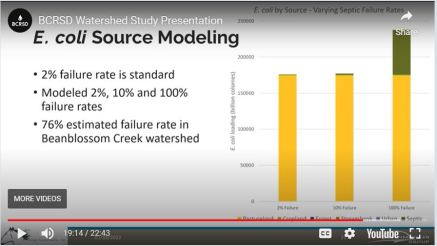
bcrsd e-coli source sampling

This conclusion has been a consistent finding in studies from throughout the State. Only “5” water samples in the targeted area identified the majority of E-coli as being human-caused. No additional analysis was provided as to how many septic systems may be contributing to the problem in these areas. Per the Pareto principle, 80% of the problems could be due to 20% of the causes supporting more cost-effective solutions.

    • Lake Monroe Watershed
      • E-coli levels in all the 2020 Lake Monroe samples were well below the state standard of 235 CFU/100 ml (CFU = colony forming units of bacteria). …. The South Fork (Jackson County) sub-watershed appears to be the largest contributor of E. coli.
    • Indiana Water Quality 
      • In a recent report, “the major cause” of E-coli IS NOT due to the possibility of failed septic system – it’s agricultural runoff from industries that are in compliance with federal and state laws and regulations. “IDEM said combined sewer overflows, untreated stormwater and wastewater that discharges to nearby streams, rivers and other water bodies were the largest sources of E. coli bacteria, one of the impairments cited to the EPA.”
      • Mar 31, 2022. Indiana ranks highest in nation for miles of polluted waterways, report finds
      • “According to the report, a major contributor to water pollution is manure and fertilizer runoff from farms. This causes the concentration of E. coli and nutrients that promote bacterial growth in waterways. “
      • Watershed Coordinator Maggie Sullivan, who works at the nonprofit Friends of Lake Monroe, said Lake Monroe suffers from nutrient contamination. Lake Monroe also has streams that feed into the lake which have elevated levels of E. coli, but levels in the lake are well below state standards. “Our biggest concern right now is harmful algal blooms,” Sullivan said. 
  • Records and Useful Life of a Septic System. The video also identifies what is “speculated”  to be an “average useful life” of a septic system along with the lack of records in the Health Department, to conclude that an “estimated” 76% (2,200 systems) need repair or replacement. No documentation of inspections by the Health Department of the suspected properties was referenced to support the claim as to inadequate systems.
    • Was the “estimated” not documented failure rate overstated to influence the modeling (see above graph)?
    • Sweetwater Lake. (Watershed Study, pg. 26). “There are 550 homes around Sweetwater Lake, which represent the largest concentration of residential septic systems in the watershed.  “Failures”  were identified as being caused by “abuse, lack of maintenance, or grandfathered installations.”  No evidence of any “significant threats to water quality resulting from septic systems.”
    • Note that “potential” for problems was identified but nothing to indicate existing septic management practices would not continue to be effective.
    • Of the 550 homes, what would the BCRSD estimate to be the failure rate given “available records” and “useful life.”

Indefinite Useful Life. Conventional septic systems are designed to operate indefinitely if properly maintained.” (EPA 932-F-99-075). Presby Systems has also identified that a well-designed and maintained system can have an indefinite life. The county is flexible in approving Presby systems to accommodate site-related challenges that support repairs/replacements for existing homes. Pump and Haul is another approved option in some circumstances. A non-statistically valid survey with 113 responses was referenced as supporting the need for repairs/replacements of the existing system. It is unknown if needed actions may have already been completed.

Soils. The water study also identifies that county soils are “very limited in their ability to drain and treat the wastewater produced by a septic system. The State of Indiana has identified the criteria for soils and requires soil testing before a septic permit is granted by the county. I assume the county is in compliance with State guidance and statutes. This fact as to indefinite life is not referenced in the study.   Presby Systems (approved by the State and County), identify that their septic systems “treat wastewater before it is released into the ground and claim their “technology removes up to 98% of wastewater contaminants, recycling clean water into the environment and recharging natural water supplies.”

Economic RISK to Residents. It is unknown at this time if the BCRSD can identify (now or at a future date) a  higher standard for approving septic permits than what is allowed by the State and county. Given the relative power of an RSD that includes making decisions independent of elected officials, the allegations by the BCRSD regarding soils and the useful life of a septic system should be clearly documented and posted on the main page of the county website. The purpose is to prevent/mitigate any possible class-action lawsuits so that existing and prospective new residents can be aware of the potential risks posed by the BCRSD associated with owning property in Brown County.

Additional Comments

https://browncountyregionalsewerdistrict.wordpress.com/strategic-plan/

Helmsburg and Lake Lemon Corridor. The justification of sewer service in Helmsburg west to Lake Lemon is supported with valid justifications to include community support.

Bean Blossom Corridor. I continue to question the assumptions, data, and level of analysis used to support the scope of “solutions” identified for the Helmsburg and east to Bean Blossom and Woodland Lake corridor.

Economic Development. The intent for providing sewer service in the Bean Blossom area has always included the desire by a few for economic development. This has been reinforced by elected officials and the current BCRSD Board president, who has acknowledged his commercial interests in the area. Economic development-related analysis to include any adverse effects on the low to moderate-income level residents was not covered within the scope of the current projects.

 Key Points 

Response to key points provied by Todd Trinkle, Project Manager / Regulatory Specialist, Lochmueller Group, April 14, 2023.LM – Response to Questions – Watershed Study

Water Quality and The Major source of E-coli. Despite claims to the contrary in the strategic plan, the water study identifies that E-coli from pastureland, “AND NOT” failing septic systems (the prevailing BCRSD narrative), is recognized as the major source of E-coli.

Not So!  Claim  (below) identified in the Wastewater Strategic Plan, April 2022, Executive Summary, pg iv. BCRSD Stratggy Overview E-coli

Conflicting position – Watershed Study:

    • There were 22 total samples. Of the five (5) samples that tested high for human-caused E.coli, only two BB10, BB12, exceeded the state standard. (Figure 28, pg. 64.)
    • It was stated that samples detected pharmaceutical and hair care products indicating human contamination. However ….
      • Regarding the detection of pharmaceuticals in the water, this topic was covered in the Brown County Democrat – STREAM SAMPLING: Where’s the contamination coming from? By Sara Clifford – 1/28/20. The information included in the article states: “The highest detections in surface waters are often associated with municipal wastewater treatment plant outfalls.” Would this be true for functioning septic systems as well, e.g., an effective septic system will not treat pharmaceuticals?
    • Figure 33 details that pastureland loads more E.coli to Brown County streams than other sources under all modeled septic failure modeling scenarios. Only if 100% of documented septic system failures are failing do they contribute a significant volume of E.colito the entirety of Brown County.”
      • Note: There are no documented failures and a “significant volume” is not the majority (see graph below).

Watershed Study – Model
Sources of E-Coli: Yellow Pasteurland; Green – septic systems

bcrsd e-coli source sampling

This conclusion has been a consistent finding in studies from throughout the State. Only “5” water samples in the targeted area identified the majority of E-coli as being human-caused. No additional analysis was provided as to how many septic systems may be contributing to the problem in these areas. Per the Pareto principle, 80% of the problems could be due to 20% of the causes supporting more cost-effective solutions.

    • Lake Monroe Watershed
      • E-coli levels in all the 2020 Lake Monroe samples were well below the state standard of 235 CFU/100 ml (CFU = colony forming units of bacteria). …. The South Fork (Jackson County) sub-watershed appears to be the largest contributor of E. coli.
    • Indiana Water Quality 
      • In a recent report, “the major cause” of E-coli IS NOT due to the possibility of failed septic system – it’s agricultural runoff from industries that are in compliance with federal and state laws and regulations. “IDEM said combined sewer overflows, untreated stormwater and wastewater that discharges to nearby streams, rivers and other water bodies were the largest sources of E. coli bacteria, one of the impairments cited to the EPA.”
      • Mar 31, 2022. Indiana ranks highest in nation for miles of polluted waterways, report finds
      • “According to the report, a major contributor to water pollution is manure and fertilizer runoff from farms. This causes the concentration of E. coli and nutrients that promote bacterial growth in waterways. “
      • Watershed Coordinator Maggie Sullivan, who works at the nonprofit Friends of Lake Monroe, said Lake Monroe suffers from nutrient contamination. Lake Monroe also has streams that feed into the lake which have elevated levels of E. coli, but levels in the lake are well below state standards. “Our biggest concern right now is harmful algal blooms,” Sullivan said. 
  • Records and Useful Life of a Septic System. The video also identifies what is “speculated”  to be an “average useful life” of a septic system along with the lack of records in the Health Department, to conclude that an “estimated” 76% (2,200 systems) need repair or replacement. No documentation of inspections by the Health Department of the suspected properties was referenced to support the claim as to inadequate systems.
    • Was the “estimated” not documented failure rate overstated to influence the modeling (see above graph)?
    • Sweetwater Lake. (Watershed Study, pg. 26). “There are 550 homes around Sweetwater Lake, which represent the largest concentration of residential septic systems in the watershed.  “Failures”  were identified as being caused by “abuse, lack of maintenance, or grandfathered installations.”  No evidence of any “significant threats to water quality resulting from septic systems.”
    • Note that “potential” for problems was identified but nothing to indicate existing septic management practices would not continue to be effective.
    • Of the 550 homes, what would the BCRSD estimate to be the failure rate given “available records” and “useful life.”

Indefinite Useful Life. Conventional septic systems are designed to operate indefinitely if properly maintained.” (EPA 932-F-99-075). Presby Systems has also identified that a well-designed and maintained system can have an indefinite life. The county is flexible in approving Presby systems to accommodate site-related challenges that support repairs/replacements for existing homes. Pump and Haul is another approved option in some circumstances. A non-statistically valid survey with 113 responses was referenced as supporting the need for repairs/replacements of the existing system. It is unknown if needed actions may have already been completed.

Soils. The water study also identifies that county soils are “very limited in their ability to drain and treat the wastewater produced by a septic system. The State of Indiana has identified the criteria for soils and requires soil testing before a septic permit is granted by the county. I assume the county is in compliance with State guidance and statutes. This fact as to indefinite life is not referenced in the study.   Presby Systems (approved by the State and County), identify that their septic systems “treat wastewater before it is released into the ground and claim their “technology removes up to 98% of wastewater contaminants, recycling clean water into the environment and recharging natural water supplies.”

Economic RISK to Residents. It is unknown at this time if the BCRSD can identify (now or at a future date) a  higher standard for approving septic permits than what is allowed by the State and county. Given the relative power of an RSD that includes making decisions independent of elected officials, the allegations by the BCRSD regarding soils and the useful life of a septic system should be clearly documented and posted on the main page of the county website. The purpose is to prevent/mitigate any possible class-action lawsuits so that existing and prospective new residents can be aware of the potential risks posed by the BCRSD associated with owning property in Brown County.

Additional Comments

https://browncountyregionalsewerdistrict.wordpress.com/strategic-plan/

Helmsburg and Lake Lemon Corridor. The justification of sewer service in Helmsburg west to Lake Lemon is supported with valid justifications to include community support.

Bean Blossom Corridor. I continue to question the assumptions, data, and level of analysis used to support the scope of “solutions” identified for the Helmsburg and east to Bean Blossom and Woodland Lake corridor.

Economic Development. The intent for providing sewer service in the Bean Blossom area has always included the desire by a few for economic development. This has been reinforced by elected officials and the current BCRSD Board president, who has acknowledged his commercial interests in the area. Economic development-related analysis to include any adverse effects on the low to moderate-income level residents was not covered within the scope of the current projects.

Conclusion.  I would encourage concerned citizens to review the videos. The published plan and study provide the supporting detail. A public hearing is required before the applications for project funding are submitted. The RSDs have to allow for citizen input at the hearings. Input can be ignored. The Hearing is recorded which will provide more testimony to be considered by state and federal officials.
Commissioner Meeting Notes: Wed, March 15, 2023

Updated Mar 16, 2023

Commissioner Meeting Notes, Wed Mar 15, 2023. 6:00 p.m.  Audio of the meeting (25 minutes).

This post with any comments at the Facebook group –  Brown County Matters.

Courthouse Additions – Sally Port and Security Entra.m.nce.  The commissioner’s financial advisor from Baker -Tilley identified the additional funds needed (550K) to support these projects. The county previously budgeted 500K.  More details on the source of funds will be presented at next week’s County Council Meeting on Monday, March 20,  6:30 p.m., Salmon Room, County Office Building, 201 Locust Lane.

Indian Hill Railroad Crossing.  Matt Pierce, Indiana House of Representatives, reinforced his statement and correspondence provided last year that legislators would provide the support – needed (including legislation), to re-open the crossing to pedestrian traffic.  This provides access to the Tecumseh Trail. He stated that any claims as to 140K or more in costs for signage/signals were overstated. Commissioners directed the county legal council to contact Representative Pierce to discuss options.

    • History on the “closing.” Part 1: Closure – Railroad Crossing – Indian Hill Rd
    • Commissioners have acknowledged that they made a mistake, were not aware that the closing would impact access to the Tecumseh Trail, and that a public hearing should have been conducted. There is no history of accidents at the crossing.
    • Commissioners have expressed no interest in re-opening the crossing to include vehicle traffic. This option may require legal action by citizens. Commissioner Pittman acknowledged (in the presence of legal counsel), that a public hearing was required, so the scope and cost of any legal action by citizens, may be feasible through crowd-funding efforts. If the decision was illegal and ruled as such, I assume the commissioners would have to have a new public hearing to keep the crossing closed. Legal action, if this includes depositions,  may lead to the source of the motivation for the closing of the crossing.

Audio – Remarks by Matt Pierce begin at 16:00 https://independentvotersofbrowncountyin.com/wp-content/uploads/2023/03/commissioners-march-15.m4a

Peaceful Valley Heritage.  Vivian Wolf of the PVH asked for commissioner support the posting of signs with QR Codes to promote our history.  Signs would include locations at the overlooks and covered bridge to promote our history supported with self-guided driving tours.

Highway Department – Road Paving Plan – 2026.  Commissioners to post on the county website.  The plan was first presented last October and has recently been updated.

Brown County Regional Sewer District (BCRSD) Board Meeting Notes, Tues Mar 14, 2023.

Updated Mar 15, 2023

Meeting Announcement and comments – posted at Brown County Matters

Audio of the meeting

Brown County Regional Sewer District (BCRSD) Board Meeting Notes, Tues Mar 14, 2023. Location Jackson VFD – Helmsburg.

Next Joint Meeting with Helmsburg RSD –  28 March  2023, 6:00 p.m. Brown County Community Foundation – lower level.

Applications for Funding (Preliminary Engineering Reports (PERs). Both boards are expecting that their PERs will be completed by the Mar 28 meeting and be ready to submit for review to approval authorities.  Funding sources include the State Revolving Fund and USDA. The PERs provide include the “documented justification” for the projects.  May also include Letters of Support.  Another source of funds may be the Bilateral Infrastructure Funds.

    • A Public Hearing is required to present the PERs are required.  Dates TBD.  The foundation for the PERs is provided in the Brown County Wastewater Strategic Plan and Water Study that the BCRSD has refused to present at a public meeting.  These plans are available on their website.  Any questions can be asked at the public hearing on the PERs.
    • This BCRSD PER should include the documentation supporting the allegations and speculation regarding septic system failures, water quality, and adequacy of soils.
    • The SRF may not question the evidence that supports the justification of need but this may not be the case at the federal level.

Attendees. About 9 people from Lake Lemon attended the meeting.   Lake Lemon residents have been the most supportive of obtaining sewer service.

Community Awareness. BCRSD expects to place ads in the Democrat to raise awareness of their plans and website.

Needed Shift in Priorities.  The number one priority for the BCRSD was building a new sewer plant in Bean Blossom.  The PER for this project was submitted in 2018 and approved by the SRF. The project was considered a high priority.  The BCRSD requested that this project be kept on the priority list.

When the BCRSD failed to acquire land for a plant in Bean Blossom (the purpose for the 2018 PER), the scope of the project changed significantly. In addition to the Bean Blossom area, Helmsburg and areas west to Lake Lemon are now (not in 2018) included in the scope of this first phase.  The Helmsburg and the Lake Lemon areas have valid needs and the support of current and new customers.

Timeline.  Review by funding sources generally takes 30-90 days.  Feedback is expected around mid-summer and a formal commitment later in the year.   Construction cannot begin until 85% of needed easements are acquired (Per BLN contractor).  Not sure if this 85% is a state and/or federal standard.