Indian Hill RR Crossing. Audio begins at 19:00. Hallelujah! Commissioners with a 2 to 1 vote, agreed to petition the Indiana Department of Transportation (INDOT) to re-open the crossing. Commissioners had the power to close the crossing. Only INDOT has the power to consider re-opening. The Railroad can appeal the decision to re-open. Commissioner Sanders was the No vote and wanted more information regarding potential costs.
Representative Matt Pierce has taken the lead in representing the legislature’s interest in supporting the re-opening. Our State rep Erik Koch and House Rep Dave Hall have also expressed their support for re-opening.
Pay Increases. The deadline Department to submit requests and justification for pay increases is the June council meeting. The council unanimously approved a pay increase for the Court Security Officer Baliff from pay grade 11 to 15 and a $10.50 an hour pay increase for nurses.
Appropriations. Council approved an additional 30,000 for the Public Defender Board.
Council approved an expenditure of $200,000 requested by the Hamblen Township Fire Protection District. This comes from their budget and not the county’s. Council is responsible for reviewing their budget.
Civic Refresher. In America, We the People, are top management. Citizens are responsible for holding elected and appointed officials accountable for ensuring the efficient and effective use of all tax dollars.
Given the imperfections of human nature, moral corruption is inherent in all systems and processes. Consequently, problem identification and decision-making require the highest levels of integrity, competence, and transparency.
Citizens are responsible for being informed voters and holding our elected and appointed officials accountable for the efficient and effective use of tax dollars. Citizens also serve in the role of Jurists who should assess both sides of the argument and supporting analysis before making or supporting a decision. The Public Hearing on the presentation of Phase 1 of this project represented a one-sided closing argument. Citizens were allowed “2 minutes” for comments and were informed they could send comments and questions via email and a response would be provided.
In addition to serving as Jurists, citizens also have the responsibility to Appeal (challenge) any approval decisions to the appropriate state and federal agencies including expecting the involvement of elected representatives.
Given the imperfections of human nature, moral corruption is inherent in all systems and processes. Consequently, problem identification and decision-making require the highest levels of integrity, competence, and transparency. The Brown County Leader Network offers methods and tools to support changes that can result in improvement.
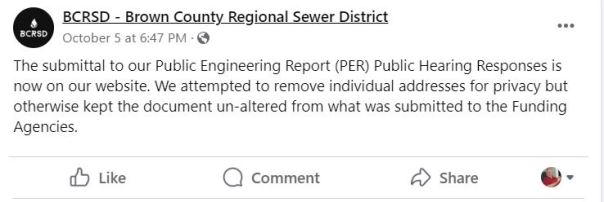
Oct 10, 2023. Request for Info (RFI) to the BCRSD – When were these responses forwarded to the State agencies? When was the updated PER forwarded? Per the BCRSD Facebook page, this response was posted to their website on Oct 10, 2023. The hearing was July 8, 2023 and the cutoff for all questions was July 14, 2023.
Sep 28, 2023. Joint Meeting Notes – Helmsburg and Brown County Regional Sewer District Boards, Reviews of Internal Controls by Agencies and Elected Officials. Audio of the meeting
Board Members: Mike Leggins (President), Clint Studabaker (Vice President), Phil LeBlanc ( Treasurer), Richard Hall ( Secretary), Matt Hanlon (At large).
State Funding. Both RSDs will be completing paperwork for the first round of funding. Helmsburg received approval to build a new plant. The BCRSD received approval for planning related to the collection system and an initial project.
SRF Loan Program Process: Note: The IFA:SRF approved the projects before reviewing the results from the public hearing on July 8, 2023. This includes citizens’ questions and concerns and the responses by the BCRSD/HRSD.
Federal Funding – LMI. The BCRSD has received support for federal funding from the USDA – Rural Development Office. The amount of grant money is dependent on the federally determined Low to Moderate income level (LMI). The western corridor (Helmsburg to Lake Lemon) meets the LMI criteria for grant money. Appears that the eastern corridor – Bean Blossom to Woodland Lake, may not meet the minimum LMI level to obtain additional funding from grants.
Project Review on Behalf of the Citizenry. Both the state and federal governments have statutes, policies, and processes in place to help provide assurance to citizens on the Effective and Efficient use of tax dollars. The intent of internal controls is to prevent waste, fraud, abuse, and mismanagement.
Oversight is provided by the Offices of Inspector General (OIGs) respectively.
The responses by OIG offices can be provided to state and elected officials for their respective review and approval. Insight from this step can identify needed improvement in agency operations, policy, and statutes.
The quality of responses by elected officials can be used by citizens (voters) in determining a candidate’s qualifications for office via the election process.
Internal Controls – County Level. Unfortunately at the County level, the scope of review of internal controls by the State Board of Accounts (SBOA) is primarily focused on finances and not operations, and compliance by county offices is generally voluntary. This puts the burden on citizens to expect compliance and reinforce their commitment through the election process.
Formal Request for Review. To initiate a review of the approval-related processes, I have filed a formal request with the Indiana Office of Inspector General (OIG)requesting an assessment of the adequacy of internal controls of the Indiana Finance Authority (IFA), State Revolving Fund (SRF).
Sep 7, 2023. Brown County Regional Sewer District (BCRSD) Board Meeting
Board Members: Mike Leggins (President), Clint Studabaker (Vice President), Phil LeBlanc ( Treasurer), Richard Hall ( Secretary), Matt Hanlon (At large).
Public Hearing on July 8 – Responses to Questions. The BCRSD response to questions from the public is expected to be available for review on their website next week at the earliest. A copy will also be forwarded to the State. Note: Concerns and questions regarding the quality of the responses will likely need to be addressed by other State and Federal offices that can provide an unbiased, objective, and independent assessment of the respective issue (s).
Monroe County Commissioners have asked that the BCRSD boundaries be extended to provide service for their citizens who live on the western end of Lake Lemon. A significant development that will increase the number of customers in the western corridor.
New WW Plant Funding. Helmsburg will be receiving funding to build a new plant that will support the BCRSD Phase 1 Project. The BCRSD will collect the wastewater and Helmsburg will process it.
First Hook-ups – West or East? The BCRSD will be requesting funding for additional engineering planning and support for Phase 1 which will include easements, acquisitions, and plans at the level of detail (85%) needed to support construction. They will also identify their first collection project with a projected budget of around 8 million. For example, do they hook up customers in the Western Corridor – Helmsburg to Lake Lemon, or the Eastern Corridor – Helmsburg to Bean Blossom, or … do they go a little both ways? A good bet may be that the more paying customers they can hook-up as fast as possible may be a top vote-getter.
Note that Bean Blossom has been the number one priority in the county by a few for sewer service.
Easements? Any significant push-back from residents regarding easements may factor into the decision as to direction – West or East.
Federal Funding? The BCRSD will be meeting with the USDA/Rural Development on Sept 19, 2023, regarding available federal funding. The BCRSD also provided a copy of their PER to USDA/RD.
NEXT Joint Meeting – HRSD and BCRSD. Scheduled for Thursday, Sept 28, 6:00, Brown County Community Foundation. Topic to include the timeline on the Phase I related projects.
Sewer expansion project – Background info: The proposed $50.5 million Phase 1 Project included a western corridor (Helmsburg to Lake Lemon) and an Eastern Corridor (Helmsburg to Bean Blossom to Woodland Lake). Helmsburg RSD is to process the wastewater and the BCRSD is to collect the wastewater from new customers.
Great news!Congratulations to the HRSD Board. The Helmsburg RSD has received approval with a high priority this year to build a needed new plant in HELMSBURG to replace their current aging plant. Cost is currently estimated at around 9 million. Any additional projects will be considered next year. This project will support their existing customer base. The project, with grants, is expected to lower the monthly customer sewer bill which is currently at $92.50. The plant will be designed to handle 100,000 gallons of wastewater with the capability to expand to handle another 100 – 200K gallons at a future date. The estimate to handle the volume for the Phase I ($50.5 million) Plan is 300K gallons.
Responses to questions from the Public Hearing are expected to be available via the BCRSD website, within the next two weeks. The quality of the responses and any proposed changes will help determine the scope and success of future projects. The questions and comments are primarily related to the BCRSD wastewater collection project. There was no opposition to the Helmsburg project to replace their current plant to include the capability for expansion
Funding Strategies. Projects estimated in the $6-7 million range currently have the highest priority in getting grant money. The grants are needed to keep the rates low. Projects exceeding this amount can receive additional funding via low to no-interest loans.
Future Expansion. Given the guidance on keeping future projects in the $6-7 million range, the next stage of the project is to add more customers. A current expectation is that the priority should be adding the customers in the western corridor – Helmsburg to Lake Lemon. The expectation for the Brown County RSD may be to add one or more areas in the eastern corridor (Helmsburg to Bean Blossom to Woodland Lake) as soon as possible.
The purpose of the Public Hearing on July 8, 2023, was for the Helmsburg Regional Sewer District (HRSD) and Brown County Regional Sewer District (BCRSD) boards to present their Preliminary Engineers’ Reports (PERs) to the public. Citizens were provided with “two minutes” to express comments and ask questions. Citizens were also informed they can submit written comments and questions through July 14, 2023, and they would receive a reply to their input. My additional comments and questions are included in Enclosures 1 and 2.
I support the Phase 1 project in the Western Corridor – Helmsburg to Lake Lemon. There is a valid need and overwhelming community support. This should be designated as the highest priority for funding and construction. Consideration should also be given to expanding the HRSD boundaries and expanding its board to include a representative from Lake Lemon and Bean Blossom, respectively.
I do not support the Phase 1 project in the Easter Corridor – Helmsburg to Bean Blossom to Woodland Lake. Despite a 20+ year endeavor to acquire sewer service in the Bean Blossom area, there is no direct evidence of failing or inadequate septic systems to the extent that would justify the scope and cost of the project in this corridor. The scientific method was not applied or referenced with sources to support studies to validate the theory that “76% (2,200) systems need repairs or replacement.” Consideration should be given to an independent and objective assessment of the future role of the BCRSD.
Enclosure 1 provided background information and context on the Phase 1 projects. This includes the responsibility of citizens to ensure the review of appropriate state and federal officials in ensuring the efficient and effective use of taxpayer dollars. Enclosure 2 provides my questions.
July 8, 2023. Post 7 Public Hearing – Notes and Audio
No Vote at this time – Eastern Corridor. Phase 1 of the project includes a Western Corridor (Helmsburg to Lake Lemon) and an Eastern Corridor (Helmsburg to Bean Blossom to Woodland Lake.). I’ve been following this issue since 2016, routinely attend the BCRSD Board Meetings and have reviewed all of the supporting documentation.
The presentation confirms my previous assessments – the Eastern Corridor should be put on “pause” until the need is validated and there is evidence that the scope of the investment and strategy justifies the expense. It is also important to confirm community-wide support.
In contrast, the Western Corridor has validated the need and has obtained community-wide support.
Despite comments by the BCRSD Board members to the contrary:
“Soils” in Brown County are suitable for septic systems. Soils are tested before a permit is issued.
Impaired “waterways” are not primarily due to waste from failing or inadequate septic systems. Per BCRSDs Watershed Study (pg.63), only 5 of the 22 water samples identified the majority of E.coli as being of human origin. “…pastureland loads more E.coli to Brown County steams than other sources under all modeled septic failure modeling scenarios. Only if 100% of documented septic systems are failing do they contribute a significant volume of E.coli to the entirety of Brown County.” (Watershed study, pg. 69-70)
BCRSD Board members in their opening comments reinforced themes related to inadequate soils (LeBlanc), environmental health due to E.coli (Studebaker), impaired waterways, 62% suspected failures of systems, and human-caused E. coli (Hanlon). Hall stated, “I feel there is a need.”
BCRSD Board members: Mike Leggins (President), Clint Studabaker (Vice President), Phil LeBlanc ( Treasurer), Richard Hall ( Secretary), Matt Hanlon (At large).
Community Support? The BCRSD Prelimary Engineer Reports (PER) includes information derived from a taxpayer-funded wastewater strategic plan and watershed study. The plan and study provide the basic premise for the justification of need. The cost of the grant-funded project was $118,000. It required a 10-percent match — $11,800 — which came from the County.
BCRSD Board members refused to hold a public meeting to present their plan. This would have provided them with the opportunity to defend their arguments and conclusions, address questions and concerns and build community support if possible. This should have happened before moving forward with the development of the PER and the Public Hearing. (PER – Read Aheads).
For the Record. I will be asking copies for of all the information submitted by approving officials and will post on Brown County Matters to help ensure responses to all submitted comments and questions were addressed.
Citizenship. American Citizens (top management) have a responsibility to be informed voters and to hold elected and appointed officials (and their contractors) accountable. We also have a responsibility for serving in the role of Jurists to ensure that decisions are based on both sides of an argument. Brown County taxpayers have contributed over a million dollars in support of this project.
Balanced Argument. The presentation at the Public Hearing represents a one-sided closing argument “by the prosecution.” Citizens have the opportunity to provide their input by July 14, 2023. The process requires that responses to be provided by the project sponsors – BCRSD and HRRSD. Approving officials have an obligation to review all the information presented before making a decision. By federal and state statutes, Citizens (unbeknownst to many) do have the right to question or appeal any final decision which should involve a review by subject matter experts that are independent, objective, and represents citizen interests as opposed to those advocating and benefiting from this project. Information from this phase also becomes part of the record.
June 15, 2023, Post No.6 Funding Review and Approval Process.
Public Hearing. A Public Hearing of this project is required by statute. The Hearing is scheduled for July 8, 2023, at 10am, at the Brown County Fairgrounds. The plan and studies that provide the justification for this project were developed without any public meetings to gather input from citizens. The Hearing provides citizens with the opportunity to ask questions and get answers. This information becomes part of the official record.
Funding. The applications for funding (Preliminary Engineering Reports (PERs) were submitted to State officials and if/ when approved, can be submitted to federal officials. Public Hearing – Read Aheads – Sewer Expansion
State Funding. The Indiana Finance Authority (IFA), and State Revolving Fund (SRF) loan approval processes are detailed on their webpage under loan approval process: The site also includes copies of the forms and checklists used in the approval process.
Federal Funding. USDA Rural Development takes in applications for funding through RD Apply. RD Apply | Rural Development (usda.gov) The application is reviewed and underwritten when the entity applies for funds.
Internal Controls. The purpose of federal and state guidance on internal controls is to prevent waste, fraud, abuse, and mismanagement. This is the guidance that is referenced in allegations made by whistleblowers.
State of Indiana – Internal Control Standards administered by the State Board of Accounts. Indiana Code 5-11-1-27(e) provides that through the compliance guidelines authorized under IC 5-11-1-24, the state board of accounts shall define the acceptable minimum level of internal control standards for internal control systems of political subdivisions, including the following: (1) Control Environment. (2) Risk Assessment. (3) Control Activities. (4) Information and Communication. (5) Monitoring.
Federal. The governing statute for internal controls is the Federal Management Financial Integrity Act (FMFIA) of 1982. OMB Circular No. A-123 defines management’s responsibility for internal control in Federal agencies. This Circular provides guidance to Federal managers on improving the accountability and effectiveness of Federal programs and operations by establishing, assessing, correcting, and reporting on internal control. … Management is responsible for establishing and maintaining internal control to achieve the objectives of effective and efficient operations, reliable financial reporting, and compliance with applicable laws and regulations. References: FMFIA, OMB Circular A-123 – Management’s Responsibility for Internal Control
In terms of the BCRSD’s Wastewater Strategic Plan, Watershed Study, and application for funding via a Preliminary Engineering Report (PER), systemic bias is an inherent part of the process. This bias limited alternatives to the options of a gravity or low-pressure sewer system. (Ref BCRSD PER).
The same engineering firms whose specialties include engineered wastewater treatment systems, can legitimately and legally compete to develop strategies, plans, studies, and applications for funding. They can also compete to do the work associated with the approved projects. This supports the adage that “If your only tool is a hammer, everything looks like a nail.”
For instance, for manufacturers and suppliers of septic systems, what would be their perspective regarding an overall plan for the county and how individually managed septic systems can be part of the solution?
Given the inherent bias, it becomes imperative for citizens (We the People) to provide the needed oversight on the quality and scope of the proposed projects. A one-sided closing argument is not sufficient for supporting major decisions that can impact almost everyone in the county.
The “jury” (citizens), need to consider an opposing argument, review the transcripts (supporting information – see Read Aheads below), and ask questions to support their respective decision regarding approval, disapproval, or need for changes in the proposal. In this case, a Public Hearing is required in order to obtain citizen input regarding the project. Citizen input becomes part of the record.
In preparation for this meeting, a review of the supporting documentation is needed. A good start is with the two videos. The “foundation” for the solutions identified in the PER is derived from the BCRSD WW Strat Plan and Watershed Study.
May 23, 2023.Post No. 4. Estimates and Assumptions. In a previous post (May 17, 2023), I provided the history of the commercial interest in expanding sewer service in the Eastern Corridor (Helmbsurg to Bean Blossom to Woodland Lake). The option of the private sector developing strategies to support their interest in development and sewer service is not mentioned.
The two prior presidents of the BCRSD Board both identified that there was no documented direct evidence of failing septic systems. The current president acknowledges his commercial interests in expanding sewer service in the Bean Blossom area. This post and comments also at Brown County Matters.
Justification of Need. To justify a solution for the Eastern Corridor, a problem had to be identified. The BCRSD created a justification for the need based on estimates of failing septic systems due to the projected age of systems, lack of records, and water samples.
Record Keeping. Regarding record keeping, when (in what year) did the State require that the county maintain records, and what records were required to be kept? When and How did/does the county enforce the guidance? An assumption can also include that individuals installed a septic system using the prevalent technology at the time and repaired/replaced their systems as needed without the knowledge of the health department.
Estimates and assumptions. Of 3,000 septic systems in the Bean Blossom Watershed, it was speculated that 76% (2,200 systems) of these need repairs or replacements. This is based on the “assumptions” derived from an observation that 41% have no record on file and an estimate that 35% are near or past design life. (Ref: Video presentation, Watershed Study)
The watershed study also references Cordry-Sweetwater Conservancy District. (Ref: Watershed study, pg. 25-26)
There are 550 homes around Sweetwater Lake, which represent the largest concentration of residential septic systems in the watershed. “Failures” were identified as being caused by “abuse, lack of maintenance, or grandfathered installations.”
No evidence of any “significant threats to water quality resulting from septic systems.”
Note that “potential” for problems was identified but nothing to indicate existing septic management practices would not continue to be effective.
QUESTION. Of the 550 homes, what would the BCRSD estimate be on the failure rate given available records and “useful life?
Commercial systems and Records? In Table 3 Service and Study Area Flow Estimates, page 8 of the PER, there are 612 Residential Units identified. There were 927 commercial units identified. QUESTION: What is the status of the “Records” for the commercial units? How many of these units have evidence of septic system failures?
Water Quality. The Watershed study identifies that “pastureland loads more E.coli to Brown County steams than other sources under all modeled septic failure modeling scenarios. Only if 100% of documented septic systems are failing do they contribute a significant volume of E.coli to the entirety of Brown County.” (Watershed study, pg. 69-70)
Only 5 of the 22 water samples identified the majority of E.coli as being of human origin. (Watershed study, pg. 63) No additional analysis was referenced to identify how many systems may be contributing to the problem. In general, 80% of problems may be due to 20 of the systems.
QUESTION: How many septic systems may be contributing to E.coli?
Design Life. Regarding the useful life of the systems, the BCRSD identified that “Various sources suggest 25 years as the average lifespan for a well-maintained septic system” (Ref: BCRSD Septic System Information as of August 2020).
QUESTION: What are the sources for the estimate of 25 years? Do these sources include findings derived from peer-reviewed studies?
Per the EPA, “Conventional septic systems are designed to operate indefinitely if properly maintained.” However, because most household systems are not well maintained, the functioning life of septic systems is typically 20 years or less.” (Ref: EPA 932-F-99-075 September 1999). Presby Systems has also identified that a well-designed and maintained system can have an indefinite life.
Indiana DOH. The Indiana Department of Health identified that “There are nearly 1 million septic systems in Indiana” and estimated that 20% are inadequate or failing.
QUESTION: What criteria does the State follow to derive the 20% estimate?
Validating estimates and assumptions. The counter to anecdotal evidence as a basis for supporting decisions is the application of the scientific method. This method includes identifying operational definitions of key terms (such as failing and inadequate systems, useful life), data collection and statistical sampling plan, inspections, data analysis, and conclusions. Findings from a statistically valid sample can then be applied to the larger population.
QUESTION. Was the scientific method used to valid the estimates as to design life of a septic system?
QUESTION: Was the scientific method applied to confirm the estimates as to the percent of failing and/or inadeqate systems?
QUESTION. What are the State criteria for determining that a specific system is inadequate?
SOILS. The Brown County Watershed Study (1) identifies “some” of the Literature cited (pg. 72) but does not include a link or footnote to the source document that would provide the supporting detail for the respective statement. This could be considered a material weakness in internal controls that undermines the justification for funding.
On the topic of Soils, the following is a supporting and misleading premise: “According to Purdue University’s Census of Wastewater Disposal by Indiana County, all Brown County soils are severely limited for septic system use. Soils data complied by NRCS support these findings indicating that more that 99% of soils in Brown County are severely limited for on-site septic use (Figure 19).” (Ref Section 4.2.2., pg.40). NRCS – Natural Resource Conversation Service/USDA
Th BCRSD Preliminary Engineering Report ( pg. 1) in reference to the PER, states that “The Report follows the Brown County Regional Sewer District Strategic Wastewater Plan dated April 2022.”
This reference (no footnote) to Purdues’ and USDAs assessment on “soils” is repeated in the PER (pg.6) which also includes the following: “United States Department of Agriculture (USDA) also classifies soils in Brown County as “Severe” in terms of septic system unsuitability. Despite these limitations, of the 8,400 households in Brown County, nearly7,700 are still served by on-site septic systems”
The STATE OF INDIANA, NOT the USDA and its bureaucracy, determines the suitability of soils. Indiana requires the testing of soils and has identified the acceptable criteria before a septic permit is issued.
The Soil “argument” represents a misleading premise that is not supported by State policy. The State has concluded that Soils can be suitable for septic systems.
Can the BCRSD identify (now or at a future date) a higher standard for approving septic permits than what is allowed by the State and county?
Phase 1 of the sewer expansion project includes a Western corridor (Helmsburg to Lake Lemon) and an Eastern Corridor (Helmsburg to Bean Blossom to Woodland Lake). I have no issues with the Western Corridor which may account for about half of the total cost. There is a valid justification that includes the need to replace an aging sewer plant, failing septic system in flooding conditions, and community support. Further, the current monthly cost to the 70 Helmsburg customers is $92.50 and adding more customers may stabilize future increases and perhaps even result in a lower monthly bill. The Helmsburg and Lake Lemon communities also have active citizen groups. For Lake Lemon, it is the Lake Lemon Environmental Group. The Helmsburg community developed a Community Development Corporation to provide citizens with a voice regarding major decisions in their community.
Some History. Previous Bean Blossom efforts to acquire service from Helmsburg and Nashville were not successful due to cost. This led to the decision to build a new plant in Bean Blossom and expand the area (and customer base) to be served.
The BCRSD submitted an application for funding for a new sewer plant in Bean Blossom in June 2018 with the expectation that funding and construction would begin within 18 months. Despite the need in Helmsburg and Lake Lemon, Bean Blossom was the priority project for the county. Letters of support from residents of this project were from “1998.”
In a meeting punctuated by heated debate, the Brown County Regional Sewer District Board took public comment last night on its plans to build a sewer system to serve Bean Blossom. … About 40 people showed up to hear about the need for the project, what it’s going to cost residents and what building it — or not building it — might mean for the future of their community.
After spending 200K of county taxpayer funds, the BCRSD was unable to acquire land. This forced them to expand the scope to include the Eastern Corridor – Helmsburg to Lake Lemon.
I wrote a Guest Column in the Democrat (April 2020) making the case that a delay of the project was warranted. The article referenced that a county-wide strategy would be developed. I did not expect that it would be completed without any public meetings or input from citizens and elected officials. GUEST OPINION: Bean Blossom sewer plant: Delay warranted.
Motive. In contrast to the support from Helmsburg and Lake Lemon residents, the proponents of the 20-plus-year interest in expanding sewers in Bean Blossom have been from a few with interests in economic development or supporting their businesses. This includes support from the current BCRSD president Mike Leggins who has acknowledged his commercial interests in expanding sewer service in the area. Another emerging interest is environmental with a long-term goal to change agriculture and livestock management practices. (Opposition/Legal Action).
Mike Leggins bought six lots on Old Settlers Road in 1988. He razed the vacant, condemned or burned-out homes that stood on them and put up five new ones — family homes, with three or four bedrooms.The septic systems that served them soon failed, even though the systems were new. Leggins said the high water table was to blame; waste was hitting the groundwater before it had been sufficiently filtered and cleaned.Now, Leggins, the landlord, has to use those homes as if they were two-bedroom homes in order to not put strain on the septic systems — and even that doesn’t prevent them from sending waste downhill, he said.He isn’t the only business owner who’s dealing with sewage flowing where it shouldn’t, including at the back door of his own home, he said. Brownie’s restaurant, the Bill Monroe Music Park, the Bean Blossom Trailer Court
Previous BCRSD Board President – Judy Swift Powdrill. “Again, I do feel that there is a need; however, I also feel that as a taxpayer and the person who went before the county council and made this presentation … I feel like that we need to put some of our future movement on pause. … I cannot see us continuing to spend money without absolute proof that there is this need and want.”
At the start of the sewer board’s next meeting on Dec. 11, it was announced that Swift Powdrill had resigned. Longtime board member Mike Leggins was elected to replace her as president.
Werling lambasted past sewer board members and the health board for a lack of detailed documentation about the need for the sewer project, and alleged “sabotage” by the health department when the sewer board tried to obtain a “boots on the ground” survey of septic system failures in the Bean Blossom area to show the need for the project.He also brought up cost omissions in the sewer project engineering report, which a previous sewer board commissioned with county money.At least four engineering reports have been done since 2001.
Consequently, justifying a need and expanding the customer base and area to be served had to be expanded in order to justify funding. A need, other than development, also had to be developed.
Future posts will address the justification of the need provided in the supporting project documentation.
May 15, 2023. BCRSD Sewer Expansion Project. Post No. 1. The aim of this first post is to introduce and provide context for the upcoming “trial” (public hearing) on the sewer expansion project and to provide the opportunity for citizens to discuss/debate the issues.
I used the term “trial” to reinforce that a “jury” applies critical thinking skills to assess the arguments and to make a decision. The “jury” in this case consists of county residents who are affected by a county strategy.
No Public Meeting. The BCRSD has refused (which they can legally do) to present the “Brown County” wastewater strategic plan at a public meeting. This plan identifies the justification of the project. The BCRSD position is that the posted video presentations and supporting documents are sufficient. Their decision for no public meeting is supported by our “elected” officials who appointed the BCRSD board members. In 2024, three council positions and two commissioner positions will be on the ballot.
I will be providing a series of posts including the argument and counter-arguments for the “proposed” Phase One $50.5 million project. The required Public Hearing is tentatively scheduled for July 8, 2023. These posts will also be added to a timeline (see link).
If public concerns expressed at the hearing are not addressed and the project is approved by the funding agencies, their decision can be challenged (appealed) under state and federal statutes that deal with issues with waste, fraud, abuse, and mismanagement.
The justification – the case/argument for this project is provided in a wastewater strategic plan and watershed study contracted by the “appointed” board members to the BCRSD Board. Funding (over 100K) was provided via the state with some county matching funds. Link to the Video Summaries, strategic plan, and watershed study.
Interesting that the documentation does not include footnotes that would provide specific references supporting the opinions used to justify the project.
Context
Critical thinking and responsibilities of Citizens (the “Jury”). Critical Thinking involves the process of developing and defending a good argument using facts and reason. In the U.S. justice system, for example, the process begins with an allegation of a problem. A member of a jury applies critical thinking skills to support their respective decision as to Yes (true, guilty) or No (false/not guilty).
The prosecutor and defense represent both sides of the argument respectively. The argument also includes a discussion on motive. Witnesses can offer additional information and be cross-examined (challenged) by the opposing counsel. The Judge ensures that the information presented by both sides is credible (rules of evidence). The Judge also decides on the sentence if the defendant is found guilty. Civil cases are less stringent than criminal trials that have the standard of allowing for reasonable doubt. The media can also play an important part of reporting on the presentation of both sides of the argument.
When the county government proposes any solutions – changes in policy, ordinances, resolutions, new strategies or programs, etc., citizens are responsible for ensuring there is a clear understanding of the problem that the “solution” is attempting to resolve. Too often, We the People are presented with only a “closing argument” and are expected to accept the vote/decision. There is rarely any transcripts (supporting documentation).
For example, in supporting a major decision to vote yes or no, minimum information requirements would include the statement of facts, assumptions, constraints, risks, decision criteria, and analysis of alternatives which includes the pros and cons of each alternative.
Citizens can provide input regarding the vote but this “testimony” can be considered just a mere formality by the proponents of the change. In other words, the other side of the argument can be and is often ignored.
Examples in Brown County of changes supported by one-sided arguments include the Music Center, the Closing of the Indian Hill RR Crossing (efforts underway to reverse this decision), and the revised septic ordinance that exceeded state requirements. When citizens had the opportunity for their voices to be heard such as in the school referendum, they voted No. The rationale for the No vote, in this case, included the lack of a good argument as opposed to relying on emotion.
The following link provides additional information regarding critical thinking including a list of fallacies. A fallacy is an error in logic. The most common is ad-hominin – where through ignorance or deliberation, the messenger is attacked as opposed to the message. This line of attack generally signals “game-over” e.g., the lack of a good argument.
(1) On August 7, 2020, the VSTOP team successfully completed an RLA pilot in Brown County, Indiana. This activity was carried out by VSTOP in collaboration with the Election Assistance Commission, the Brown County Clerk’s Office, and Brown County Commissioner Diana Biddle.
Also participating were two members of the VSTOP CEATS cohort: Karen Wheeler and Beth Sheller.
The VSTOP Team members who participated are: Jay Bagga and Bryan Byers, VSTOP Co-Directors, Molly Owens, Project Specialist, Mani Kilaru, IT Specialist, Chad Kinsella, VSTOP Faculty Fellow, and Sajal Sheel, Graduate Assistant.
The following information was gathered as part of the pre-work and planning phases of the Brown County RLA pilot. This information was considered and entered in the Stark Tool, which assisted the VSTOP team and county election officials in deciding which race should be audited during the RLA pilot. Brown County uses the Unisyn 2.0A Ballot Card Voting System. According to the VSTOP inventory, there are 15 OVO (OpScan) units and 15 FVT (Ballot Marking Device) units. There are 12 precincts in Brown County and the county stores ballots by precincts. These ballots were not separated by Party.
The RLA Team audited the following races:
• Republican races (R): President of the U.S. and County Treasurer, and Jackson 2 Precinct Committeeman
• Democrat races (D): President of the U.S. and US Representative in Congress District 9
Each of the above contests was audited with a risk limit of 10%.
There were a total of 3,143 ballots of which 1,258 were Democrat ballots and 1,885 were Republican ballots.
President of the U.S. (R): The RLA tool instructed the RLA Team to audit a sample of 6 ballots for ballot polling with a diluted margin of 85.52%. The RLA team oversampled the ballots for ballot polling and reviewed 104 ballots. The Stark method functioned as expected and confirmed the “Donald J. Trump” outcome in the Brown County precincts with high levels of statistical assurance (100% for the Ballot Polling RLA).
County Treasurer (R): The RLA tool instructed the RLA Team to audit a sample of 119 ballots for ballot polling with a diluted margin of 18.30%. After reviewing the initially sampled ballots, the risk limit was not met. RLA team sampled a total of 270 ballots to attain the risk limit. The Stark method functioned as expected and confirmed the “Andy Vasquez Bond” outcome in the Brown County precincts with high levels of statistical assurance (96% for the Ballot Polling RLA).
Jackson 2 Precinct Committeeman (R): All 110 ballots were sampled for the Jackson 2 Precinct Committeeman, a contest that was close. Results were verified but the winner received two additional votes in our count. After closely examining the ballots, the RLA team confirmed that the additional ballots might have been counted by the voting machine as undervotes or overvotes.
President of the U.S. (D): The RLA tool instructed the RLA Team to audit a sample of 12 ballots for ballot polling with a diluted margin of 61.21%. The RLA team oversampled the ballots for ballot polling and reviewed 73 ballots. The Stark method functioned as expected and confirmed the “Joseph R. Biden” outcome in the Brown County precincts with high levels of statistical assurance (100% for both the Ballot Polling).
US Representative in Congress District 9 (D): The RLA tool instructed the RLA Team to audit a sample of 43 ballots for ballot polling with a diluted margin of 24.74%. The RLA team oversampled the ballots for ballot polling and reviewed 73 ballots. The Stark method functioned as expected and confirmed the “Andy Ruff” outcome in the Brown County precincts with high levels of statistical assurance (100% for both the Ballot Polling).
Indian Hill RR Crossing. Some good news. Positive developments in the efforts to re-open the crossing. Jake German from Barnes and Thornburg stated that they are working on the draft petition from the county to INDOT to re-open the crossing. Scott Rudd summarizes the argument for re-opening. Rick Kelly from Farm Bureau reinforced their support for the Weddle Farm and the hardships (costs, risks, safety concerns) that the closing has placed on their operations. Farm Bureau is also working on a resolution from the organization supporting holding public hearings on any closing of a public road. Note: Commissioner Braden clarified that Indiana Hill Road is open, it is the crossing that is closed.
Rick Kelly identified that the land for the Railroad crossing was sold in 1905 by the Weddle family and has been used for 113 years.
Commissioners Sanders and Braden added their support to include gathering the information needed in making the case that would preclude any opposition from the Railroad in re-opening the road.
Background. Application for funding via Preliminary Engineering Reports (PERs) were submitted to the State on March 31, 2023, by the Helmbsurg Regional Sewer District (HRSD) and the Brown County RSD (BCRSD). Link to the PERs
The Proposed Phase I (see Map) of expanding sewers includes a Western corridor (Helmsburg to Lake Lemon and an Eastern Corridor – Helmsburg to Bean Blossom and Woodland Lake. The BCRSD collects the wastewater. Helmsburg RSD will process.
Public Hearing – July 8, 2023. The required public hearing is scheduled for Saturday, July 8, 2023 from 10am to noon at the Brown County Fairgrounds – 4H community building.
The hard copy PERs are to be available at 4 locations to include the library.
The hearing provides the opportunity to go on record with questions, your support, or lack of support.
Questions?
The PERs are based on the County Wastewater Strategic Plan and Watershed Study. I recommend a review of the short video presentations.
Water Quality. The watershed study confirms that the major cause of e.coli in streams IS NOT failing septic systems but pastureland. Even if there was a 100% failure rate of septic systems, the main cause would still be pastureland.
5 OF 22 water samples did indicate human-caused e.coli likely due to inadequate septic systems. No additional analysis is planned to identify “how many” systems may be contributing to the problem. 80% of the problem could be due to 20% of the systems.
Soils. The study cites that the federal government (USDA) concludes that Brown County Soils are not suitable for septic systems. This is in conflict with State policy that requires soil testing before a septic permit is granted.
Presby Systems. No mention that Presby Systems treat wastewater before it is released into the soil which negates the poor soil argument. Presby also identified that their systems have an indefinite life if installed and maintained properly. Presbys are being used as replacement systems in the county.
Pharmaceuticals. Indications of pharmaceuticals in the water samples are to be expected. “The highest detections in surface waters are often associated with municipal wastewater treatment plant outfalls.” Septic systems do not treat pharmaceuticals. There is no violation of any federal or state standards. Ref: Brown County Democrat – STREAM SAMPLING: Where’s the contamination coming from?By Sara Clifford – 1/28/20.
Need. The PERs include a section on “Need” as opposed to “want.”
The Western Corridor (Helmsburg to Lake Lemon) has valid needs that include: an aging sewer plant, over 200 failing systems in the Lake Lemon area in flooding conditions, and customer support (over 140 letters) included in the PER. Helmburg customers also need more customers to help reduce and/or stabilize costs. They are currently paying $92.50 a month for service.
The Eastern Corridor (Helmbsurg to Bean Blossom to Woodland Lake) has based a need on an estimate as to failing septic systems due to a lack of records and the projected age of a system.
Estimates and assumptions. Of the 3,000 septic systems in the Bean Blossom Watershed, it was estimated that 76% (2,200 systems) of these need repairs or replacements. This is based on the assumptions derived from an observation that 41% have no record on file and an estimate that 35% are near or past design life. No reference was provided to support the study (s) regarding design life.
Record Keeping. There was no explanation regarding record keeping, e.g., When were records required? What information was expected to be recorded? In the absence of records, it can also be assumed that septic systems were installed using the current technology at the time and were repaired/replaced when needed.
Generate Report produces downloadable pdf. — Need Crossing Number
Example 1: From the 1st link above, the crossing in Trevlac, Brown County, Indiana at Indian Hill Road is designated as DOT# 292193F. On the 2nd linked page you will find the following:
Example 2: Using 1st link, the Federal Crossing ID (USDOT) of RR crossing where SR-45 crosses tracks to the west of Indian Hill Road is #292 192Y. Entering 292192Y (no space) in second link box generates report for that crossing (attached).
Indian Hill RR Crossing. Last topic on the agenda. The audio of the discussion starts at 17:47. A very informative exchange of information.
Presentation and Discussion. Scott Rudd (former Nashville Town manager, current county councilman) provided an excellent presentation reinforcing the case and the urgency for re-opening the crossing.
Bob Weddle (25:07) of Weddle Farms (7th generation farm) shared his story on the impact the closing has had on his farming operations including the safety risks and concerns. The family granted the original easement to the railroad.
Mike Moga: Barnes and Thornburg: 1:09:13. IC 8-6-7.7- 3.1. Commissioners can close a crossing but only INDOT has the power to re-open. County can petition INDOT and if INDOT agrees, the RR has the right to appeal. Costs unknown. Initial cost estimates by the RR appear to be grossly overstated. Not clear on INDOTs support of the county to re-open.
Section 8-6-7.7-3.2 – Petition for closure; public hearing; determination and findings by unit
IC 8-6.7. – 3.2a “(e) Notwithstanding subsections (a) through (d), a unit and a railroad may agree to close a crossing within the jurisdiction of the unit.
Tim Clark -1:16:02 Legislative Support and Public Hearing. The supporting statute regarding the public hearing is IC 86-6.7-3.2a Section E. If an agreement is reached between the commissioners and the RR, no public hearing was required.
Representative Matt Pierce reinforced that the Legislature will support local decisions regarding the crossing and has initiated discussions with INDOT and the railroad.
Motion by Commissioners to Pursue a Petition to INDOT. Pittman and Braden voted Yes, Sanders No. Commissions Sanders also supports re-opening and wants more information from INDOT. He wants to consider legal advice, costs, and risks. He suggested revisiting the issue in 2-weeks and inviting input from the public.
Questions.
What if INDOT will not support re-opening?
What actions can the Legislature take to support the re-opening?
If INDOT does support and the railroad appeals, what is involved in this process? Could it include a lawsuit against INDOT and the County?
If INDOT and the County are successful in re-opening, what would be the costs? Estimates have ranged from under $2,000 per statute and regulation to an estimate provided by the railroad of over 100K.
The railroad also suggested a “tunnel” (who funds?) which is unnecessary for a crossing with no reported accidents – ever. The tunnel option is likely nothing more than a delaying tactic to encourage the commissioners and citizens to abandon all hope.
Courthouse Additions – Funding Approved. Council unanimously agreed with a change proposed by the commissioners allowing more of the ARPA funds to be used for the courthouse.
Breakdown of the Commissioner’s sources for funding the $1,061,000 Courthouse Addition:
$500,000 ARPA
$130,000 ARPA (Originally earmarked for a “Quality of Life” Project)
$175,000 3M Loan (Originally earmarked for Helmsburg Stormwater Project) (Leftover after project finished)
$136,000 3M Loan (Originally earmarked for A/C replacement at Jail)
$50,000 3M Loan (Originally earmarked for 911 and Sheriff Radios Update) (Leftover after project finished)
$35,000 3M Loan (Originally earmarked for Siding on Senior Citizens Building)
$20,000 3M Loan (Originally earmarked for Security Improvements)
$15,000 3M Loan (Originally earmarked for IT Tech) (Leftover after project finished)
$1,061,000Total
*The County Council needed to approve the change to the ARPA Plan to move the $130,000 “Quality of life” Project to the Courthouse funding.
Please let me know if there is anything else I need to do or provide.
County Wastewater Strategic Plan – Phase 1. ($50.5 million). Matt Hanlon, a BCRSD board member appointed by the council, provided a brief overview of the strategy and results of the watershed study. No substantive questions or discussion. The applications for funding via the Preliminary Engineering Reports (PER), were submitted by the April 1 deadline.
Public Hearings. The required public hearing may be scheduled in the early July timeframe. The PERs were derived from the County Wastewater Strategic Plan and Watershed Study developed at a cost of over 100K provided through a grant and some county matching funds.
No Public Meeting. The BCRSD Board with the support of the Commissioners and Council determined that no public meetings would be held to present the plan to county citizens. The video presentations and actual plans and study were determined to be sufficient.
Case Study. Review and Approvals. I’ve made initial contact with state and federal officials to obtain more information on their respective review and approval processes. I plan on developing (and publishing) a case study that will include a rather extensive assessment with questions that I will share with the approving officials, their respective auditors, and on social media. I will also include the documentation and correspondence that I receive back from these agencies. State and federal elected officials can also be helpful in navigating any issues with the respective bureaucracies. The public hearings can provide additional information as well.
The Process. In developing proposals for major changes, there are two general approaches. In this case, appointed officials with funding from the county and state, identified what they believe to be the best options for the county with no public input. The required hearings are often considered just a formality. This approach is less transparent, can be problematic, and can be fraught with more risk, suboptimization, conflict, and drama.
Failed project. A recent example of this approach was the project to develop a new sewer plant in Bean Blossom. The public hearing (which was contentious at times) was conducted in June 2018 with the expectation that approvals and construction would begin within 18 months. The Letters of Support included in the PER were from “1998.” The project was canceled when land could not be acquired.
Collaborative Approach. In contrast, the aim of our system of government (local and national) is to work together to implement solutions that lead to “more perfect” outcomes where everyone benefits or at least, is not any worse off. This approach requires that you identify all the stakeholders (aka – We the People) affected by the change in the near, mid, and long-term, their respective needs, and the feedback they will need throughout the lifecycle of the project to assess if changes resulted in improvement. This helps to identify opportunities for improvement. Starting with these steps helps to identify the scope and extent of the problem (s) to be “solved,” the decision criteria, and the associated risks. The outline of this approach is provided through the Brown County Leader Network.
I encourage everyone to review the videos and scan through the supporting documentation. Write down any questions you may have and present at the public hearings. Your questions (and responses) become part of the record.
A Successful Small Project – the Courthouse Additions. At least two previous attempts were made to add a major addition and replace the courthouse with a Justice Center that was not supported by the community. Judge Wertz applied an incremental approach and obtained grants and some county funding to make needed renovations. On the new courthouse additions (around a million), she obtained a grant for funding the plan, identified the critical priority (sally port) and a “good to have “(security entrance), and made her case at numerous commissioner and council meetings. The trust she has built within the community was another advantage. I never heard anyone object or question the need for the project. Both the council and commissioners worked to identify the needed funding.
2024 Budget. Regarding increases in tax revenue from sources such as income and property taxes, the state applies a formula (a growth quotient) that determines how much additional revenue the county will have available in the 2024 budget process. The council can either accept or reject the resulting tax increase. In the past few years, the council has always voted to accept. Background info – the 2023 Budget Hearings
PERs – Applications for Funding. Helmsburg and the Brown County Regional Sewer District (RSD) Boards submitted their PERs on March 31. April 1 was the deadline. Link to copies of the PERs for Phase I
Approving Authorities. It is expected that the approving authorities – State Revolving Fund (SRF) and Rural Development (USDA) would provide feedback. The documents would be updated with needed feedback in preparation for the required Public Hearing (Date TBD) I’m looking forward to seeing the quality of the review provided by the SRF and USDA.
Next Joint Meeting with HRSD. Apr 25, 2023, 6:00 p.m. Brown County Community Foundation.
County Council Update? The BCRSD requested to be added to the agenda for the Council meeting on Apr 17, 2023. The intent is to provide an update regarding the proposed solutions. (PERs). The BCRSD board has refused to conduct a public meeting to defend what they identified as the scope and extent of the problem as identified in the County Wastewater Strategic Plan and Watershed Study that was developed at a cost of over $100K. Note the Commissioners are responsible for policy – the council is responsible for the budget.
Resolution? It was recommended that the county pass a resolution supporting the project. This would fall under the commissioner’s responsibility which implies that the commissioners are knowledgeable about the needs and scope of the project.


 Independent Voters of Brown County IN