All posts by Tim J. Clark

ROI Ready Communities – Strategic Planning

Four Indiana Uplands counties have completed ROI Ready Communities Quality of Place & Workforce Attraction Plans! See the plan for Brown

Application is now open for the first round of Ready Communities implementation grants for projects in these counties! Up to $1 million available. Application due April 15.

Apr 10, 2019. Community Strategic Plan. Presentation at the Playhouse.
Final Brown County ROI Plan 2019_04_10

Mar 13, 2019. Quality of Place and Workforce Attraction Plan  ROI brown-county_final-3-13

Jan 28, 2019.  Envisioning the future: Grant money available for development projects 

  • Brown County has opportunities to get hundreds of thousands of dollars in grant funding from the Lilly Foundation to use on three community projects.
  • About 80 people showed up at the Brown County Playhouse Jan. 23 to help figure out what those projects might be, and to help to steer an overall strategic plan for the county.

Jan 24, 2019, BCCF Facebook – Recap from the session.

Jan 23, 2019. Presentations from the January 23, 2019, Town Hall, Brown County Community Foundation (BCCF) – Announcement on Facebook

  • 5:00 to 6:00   p.m.  Open House Session –  Sponsored by the Redevelopment Commission (RDC). Presentation by Thomas P. Miller and Associates (TPMA) which is the company selected by the county to create the economic development strategic plan.
  • 6:00 – 8:00 pm Presentation of the Strategic Plan Unveiling. This was followed by break-out sessions to collect more input regarding the plan and additional suggestions.

Jan 15, 2019. County’s economic plan to be discussed at Playhouse The Brown County Community Foundation and the Brown County Redevelopment Commission will host a public forum on Wednesday, Jan. 23 to discuss the county’s economic strategic plan and possible grant opportunities.

Sewers and Septics – What is the problem?

Sewers and Septic Systems – What Is the Problem?

Revised Jan 10, 2019 – Will be submitted to the Brown County Democrat, Guest Opinion (Target date for publication Jan 21, 2019)

The Brown County Regional Sewer District (BCRSD) Board is taking action that could affect the quality of life for most Brown County citizens. A regional sewer district has the authority to require or waive a sewer connection for any residence in their respective district. A possible correlation regarding a relationship between the age and efficacy of septic systems and the quality of water in our lakes, streams and creeks leads to a need for the BCRSD to address two key questions as an integral part of a countywide strategy:  To what extent should residences located near a wastewater treatment facility be required to hook up to sewers? To what extent should all residences – 90 percent of which utilize septic systems – be required to have their septic systems inspected on a recurring basis?

Everyone wants a safe and healthy environment. But citizens should also expect that elected and appointed representatives identify and document the process that they will apply to understand a problem and determine the best solutions for the county.

The standard practice within the county is for groups with a special interest in a project to apply an ad-hoc process. Ad-hoc is defined as an approach that is taken for a particular purpose without considering the wider scale impacts. Ad-hoc strategies are suboptimal – they do not lead to the best results.

The special interests that support the Bean Blossom sewer project are those with a commercial interest such as the owners of the Trailer Park, Brownies Restaurant, and the Bill Monroe Music Park. Individual interests include those of the current President of the BCRSD Board who has acknowledged that he owns rental properties in the area to be served that do not have adequate septic systems. Other interests represent those in the area of development. These interests are represented by the county redevelopment commission that is promoting economic development for the area without a documented plan that is supported by the community.

The emphasis on development was recently identified in the article “Waste disposal ‘first and foremost’ in development decisions,” which appeared in the Dec. 4 issue of the Brown County Democrat.

The need for a better problem solving and decision-making process was recently reinforced by comments made by BCRSD board member Clint Studabaker. Regarding the issues of septic systems and sewers, he stated: “It’s not rocket science. … It’s more complicated than that.”

The situation is no more “complicated” than any other significant challenge with political, social, cultural and economic implications. What makes it complicated is when ad-hoc processes are applied to develop solutions that may benefit a few but can lead to more problems for most citizens.

I have provided an example of a decision-making process to members of the county council, commissioners and members of the BCRSD board. It is also available on the Independent Voters of Brown County IN website.

 How this situation arose

At its June 18 meeting, the county council approved a request by the BCRSD board for $270,000 to provide the funding needed to submit an application for funding of a wastewater treatment plant in Bean Blossom. This project is estimated to cost over $7.3 million with funding provided by the State Revolving Fund (SRF). The SRF is funded through federal grants. The SRF approves funding based on the income levels of the population to be served and on environmental need.

In 2018, the BCRSD board spent approximately $70,000 on engineering and consulting services. At the Dec. 17 county council meeting, Mr. Studabaker requested that the balance of the funds be appropriated for use in 2019. The county council will vote on this request on Thursday, Jan. 24.

In addition to the request for funding, Mr. Studabaker made a presentation on the status of the project that reinforced the need for a countywide strategy. Most of his presentation covered environmental challenges and issues in the areas of water quality, soils and septic systems. Outdated water sample results have indicated high E. coli levels. Tests are now available that can determine if the E. coli levels are due to causes that include animal contamination or human contamination due to failed septic systems.

At the sewer board’s Jan. 8 meeting, Mr. Studabaker reinforced that a countywide strategy was needed and could take 30 years to implement. Implementation would be supported in phases starting with the Bean Blossom area.

Data provided by the BCRSD identified that there are approximately 8,400 households in Brown County, and only about 700, or 8 percent, have sewer access.

At the BCRSD’s Dec. 4 meeting, BCRSD board President Judy Swift-Powdrill recommended that the Bean Blossom Sewer Project be delayed until the need for sewers was validated and the residents’ support for it was established. Her fellow board members did not specifically address her recommendation and voted to continue funding the project. At the BCRSD’s Dec. 11 meeting, it was announced that Ms. Swift-Powdrill chose to resign.

The previous BCRSD board president, Evan Werling, also resigned. He, too, stated that a need for sewers was not validated. He also warned citizens at a public meeting that the BCRSD board has the power to enter into contracts without commissioner or council approval. If this does not concern you, it should.  The context for Mr. Werling’s warning concerned the contract proposed by the Town of Nashville to provide sewer service. Mr. Werling and the Board did not believe the contract was in the best interests of the county and voted to reject the contract.

In his presentation at the Dec. 17 county council meeting, Mr. Studabaker did not address the lack of a documented need or desire for sewers, as recommended by the two previous BCRSD board presidents. Mr. Studabaker – a retired civil and environmental engineer with a special interest in the watershed – is working to make an environmental-based case (unsubstantiated at this point) that soils, water quality, and the age and condition of septic systems in the county are the “problem.” Mr. Studabaker is also on a health board committee that is working to update the septic ordinance.

An opinion that is often used to justify the need for sewers is the “estimate” that a useful life of a septic system “averages” 25 years. However, an “average” of 25 years could include a useful life ranging from 1 to 49 years. Variables that affect useful life include design, location, materials, equipment, technology, water usage, maintenance, and soils to name a few. Can a well-designed and maintained system last the lifetime of a home?

A worse case for residents in the Bean Blossom area is having a failed system and not having the land or soils needed to replace the system. Sewers would likely be welcome in these cases. However, access to sewers will not be an option in all cases. Many residents in the county live in areas where installation of sewers may not be economically feasible. In this case, a countywide strategy and plan is needed to identify the range of possible options that are available to citizens.

Questions that need to be answered

Before the BCRSD receives any more funding from county taxpayers, its board member000000s should provide written responses to the following questions:

BCRSD Board – Roles, responsibilities and authority

(1) What criteria will be used by the sewer board to grant waivers for a sewer connection?

(2) Can the health department or BCRSD take action that will force inspections of septic systems with outdated records, especially the ones installed before 1977?

(3) Can the BCRSD, with IDEM’s support, expand its boundaries to include conservancies? Can it take over or consolidate the Helmsburg sewer district or any other sewer district? If so, how would this be done? What are the projected costs of operating this utility? How many employees will be needed?

(4) Do the other sewer districts (e.g., Nashville, Gnaw Bone, Helmsburg) have the power to require people to connect to a sewer or pay for sewer services not rendered?

(5) Other than appointments, do the commissioners and council have any authority over the BCRSD, or is the governing authority IDEM? If IDEM, why isn’t that organization funding the BCRSD?

(6) What funding is available to assist people to meet any future health department or BCRSD requirements for sewer hookups, septic system inspections, and possibly septic systems repairs/replacements? What if a residence is not in an area that could be served by sewers and a new/upgraded septic system is not possible due to terrain and soil conditions?

Service area – Proposed Bean Blossom sewer project 

(7) What is the evidence showing that there is a problem with failed septic systems in the Bean Blossom area that justifies a $7.3 million investment of taxpayer money?

(8) At the June 21 public meeting of the BCRSD board, citizens were first informed that an application for the Bean Blossom sewer project was being submitted to the state. Citizens expressed concerns and asked numerous questions. Board members responded that citizens would be provided with answers to their questions. This information was finally provided at the Jan. 8 meeting and neglected key questions: What percent of the 240 customers to be served, support the Bean Blossom project? How many citizens will request waivers and how many might not grant permission for any needed easements?  If easements are not granted, will eminent domain be needed?

(9) What other (likely less expensive) wastewater treatment options have been identified to support development and commercial interests in Bean Blossom?

(10) The Helmsburg wastewater treatment plant has excess capacity. Why hasn’t an arrangement with the Helmsburg sewer board been worked out?

Economic development – Questions for commissioners and council

(11) If the “need” for sewers is to support commercial and development interests, should the council and commissioners require that Bean Blossom area residents follow the example of the Helmsburg community? Leaders in Helmsburg, with the help of the county redevelopment commission, created an economic development area (EDA) and formed a community development corporation (CDC). The CDC provides all residents with the opportunity to identify what they want and do not want in terms of community and economic development.

(12) Should CDCs be promoted for use in other areas of the county? Note that the draft of the 1993 comprehensive plan (available at the planning office) identified a development strategy for hamlets and villages within the county.

To summarize, the county council should require the development of a countywide assessment and a strategy for sewers and septic systems before any more county money is invested in the Bean Blossom sewer project.  An effective strategy requires a thorough understanding of the scope and extent of the problem and would address the questions identified above.

If county citizens want the best results from plans, policies and projects, then a collaborative as opposed to an ad-hoc process must be used to assure citizens that any changes will most likely result in a better county for everyone.

Tim Clark of Brown County is a quality improvement practitioner, educator and author who specializes in the public sector. He is a senior member of the American Society for Quality and is a certified quality auditor. He has master’s degrees in strategic studies and public administration and has served on the Brown County Redevelopment Commission and on the Brown County Schools Strategic Planning Committee. He can be reached at tjclark2036@gmail.com.

Additional information on the Project – Articles and Letters in the Brown County Democrat, Facebook Posts at Brown County Matters – Regional Sewer Board – Bean Blossom Sewer Project – For the Record 

Feb 18, 2019. Joint Meeting – Helmsburg and Gnaw Bone Regional Sewer Districts. Provides some background information on the history of their plants and the collaboration on billing.

Jan 8, 2019. Answers to Questions prepared by the BCRSD Board 20190108 qanda

PowerPoint Presentation presented by Clint Studabaker 20181217 BC Council December 17, 2018, Presentation

Mother Earth News – Secrets of the Septic System If your home has a septic system you should know how it works — and how it might fail. Our correspondent provides an explanation.
 

Tribes of American Voters

Note: The RealClear Politics is one of the rare websites that offers articles with opposing points of view.

FYI — link to the principles and platform of the two major political parties:

Five Tribes of American Voters, RealCelar Politics 

“Every difference of opinion,” Thomas Jefferson warned in his first inaugural address, “is not a difference of principle ….  “We are all Republicans,” he added. “We are all Federalists.”” Thomas Jefferson

  • Not anymore. In 21st century America, any notion that election results end the argument, however temporarily, is an anachronism. So, too, is the conceit that a nation this large and diverse is divided neatly along “50-50” lines, with half of America’s 253 million adults supporting Democrats, and the other half backing Republicans.
  • “Resistance” — to President Trump and the Trump-era Republican Party .. is one of the five American “tribes” identified in a sweeping new public opinion survey conducted by RealClear Opinion Research 

Seven (7) …  Hidden Tribes: A Study of America’s Polarized Landscape  Hidden Tribes Report

This report lays out the findings of a large-scale national survey of Americans about the current state of civic life in the United States. It provides substantial evidence of deep polarization and growing tribalism. It shows that this polarization is rooted in something deeper than political opinions and disagreements over policy. But it also provides
some evidence for optimism, showing that 77 percent of Americans believe our differences are not so great that we cannot come together.

The segments have distinctive sets of characteristics; here listed in order from left to
right on the ideological spectrum:

  • Progressive Activists: younger, highly engaged, secular, cosmopolitan, angry.
  • Traditional Liberals: older, retired, open to compromise, rational, cautious.
  • Passive Liberals: unhappy, insecure, distrustful, disillusioned.
  • Politically Disengaged: young, low income, distrustful, detached, patriotic,
    conspiratorial.
  • Moderates: engaged, civic-minded, middle-of-the-road, pessimistic, Protestant.
  • Traditional Conservatives: religious, middle class, patriotic, moralistic.
  • Devoted Conservatives: white, retired, highly engaged, uncompromising,
    patriotic.

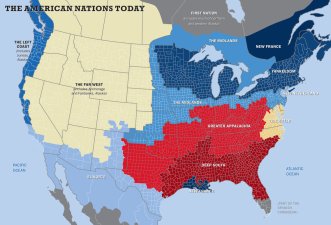
This map shows the US really has 11 separate ‘nations’ with entirely different cultures

The American Nations Today

Political transformation, one county at a time

Dec 11, 2010  BCD, GUEST OPINION: Political transformation, one county at a time by Tim Clark

Straight-ticket voting in the 2018 elections was reported by the Brown County Democrat to be the highest in the past 10 years where “56.7 percent of voters automatically voted for everyone on the ballot for their chosen party, and the majority — 65.5 percent of them — were Republicans.”

These results are not indicative of an effective political system. Given human nature, it is impossible for one political party to have all the best candidates.

The expected drama that will be associated with the 2020 elections may likely encourage more default straight-ticket voting for candidates running for state and national office. At the local (county) level, it’s much easier to meet and get to know a candidate (or the incumbent) and determine their capability and qualifications for a respective office.

A monopoly on political power reinforces the county government’s preference to support special interests in applying ad-hoc processes that do not result in achieving the best outcomes. This approach for leading change is not in the best interests of the county, country or the individuals involved in the process.

A common strategy within the county is to empower ad-hoc groups of unelected individuals to make major decisions by applying processes that, by design, cannot and will not produce the best outcomes. These ad-hoc groups create and lead projects with funding that is initially or later approved by elected officials. These projects often do not seek wide-scale community support and are not guided by county strategic, comprehensive and economic plans that are developed and continually improved with citizen input. Political parties can also be considered as ad-hoc groups that represent special (partisan) interests.

Examples of past and current projects — many of which proposed or involved a significant investment of tax dollars include the following:

  • An unsuccessful application for an Indiana Stellar Grant that proposed major projects without countywide input and involvement;
  • The Salt Creek Trail that, despite the original intent, is acquiring land through an enticement of inflated land prices and threat of condemnation;
  • Bean Blossom sewers, where a solution was proposed before the problem was identified;
  • A government-owned music venue led by local innkeepers that included a refusal by the commissioners and county council to hold public meetings to discuss the desirability and feasibility of the project; and
  • A proposal for a new county government Justice Center without a thorough analysis of alternatives and identification of a compelling need to justify the new debt.

This situation, major decisions determined by the few, is not unique to Brown County. A study of federal policies using data over 20 years “compared what the public wanted to what the government actually did” and concluded that “the opinions of 90 percent of Americans have essentially no impact at all.” For more information, see “The Problem” at represent.us. This report led to media headlines throughout the world that suggested the U.S. was functioning as an oligarchy.

The U.S. political system was designed to be continually improved by “We the People” at the local level in pursuit of “a more perfect Union.” Achieving this aim requires that action produces results where everyone gains or at least, are not any worse off in the long-term. Although the aim (more perfect) was identified in the U.S. Constitution, we lack a common method, process and language that we can use in working together to achieve this vision.

Early in our country’s history, political parties emerged to identify and offer methods for identifying changes that result in improvement. George Washington, in his farewell address, warned against forming political parties but his advice was ignored by his immediate successors, John Adams (Federalist) and Thomas Jefferson (Democratic-Republican). Adams won in 1796 and Jefferson in 1800. Political parties identify the variation on issues, but also contribute to divisiveness and suboptimal solutions. The fact is that everyone wins when optimal methods are applied in the pursuit of “more perfect.”

Social media, which includes Facebook, is an evolving and disruptive technology that can support the needed transformation to better methods and processes that should be welcomed by most citizens. Some people also prefer to maintain the status quo — no change needed.

At the county level of politics, name recognition and family reputation that is often linked to past generations are of significant political advantage. Name recognition along with party affiliation (Republican in this county) is often all that is needed to get elected. Communication is another challenge within the county. If citizens do not read the Brown County Democrat or follow issues on social media, they will not have knowledge of the issues. This lack of information can lead to a default vote where it is assumed that a respective party has your best interests in mind.

In the past, elected officials could vote without a concern that their name and reputation would be associated with any adverse consequences of their vote. With social media, officials, as well as the community, can be held responsible over the life cycle of a vote which becomes part of the documented history of the county. And, with social media, there is always the potential for a story to go “viral.”

Transformation is defined as a change that leads to sustained improvement. Political transformation can begin at the local (county) level. A simple change that voters can make that can result in significant improvement is to vote for and support the best local candidate regardless of political party affiliation. How does the candidate define “a more perfect” county? Do they understand the importance of planning? What do they identify as a priority? And what feedback do you need to determine that a change has led to an improvement?

Tim Clark of Brown County is a quality improvement practitioner, educator, and author who specializes in the public sector. He is a senior member of the American Society for Quality (ASQ), has been certified as a quality auditor and has master’s degrees in strategic studies and public administration. He has served as a member of the Brown County Redevelopment Commission and has served on the Brown County Schools Strategic Planning Committee. He can be reached through the newspaper at newsroom@bcdemocrat.com.

Dec 11, 2018. Brown County Democrat – GUEST OPINION: Political transformation, one county at a time By TIM CLARK, guest columnist  Article posted at Brown County Democrat Facebook Page

Indiana’s Public Access Law – Freedom of Information

The Access to Public Records Act of Indiana states that “…it is the public policy of the state that all persons are entitled to full and complete information regarding the affairs of government and the official acts of those who represent them as public officials and employees. Providing persons with the information is an essential function of a representative government and an integral part of the routine duties of public officials and employees, whose duty it is to provide the information.

Copying Fee

Greg Bowes Ind. Code 5-14-3-8(c): ” The Indiana department of administration shall establish a uniform copying fee for the copying of one (1) page of a standard-sized document by state agencies. The fee may not exceed the average cost of copying records by state agencies or ten cents ($0.10) per page, whichever is greater. A state agency may not collect more than the uniform copying fee for providing a copy of a public record. However, a state agency shall establish and collect a reasonable fee for copying nonstandard-sized documents.” Statute is available at: http://iga.in.gov/legislative/laws/2018/ic/titles/005/….


Helmsburg Revitalization – Community Led

Helmsburg Community Development – Facebook Page

In the fall of 2016, Community Leaders in Helmsburg requested assistance from the County Redevelopment Commission (RDC)  to help address distressed properties and support economic development through housing and commercial development-related opportunities.

The community development initiative in Helmsburg is an excellent example of what “right” can look like.  It was driven and led by community leaders with the support of local businesses, the community church, and the RDC.  The RDC had the support of the commissioners, council, and APC, who had to approve the plan.  The surveyor’s office, Sheriff, Highway, and Health Department also provided their support.

The Helmsburg strategy aligns with the village and hamlet concept identified in the 1993 Draft Comprehensive Plan (pg 46).

Establishing a Community Development Corporation (CDC) provides Helmsburg citizens with even more control over their future. And Kudos to the Brown County Democrat for their continued coverage of the story.

Helmsburg provides the example for citizens of defining what they want and do not want in terms of community and economic development and taking action that results in everyone gaining or at least, not be any worse off. It was NOT an easy process but everyone worked together to make it happen. This example should be considered the Brown County Way.

The timeline and required paperwork – to include the Economic Plan and identification of the Economic Development Area:

The Helmsburg Plan aligns with the Draft 1993 County Comprehensive Plan. See Hamlet and Rural Village Development.

July 30, 2020. Hope in Helmsburg: Multiple redevelopment projects under way to reinvigorate community

    • A community that hasn’t seen a lot of new investment or interest in recent years now has not one, but three residential building projects under way.
    • The Brown County chapter of Habitat for Humanity is in the process of building two houses from scratch on a previously abandoned parcel, down the street from the Helmsburg General Store.

Dec 31, 2018. BCD, Letter: ‘We all should encourage this cooperative spirit’ by Bill Austin.

Dec 22, 2018Facebook Post – Brown County Matters

The Brown County Democrat published a series of articles on actions to revitalize the Helmsburg Community

News and Articles 

Aug 6, 2020. Office of Community and Rural Affairs (OCRA).  KUDOs to the Community Leaders in Helmsburg that identified stormwater management as among the highest priorities for the community!   

  • Brown County is awarded $600,000 for flood drainage improvements. This project will aid the Town of Helmsburg by replacing old storm sewers along Helmsburg Road, Main Street and First Street with new piping. Storm sewers along the eastern portion of North Street will also be extended along with drainage ditch improvements in several areas. Finally, new street inlets will be installed in areas where none exist.

July 28, 2020. BCD. Hope in Helmsburg: Multiple redevelopment projects under way to reinvigorate community by

Mar 17, 2020. BCD.  Helmsburg stormwater project takes next step By Suzannah Couch

Jan 10, 2020LOOKING BACK: Life in Helmsburg at the turn of the last century. Submitted by Pauline Hoover, Brown County Historical Society

Nov 28, 2018.  Approved.  BZA to consider setback variance for 2400 and 2410 Main St. in Helmsburg by petitioner Andy Szakaly

Apr 17, 2018Helmsburg sewer rates rising; public hearing this week

Aug 15, 2018What’s Bean Blossom-Helmsburg Revitalization Project?

April 11, 2018Helmsburg Community Development Corporation taking shape

Dec 19, 2017.  Helmsburg group drawing up vision for community Helmsburg residents decided in November to form a formal association, Helmsburg Community Development. At their next meeting Dec. 6, they got a partial list on the wall of what they do and don’t want to see in their community.

Oct 24, 2017 – County gives Helmsburg new tools for redevelopment Helmsburg residents are taking more steps to take charge of their community’s future. Jim Kemp, a member of the Brown County Redevelopment Commission, reported on progress at the Oct. 12 RDC meeting. He and other RDC members have been assisting the Helmsburg Leadership Team in trying to solve some of the problems and goals they’ve identified, including improving the curb appeal of their community.

Aug 22, 2017. Residents plotting new vision for Helmsburg – Brown County DemocratDrug deals. Home-security problems. Short-term tenants who don’t have “roots.” Properties that aren’t being fixed up or cleaned up, which affects other properties’ values. … Helmsburg residents had no trouble listing the concerns they have about their community. … They also had no trouble coming up with another list at their last community meeting: Honesty/trust. Accountability. Security. Family/friends. Neighborhood. These are the “shared values” they have for their community.

July 11, 2017. COUNTY NEWS: Economic development area OK’d; redevelopment commission budget may be restored Helmsburg has been cleared to take the next steps toward its future after the Brown County Redevelopment Commission’s vote last month.The RDC voted unanimously June 22 to confirm an economic development area for Helmsburg. This allows the RDC to buy properties in Helmsburg that are “distressed” or “abandoned” and to convert them to livable, owner-occupied homes, or to clear them and build new properties.

May 31, 2017Commissioners OK Helmsburg economic development area

April 25, 2017Helmsburg properties bulldozed; local team charts future

March 15, 2017Community leadership team taking hold of Helmsburg’s future

Jan 5, 2017Helmsburg development: What is area’s next chapter?

Nov 23, 2016Residents of Helmsburg settled and stayed for various reasons; meetings ongoing to discuss village’s future.

Twin Lakes Regional Sewer District – A model for Brown County?

The situation,  history, and talking points, regarding the issues within the Twin Lakes Regional Sewer District in Monticello, IN is similar to what is now occurring in Brown County.

Twin Lakes Regional Sewer District (TLRSD) Monticello Indiana, White County District

  • History. … Poor water quality, failing septic systems, poor soil conditions and other septic system problems ….
  • In 1995, the District territory was expanded to include the Tippecanoe River, and the Lake Shafer and Lake Freeman corridors from the north White County line to the south White County line. In 2000, per request of the Carroll County Commissioners, the District territory was expanded to include the east side of Lake Freeman from the south White County line to CR 725 N Carroll County.
  • Tax Liens and Sales. Google:  Twin Lakes Regional Sewer District tax liens, tax sales, foreclosures

Dec 2014 Article – Regional Sewer and Septic Strategy – Outdated Septics, Water Quality, Terrain and Installation Challenges

  •  Low Pressure, High Profile. Milestone pressure Sewer Installation completed in Twin Lakes, IN
  • The article describes the need for the system and conditions for installation. The focus was on systems at risk for polluting water in lakes, creeks, and streams.
  • The conditions covered by the Twin Lakes Regional Sewer District (TLRSD) appears similar to Brown County. In addition to our waterways, major lakes include Cordry and Sweetwater, Woodland Lake, Lake Lemon, Lake LaSalle, etc.

Sep  23, 2009.  Legislative panel hears sewer district complaints Indianapolis Recorder Newspaper

  • Mike Mettler, director of the State Department of Health’s environmental public health division, said Indiana has about 800,000 homes with septic systems and that a quarter or more of those are failing or were improperly installed. … “These systems have a finite life,” he told the panel. “They don’t last forever.”
  • Legislators studying Indiana’s regional sewer districts heard complaints Tuesday that some of those districts are abusing their powers as they push forward projects to extend sewer lines into rural areas. At least one district head called the criticism unfair.
  • Carroll County resident Pat Robertson told members of the Environmental Quality Service Council that the Twin Lakes Regional Sewer District in northwestern Indiana has been heavy-handed, secretive and “a perfect example of government gone wrong.”
  • Robertson said the district has forced residents around Lake Freeman about 75 miles northwest of Indianapolis to shutter what in some cases were perfectly good septic systems and pay a $1,000 connection fee to use the city’s sewers.
  • Ted Stubbs, the president of the Association of Regional Sewer Districts, told the panel that sewer systems attract controversy because they are among the most expensive public infrastructure projects.
    • But he said sewer extensions have improved water quality, eliminated public health threats and boosted property values across the state.
    • “This has not happened without controversy or problems, but it has made many areas of Indiana a better place to live, work and play,” he said.

Sep 18, 2008Carroll County citizens hope Governor will stop sewer district Topix, Carrol County News

  • A group of Carroll County residents hopes the governor will step in and stop a sewer district from including more than 1,000 homes around Lake Freeman

Aug 31, 2009.  Tensions run high at TLRSD meeting, as Phase IV plans are discussed with affected residents.

  • The goal of the TLRSD is to eliminate septic systems near waterways, thereby reducing the amount of pollutants from leaking sewage and waste.
  • But as Phase IV approaches, many of those who will be affected are worried about the possible one-time and monthly costs.

Aug 8, 2008.  Residents preparing to sue sewer district, Pharos-Tribune, Logansport, IN.

  • Hundreds of angry Carroll County residents are preparing to file a class-action lawsuit against a regional sewer district they say is abusing their civil rights for profit.
  • Under Indiana law, once a district gets approval to enlarge its boundaries, it has complete authority to increase its sewer lines and force nearby residents onto the system

July 9, 2008TLRSD: prepare for law suit Carroll County residents make threat of legal action against sewer district, IDEM following meeting.

  • “Over the past years commissioners of Carroll County have received hundreds of requests from citizens and property owners in northwest Carroll County hoping that we do something to curb what they see as the tyranny of the Twin Lakes Regional Sewer District,” Brown said.

May 28, 2008County leaders to meet with IDEM about sewer district, Carroll County Comet.

  • “It seems like somehow we have developed an institution with more power than we do,” George Mears said as he provided the second.
  • Other opponents at the meeting complained although commissioners said sewer district issues should be addressed by IDEM, the state agency indicated the problems should be solved at the local level.


2018 Median Property Taxes and Home Values – Brown County

Indiana Median Home Prices by County- Brown County —  5th Highest

This U.S. Census Bureau American Community Survey (ACS) five-year estimates data set includes information about median home values in a number of geographic areas ranging from statewide to census tract. The data set includes median home value data from 2009-2016.

Affordable Housing Discussions – Completed ROI Study

2019 Completed ROI Regional Housing Study – Brown County Profile starts on page 43

Meetings providing local input into the study

Nov 26, 2018. Notification Facebook – Brown County Matters by Jim Kemp, President of the RDC — Meetings to Discuss The Affordable Housing Issue.

My summary of the discussions provided below.  I welcome the study sponsored by the Regional Opportunity Initiative (ROI) that covers all 11 counties in the southwest central (Uplands) region.

“Affordable Housing”  in Indiana often refers to available places to rent and purchase and generally is associated with those in the low to moderate income level.  However, “affordable” can also be defined as a mortgage and principal payment at 30% of monthly income.  So, with this definition, housing would have to be both “affordable” and “available.”

RDG Example Regional Housing Study Lake of the Ozarks

In addition to these meetings, an online survey will be available to county citizens. Input from these meetings and from the survey will be integrated within a market analysis. Ideas and suggestions will be presented to the community in early spring.

Dec 6, 2018 Notes from Public Meetings

  • 9:00 a.m. Local Business Community, Realtors, Developers, Builders, Lenders
  • 10:30 a.m. Elected and Appointed Officials
  • 1:00 p.m. General Public and Community Organizations
  • 2:30 p.m. City and County Staff
  • 4:30 p.m. Brown County School Corporation Staff & Employees

Overall Agreement

  • Maintain our Quality of Life – Country / Artist Colony of the Midwest  — they way it has been – and find the right balance.  This is the attribute desired by residents that were born here and attracts many new residents to the county.
  • When it comes to affordable and available housing, there is no “one thing” – many options are needed.
  • Infrastructure is a key component. We currently have three wastewater treatment facilities that have the capability to expand. These are located in Nashville, Gnaw Bone, and Helmsburg.  Another facility is being proposed for Bean Blossom.

Local Business Community, Realtors, Developers, Builders, Lenders: 

  • “Affordable” is based on income — mortgage that is within 30% of income.  The housing also has to be available.
  • Need Credit Scores in the mid to high 600s
  • Need an inventory and eligible buyers (lack of savings and debt an issue for many millennials)
    • Under 125K not livable; 150-200K have issues
  • Rent – $700-800 is an affordable range, easy to keep rented – no more than a 2-month vacancy.
  • Principal and Interest on 150K, 5% interest, 30 years – $805.00 per month
  • Demand.
    • Employee Housing – tourism/ hospitality industry
    • Starting teachers ($30k year)
  • Rural Living – Utilities and other costs can be higher – propane, home maintenance, electric, water, sewers if available, fire insurance, individual road maintenance, may need a chainsaw.
  • Expansion of broadband is a plus
  • Great schools and Leadership supported with ROI Ready Schools grants.  STEM initiative another plus.
  • We are a bedroom community.  Residents commute to the better-paying jobs located in other counties.

Elected and Appointed Officials

  • Commissioner Diana Biddle stated we had an “availability” issue as opposed to an “affordable” issue and stated we had too many tourist homes.   The tourist home issue was discussed at the APC meetings – 184 tourist homes (8,512 total homes) and they are at the higher price range end -$240K and up which is NOT in the “affordable” range.  We also have a large percent (20%+) of second homes.
    • If you accept a new definition of “affordable” as being a mortgage payment at 30% of monthly income, then restricting tourist homes may result in more “available” homes at the higher end of the market. This is a “new” argument with pros and cons.  
  • Septic / Sewer Issues discussed with the point being more homes need to be hooked up to sewers vs septics.

 General Public and Community Organizations

  • What should be the target number for affordable homes?  If you want to add 2,500  people to cover the projected loss in population, need 1,000 homes.
    • Available land an issue – 53% of land federal and state-owned.
    • Clusters of 10-15 homes per a development may work
    • Population in 2017 at 15,035. Projected to peak in 2020 at 15,393 and drops to 13,821 in 2040 (-1,572) and to 12,785 in 2050 (-2,608)
  • There is no “one thing” … Likely need different options depending on the township
  • Helmsburg (Jackson Township) has 32 lots available if zoning variance approved.  Could build for $100,000K sell at $110,000.
  • Noone wants the vinyl village/box home developments
  • Want to maintain county as “Country / Artist Colony of the Midwest.”
  • Tax policy of low property high income contributes to higher land prices, higher median home values, and second homes.
  • Affordable housing can be attractive to just not the local residents but to potential new residents as well — the 55+ age group that may be looking for a retirement or second home.

City and County Staff (did not sit through all of this one)

  • Sewer Service – want more customers and have the capability to expand the plant
    • Septic System code introduced in 1977 … and half homes built before that would not meet current codes.
  • Maple Leaf will lead to more growth – Synder Farm ideal for more development.

Brown County School Corporation Staff & Employees

  • Declining enrollments and the impact on funding a major problem.
    • Open enrollment (no cost to parents for enrolling their kids in other districts) is a factor. Reasons are due to convenience/location.  Schools in other counties may be more convenient for parents who commute to work outside the county.
    • There is some recruiting. Other districts may also have programs not available in BC.
  • 30% of existing staff live in the county, others mostly live Columbus and Bloomington.  Many teachers start living outside the county due to limited available and affordable housing and over time, get established in other communities (schools, churches, friends community)  and choose not to relocate to the county.
  • Need affordable options for starting teachers — 30K salary.
  • The 2008 flood caused a loss of many families that could not afford to rebuild.
  • The Forest Hills Apartments (accommodated county residents) and did not lead to increases in enrollment.

Facebook Post of this Post – Additional Comments

  • Need to apply a “holistic framework” which includes economic, environmental and social dimensions in equal parts. Nor any mention of “smart growth” which would include, green building materials, utilizing southern exposure at building sites to capture solar energy. It is hugely important that we drive the direction of how when and where our community grows. I know it was mentioned in yesterday’s community portion about free market driving the needs of the people, but again market would not exist if it were not for the government. We must not allow the bottom line to drive community develope if we are to form a more perfect union. A holistic framework must be put in place in order to produce positive economic, environmental and social change. — JoAnne Highbaugh

PLANS.

  • If you fail to plan, you plan to fail — Benjamin Franklin
  • Plans are nothing; planning is everything — Dwight D. Eisenhower

The context for a housing plan with a focus on Quality Of Life can be provided by a county strategic plan, Comprehensive Plan and Economic Plan.

The Vision 2010 and 2020 Plans supported by the Community Foundation would be components in a county strategic plan.  Leading Brown County is the revised Brown County Vision 2020: A Vision for the Future that was updated August 2014.

The County Comprehensive Plan (see 2012 and draft 1993 plans) provides a context for the Housing Study as will the  Economic Development Strategic Plan that is in the process of being developed.


Misc Documents

TFP No, You Are Not on Indigenous Land – by Noah Smith

Nashville sewer rates and charges

2021-Open-Letter-From-Retired-Generals-and-Admirals-9-May-2021

READI-Informational-Revised-June7

April 19 2021 Agenda County Council

RDC Statement – Data Sharing – Commissioner Meeting 2020_08_19

ASQ Govt Div System Maturity Model

Brown County COVID-19 Letters

Brown County Maple Leaf Bldg Corp First Mortgage Note Feb 8 2018 3,500 ,000

Brown County Maple Leaf Bldg Corp First Mortgage Note Dec 27 2018 9,000,000

CVC – Pledging Innkeepers tax

In the Middle_ A Graduate Student in the (Farmers’) Marketplace of Ideas

2020304 Community Decision Making Process CDMP

Brown County Schools – Policy Citations

Brown County Inventory of Roads

2020_02_11 Pavement Inventory and Condition PDF

Instructions Spreadsheet – Inventory of Roads

As of  2020_02_11 9:00 a.m.  Pavement Inventory and Condition – State

Commentary_ Enjoying the Indiana sales tax _ Columns _ hoosiertimes.com

20191212_Draft Policy Brown County Commissioner Appointments

Herald-Times:

June 12, 2019. Indiana Daily Student (IDS),  2019 06 12 White supremacist allegations follow market farmers   (2019 06 12 White supremacist allegations follow market farmers

Amazon Storefronts – Small-town entrepreneurs reach global customers

Brown County Parks and Rec Meeting – Audio 2019_11_20

Center for Sustainable Living, Bloomington IN.

2015-IRS From 990 EZ Center for Sustainable Living

Community Food System Development Model
IU Community Food Systems – Includes BC Fact Sheet

20190930 BFM Fact Sheet

IDEM Bill Monroe – Wastewater Treatment

State Approved Treatment Plants

  • Sep 20, 2016. BCD, Opry rebuilding: ‘We’ll get there.’ By -\
    • He has received approval from the state health department to construct a wastewater treatment plant to serve the new building.
    • The Opry needed a new wastewater solution because the state health department decided that the septic system couldn’t be reused. The system sits in the floodplain for Salt Creek, as does the entire property, so there was no suitable spot to build a new septic system.
    • Wayman had to get approval for a wastewater treatment plant instead, which is permitted in the floodplain.
    • Nearly a year ago, he was issued a permit from the Indiana Department of Environmental Management to begin building the plant.
    • That permit is good until Tuesday, Nov. 1.
  • June 14, 2019. BCD. Owner of Little Nashville Opry land dies; status of rebuilding unclear By  –
    • In 2013, the Brown County Council approved a $250,000, 10-year tax abatement to help Wayman secure financing to build his own wastewater treatment plant. The 10 years were not going to start until the building was finished, and the tax break would not carry forward if the Opry ceased to operate during those 10 years, according to newspaper archives.
    • At that time, the tax abatement was the first one the county had ever approved.

BCRSD Aug 13, 2019 Meeting – Recording – MP3

Calculation of Estimated Maximum Levy for Budget Year 2020 Brown – 190711 – 2020 Estimated Maximum Levy

Supplemental Distributions CY2019 190515 – STATE BUDGET AGENCY Memo – Supplemental Distribution – approved  Brown $ 393,122

190701 – State Budget Agency Memo – 2019 State Assessed Value Growth Quotient

July 15, 2019. 2019_07_16_08_51_35 Ordinance to Thaw the County Property Tax Maximim Levy

Uploaded July 15, 2019. 135N Property Deed

July 9, 2019 Brown County RSD Meeting – Audio

County Council Agenda July 15, 2019 County Council Agenda July 15, 2019 1

July 5, 2019. WTIU/WFIU. Nashville Temporarily Picks Consultants Over Full-Time Town Manager

June 25, 2019Town gets ‘strategic direction adviser’ By  –

2018 Timber Contract 2018 Timber Contract for 135N Overlooks 23

Terms and Definitions

LoWV – Who is Where in Brown County?

National Low Income Housing Coalition – Indiana 2019

REPORT RELEASED TODAY: AFFORDABLE HOUSING FURTHER OUT OF REACH FOR AVERAGE & LOW-INCOME HOOSIER RENTERS

The Indiana Institute for Working Families (Institute) is a program of the Indiana Community Action Association, Inc. (IN-CAA).

20190627 RDC – Jim Kemp Handout RDC Meeting 2019_06_27 – Jim Kemp Handout