Tag Archives: politics

BCD: Govt Updates Sep 23, 2025

Brown County Democrat (BCD) – Articles covering Commissioner, Council, and RDC meetings.

This post at BCM. 

    • BCM – Press Release – Arrest of former county Surveyor. Background: Following the arrest of the former surveyor (an elected position), various county offices received numerous calls expressing concern and requesting more details. With the advice of our attorney, the Board of Commissioners issued a press release to provide a county response.

Commissioners debate Music Center’s future, delay ordinance, give updates on projects
By Courtney Hughett -September 23, 2025 

County Council holds budget hearing, discusses IU partnership, legal costs, and court evaluations By Courtney Hughett -September 23, 2025

    • “… unresolved legal costs connected with employee compensation matters…” The information was presented out of context and without an understanding of the total situation and the facts.

    • An executive session was held with the council on Friday, Sept 19, 2025, and the issues were explained and discussed, which led to better understanding and support.  The council has no authority to dictate the decisions commissioners should make, which require legal support.

From homes to planning: Redevelopment Commission grapples with affordability and community input  By Courtney Hughett -September 23, 2025

    • A recurring theme of the RDC discussion was the need to update the county’s comprehensive plan with real community input beyond Nashville. Commissioner Clark told the Redevelopment Commission that their role could be to help with the public engagement side of the update. Members agreed that the plan should be broken down by community, Helmsburg, Gnaw Bone, Elkinsville, Bean Blossom, Story, and others, so that each area of the county has the chance to say what it wants, rather than Nashville dominating the process. Some communities, Clark said, are adamant that they want to be left alone, and that preference also needs to be respected.
    • The group discussed holding open-house style sessions in familiar places, such as libraries, churches, and fire stations, where residents could write down or speak about what they want and don’t want in their neighborhoods. Clark noted that the surest way to pack a meeting room is to change something close to home, especially zoning, because “people don’t know what zoning really means until it changes next door.” That reality, combined with the speed at which rumors and social media can spread, led members to emphasize the need for plain, clear communication. They said the county has to focus on the “why, what, how, and who” of any proposal so that misinformation doesn’t take hold before facts do.

Mt. Tea State Forest / Access via Pumpkin Ridge Road.  Notes from the Aug 20, 2025 Public Meeting

Mt. Tea State Forest / Access via Pumpkin Ridge Road. 

Timeline of the Project, Supporting Documentation

Notes from the Aug 20, 2025 Public Meeting

Executive Summary

The Mt. Tea State Forest access project has raised concerns about cost, environmental impact, safety, and communication with residents. While initial plans proposed a $7 million INDOT road upgrade, public feedback has pushed for more modest alternatives. Key issues include protecting the rural character of Brown County, ensuring fair decision-making with stakeholder input, and improving transparency in communications. Road options range from full INDOT upgrades to minimalist or county-led improvements, with “do nothing” also being considered. No final decision has been made, and commissioners have committed to ongoing updates and public involvement before moving forward.

History

Concerns

  • No evidence of public meetings between 2022–2024 to gauge community support or define the scope of the problem.
  • Commissioner Sanders (term began in 2022) was also unaware of such meetings.
  • At the August 20, 2025 commissioner meeting, citizens voiced strong opposition — highlighting the risks of pursuing solutions without clear agreement on the problem.

Decision-Making Process

Role of Elected Officials

  • Expected to identify the best solution for the county.
  • Must listen to all stakeholders and apply a transparent process.

Why the Process Matters

  • In controversial issues, groups typically fall into:
    • A vocal minority strongly for or against a change.
    • Many are indifferent or uninformed.
    • A persuadable middle who can support change if engaged.
  • Public input and open meetings reduce conflict and improve outcomes.

Citizenship and Decision-making

The decision-making process can also parallel a citizen’s responsibility when serving as a jurist, which includes: 

  • Listen to the information and scenarios presented from all sides of the argument.
  • Assess the facts and evidence, consider the closing arguments, and agree on a decision.
  • Deciding after hearing only the opening argument without a more complete understanding of the situation would not yield the best outcomes.

Stakeholders

  • Property owners (potential land sales).
  • Residents who use Pumpkin Ridge Road.
  • Residents in surrounding areas.
  • Countywide residents and taxpayers.
  • Visitors to Mt. Tea.
  • DNR, INDOT, and the Governor.

Elements of Good Decision-Making

  • Establish facts and assumptions.
  • Identify constraints and risks.
  • Define decision criteria.
  • Compare positives and negatives of each option.
  • Select a solution and implement it with a clear project plan.

Reference

Concerns with the Road Design

Issues Raised by Citizens

  • Environmental impacts
    • Threats to endangered species.
    • Water quality risks in ponds and streams.
    • Disruption of possible historical sites.
  • Road and construction concerns
    • Safety risks at a hazardous intersection.
    • Ability to navigate during construction.
    • Long-term effects on rural character.
  • Community and cultural concerns
    • Protecting Brown County’s natural beauty.
    • Preserving quality of life for nearby residents.

Economic Context

  • Brown County’s culture is rooted in its rural environment.
  • A large part of the economy depends on residents who live locally but earn income outside the county.
  • About 77% of wages earned by county taxpayers come from outside Brown County.

Project Cost Concerns

  • Original INDOT estimate: $7 million.
  • Many viewed the cost as excessive, leading to speculation about the project’s intent and scope.

Current Status

  • INDOT is preparing more modest alternatives.
  • Goal: reduce financial burden while addressing key safety and environmental concerns.

Road Options Comparison

Option

Description

Pros

Cons

1. INDOT 30 MPH Road Standard

Full upgrade to meet 30 MPH speed limit

Meets state standards, designed for higher traffic

Costly ($7M), strong community opposition, seen as impractical

2. Minimalist INDOT Option

Scaled-back version, possibly unpaved, lower speed (≈20 MPH)

Lower cost, preserves rural feel, similar to park roads

Less durable, details still in development

3. County-Led Upgrade

Local project to maintain Pumpkin Ridge as a county road

More local control, potentially lower cost

County bears responsibility, funding uncertain

4. Do Nothing

Leave road as-is

No cost, no disruption, preserves status quo

Does not address safety issues, may limit access

Top of Form

Funding & Safety Note

  • The 2022 INDOT plan was drafted to support a state funding request.
  • A 2025 survey conducted in Mar/Apr may allow for lower-cost alternatives.
  • Savings could be redirected to improve the hazardous Pumpkin Ridge–Hoover Road intersection.

DNR – Property Management

Citizen Concerns

  • Increased visitors due to improved access.
  • Mt. Tea is remote, with no water supply or privies.
    • Risks include fire response challenges.
  • Potential road damage from logging trucks if logging occurs.
  • Worries about future expansion to include:
    • Horse amenities.
    • All-Terrain Vehicle (ATV) use.

DNR Response

  • Current plans do not include horses or ATVs.
  • Facility development remains limited (primitive camping, campfires only).

Communications

Ongoing Challenges

  • Limited citizen awareness due to:
    • Declining newspaper readership.
    • Inconsistent social media updates.
    • Low sign-up rates for meeting agenda notifications.
    • Reliance on neighbor-to-neighbor communication.

Effects on Engagement

  • Many residents miss notices of pending projects.
  • Lack of information leads to skepticism and opposition.

Emerging Solutions

  • Establishment of neighbor networks to ensure project updates reach more households.

Miscommunications

Public Misunderstandings

  • Many believed commissioners would vote on August 20, 2025.
  • In fact, no vote was scheduled.

Timeline of Key Events

Date

Event

Notes

2022

INDOT develops road upgrade concept

Supported by previous commissioners

2023

Funding requested from Governor

Backed by Commissioners + DNR

2022–2024

No public meetings identified

Raised concerns about lack of citizen input

May 22, 2025

Commissioners vote against approving INDOT agreement

Clark & Sanders oppose

June 2025

Executive session with INDOT, DNR, project engineer

Sought deeper understanding

July 16, 2025

INDOT presents video and answers questions

Commissioners postpone decision, seek more citizen input

August 20, 2025

Public meeting with strong citizen opposition

Highlighted environmental, financial, and cultural concerns

Key Takeaway

  • Miscommunication about the vote created frustration.
  • Clearer messaging on meeting purposes and timelines is essential.

The Way Ahead

  • The INDOT agreement will not be signed until:
    • A mutually acceptable solution is identified.
    • A project plan aligns with the terms of the agreement.
  • Key considerations moving forward:
    • How construction changes could alter project scope.
    • How modifications will be approved.
    • Risks and mitigation strategies.
    • Eminent domain authority will not be delegated by commissioners.

Next Steps

  • Progress updates will be shared at every commissioner meeting.
  • Special public meetings may be scheduled to allow deeper discussion of key issues.

Additional Information

Key Issues at a Glance

Environmental & Cultural Concerns

  • Potential impact on endangered species and historical sites
  • Water quality risks to nearby ponds and streams
  • Preservation of Brown County’s rural character and natural beauty

Financial Concerns

  • Original $7 million INDOT plan considered excessive
  • More modest alternatives under review
  • Possibility of redirecting savings to hazardous intersection improvements

Safety Concerns

  • Hazardous intersection at Pumpkin Ridge & Hoover Road
  • Road usability during construction
  • Fire risk from primitive camping without water access

Community & Communication Concerns

  • Lack of early public meetings (2022–2024) raised trust issues
  • Misperception that a decision would be made on Aug 20, 2025
  • Ongoing need for better communication between commissioners, residents, and agencies

Brown County Democrat – Articles on the topic


2026 – Managing Revenue from the Innkeepers Tax

Last updated – Aug 18, 2025   

Posts at Brown County Matters (BCM)

Discussion – County Council Work Session, Aug 12, CVC Budget – Starts at 2:40:45

IC 6-9-14 Chapter 14. Brown County Innkeepers’ Tax. How to change?  The County identifies the desired changes and requests support for these changes from our legislature (House and Senate).  Indiana’s Legislative Services Agency (LSA) makes the final changes to the statute in preparation for a vote by the legislature.   It can help to have a lobbyist support the changes. Unclear why any changes that have been approved for other counties would not be approved for application in Brown County.

Tourism can also be broadly defined to include costs for services critical in supporting visitors and tourism, such as 911 services, for example. 

County Council Working Sessions: (This information posted  at BCM)

Who Decides? 

New Revenue and Big Decisions for the County Council and Voters – 4 council seats are up for election in the 2026 primaries. Citizens will have the opportunity this year to question and challenge how the revenue from the innkeepers’ tax should be spent in 2026 and beyond. The council is required to hold a public hearing on the budget – date – TBD

    • The four open seats: District 1 (Gary Hewett), District 2 (Darren Byrd), District 3 (Joel Kirby), and District 4 (Jim Kemp)
    • 2026 proposed CVC Budget for the Revenue from the Innkeepers Tax
      • Discussion on the topic: Quality of Life Committee – For the Record 
        • As Brown County prepares to begin state collection of its new 3 percent innkeepers’ tax, members of the Quality of Life Innkeepers’ Tax Steering Committee held a wide-ranging discussion on July 23 about how the revenue should be managed, monitored, and allocated in the years to come.

At this point, it appears that the County Council could approve 5% for tourism, and 3% could be transferred to the county. This would help cover some of the costs associated with tourism and/or provide funding for projects that more county citizens can enjoy.

For context, voters can think of themselves as jurists. What are the arguments for and against a decision? Is the position supported with an understanding of all the facts and available evidence?

Additional context below. The link is to the articles on the topic in the Brown County Democrat by Courtney Hughett.

What’s new?  The County Council’s increase of the innkeeper’s tax from 5 to 8% may help dispel the assumption that the revenue from the innkeepers’ tax must be spent solely “to promote the development and growth of the convention and visitor industry in the county.”    Other counties have been spending the revenue in various areas that are not specifically defined, including quality of Life (could include public safety?), parks, historic preservation, and economic development (infrastructure).

Economic Driver? Another myth is that “tourism” is the economic driver for the “county.” Our county is funded primarily by residents who do not have a financial interest in tourism. Tourism brings in around $21 million in gross income, and county residents contribute over $511 million of taxable income (gross minus deductions). The county is funded primarily by income and property taxes.

Inadequate Plans.  RepresentativeUnfortunately, the belief that tourism is the main economic driver guided the proposed 2025 revisions to the County Comprehensive Plan, as well as the 2019 Economic Development Strategic Plan. Neither of these plans was approved by the Commissioners.  Neither had wide-scale community input, involvement, and support.

Convention Visitors Bureau. (CVB). The CVB is a contractor. Other counties do not have a CVB. Their visitor center is staffed by county employees, who are funded through revenue from the innkeepers’ tax. The CVB renovated and purchased the Visitor Center. How is this financed? The CVC can also contract with a marketing company.

Background – Funding. The state is primarily funded by Sales and Income taxes. The state allows an innkeeper’s tax (that the county manages) to help promote tourism and increase sales tax. The state expects the counties to cover all the costs associated with tourism, including sheriff and emergency services (such as accidents, medical, and fire), justice center costs related to arrests, prosecutions, incarceration, probation, and necessary infrastructure (such as water, wastewater, safe roads, and bridges).

Collateral. Revenue from the innkeepers’ tax was used as collateral for the loan to build the Brown County Music Center (BCMC). When the Little Opry burned down in 2009, the private sector showed no interest in building another venue. In 2017, hotel and other tourism business owners determined that a music venue could be sustainable with the support of  taxpayers and volunteers.

Delegating Responsibility? County elected officials delegated their responsibility to citizens for managing the venue to non-elected officials. This management group can also help determine profit and allocate the excess revenue. On profitability, the options can range from booking only the most profitable acts as opposed to opting for break-even by offering as many shows as possible. The break-even option would help attract most visitors who may reserve hotel rooms and frequent the other tourism-related venues. Note that if 100% of the innkeepers’ tax was budgeted to the BCMC, this would reduce operating expenses and increase the distribution to the county.

Profits? The management group, through an Administrative Agreement, also determined that 75% of the profits (if legal) may be allocated to the Community Foundation and 25% to county taxpayers. The county taxpayers, not the Foundation, assume the financial risks of the venue. As a result of the economic decline due to COVID, federal taxpayers provided a $2.7 million subsidy, and county taxpayers another $239K.

Community Foundation leaders have defended their share of the profit. The Foundation manages 18 million in funds, and its goal is to reach as much as 30 million by 2030.

The management group consists of 7 members (originally, it was 5). Members include one representative from the county council (Darren Byrd) and one from the board of commissioners (Ron Sanders). Sanders, representing the commissioners’ position, proposed this year that 100% of the excess revenue be returned to the county. His motion was not supported by any other member, including Council Representative Darren Byrd. Bryd has stated he supports a 50/50 distribution, with his justification, ironically, being a lack of confidence in how the county or future council members would spend the money.

The Administrative Agreement was approved by the Building Corp Board (3 members), the Conventions and Visitors Commission (CVC) (5 members), and the management group, which consists of 7 members. This group must vote on changes to the Admin Agreement. This Admin Agreement can be terminated by the commissioners, with the council having approving authority over any changes (if any) to the financial agreements. 

    • Building Corp Members. Robyn Rosenberg Bowman, Mike Laros, Matt Gray.
    • CVC Members: Kevin Ault, Jim Schultz, Lance Miller, Andy Szakaly, Jimmie Tilton.
    • Management Group.
      • Kevin Ault, Co-president, appointed by the CVC.
      • Barry Herring, Co-president, member at-large, appointed by Maple Leaf Board of Directors
      • Jim Schultz, Secretary, appointed by the CVC.
      • Bruce Gould, Vice President, appointed by the CVB Board
      • Ron Sanders (commissioner appointment) – “Elected”
      • Darren Byrd (council appointment) – “Elected”
      • Diana Biddle, member at-large, appointed by Maple Leaf Board of Directors.  Was on the board of commissioners that approved the current agreements.

Accountability, Costs, Trust, Priorities.  Note that one of the justifications provided for the 75/25 split was that there was little trust in voters electing candidates who could determine the best use of the money. Thus, there was a perceived need for more capable and objective decision-making. The county has millions of dollars in unfunded requirements, with the major portion being for bridges and roads. Additional funds could also be used to cover the risk of rising employee health insurance costs and to make the needed increases to the Rainy-Day Fund. Other costs associated with tourism mentioned above include sheriff and emergency services (medical, accidents, and fire), provided to the state park and county, as well as justice center costs related to arrests, prosecutions, incarceration, probation, and necessary infrastructure — such as water, wastewater, safe roads, and bridges.

Indian Hill Railroad Crossing. The cost to re-open the railroad crossing on Indian Hill Road to current standards has been estimated at $1.9 million.   

Fiduciary Responsibility.

    • CVC appointees include 3 from the council and two from the commissioners. They are bonded and have a fiduciary (legal) responsibility for managing the revenue from the innkeepers’ tax.
    • Question: Do Council members, commissioners, and CVC members (all bonded) have a responsibility to help ensure that the revenue is efficiently and effectively managed? How will they know? What are the expectations of the voters?
      • What is required to remove a CVC member for “cause”?

Wild West?  What is the constraint on how the revenue from the innkeepers’ tax can be spent?  General categories identified for spending include “Quality of Life”  and “Economic Development.” These can be and are broadly defined by the counties.  The county, through the CVC, can also enter into contracts with both private and non-profit groups.   

The identification and prioritization of priorities, as well as the management of the revenue, becomes the wild west in terms of spending and priorities. Tippecanoe County has been referenced as providing the most detailed information on how the revenue would be allocated.

IC 6-9 ARTICLE 9. INNKEEPER’S TAXES; OTHER LOCAL TAXES. 

Tippecanoe County is among the most specific of counties in terms of revenue distribution.  Note that there are no specific definitions for the categories of spending that include Economic Development, Historic Preservation, Projects in the State Park, and Quality of Life.  

    • Ch. 7. Tippecanoe County Innkeeper’s Tax
    • Ch. 14. Brown County Innkeeper’s Tax

Economic Development Funding for private ventures?   The council has considered a proposal to fund an apartment project where the landowner wanted to lease the property and pass on the costs and risks associated with development to the county taxpayers. The hope was that eventually an increase in revenue from income and property taxes would provide a return on the county’s investment.  Note that one of the most successful commercial developments in Brown County is Hard Truth Hills.  They did not ask for any taxpayer support. 

The county has attracted commercial developments without having to provide tax subsidies or tax increment financing (TIF). 

Additional Information

Clark responds to the article, “Tilton property back on docket.”

LETTER – My letter was published in the June 11, 2025, issue of the Democrat with the title: “Commissioner addresses Tilton Property.”    

This letter is in response to the article by Dakota Bruton, “Tilton property back on docket,” Wed, May 21, 2025. This rezoning issue involves decisions on the type of development that citizens want to support in their respective areas and the process they expect to be followed to ensure the best decisions for the county.

In this case, the initial zoning change of the property was from Secondary Residential (R2), Floodplain, and Floodway to General Business (GB), Floodplain, and Floodway. The change was opposed by surrounding property owners and residents, leading to legal action to stop the change. The case has been delayed pending the decision by the commissioners to reverse the change.

Typically, for many land transactions, before an owner purchases a property with the intent to change the zoning, they can choose to make the purchase subject to pre-approval of the change. This helps reduce financial risk, validates the desirability of the change by citizens, and helps to establish a fair market value for the land. This practice (pre-approval) was not followed in this case, as it was a private transaction. The estimated increase in the value of the change to GB by Tilton is speculative.

A decision not to obtain preapproval before purchase can also reinforce the perception that a change is expected to be approved if it is favored by two commissioners, despite any negative recommendations from the Area Plan Commission (APC) and Board of Zoning Appeals (BZA).

In this case, Commissioner Wolpert spoke on behalf of the change and projects at the November 19, 2024, APC meeting. It was later confirmed that his vote to approve the zoning did not represent a conflict of interest. Commissioner Pittman typically justified changes to GB if the property was accessible from a state highway. This was not a credible justification in this case.

Pittman and Wolpert refused to delay the vote at the Dec 4, 2024, commissioner meeting to allow consideration of the changes being made to the Nashville and Brown County Comprehensive Plans. Comprehensive Plans provide guidance on zoning. Once the property was rezoned, the BZA was required to review the proposed projects – a private recreational development and an RV travel trailer park. At their meeting on January 29, 2025, the BZA did not approve either project. These projects provided justification for the change in zoning.

On the issues that Tilton raised in public meetings, which were also referenced in the article, a mistake was made on the APC application form, where I signed as an owner as opposed to the petitioner. This error was acknowledged as a mistake. The error was not considered relevant by the Planning Director, the APC, the APC attorney, and the County Attorney. Other comments Tilton made regarding notification were also determined not to be relevant since he was present at the APC meetings on the proposed changes. He also acknowledges attending the March 5 commissioner meeting, where the commissioners voted 2 to 1 for the petition to reverse the zoning change.

Regarding the change in commissioner meeting dates to decide on the rezoning, there was some misunderstanding regarding legal requirements, and commissioners were informed that there is a 10-day public notification requirement.

A question for citizens is, when a justification for zoning is based on a change that the APC did not recommend, had significant community opposition, and the BZA did not approve either of the proposed projects, what is the appropriate course of action? In this case, options included a petition submitted by the commissioners to reverse the change back to its original version.

At the commissioner meeting on June 18, 2025, citizens will be provided with the opportunity to briefly share their comments. Commissioners and the owner, Jimmy Tilton, representing William Jacob Capital, LLC, will have more time to present their arguments.

You can also share your opinion with the commissioners via email at commissioners@browncounty-in.gov

Tim Clark

Legal Notice – Published June 4, 2025 edition rezone legal notice june 4 2025 edition

Commissioner Meeting Notes, Feb 5, 2025

This post at Brown County Matters

Agenda Commissioner Meeting Feb 5, 2025 

Audio of the Meeting

  • Habitat for Humanity Proposed Project
    • 47.626 Acre Parcel
      • Divide the parcel into a maximum of 22 lots. Construct a maximum of 22 new homes in 7 years.
      • 3 Homes/Year (Years 1 – 6);  4 Homes in Year 7
      • Avg 1200 – 1500 sq ft per home
      • 3-Bed/2 Bath OR 4-Bed/2 Bath
      • Dependent upon selected families
      • Avg Appraisal Estimate: $240k – $300k +/- 
      • Approximately 1,350’ of “Old County Road #2” be added back onto the Brown County Highway Department’s roadway inventory.

Appointments – Boards and Commissions

Correction:  Letter of interest for board and commissioner appointments.  Andi Bartels applied for a CVC position – not the RDC.

  • CVC – Andy Szakaly and Jimmie Tilton – appointed by the previous Board of Commissioners and chose to remain on the CVC. Previous commissioners did not advertise the openings or consider all those who applied.
  • RDC: Jeremiah Reichmann, Chris Schneider, Alyn Brown
    • Correction: Andi Bartels applied for a CVC position – not the RDC.
  • Alcohol Beverage Commission  (ABC) – Appointment of Mathew Nelson.
  • Community Corrections – No applicants
  • Parks and Rec Board – Kyle Wagers
  • Property Tax Board of Appeals (PTBOA) – No applicants. Desired capabilities include experience in property appraisals.

Superintendant Report.BCHD Monthly Report

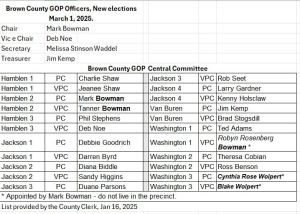
Brown County Republican GOP, Mar 1, 2025 Elections

Indiana Secretary of State – “Who’s On The Ballot” – Identify your District, Precinct, Township …
 
 
Your Precinct and District? The county GIS Map has a “layer” that identifies voter precincts. To identify Commissioner Districts, select “Index” and then County Commissioner Districts. 

Jan 31, 2025.  This post at Brown County Matters

Local Politics. Do you know the names of your PC and VPC? Do they live in your precinct? What happens on March 1, 2025?

There are 11 political precincts in Brown County. 
Republican Precinct Committeemen (PC) are elected in the primary in presidential election years. The Democrat elections for their precinct committeemen are in the off-years.

Elections for new officers (Chair, Vice Chair, Secretary, Treasurer) in the Brown County GOP are March 1, 2025. Precinct (PC) and Vice Precinct Committee (VPC) members are allowed to vote.

The Chair can and does appoint PC and VPCs” to fill vacancies, and these individuals do not have to live in the precinct. Although PCs can select their VPCs, many allow the Chair to make the appointments, thus stacking the deck to help control who gets elected
.
Vacancies – Elected Offices. Only PCs vote to fill a vacancy in an elected office. Blake Wolpert received 7/11 votes to fill the Commissioner Vacancy when Chuck Braden resigned.

So what? The Chair can influence who should run for office, be appointed to boards and commissions, who should even get county government jobs, and …. be considered “In Good Standing.” 🙂

Clark Responds to Ruling by Region 9 Republican Committee

Last updated: 02/09/2025

A slightly shorter version – without the references, of the post below was submitted to the Brown County Democrat for the Feb 4, 2025  edition. The Democrat limits submissions to 800 words.   Clark Response to Region 9 Decision.

This post shared at Brown County Matters.

Clark Responds to Ruling by Region 9 Republican Committee
The more extended version with references

After years of attending county government meetings and documenting issues, concerns, and challenges, I chose to run for Commissioner to contribute to improving the quality of services provided to Brown County citizens. I outlined my motivation and strategy on my campaign website, TimJClarkforCommissioner.com.

One of the challenges that I saw was the current leadership of the Brown County Republican Party, which is headed by Party Chair Mark Bowman. The one-party monopoly on power in Brown County leads to a centralization of power. This power can be abused and used to dictate policy by influencing (1) who will be supported as a candidate, (2) who can be selected to boards and commissions, (3) who can keep and get county government jobs, and (4) who should be appointed to fill a vacancy in an elected office.

My candidacy was challenged by Bowman, claiming “Incomplete & untrue candidate forms submitted. Not affiliated with the Republican Party.”  The Brown County Election Board refused to consider Bowman’s argument that I was not in good standing and confirmed that I met the criteria to run as a Republican.

Bowman’s contention was that I was an Independent as opposed to a Republican who has an independent mind. An Independent voter would include someone who votes for the best candidate despite political affiliation. In my case, I have consistently primarily voted for Republicans but have also very occasionally voted for a non-Republican who may have had a more conservative position on issues than the Republican candidate.

It is interesting that Mark Bowman shares this philosophy. In an interview after the 2018 county election, where Republicans swept the elections, he was interviewed and confirmed his support for independent voters:

    • “Even as a party chairman, Bowman said he doesn’t like to see so many voters choosing the straight-party option. To him, that shows voters lack knowledge about the candidates. The choice listed from one’s own party isn’t always automatically the best choice for the job, he said.”  “GOP SWEEP Nov 14, 2018, Brown County Democrat.

After I won the May primary, Bowman publicly supported an Independent Candidate – Greg Taggart, to challenge my candidacy in violation of Rule 1-25. Taggart has stated that he was a Republican running as an Independent. Taggart also identified that he was an independent voter:  In his closing comments at  the  League of Women Voters Candidate Forum, on Sept 21, 2024, he stated, 

    • “I am not a Republican, I am not a Democrat, do not put me in a category. … if you want to say I am a Republican, I am not that…” 

In December, I filed a complaint with the 9th District Republican Committee against Bowman for violating Rule 1-25. I was supported in the complaint by Rich Stanley, Charles Shaw, and Ben Phillips. Rule 1-25 states: “The term ‘Republican in Good-Standing’ shall be defined as a Republican who supports Republican nominees and who does not actively or openly support another candidate against a Republican nominee.” Many voters commonly choose to vote for the candidate that they believe would best serve the community. However, if you are in a party leadership position or an elected official, you should respect the documented rules of the State Party.  

On January 23, 2025, the 9th District Republican Committee held a hearing on my complaint. However, at the hearing, the District Officers ignored the arguments that I raised in my complaint. Instead, the District Officers put me on trial along with Rich Stanley without telling us that we were now the ones on trial instead of Bowman. We did not really even try to defend ourselves at the hearing because we had no idea that we were actually the ones being tried. We only realized what was happening after the hearing was complete and the District Officers issued their decision. In the decision, the District Officers dismissed my complaint against Bowman (which they never seriously considered). But they went even further than that by punishing me and Rich Stanley with bans preventing either of us from running as a Republican for a period of five years. Although the District Officers have no power to remove me from my current position as Commissioner of Brown County, if I had the desire to run for reelection in four years, I would not be able to run as a Republican if the Brown County Election Board supports this judgment.  (Reference: “Clark’s complaint against GOP county chair Bowman rejected”, by Dave Stafford, Brown County Democrat, Jan 27, 2025.)

The Region 9 Committee’s decision will be appealed. It will be interesting to see if the State Republican Party follows this illogical and deeply flawed decision.

At the hearing, Amanda Lowry, Chair of the Region committee, explained the unwritten rules that governed the committee’s decision:

  1. “The Republican Party is a Private Club with Rules.”
  2. You are NOT a Republican in good standing if you criticize the party or its members, vote, or donate money to a non-republican candidate—at any time in a person’s life.
  3. The rules can be selectively applied – as they were in this case.

Given this Region 9 criteria, President Trump could be considered a Republican “not” in Good Standing.

While we wait for a decision on our appeal, please remember that the election of new officers for the Brown County Republican Party is on March 1, 2024. The election is for the Chair, Vice Chair, Secretary, and Treasurer. If you want to see a positive change in leadership, contact your precinct and vice precinct committee members.

Tim Clark, Richard Stanley, Charles Shaw, Ben Phillips

County Council Special Meeting Notes, Jan 9, 2025. New financial advisor, Election for Council President.

rock em sock em robots

County Council Special Meeting Notes, Jan 9, 2025. New financial advisor, Election for Council President.  

Note: Commissioners are the executives of the county and are responsible for vision and policy. The Council is in charge of the money.

“And in this corner:”  Do we need a Patton (Kemp) or an Eisenhower (Huett), the Marines (Kemp) or the local community organizer (Huett)?

An interesting meeting with a few fireworks and a smart bomb or two that may be boiled down to the campaign for the election of the next Council President and the financial viability of the county. 

The next Council Meeting is Jan 21, 2025 at 5:30.  Should be pretty interesting. Tickets are still available (satire).

The play-by-play 
This post at Brown County Matters

New Financial Advisor.

The council contracted with Reedy Financial Group, which can provide additional support to help identify the systemic improvements needed for the county to better manage our finances and budget.  Kemp led this initiative.  I participated in the interviews and am confident the commissioners can get the help we need to include managing capital improvements and better management reports. 

The county is going through a major financial transformation. Over at least the past 10-15 years, the budget was developed with a one-year perspective. It is pretty easy to submit a balanced budget with the state: Overestimate revenues, underestimate expenses, and jump through hoops over the next year to cover needed and unplanned expenses. These could average anywhere from 400-600K per year. Over the last few years, the Rainy Day fund was reduced from around 2.5 million to as low as 70K, and money was drawn from other funds as well. This situation contributed to reducing the county’s credit rating, 

As a result of COVID-19, the county received an influx of federal dollars that masked, if not exacerbated, our financial challenges.

Kemp led the charge to develop and get agreement on the following goals:

  1. Maintain 15% cash reserve balances 
  2. Annual expenses not to exceed 90% of revenues
  3. Highway and Health Departments are required to operate within their own budgets 
  4. Rainy day fund balance of $2.5 million 
  5. Health fund 4700 with a reserve balance of $1 million 

Capital Improvement.  County elected leadership (council and commissioners) have refused in the past to develop a capital improvement plan for needed repairs and replacements.  Commissioner Sanders started work on developing this plan, starting with identifying the property that we are insuring.

PLAN, WHAT PLAN? A five-year comprehensive “financial plan” was developed a few years ago  (by the commissioner’s office) at the cost of 30K that sat on a shelf and, after one or two annual updates, was abandoned. I never heard it discussed at a council or commissioner meeting.

CAN YOU SPARE A DIME?  The county routinely borrows money (3 million last time, 4 million last year) to cover capital improvement expenses. The debt is funded through higher property taxes, and since the tax rate remains relatively the same (referred to as tax neutral), taxpayers do not notice any changes.

POWER Corrupts. We have a one-party monopoly on political power, and the lack of competition contributed to the election of a few candidates who did not have the passion, interest, time, or insight to understand what was going on. The centralized power in the hands of the few influences who can run for office, get selected for boards and commissions, and even get a county government job. Those who go along to get along can have jobs for life and avoid being shunned or blackballed.   

ELECTION – COUNCIL PRESIDENT

Jim Kemp started his term on council in 2022 and has a financial background. He may be one of the few elected officials who understand the concept of modified accruals.  The county government operates on a cash (fund) accounting vs. accrual basis. Accrual basis accounting is the common method in the private sector. Modified accruals support identifying the expected expenses in the following years.

For instance, assume you have a 5-year, 500,000 contract that is payable at 100,00 a year. The budget will only show the one-year liability – not that you still have another 400K to go.

GOALS. Kemp actually identified specific financial goals in his campaign strategy. I am not aware that another councilman has ever identified a “DOCUMENTED strategy but some can talk it to death.  Anecdotes and hyperbole are the strategies chosen by a few. If you are a preferred candidate of the local GOP, you get elected without breaking a sweat or being held accountable for results.

The exception to this situation would include Commissioner Ron Sanders and myself. We are definitely not on the preferred candidates list.

Kemp also developed a financial strategy for the county; No one questions his commitment, competence, and passion for getting us on solid financial ground. But we all have our downsides, and sometimes his passion can come across as anger to some. And he does tend to use more words than may be needed to make a point.  If his comments were recorded and transcribed, we would have a few pretty good books on the strengths and weaknesses of our culture and our financial system and challenges.

Kemp and Huett pointed out each other’s respective strengths and weaknesses.  Huett considers himself as a ‘facilitator.”  He likes working quietly behind the scenes. Huett provided support (the 4th commissioner) to the commissioner’s office which did not include the participation of Commissioner Sanders. Huett was involved in the staffing changes in the commissioner’s office, highway department personnel changes, recruiting and contracting for a construction manager (owners rep), the initiation of the county comprehensive plan, and liaising with the various interest groups in the county, such as the Brown County Community Foundation. The BCCF has opted to get more involved in local politics. Kemp reinforced that these are more liaison functions and not the primary responsibility of the Council President.

These liaison activities by Huett contributed to a situation where a 2025 budget was submitted to the state before the county council voted to approve it. The lack of attention to the job also led to non-compliance with previous policies regarding the process for reviewing the timely review of the budget.

Even more concerning, end-of-year appropriations were not passed by the end of the year, which leads to the reporting of account deficits that will be an audit finding that will reflect badly on the auditor. The auditor, repeatedly called out the council for not making timely decisions that caused chaos with the financial reporting and took time away from addressing more critical needs within the office.

The Council will have a choice to make on the direction of the county in 2025. It should be a good meeting – Jan 21, 2024, 5:30-7:30.

‘In God We Trust’ Returns to US Classrooms; Bible in Curriculum

Billy Graham: America at the Crossroads, by Billy Graham | September 21, 2020 | Billy Graham

    • As in the last days of Rome, Christianity to many people today has faded into mere form, lost its relevance to life and holds no central allegiance in our lives. When a nation loses its faith, it loses its character. When it loses its character, it loses its purpose for living. And when it loses its purpose for living, it loses its will to survive.
    • I am convinced that America stands at the crossroads of her national destiny. One road leads to destruction, and the other leads to prosperity and security. Most are going down the broad road that leads to destruction. We are going the way of Rome rather than the way of the cross.
    • Many will blame the Republicans or the Democrats. But it is the American people as individuals that should take the blame. We backslide as individuals before we begin to decay as a nation.

Dec 31, 2024, CBN.  ‘In God We Trust’ Returns to US Classrooms, Here’s How It Became Our Official Motto, Benjamin Gill

    • Over the past few years, a movement has sprung up to remind Americans of our national motto in a variety of settings from public school buildings to law enforcement vehicles.
    • One of the latest examples this year was in West Virginia where the legislature voted to require state schools to display “In God We Trust.” 

    • When asked if the move was constitutional, state Del. Tom Fast told West Virginia Watch, “This is our national motto, ‘In God We Trust,’ and it has been litigated, and it has been upheld. We can display our national motto in public schools and in our higher education institutions.

    • The move in West Virginia came after Louisiana passed a law last year that requires the U.S. national motto to be displayed in every public school classroom. Other states that have adopted similar policies in recent years include Texas and South Dakota.

June 27, 2024. “Oklahoma state superintendent announces all schools must incorporate the Bible and the Ten Commandments in curriculums, By Alaa Elassar, CNN

    • All Oklahoma schools are required to incorporate the Bible and the Ten Commandments in their curriculums, effective immediately, the state’s chief education officer announced in a memorandum Thursday.

    • At a State Board of Education meeting, Oklahoma State Superintendent of Public Instruction Ryan Walters said the Bible is “one of the most foundational documents used for the Constitution and the birth of our country.”

    • “It’s crystal clear to us that in the Oklahoma academic standards under Title 70 on multiple occasions, the Bible is a necessary historical document to teach our kids about the history of this country, to have a complete understanding of Western civilization, to have an understanding of the basis of our legal system,” Walters said.

    • Every classroom in the state from grades 5 through 12 must have a Bible and all teachers must teach from the Bible in the classroom, Walters said.

Election 2024: The Local Political Dramas – For the Record

Last updated: Nov 6, 2024  

clark bc3 2024

Nov 5, 2024. Election results: Clark wins Brown County commissioner race, Brown County Democrat.

My last campaign letter (link below) will be published in next week’s Democrat (Oct 30, 2024). It provides a little context on the local political drama this election and reinforces the importance of your vote in determining the direction of the county.

Additional Detail – the “longer” post.

Election 2024: The Local Political Drama,
by Tim J. Clark
Republican Candidate for Commissioner, District 3

The local elections in Brown County are a little different this year. The campaign strategy posted at timjclarkforcommissioner.com reinforced that a monopoly on political power leads to a centralization of power that is almost always misused.  

As a conservative and someone who consistently votes in the primaries as a Republican, I opted out of an association with the local GOP organization in 2017 that functions more like a club.  The leadership did not welcome debate on positions and hijacked conservative values and principles for the benefit of a few.  Reference: The Case for Change: Part 2: Problems, Challenges, and Capabilities. This assessment was validated in the 2024 election when the “club” chose to support an independent candidate.

I created the Independent Voters of Brown County IN website to share more in-depth information on county issues and challenges and to develop non-partisan support for improvement.  I also post information on the Facebook group Brown County Matters. 

My unwavering commitment to voters is that through transparency, accountability, and continuous improvements, we can make the necessary changes to sustain and improve the quality of government services, giving you the confidence that your voice is heard and that your concerns are addressed. Sep 25, 2024.  Letter: Brown County Democrat – Tim J. Clark  

Significant changes and improvements at the county level require non-partisan approaches, open communication, as many public meetings and working sessions as needed, and the application of a collaborative decision-making process that can result in the best solutions for the county.

County Political Organizations.  Most voters are not aware of the local political structure and dramas. This lack of awareness, often fueled by voter apathy, is a serious issue. It contributes to an imbalance of power where a few believe they can get by with anything. Power corrupts and can be more addicting than drugs.  The fact that the local paper – The Brown County Democrat, stopped covering county government meetings reduces another source of needed oversight and transparency. This policy may change with the recent hiring of a new editor.  

    • Case in Point: The Indian Hill Road and Railroad Crossing was closed without a public hearing or notification to the residents most affected. A settlement agreement with the Indiana Railroad Company was signed before the commissioners voted to close the crossing. The alleged ambiguity regarding public hearings was rectified by the Indiana Legislature, which now mandates a public hearing. 

The local political parties are led by a four-member committee consisting of a Chair, Vice Chair, Secretary, and Treasurer. The election for these four (4) positions in the republican party is in March, following the November presidential election. There are eleven (11) precinct committeemen elected every four years in the primaries.* The precinct committeemen, or the chair, can appoint the vice precinct committeemen. This group represents the “Central Committee.”  *One Republican precinct has no chair or vice.  

Mark Bowman is the chair. His wife, Robyn, is an administrator who attends county government meetings. They own Tramcore Realty and are public advocates of taxpayer-funded development. This relationship can create a perception of a conflict of interest when elected officials support developments that the community may oppose.  

The Chair, along with a select group of loyalists, wields significant influence in determining who should (1) run for office, (2) be appointed or re-appointed to boards and commissions, (3)  who should get and keep county government jobs, and (4) who should be appointed to fill a vacancy in an elected office.  The precinct committeemen, on the other hand, have the power to vote on a replacement when a vacancy occurs in an elected position.

Power Corrupts. The assessment of the misuse of power in the local GOP  leadership was confirmed after the 2024 primaries when the preferred candidate (Jerry Pittman) was defeated.

The GOP chair shifted support to an independent candidate that he may believe would better support his agenda. The Chair then leveraged other Republican elected officials and candidates for office to support the strategy. To add to the drama, other elected officials who believed they should be in charge of the party’s direction saw the opportunity to gain control and power within the party. The few in this group also support the independent, who they may also believe will not challenge their personal agendas.

Game of Thrones. The drama in Brown County is similar to the popular HBO series Game of Thrones, where different factions compete for power and dominance to the detriment of the citizenry. What a disservice to Bown County voters and a waste of time and energy that could be better spent better serving the community.

Going Rogue – Republican in Name Ony (RINO).   The local GOP decision to go rogue defies State GOP party rules. Rule 1-25 defines a Republican “NOT’ in Good Standing as someone actively or openly supporting another candidate against a Republican nominee. 

    • Everyone is expected to vote for the best candidate possible. However, if you are in a Party leadership position, you are expected to support the candidates that are elected by your voters in the primary. Another option is to resign from your position.

Indiana Republican GOP – State Races.  A county chair supporting an independent got the attention of the State GOP officials. Encouraging straight-ticket voters (the majority) to split their ticket to vote for an independent candidate may result in fewer votes for state and national candidates. Specifically, this may result in Indiana House Representative Dave Hall (R), District #62, from being re-elected. He only won by 73 votes in the last election.

Commissioner Race. Adding to the drama is an optimistic expectation that an independent (with some name recognition but little if any knowledge or experience in county government) could pull enough votes to either win by pulling enough Democrat and Republican voters or help the Democrat candidate to get elected. The Democrat candidate may be seen as more accommodating to one or more of the respective agendas. 

Gaming the Vote

Straight-Ticker Voters and Independents.  The odds are that straight-ticket Republican voters will elect the Republican candidate (Tim J. Clark), who may also get votes from independents and Democrats.   Straight-ticket voters can have the confidence that the primary voters who may have more knowledge of local politics, selected the best candidates for the positions.

I define an independent voter as someone who supports a non-partisan approach to resolving county issues. This contributes to developing the best solutions for the county. Regardless of political affiliation, we can find common ground on issues that include the quality of government services, the condition of roads and bridges, balancing the budget, saving for a rainy day, and public health and safety.

Previous Elections. When current commissioner Ron Sanders (District 2) defeated two-term incumbent Diana Biddle for commissioner in 2022, Mark Bowman unsuccessfully attempted to recruit a popular Democrat to run against Sanders as an Independent. The independent candidate who did run without the party’s visible support received 740 votes. 

Commissioner Sanders’s performance on behalf of all citizens has validated the voters’ judgment that he was the best candidate for the position.

    • 2022 Election: Sanders earned 3,281 votes, Democratic candidate Stephanie Kritzer received 2,324, and Independent candidate Jeff Harden received 740 votes. (Ref:  BC Democrat).

Qualification and Experience of the Candidates

The candidate’s websites, Facebook pages, and forum hosted by the League of Women Voters on September 21—which is available on YouTube—can provide voters with insight into the candidates’ qualifications and experience.

A Way Ahead.  I appreciate your vote and will work to implement the best solution for the county. This goal can be supported by communication, holding as many public meetings and working sessions as needed, and applying a collaborative decision-making process where all voices are heard and addressed.  

Regardless of the outcome of the November election, Republicans should support needed changes in the local GOP leadership. New elections are held in March 2025.

Tim J. Clark
Republican Candidate for Commissioner, District 3
TimJClarkforCommissioner.com