All posts by Tim J. Clark

Courthouse Project – June 5, 2018 Commissioner’s Meeting

At today’s commissioner’s meeting, one of the agenda items was on the “next step” regarding the DLZ Justice Center Feasibility Study that was presented on June 4.

The “perception” I had from Commissioners Biddle and Anderson was that nothing more was needed.  Jerry Pittman reinforced that they do need to hold a public meeting and try to get as many people to attend as possible in order to build consensus for the project. Beth Mulry – County Auditor made an excellent suggestion that meetings need to be conducted throughout the county in order to explain the need and gain support for this project.

I pointed out that the June 4 presentation did NOT identify a compelling need for this project.  I also stated that if they approved this project based on the presentation, I would sign the remonstrance petition and collect as many more signatures as I could.

Jerry asked good questions and I provided him information on a suggested county decision-making framework that does provide an outline that supports a decision.  Jerry and I will be meeting to review the process as it applies to the Justice Center project.

Note that DLZ did identified “next steps” for the project on page 46 of their presentation that includes: “Determine Financial Options – How to Fund” and “Generate an Awareness and Build a Consensus – Public Outreach.”

 Determine Financial Options – How to Fund

Umbaugh and Associates were contracted to identify funding options. Their report “DOES NOT” provide a context that identifies the total financial impacts on citizens.  They identify that the debt could range from 10-12 cents  per hundred dollars of assessed value.  Fact is that this is another line item added to property tax bills. For instance, from 2012 to 2017:

  • County Property Tax rates increased by 33%.
  • County Total Tax Levy increased by 40.4%.

On funding, I provided a hand-out at the June 4 meeting that provided key points on Brown County taxes economics.  The SPIN that the debt will only cost 10 – 12 cents per hundred dollars of assessed value is misleading.

My handout (included enclosures) provided at the June 4 Meeting: June 4 DLZ Commissioner and Council Joint Meeting

Again, this debt will be another line item added to our tax bills that continue to increase. It will also move us up to number 2  for having the highest debt per capita in the state.  And we currently have the 5th highest income tax rate in the state.

Further, the property tax system can result in annual adjustments in assessed value that can lead to higher property taxes. Higher taxes are needed to support higher spending that is approved by the county council and endorsed by the commissioners.  Other counties in Indiana are managing to live within their means without excessive borrowing and increasing taxes. Why can’t we?

Generate an Awareness and Build a Consensus – Public Outreach

To prevent a successful remonstrance, Commissioners and Council have to make a credible case that would address at least two major issues:

  • Given our economic situation, tax levels and trends, debt, and  projections for a declining an aging population, that this project is “affordable” without an undue financial burden on the taxpayers and,
  • There is a compelling need that a new Justice Center is critical and is the best and most practical option.

Options could include the following:

  1. Status quo — make need repairs and renovations to the existing facilities.
  2. Make needed repairs and renovations now to the existing courthouse and budget for ongoing maintenance.   If the prosecutor’s office needs to be replaced, then increase the size and re-build at the current location.
  3. A new Justice Center.
  4. Review the feasibility of buying and renovating the Peaceful Valley Hotel.
  5. Lease space in the Professional Building.
  6. Other …?

Proposed New Courthouse and Government Offices

Update from the June 4, 2018 Presentation by DLZ  – Part 2 of the Proposed new Justice Center

The scope of the presentation was on Plan A – a New Justice Center.  Questions were raised about the needs as well as the other options (Plan, B, C, D) that were considered.  Other options would include making needed renovations to the existing courthouse and repairing or replacing the prosecutor’s office.

Commissioners and Council stated that there would be further community meetings in order to develop a consensus that a new Justice Center is the best option for the county.

Debt that exceeds 5 million is subject to a remonstrance.  This option was not possible with the Maple Leaf project because the collateral was the innkeeper’s tax and not general funds.

About the Project

County Commissioners and Council are supporting a current proposal to build a new courthouse that will include additional government offices. The project is being marketed as a Justice Center. The old courthouse will also be re-purposed to include additional county offices as well to include new individual offices for our “part-time” commissioners.  Financial estimates and current budget practices identify that these projects will result in more debt and higher taxes.

The growth in local government spending, debt and increase in the number of government employees is in conflict with the projection from the State that we are losing population and the population we retain will be older.

Commissioners were clear on their intent for the project. They selected a firm (DLZ) with a history of designing new courthouses. They also hired a financial consultant – Umbaugh and Associates to identify financing options.  Commissioner Biddle reinforced Umbaugh’s opinion that the  “ideal time” to bid out a project would be at the end of 2018, get a bond and start construction in 2019.”

The joint meeting of the Commissioners and Council will be on June 4 at 5:00. Topics will include projected costs and financing options of new infrastructure projects. DLZ will present at 6:00. This will include their recommendation on the Justice Center and renovation costs of the old courthouse.

The previous attempt by the Commissioners and Council to borrow up to 8.25 million for a 17,400-square-foot addition to the old courthouse was defeated by taxpayers through a remonstrance.

UPDATE/CORRECTION:  A  remonstrance “IS” an option for taxpayers on this project because the loan will exceed $5 million.

The first presentation by DLZ on May 2 identified the “solution” —  a new “Justice Center”  which included a new courthouse and government office space.  DLZ did not provide details on the problem.  Details would include a thorough analysis of alternatives, workload counts, and trends, and economic projections to assess the affordability of this project on county taxpayers.

On finances, a critical consideration is the need (if available) to review the county’s capital improvement plan and budget.  This should include all infrastructure related needs and gaps.

The “ASSUMPTION” by the commissioners and council is that the costs associated with the additional debt will not have a significant impact on taxpayers.  Further, the upkeep and maintenance costs of the new projects have not been identified.  There are also overzealous assumptions regarding economic development.

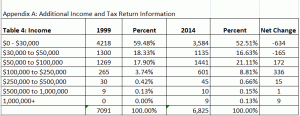
The 2017 income survey identified that 53.1% of residents fall in the low to moderate income level.  As mentioned previously, Brown County is expected to lose population and the population we retain will be older which leads to decreases in the tax base.   This results in fewer people paying more in taxes and operating costs.  Consequently, any new debt and maintenance costs will result in higher taxes on the remaining population.

Finance Facts:

  • Brown County has the third highest debt per capita in the state
  • We have the 5th highest income tax rate.
  • From 2012 to 2017:
    • County Property Tax rates increased by 33%.
    • County Total Tax Levy increased by 40.4%.
    • Certified net assessment (from which property tax is derived), increased cumulatively by 5.5% which is below the inflation rate.  This contributes to the need to raise income and property taxes.

References:

Courthouse Project

May 2, 2018.  Consultant Presentation:  New Courthouse and Government Offices  – AKA  – Brown County 2018 05-02 DLZ Justice Center Feasibility Study

  • Note that DLZ can bid on any projects that are generated from the study.

Brown County Democrat

  • May 15, 2018.   Agency recommendation after study: Build new justice center
    • An agency hired to examine the future of the historic courthouse in Brown County has offered two suggestions to the Brown County Commissioners and Brown County Council.
    • Those are to move court offices to a new building that would be built next to the Brown County Law Enforcement Center and move some county employees into the current courthouse after it is renovated.
  • Jan 23, 2018.The people’s court: Courthouse project needs public input, firm says
    • The agency hired to study the future of Brown County court operations wants to make two things clear:
      • No. 1: The people need to drive this project, and; No. 2: Whatever it ends up being, it needs to be something taxpayers can afford.
      • “I can’t stress this enough: The solution at the end of the day can’t be that we’re going to build this huge facility that’s going to meet the community’s needs for 50-plus years, but we can’t afford it,” said DLZ principal architect Eric Ratts
  • Jan 6, 2018Courthouse feasibility study kickoff meeting date set . A group will meet to discuss the next steps in what to do about the historic Brown County Courthouse next week.
  • Oct 17, 2017. Another annex? New study being done on courthouse future. For the fourth time in eight years, a study is being done on making changes to the historic Brown County Courthouse. This time, the study also will look at building a new, separate county annex building somewhere in downtown Nashville.
    • Biddle said that Umbaugh, the county’s financial consultant, said the “ideal time” to bid out a project would be at the end of 2018, get a bond and start construction in 2019.
    • The Brown County Commissioners and Brown County Council went ahead with plans to borrow up to $8.25 million to build a 17,400-square-foot addition. But taxpayers soundly defeated that proposal with a remonstrance, and citizen committees began studying other options.

Indiana Public Media: wfiu, npr, WTIU

County Website – General Information Including previous Courthouse Studies and Proposals:

Taxes and Spending on an Upward Trend

Taxes and Spending on an Upward Trend —  So What?

  • Given the enthusiasm that commissioners and council have expressed regarding new spending and debt for infrastructure projects, a Justice Center and a major Courthouse renovation, might want to ask our incumbent elected representatives what the targeted tax rates are for income and property taxes in the near, mid and long-term.
  • I just checked on how the county income tax rate compares with other counties:
    • Effective Jan 1, 2018, we now have the 5th Highest Income Tax Rate in the state.
    • Although the county is among the lowest in the state on property tax rates, since 2012:
      • Tax rates increased by 33% and the County Total Tax Levy increased by 40.4%. Certified Net Assessment (from which property tax is derived), increased by 5.5% which is below the inflation rate. This contributes to the need to raise income and property taxes.
  • And, we have the third highest debt per person in the State, we’re projected to lose population and the median age of residents is expected to be among the highest in the state.

A way ahead? Better leadership, planning and community engagement to address our challenges.

2017 Local Taxes and Finances

Covers: Taxes (property, levies), Budget and Expenditures, Employment

Source: Indiana Gateway – Local Tax + Finance Dashboard You can also generate reports by Township and the Schools.

See also:

Indiana Property Tax – Facts and Impacts

March 2013  Annual Adjustment of Assessed Values
FACT SHEET  AnnualAdjustmentsFactSheet

Nov 2, 2010. Indianapolis Business Journal IBJ – Indiana voters OK property tax cap amendment.   Indiana voters have approved a constitutional amendment that will make property tax limits more permanent. The caps limit property tax bills to 1 percent of homes’ assessed values, with 2-percent caps on farmland and rental property and 3-percent limits on business property.

Assessments do not factor in inflation. If incomes are not keeping pace with inflation, more frequent assessments can lead to increases in property taxes.  These additional taxes are added to the additional payments to cover the taxes that are added by the county council and townships along with payments on the county’s debts.  Brown County has the third highest debt per capita in the State.

May 16, 2017. Report: Local taxes, job options need further scrutiny, By Sara Clifford, /Brown County Democrat.

  • The data confirmed what many Brown County officials and residents had already known. Brown County’s population is aging and shrinking.
  • Fewer people results in a higher tax burden to support government services, unless the government is able to reduce its expenses.

Brown County Population Projections 2020-2050

census, 3D rendering, street signs


IndyStar – Data Central – Decennial Census – Brown County

  • 2020 Census – Population 15,475. This is an increase of 1.5% in 10 years. The state (Stats Indiana – see below)) projected a 2020 population at 15,394 (81 lower) with a consistent decline through 2050. The 2050 population projected at 12, 785.

Stats Indiana Brown County Population Projections 2020-2050 

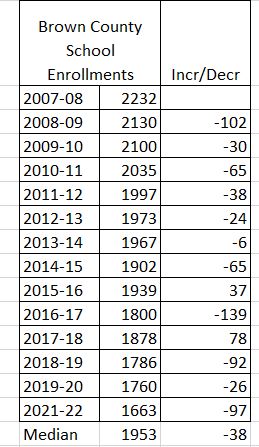
Brown County School Enrollment

BC School Enrollment 2008 - 2022

What is a business plan?

In my letter to the Democrat that was published with the title: Maple Leaf – ‘Stop Digging’,  I reinforced that the commissioners and council approved this project without reviewing the “complete” business plan at a public meeting.

When inquiries are made regarding the business plan for the Maple Leaf Performing Arts Center project,  local government officials refer you to the “The Plan”  available on the Maple Leaf website. THE PLAN – Maple Leaf Performing Arts Center of Brown County 

This “presentation” is not what is commonly referred to as a professional “Business Plan.”   The basic requirements for a plan are provided by the Small Business Administration —  Write your business plan

A simple example of a business plan for an entertainment venue is available at Example – Music Theater Business Plan  

Maple Leaf Schedule of Cost Breakdowns

For the curious minded, the auditor’s office has a copy of all the loan and contract documents. You can start with “Series 2017A Note Purchase Agreement.  Link to the budget approved by the bank that identifies the “Schedule of Cost Breakdowns-Hard Costs and Soft Costs:  Maple Leaf Hard and Soft Costs

The Maple Leaf Management Group meets Wed, May 9 from 2:30-4:40 at the County Office Building – Salmon Room.  Agenda should include information regarding the BID and compliance with the budget approved by the bank.

The final decision regarding acceptance of the Bid is made by the county commissioners.

Declaration of Interdependence

Interdependence Defined:  the state of being dependent upon one another.

My response to a Facebook post at Brown County Matters regarding a concern for unplanned change:

  • Maple Leaf,
  • Proposed Septic Ordinance,
  • Regional Sewer Board’s request for 270K that they referred to as “seed” money,
  • The Van Buren Fire Department issue to include the emergence of Southern Brown VFD,
  • The “massive” steel bridges for the Salt Creek Trail and eminent domain issues,
  • Increase in “riverfront” liquor licenses,
  • The “Justice Center,”
  • Republican party monopoly on power, and systemic resistance and refusal of elected representatives to involve the citizens in economic, comprehensive and strategic planning.

Good plans would provide the context for all of the above IF SUPPORTED BY THE CITIZENRY. P.S. Policies that lead to increases in taxes do represent an economic hardship for those with fixed and modest incomes (at least 53.1% of the population).

An easy fix: Vote independent of political party. Elect commissioners and councilman that support planning with citizen involvement that will produce results, where we all benefit or at least, are not any worse off.

Suggested Platform and Principles for Independent Voters


Financial Decision Support Model – IU Student Support

A presentation by Indiana University (IU) graduate students from the School of Public and Environmental Affairs (SPEA), Masters In Public Administration (MPA) program was conducted on  May 18, 2018, 6:00 p.m. Salmon Room, County Office Building.  Description of the presentation provided below.

This was the second in what we expect to be a long-term project that will provide citizens and their elected representatives with the information and knowledge needed to make competent financial decisions.  From 2018 thru mid-2021, work was continued by Jomar Floyd (IU student/now alumni) and Tim Clark on a proposal to support financial management and modeling.  Constraints on forward progress included Covid, the county’s implementation of a new financial software system, and a new Redevelopment Commission (RDC) project to collect and analyze  property data contained within the the county’s GIS system.

We are grateful for the support of IU and the SPEA/MPA Program. The 2018 report includes an outreach to the other academic disciplines that help leverage needed resources. It also includes a recommendation to request support from the IU Center for Rural Engagement …  who “works with community partners to design and implement innovative approaches to the opportunities and challenges facing rural Indiana.”

At the county level of government, we can provide the data. But, we are a small a small county. We don’t have the capability, resources or expertise to develop and sustain a model. Other rural counties may be in a similar situation.

July 4, 2018. Brown County Democrat.  IU students discuss how data can guide county’s financial decisions by Sara Clifford. A group of Indiana University graduate students spent last semester studying Brown County’s tax structure and other variables. Their goal was to help county leaders develop tools to forecast how changes in taxes, spending, and the county’s economy will affect taxpayers and local government — a “county financial and decision support model.”

  Description of the 2018 Presentation 

Are county revenues and costs trending up or down?  When will tax increases be needed or can we reduce taxes?  What will be the financial impact of the projected declines in population? What might be the financial impact of any economic development plans? Will development strategies lead to increased revenue from property and income taxes?

2018 Project. Graduate students from Indiana University’s School of Public and Environmental Affairs (SPEA), Master’s Public Administration (MPA) program, will be providing a presentation on a prototype for a Brown County Financial Decision and Support model. This model forecasts revenue and expenditure and estimates the effects of changes that the tax structure will have on revenue and expenditures. The first step is developing a forecast model for Brown County’s two largest revenue sources –  Local Income Tax and Property Tax.

The presenters are Jake McVeigh, Jomar Floyd, and Chase Burton. In addition to Jomar and Chase, the database management team consists of Kristen Hurns and Sara Dobbins.  The students were supported by Professors Duncan Denvil and Roger Morris.

2017 Project.  This project is a follow-on project that builds on the findings and recommendations identified in an analysis conducted by a 2017 Graduate SPEA/MPA class. Students Liza Bartlett, Daniel Lopez, and Drew Sherman developed their report and presented their finding to members of the Redevelopment Commission (RDC), county council and the public:  Report: Local taxes, job options need further scrutiny.

A better model for assessing economic sustainability is critical for providing Brown County with the feedback needed to assess the effectiveness of community and economic development plans. This project was supported by the RDC and community members Tim Clark and Brandon Harris.

More Information