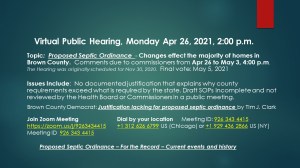
 Updated (edits) May 13, 2021
My comments provided to the Commissioners requesting a NO vote on the Proposed Septic Ordinance. PDF copy 2021_05_03 Comments Septic Ordinance F01
The ordinance was passed on May 5, 2021, on a vote of 2 to 1. Specific responses to the written comments provided by citizens identifying questions, concerns, and recommendations were not discussed. Commissioners Pittman suggested a two-week delay to allow time to review the comments and provide a response. His request was refused by Commissioner’s Biddle and Braden.
Comments Provided to Commissioners – May 3, 2021
TO: Brown County Commissioners
From: Tim Clark, County resident, and volunteer – Brown County Leader Network
Subject: Comments – Proposed Septic Ordinance and Supporting Report
An ordinance that has significant impacts on most residents in the County should not be passed without a unanimous vote. Comments and questions provided by citizens should also be addressed.
The vote for this Ordinance should also be supported with documentation that justifies the requirements that exceed the state code. Otherwise, as Commissioner Pittman has stated, stick with the state code. When the State proposes changes to the Indiana code, there are numerous public hearings and vigorous discussion and debate to include the identification of any legal ramifications. County citizens were not afforded a similar opportunity to understand the justification for the additional county requirements.
Justification for exceeding the state requirements should include cost, benefits, risks, and a respective mitigation strategy. This standard would meet a level of due diligence expected by the citizens you have been elected to serve. The expectation for an ordinance should include outcomes where everyone benefits or are not worse off in the long-term. This version of the Ordinance does not meet this standard.
I will continue to reinforce that a better process is needed that would result in an ordinance that all of the commissioners can support. An outline of a process I have shared with you has been developed by the Brown County Leader Network (BCLN). This program was developed with a grant from the Office of Community and Rural Affairs (OCRA) to support the Hometown Collaborative Initiative (HCI). Commissioner Biddle initiated the application for the grant, and Commissioner Pittman provided the opening presentation to the HCI selection committee. Commissioner Dave Anderson also supported the initiative.
The BCLN team unanimously selected Leadership (as opposed to Economic Development or Placemaking) as a needed area for improvement. This decision is reinforced by the divisiveness that is associated with this proposed Ordinance and very likely community efforts to repeal if it receives a “Yes” vote. The process for developing a stakeholder analysis would reinforce the flaws and weaknesses in the Ordinance and the processes used to develop it.
I’ve included a copy of my statement I made at the Public Hearing on April 26 (encl 1) along with more specific comments that I included in the proposed Ordinance (encl 4).
Since the “Report” (Septic Ordinance for Brown County, Indiana), written by some members of the Health Board and Septic Committee, was provided to the commissioners to support a “Yes” vote on the Ordinance, this becomes part of the record. The Report represents a misleading narrative that intersperses facts with speculation, anecdotes, opinions, and assumptions. My comments on the Report provided in Encl 3. The Report reinforces a misleading narrative of an “environmental nightmare” used in the past by the Health Department to justify a proposed ordinance on septic management, the creation of the Brown County Regional Sewer District (BCRSD), and the proposed Bean Blossom Sewer plant.
I also provided an introduction to a stakeholder analysis (encl 2) to raise awareness of just some of the stakeholders and their possible if not likely interests regarding the motivations for this Ordinance.
In summary, I support Commissioner Pittman’s recommendation that an ordinance be limited to following the state code. Any additional requirements that exceed the code should be justified to include the cost, benefit, and risk. Further at a minimum, a stakeholder analysis should be developed to help better understand citizens’ concerns and expectation and help support any future improvement strategies.
Respectively,
Tim Clark
Enclosures:
(1) Statement made at the Public Hearing on April 26, 2021
(2) Introduction – Stakeholder Analysis. Groups and Competing Interests
(3) Comments on the “Report” developed by members of the Health Department and Members of the Septic Committee.
(4) Additional comments on the Proposed Ordinance – in caps and highlighted
Enclosure 1 Tim Clark — Statement – Public Hearing Apr 26, 2021
As you may recall, I wrote a two-part article in the Democrat last November on this proposed decision and shared it with the commissioners. The title of the columns was “Justification lacking for proposed septic Ordinance. Nothing has changed since then. There have been no published challenges to anything I said or recommended.
The phrase “Nothing personal, just business” was made famous in mafia movies before someone got whacked. To paraphrase this a little, my comments are nothing personal; it’s the process that needs to be wacked and buried.
About this time four years in ago 2017, Commissioners met with members of the Health Board and those working on the Ordinance in a “working session.” I said the same thing then as I am now – identify the unique requirements to Brown County and provide a justification that would include costs, benefits, and risks.
I also reinforced the value of Standard Operating Procedures (SOPs). SOPs would cover both operations to help ensure consistent enforcement and administration. Administrative SOPs (guidance) would address the ambiguities in the Ordinance. For example, the use of the term “may” was used 13 times and identifies the need to include the decision criteria to help prevent selective enforcement, litigation, and abuse of power.
In my government career, if I recommended to an executive to approve a policy like this, I may have had at least 50 pages of supporting documentation with links to another 1,000 pages. The purpose would be to make the case that the solution aligns with the problem, and citizens would not be adversely affected by the change.
Another issue that came out during these meeting in 2017 was the tendency for the proponents of a new ordinance to sprinkle in a few facts along with their assumptions, opinion, and speculation on health and safety-related issues. This can result in invoking fear by scaring people as to a threat in order to obtain their support for change. This approach was taken again with the “Report” developed by the Health Board and members of the Septic Committee that was shared with the commissioners and posted in the Democrat.
The overall experience back in 2017 led me to help support the development of a community and county decision-making process that I have shared with the commissioners and the Health Board. It is included in the support materials for the BCLN. Maybe now is a good time to apply the process in phasing in any needed changes to the Ordinance. For the record, I will be providing written comments on the process, the Ordinance and the Report.
It may take only two (2) votes to pass this Ordinance, but it also only will take two votes to repeal it if it is passed. I hope the Commissioners will support getting it right and will perform their due diligence on behalf of the citizens they serve.
Tim Clark
Enclosure 2 – Introduction – Stakeholder Review and Assessment
Any proposed change should result in outcomes where everyone benefits or at least, are not any worse off in the long-term. Meeting this standard requires that you identify the stakeholders, their needs, expectations, and the feedback they need to assess results.
Below is an “introduction” to some stakeholder groups affected by the proposed septic Ordinance and their possible interests. A formal session would obtain this information from each group and the results documented.
This “introduction” is followed by a “Getting Started” assessment developed through the Brown County Leader Network.
Competing Interests (Stakeholder/Interests)
Homeowners with Functional Septic Systems. A functional and cost-effective septic system that, when maintained has an indefinite life.
- With a projected decline in population in Brown County, this group represents the potential new market for sewer service for existing and new plants.
- Municipal and Regional Sewer Districts can force hook-ups and although waivers can be granted functional systems, they are only temporary.
Homeowners with non-functional or marginal systems. Pump and Haul can be a temporary solution for residents whose properties will not support a new system. Sewer service may be needed for these residents.
Sewer Plant Managers. A functional system and a growing customer base that can stabilize the increases in expenses as a result of long-term maintenance costs.
Sewer Plant Customers. Reliable and affordable service. The recommended target for a monthly fee by the State is $65.00. The current rate in Helmsburg is $92.50 due to an aging system and a loss of customers.
Property Developers. An expansion of sewers that increases the marketability and price of their land and project.
Economic Development. An expansion of sewers that may lead to more commercial businesses and residences.
Business Owners. An expansion of sewers that prevent the need for their investment in upgrading or installing their system and lowering their cost of operations.
Government. Safe Environment. Residents that maintain their septic systems and repair or replace as necessary. Pump and Haul supported as a last resort. Works with the community foundation and supports residents that needs financial aid to repair or replace their systems or hook-up to a sewer. Provides information and education to homeowners to include septic system maintenance, inspection criteria, locating their system, et.al
Citizen Volunteers. Share time and expertise. When involved in supporting changes to policies, are provided with a clear purpose and guidance. Provided the opportunity to brief appointing officials and the public with updates throughout the process to obtain feedback and direction.
Realtors. Homeowners that cannot afford the cost of sewers or repairs and replacement of septic systems are a potential customer. Functional septic systems that easily pass inspection facilitate sales. In some cases, homes on sewers can lead to higher market value.
Septic System Industry. Customers that need repairs and replacements and support for maintenance. Clear guidance from the government on installation and inspection standards.
Elected and Appointed Officials. ?
Gentrification? Higher costs of living in a population where 53.1% of residents are in the low to moderate-income level can lead to “gentrification,” where the higher-income individuals replace the lower-income residents.
Getting Started – Stakeholder Analysis
Name (Individual/Organization):
Contact Information: (cell, email):
What is the goal of your initiative, project, program?
STAKEHOLDER COMMUNITY
DIRECT STAKEHOLDER – Receive the service and/or product.
- Who are your direct stakeholders or customers?
- What are the needs of your customers/stakeholders?
- What services/products are or will be provided?
- What are the expectations of your stakeholders/customers?
- What feedback is/would be used to determine if customer expectations are being met?
INTERNAL STAKEHOLDERS
- Who will or does provide the service and/or products?
INDIRECT STAKEHOLDERS
• Who are the other stakeholders that are affected and/or have an interest in the products/services provided?
Enclosure 3 – Comments – “Report” – Septic Ordinance for Brown County Indiana submitted by members of the Health Board, Department, and Septic Committee
Link to the Report Mar 16, 2021. BCD, Septic ordinance work session packet posted – Staff Report
Septic Systems are a viable and proven technology. A report by the Environmental Protection Agency concluded that “Conventional septic systems are designed to operate indefinitely if properly maintained.” (EPA 932-F-99-075). The Presby Corporation has also identified a similar finding: “If the system is designed, installed and maintained properly, there is no limit to the life expectancy of Enviro-Septic® Technology.”
Everyone wants a healthy environment. Citizens also want to have trust and confidence in their government to include elected and appointed officials as well as county government employees.
Since this Report was provided in support of the proposed Ordinance and referenced in the public hearing, it becomes part of the record with an expectation that the commissioners are aware of its contents, findings, conclusions, and “relevance.”
The Report does not include footnotes so references to EPA and other referenced to possible studies could not be reviewed.
Summary
What are the specific issues or problems identified in the Report and to what extent will problems be “solved” by the proposed new Ordinance?
Regarding the terrain and soils, are septic system solutions in Brown County any different than what is being done in other areas with similar terrain and soils? Do the condition in the County infer that all if not most septic systems should be sand-lined? If so, is there a published analysis that supports this contention?
The Report does reinforce the need for a county-wide wastewater strategy, including water sampling. This is being developed which I hope will include the identification of the scope and extent of any problem.
Misleading Narratives
The report presents a misleading narrative that does not contribute to building trust and confidence in government. It mixes in facts – e-coli levels, records or lack thereof, and age of systems with speculation and opinions as to the viability of septic systems and possible causation to health and safety-related issues.
Septic Systems. There is no data yet from water sampling that may help identify the scope and extent of the problem (s). The ongoing water testing for e-coli will determine what if any level is due to human contamination caused by inadequate septic systems. If there is human contamination, the next step will be to identify the source (s). Could a few systems be causing the majority of the problem?
Enteric Disease. In reference to the 41 cases cited of enteric disease from 2012-2017 (p9), the specific source of the contamination is not known. In addition to contamination in the water and environment, poor hand hygiene and food handling can also put individuals at risk.
Pharmaceuticals. Regarding detection of pharmaceuticals in the water (p11), this topic was covered in the Brown County Democrat – STREAM SAMPLING: Where’s the contamination coming from? By Sara Clifford – 1/28/20. Information included in the article states: “The highest detections in surface waters are often associated with municipal wastewater treatment plant outfalls.” Would this be true for functioning septic systems as well, e.g., an effective septic system will not treat pharmaceuticals?
Overstatement. On a linkage of Septic Systems Failures with Sewers, the Health Department in 2013 alleged and overstated that there was an environmental nightmare in the Bean Blossom area due to failed septic systems. This was never substantiated. Five years later, in a follow-up report in 2018, the Health Department stated there “may be” problems due to the age of systems. (Ref: Brown County Democrat, GUEST OPINION: Justification lacking for proposed septic Ordinance, by Tim Clark)
Trust. Maintaining and improving the quality of septic systems in the county requires the trust and cooperation of the citizenry. Communication should be clear in identifying what is known, and what is unknown. A perception of an agenda that presumes a large-scale failure of systems and pushes sewers only increase residents’ mistrust of government and opposition to any change.
Anecdotal. The statement in support of the Ordinance from a Columbus area Septic Installer represents a conflict of interest. How many installers that desire to do business in the county are going to criticize an ordinance that has been approved by the Health Board and Department?
Septic Systems – Age, Conditions, and Records
Regarding the statement: “Various sources suggest 25 years as the average lifespan for a well-maintained system” (pg 8). This claim was also used as a justification for the Bean Blossom Sewer project. This statement was not supported with a reference.
Ernie Reed, from the Health Department, has since provided follow-up information on this statement (4/29/2021) via Facebook – Brown County Matters): He states:
- … the failure is an industry average. Most all failures are caused by system abuse, lack of maintenance and biomat growth.
- A properly installed, well maintained system that has not been abused should last the life of a home.
- Understand that all systems (well maintained and abused) was counted in the average.
- The average was a study preformed NOWRA in the late 90s and early 2000s. My old customers was a part of this study.
I have asked for a copy of this report if it is still available. Too reinforce Ernie Reed’s point, EPA and Presby have both stated that a septic system has an indefinite life if properly maintained.
The Challenge. For the sake of argument, if you “assume” that 25-30% of septic systems throughout the County may be inadequate or failing, and many if not most of these are not in an area that will be served by sewers, then what? What is the range of viable options? How do you validate the (25-30%) estimate and would this be a baseline for monitoring improvements over time? What is the communication and improvement strategy with residents?
- For the estimated 3,813 residents with systems older than 28 years, is the inference that many if not most of these system are failing and residents may be contaminating the environment? If so, if you also assume an “average” $10,000 per system to repair or replace, that would indicate a $38 million dollar expense for county residents.
- Over half (53.1%) of residents in the County are in the low to moderate-income level (2017 survey by the RDC).
- In the case of failing systems, are state laws being broken? If so, now what?
- In the review of records that indicated that systems located in areas with a high-water table might be contaminating the groundwater, what are the options in these cases? Perimeter drains? Other?
- Pump and Haul is also a last resort option for individuals that may need time and money to make needed repairs and replacements or a connection to an existing or planned sewer system. Why wasn’t this option added included in the Ordinance?
Note also, many of the “older” systems may have been repaired or replaced without notification to the Hearth Department due to lack of trust in Health Department personnel and policies.
Competing Interests
What are the motivations for this proposed Ordinance and the possible conflicts on interests among the various stakeholder groups? See Encl 2.
The push for expansion of sewers is also advocated by those who would benefit from additional customers (sewer districts) and development to include businesses that would be saved the expense of upgrading their wastewater systems.
In the case of the Gnaw Bones sewer plant, a private developer (Real America) and not the government paid for the cost of expansion (Forest Hills Apts) and helped lower the monthly rates for all customers.
Nashville has an aging wastewater system in need of major upgrades. Their population is not projected to steadily increase. They are also developing plans for economic development. Their wastewater treatment master plan strategy includes an allegation that residents within their coverage area would support expansion in several areas. No surveys were ever done of residents living in these areas.
Brown County’s population is expected to decline. A survey in 2017 identified that 53.1% of residents were in the low to moderate-income level. Upgrading septic systems or adding a new monthly bill for sewers can be challenging for many. Further, as sewer systems age, the costs of maintenance increase. And if the population is declining, the costs can be even more prohibitive for many. Consequently, a clear understanding of the problem, community buy-in, and comprehensive planning processes are critical for improving quality and economic sustainability.
Better Processes and Methods Will Help – BCRSD, Bean Blossom Project
To reinforce the need to consider better processes for leading change and gaining citizen support, consider the case of the Bean Blossom sewer project. This Project has been an ongoing initiative for at least 15+ years. The application (preliminary engineering report) for a new plant was introduced in June of 2018 with the expectation that the Project would be approved within a year. Approximately $220,000 of the $270k provided by the County has been spent on plans, no land has been acquired, and letters of support included in the application are from 1998.
Nashville’s wastewater master plan has identified that they can provide service to Bean Blossom at less cost than building a new plant. Further, a previous BCRSD board when Judy-Swift-Powdrill was president, voted to work with Nashville in providing sewer service to Bean Blossom. Nashville never declined to provide service.
In contrast, “residents” in the Lake Lemon area — NOT the Health Department or BCRSD, have publicly identified failed systems, and took action to request support for sewers. When Lake Lemon floods, over 200 septic systems are in failure mode. This is not a new issue in the area.
Action is now being taken to review possible options that may include needed upgrades and expansion of the aging Helmsburg plant. Helmsburg has lost customers and higher maintenance costs have resulted in the customer having a monthly bill of $92.50. The suggested target rate identified by the State is $65.00 a month. Why wasn’t his project the priority as opposed to Bean Blossom? (Hint: process).
Brown County Regional Sewer District (BCRSD) Board. A failing experiment? The platform of the local Democrat Party in 2020 included the position to dissolve this Board. There is little to no evidence that the benefit exceeds the costs. Their actions have led to acquiring a grant for a regional and wastewater strategic plan. These initiatives can be aligned under the county Planning Commission. It is this office that is responsible for comprehensive planning.
- The wastewater strategic plan is a step in a positive direction but must also be aligned with the county’s comprehensive plan, financial plan, and any economic strategic plans. This level of required analysis and planning can be supported through the Brown County Leader Network.
Additional information regarding planning and options included in the Brown County Democrat:
Suggestion. What appears to be missing is a sustained communication strategy for building trust within the community. Education sessions through the Career Resource Center, mailings, and access to information on septic systems, operations and maintenance, how to inspect to ensure a system is functioning properly, and the importance of knowing the location of a system are all things that would be helpful and could be reinforced on a frequent basis. An e-book could also be helpful with reinforcement in articles in the Democrat. The priority should be to build trust and educate the citizens on septic system maintenance and inspections.
Conclusion
The Report is more in support of an overall county wastewater strategy than a justification for the changes being proposed in the new septic Ordinance.
In building community support for change, better processes should be considered.
Any changes to the proposed ordinance that exceed state code should be justified to include identifying the cost, benefit, risk, and an appropriate mitigation strategy. Without this justification, the Ordinance should be focused on complying with the state code.
Additional Information:
I have been maintaining a blog post with a timeline associated with the proposed new Ordinance dating back to 2017. See Proposed New Septic Ordinance – For the Record
Enclosure 4 — Comments Health Board Approved Septic Ordinance July 21, 2020
Summary of Recommendations
- Overall, identify the requirements in the Ordinance that exceed what is required by the State. Develop a documented justification with credible references for these changes to include the cost, benefit, risk, and any needed mitigation strategy. The additional requirements are the most likely to be challenged in court. This documented justification will also help identify the need and development of SOPs and/or supporting guidance.
- Another option at this point is to limit the scope of a new ordinance to the state code with additional guidance needed to clarify the requirement – such as on permits and inspections. This is the position of Commissioner Pittman which I support.
- SOPs – Operations. Commissioners should direct the Health Board to review the DRAFT SOPs (and planned additions) and their alignment with the Ordinance.
-
- SOPs are a living document that support the Ordinance approved by the Board of Health. SOPs should be continually improved. SOPs would include operational and administrative procedures. Operational SOPs have been drafted but are incomplete.
- SOPs – Administration. SOPs or policies should address the ambiguity in the Ordinance associated with enforcement.
- Ambiguity is identified in the use of the word “may.” The term “shall” is defined as mandatory and identifies actions that should be addressed in an SOP. SOPs and any supporting guidance could help ensure the consistent enforcement of the Ordinance, avoid selective enforcement, litigation, and potential abuse of power.
- The Ordinance should include actions referenced in the SOPs – examples being “Complaints” and “Pump and Haul.”
Following is the complete proposed Ordinance. I added comments in sections using all CAPS and BOLD type to make them easier to find and read.
Proposed Septic Ordinance
Published in the Brown County Democrat, April 21, 2021
Health Board Approved Septic Ordinance July 21, 2020
SEPTIC ORDINANCE FOR BROWN COUNTY, INDIANA
RESOLUTION
It is the desire of the Brown County Board of Health to replace the Ordinance No. 97-875 regarding the construction, maintenance, inspection, and operation of onsite sewage systems (also referred to as septic systems) to include all properties within Brown County, Indiana. Accordingly, it is hereby resolved by the Brown County Commissioners that Ordinance No. 97-875 is replaced by this Ordinance.
Applicable Indiana law and, specifically, the requirements found in Rule 410 IAC 6-8.3 are fully incorporated by reference as a part of this Ordinance and shall include any later amendment, repeal, or replacement to the statutes and regulations as the same are published in the Indiana Administrative Code, with effective dates as fixed herein. All interested persons should refer to Rule 410 IAC 6-8.3 to wholly interpret their individual application.
Set forth below are certain requirements adopted by the Brown County Board of Health (and approved by the Brown County Commissioners), in addition to the requirements of the Indiana State Department of Health set forth in Rule 410 IAC 6-8.3, relating to the construction, maintenance, inspection and operation of onsite sewage systems in Brown County, Indiana.
Proper operation and maintenance of septic systems is critical to the long-term functionality of onsite sewage systems. The Indiana Onsite Wastewater Professionals Association (IOWPA) is an excellent reference. Purdue University’s Extension Service offers guidance documents for operating and maintaining onsite sewage systems, including document # HENV-107-W.
ARTICLE I
PERMITS
Installation of new onsite sewage systems, and repairs or modifications to existing systems, require a septic permit issued by the Brown County Health Officer. The Brown County Health Department will review applications for completeness and provide timely responses to the property owner, or its designee, for deficiencies and re-submittal requirements for approval.
Section 101: The property owner or agent of the owner must obtain a septic permit signed by the Brown County Health Officer prior to construction of any building or private residence for which an onsite sewage system is required. Plans, specifications, and other information shall be reviewed by the Brown County Health Officer prior to issuance of a permit. A permit shall be paid for at the time the application is filed.
Section 102: The Brown County Recorder shall record any bedroom affidavit required by Indiana Code 410 IAC 6-8.3 Sec.6 (2) to exempt any potential bedrooms in the definition of bedrooms for the purpose of sizing an onsite septic system for a residence. A copy of the recorded affidavit must be supplied to the Brown County Department of Health before any onsite septic system permit can be issued.
Section 103: A newly-constructed dwelling cannot be occupied until the septic permit is signed and an occupancy permit has been issued.
Section 104: The permit shall be posted in a conspicuous place at or near the construction site. It should be plainly visible from the public thoroughfare. The permit must be available on site for final inspection approval signature by the Brown County Health Officer.
Section 105: Before commencement of construction of any public or semi-public building or establishing a recorded subdivision, all plans and specifications must be submitted to the Indiana State Board of Health for review and letter of approval. Upon receipt of the letter of approval, a local construction permit must be obtained from the Area Plan Commission.
Section 106: All permits issued for construction of a private onsite sewage system are valid for a period of one (1) year from date of issuance. All construction must be completed within one year from date of issuance of the septic permit; otherwise, applicants must reapply and receive a new permit and pay another permit fee. When laws change within the timeframe the permit is active, the permit shall be deemed grandfathered as issued. Renewal permits are subject to applicable Indiana law and this Ordinance, all as amended from time to time.
ARTICLE II
INSTALLATION
Numerous treatment systems have been developed, and are being developed, to offer reasonable alternatives to traditional tank and lateral field septic systems. New systems (for example, poly tanks and Presby systems) continue to enter the marketplace, but may be at higher cost to install and operate and require more extensive record keeping to insure proper operation. The Brown County Board of Health, according to Rule 410 IAC 6-8.3, will evaluate these systems for use in Brown County.
- WHAT IS THE PROCESS FOR EVALUATION? WHAT EVALUATIONS HAVE BEEN DONE? WHAT ARE THE ALTERNATIVES FOR BROWN COUNTY CITIZENS? WHERE IS THIS INFORMATION POSTED?
Section 201: The onsite sewage system and soil absorption area must be identified and flagged prior to construction of any building or improvement suitable for occupancy and prior to a mobile home being placed on the property. The soil absorption area must be protected from vehicle traffic or anything that could cause compaction.
Section 202: Onsite sewage systems with issued permits must be installed and/or upgraded and receive final approval by the Brown County Health Department prior to any construction above the foundation floor level and prior to a mobile home being moved onto the property without prior approval of the Brown County Health Officer.
Section 203: For new residential construction, major repairs, and replacements, all tanks for two (2) bedrooms or less must be a minimum of 1,000 gallons. Placement of all septic tanks shall be a minimum of 10’ from the structure and a recommended maximum distance of 25’ from the structure.
Section 204: The elevation readings must be identified on the proposed septic drawings provided by a Brown County Registered Septic Contractor. Drawings without elevation readings or any other information deemed necessary by the Brown County Health Officer will not be approved.
- IS THE ELEVATION READING REQUIRED BY STATE CODE?
Section 205: Each property owner must obtain a Soil Evaluation Report showing three soil borings, or one pit and two soil borings, per septic site. All of the soil borings or pits must be located within the soil absorption field or bed.
Section 206: For each dwelling, five hundred (500) square feet of subsurface absorption field for each bedroom and/or bedroom equivalent, with a minimum of one thousand (1000) square feet, is required for soils with a soil loading rate of 0.3 or greater. Six hundred (600) square feet of subsurface absorption field per bedroom is required for 0.25 soil loading rate. Sand-lined systems, or other technology new to Indiana (TNI) shall be configured on state-approved guidelines. Additional square footage may be required by the Brown County Health Officer as a result of the Soil Evaluation Report.
- SOIL LOADING RATE – WHAT IS THE SOURCE/REFERENCE FOR THE INFORMATION ON SOIL LOADING?
- WHAT SYSTEMS ARE BEING INSTALLED? THE PERCEPTION IS THAT PRESBY (sand-lined) SYSTEMS ARE THE ONES TYPICALLY RECOMMENDED. HOW IS THE DECISION MADE REGARDING TYPES OF SYSTEMS RECOMMENDED?
- WHAT IS THE DECISION CRITERIA FOR ”MAY”?
Section 207: All trench systems must have five (5) feet of non-perforated pipe measured from the header trench to each absorption trench. This 5-foot requirement does not count for the calculation of a system’s absorption area.
Section 208: The distribution box must be coated with an asphaltic coating, with the exception of plastic distribution boxes, and contain speed levelers on each outlet pipe except as provided in Section 209.
Section 209: Speed levelers are not required on sand-lined systems if the distribution box is used only as a velocity reducer.
Section 210: Buildings, foundations, slabs, garages, patios, barns, outbuildings, above ground and belowground swimming pools, retaining walls, roads, driveways, parking areas, decks, fences, and paved sidewalks must be a minimum of twenty-five (25) feet from the absorption field if located down slope from the absorption field without a perimeter drain.
Section 211: If the distribution box does not have a riser, a piece of rebar the length of the distribution box must be placed on the lid for future metal detection locating.
Section 212: A perimeter drain is required on all four (4) sides on all sand-lined systems and sand mounds unless a change or exemption is approved by the Brown County Health Officer prior to installation.
Section 213: The high vent on sand-lined systems requiring such vent requires a 4′ anchor pipe attached to a “TEE” coming off of the distribution box for stability.
Section 214: The distance of a subsurface drain must be a minimum of ten (10) feet from the absorption field, and no greater than fifteen (15) feet. The father the distance the less effective the drain will be.
Section 215: A variance of any provision of this Article II may be approved by the Brown County Health Officer due to an extenuating circumstance (for example, poor soil condition, rockiness or steepness of slope).
- S215 – WHAT IS THE DECISION CRITERIA FOR ”MAY”?
ARTICLE III
REPAIR OR REPLACE EXISTING ONSITE SEWAGE (SEPTIC) SYSTEMS
The Brown County Board of Health acknowledges that a number of older onsite sewage systems may not meet all current requirements of the County or the Indiana State Department of Health due to site or system limitations. Accordingly, the Brown County Health Officer may consider proposals for repair or remediation that make the best use of the available space and systems and meet reasonably acceptable standards in the interest of public health and environmental concerns.
- WHAT IS THE DECISION CRITERIA FOR “MAY”?
Section 301: For the purposes of this Ordinance, a landscape modification means any excavation or alteration of landscape or surface area within or adjacent to an onsite sewage system as defined in Rule 410 IAC 6.8-3-57.
- WHAT ARE EXAMPLES OF LANDSCAPE MODIFICATION? WHAT IS THE DEFINITION? DOES THIS INCLUDE ITEMS MENTIONED IN SECTION 210? OTHER?
- WOULD A LANDSCAPE MODIFICATION INCLUDE A FLOWER BED?
Section 302: To insure there are no encroachments on or into the on-site sewage system area the owner shall obtain a septic record or septic locate approved by the Brown County Health Officer prior to any landscape modifications. Reference Section 201.
- WHY IS THE HEALTH DEPARMENT INVOLVED IN THIS ISSUE? WHAT’S THE PROBLEM?
- S 302. HOW CAN OR HOW WILL THIS BE ENFORCED?
Section 303: When soil absorption field replacement is required and no other site is available, a sand-lined system (or other TNI approved by the Indiana State Department of Health) can be installed at the same location as the old septic system. In such cases, the old septic system must be removed and Spec 23 sand added to fill the void. This work must be completed by a Brown County Registered Septic Contractor in accordance with the manufacturer’s construction and installation manuals.
Section 304: Examples of failures include, but are not limited to, the following: the backup of sewage into a structure; the connection of an onsite sewage system to any drain tile; liquid level in a septic tank above the inlet invert; liquid level in a treatment unit above that recommended by the manufacturer; structural failure of a septic tank or treatment unit; or water samples documenting contamination of ground water or surface waters caused in whole or in part by the onsite sewage system.
- WHAT IS THE PROCESS FOR DETERMING THAT A SPECIFIC SYSTEM IS CAUSING THE CONTAMINATION OF SURFACE WATER? COVERED IN A SOP?
- SOP REFERENCES COMPLAINTS. DOES SECTION 304 COVER THE RANGE OF WHAT COULD BE INCLUDED IN A COMPLAINT? WHY AREN’T COMPLAINTS MENTIONED IN THE ORDINANCE?
ARTICLE IV
TECHNOLOGY
The Technology New to Indiana document, or TNI, is a cumulative listing of additional septic system designs and components approved for application and use by the Indiana State Department of Health. Given the challenging soil types for septic installations in Brown County, the Brown County Health Department will consider approved TNI alternative technologies, when appropriate. The adoption by reference in this section to TNI reflects the commitment of the Brown County Health Department to consider other options as to solve the County’s septic challenges, taking into consideration public health and environmental matters.
- WHAT IS THE DECISION CRITERIA FOR DETERMING “WHEN APPROPRIATE”?
- WHAT TNI TECHNOLIGIES BEEN INSTALLED AND OR APPROVIDED IN BROWN COUNTY?
Section 401: The installation of any other residential sewage disposal systems not described in Indiana State Department of Health Bulletin S. E. 11 and Rule 410 IAC 6-8.3 shall be approved by the Brown County Health Officer after plans and specifications bearing the written approval of the Indiana State Department of Health have been received.
ARTICLE V
INSTALLATION INSPECTIONS
Inspection of a new installation, or the repair or modification to an existing septic system, is critical to insure that the project is completed in accordance with the plans and specifications of the manufacturer. Brown County Health Department representatives will work with the homeowner and authorized septic contractors to review the progress of each septic project and approve each project when all requirements are met.
Section 501: For the purposes of this Ordinance, a Brown County Registered Septic Contractor means a person who has passed the Brown County Health Department’s septic test within the required time frame and has paid the annual contractor’s fee for that given year. See Article VI herein.
- MAKE THIS TEST VOLUNTARY OR DELETE THE REQUIREMENT.
- THE COUNTY LIST OF REGISTERED CONTACTORS CAN IDENTIFY THAT THEY PASSED THE TEST AND CONSUMERS CAN DETERMINE IF THIS IMPORTANT TO THEM.
- JOHN KENNARD PUBLICALLY STATED THAT SOMEONE CAN PASS THE TEST AND NOT BE COMPETENT TO INSTALL A SYSTEM.
- UNECESSARY BUREAUCRACY INCREASES COSTS, MAY RESULT IN FEWER INDIVIDUALS WANTING TO DO BUSINESS IN THE COUNTY.
Section 502: The Brown County Health Department has the authority to administer a stop-work order and the Brown County Registered Septic Contractor shall not continue any work until the stop-work order has been lifted.
Section 503: A Brown County Registered Septic Contractor must be on site for all inspections, including the final inspection, and as required by the Brown County Health Department.
Section 504: The Brown County Registered Septic Contractor will be required to uncover any improperly covered up work to allow proper inspection. Additional soil cover (if required), seeding, and placing straw over the absorption field are the responsibility of the Brown County Registered Septic Contractor and will be required prior to final approval by the Brown County Health Officer.
Section 505: The site evaluation may be postponed until the area is cleared based on Rule 410 IAC 6-8.3-74(f), and a re-inspection fee will be incurred. If the ground is disturbed, a new septic site may be required.
- S505 WHAT IS THE DECISION CRITERIA FOR REQUIRING A NEW SEPTIC SITE? COVERED IN A SOP?
- WHAT IS THE DECISION CRITERIA FOR ”MAY”?
Section 506: For site evaluations, the septic system must be visibly marked with a flag at the beginning and a flag at the end of each trench or bed, and a flag approximately every 20′ along each finger or 30 feet along the upper and lower edge of each bed. The Brown County Registered Septic Contractor must identify the contour of the septic beds or each trench finger sufficiently with flags for the site evaluation.
Section 507: At least two (2) inspection ports are required in the subsurface drain for inspection purposes. The inspection ports must be no higher than four (4) feet tall.
Section 508: If a property has a gate or other device restricting access, the gate or device must be unlocked for site evaluation(s). If access is denied for any reason, a re-inspection fee will be incurred.
ARTICLE VI
REGISTRATION FOR SEPTIC CONTRACTORS
In an effort to avoid unnecessary and preventable losses and expenses for property owners, contractors and others shall be required to satisfy all requirements for registration as a Brown County Registered Septic Contractor; it being understood that soils conditions and slopes of Brown County can present unique and difficult challenges requiring particular knowledge and expertise.
- WHAT IS THE BASIS? HOW MANY (WHAT PERCENT) OF CASES OF “UNNECESSARY AND PREVENTABLE LOSSES” HAVE THERE BEEN? ANY DOCUMENTATION TO VALIDATE A PROBLEM?
- WHAT ARE THE UNIQUE AND DIFFICULT CHALLENGES? ARE THESE REFERENCED IN GUIDANCE FROM THE STATE?
- IS BROWN COUNTY THE ONLY COUNTY IN THE “COUNTRY” WITH THESE “UNIQUE AND DIFFICULT CHALLENGES?”
- DO THE MANAFACTURES OF SYTEMS INCLUDE GUIDANCE FOR THE CHALLENGES?
Section 601: Any person engaged in or intending to engage in the installation or repair of onsite sewage (septic) systems within Brown County, Indiana shall submit an application to the Brown County Health Officer to have their name placed on the County Register as an approved contractor. In addition, such person must pay an annual fee prescribed by the Brown County Health Department.
- WHAT IS THE PROCESS AND COST?
- HOW IS THIS DIFFERENT THAN WHAT IS EXPECTED FROM OTHER CONTRACTORS?
- WHY NOT HAVE SIMILAR REQUIREMETNS FOR ALL CONTRACTORS REGISTERED WITH THE COUNTY?
Section 602: The applicant must successfully pass a written test of requirements administered by the Brown County Health Department.
- S501 AND 602. ARE THE PROFESSIONAL CERTIFICATIONS FOR OTHER CONTRACTORS (electricians, plumbers, HVAC, et.) VERIFIED BEFORE THEY ARE REGISTERED TO DO WORK IN THE COUNTY?
- MAKE THIS TEST VOLUNTARY OR DELETE THE REQUIREMENT. JOHN KENNARD PUBLICALLY STATED THAT SOMEONE CAN PASS THE TEST AND NOT BE COMPETENT TO INSTALL A SYSTEM.
- THE SOPS IDENTIFY THE REQUIEMENTS AND THE WORK IS INSPECTED AND CAN BE RE-INSPECTED TO ENSURE COMPLIANCE. ADDITIONAL INSPECTION FEES CAN ALSO BE ASSESSED.
- UNECESSARY BUREAUCRACY INCREASES COSTS, AND MAY RESULT IN FEWER INDIVIDUALS WANTING TO DO BUSINESS IN THE COUNTY.
Section 603: A Brown County Registered Septic Contractor must be adequately insured and provide proper documentation confirming coverage(s) of such at time of license application and annual license renewal. Required coverages include at least $1,000,000 general liability and completed operations liability insurance.
- IS THE MILLION DOLLAR REQUIREMENT APPLIED TO ALL OTHER CONTRACTORS REGISTERED WITH THE COUNTY? INSURANCE SHOULD COVER THE DAMAGES ASSOCIATED WITH A BAD INSTALLATION –WHEN WOULD THIS REACH $1,000,000 OR EXCEEED A $100,000?
- WHAT SITUATION WOULD OCCUR THAT WOULD NOT BE CAUGHT IN AN INSPECTION OR RE-INSPECTION?
- IS THERE DOCUMENTED EVIDENCE OF A PROBLEM TO JUSTIFIY THE NEED FOR THE MILLION DOLLAR “SOLUTION?”
This proposed insurance requirement exceeds what is required by other contractors that are licensed by the County (see Ordinance 12-17-90, A Comprehensive Listing of Contractors Operating within the Jurisdiction of Brown County, IN). The liability insurance requirement in this Ordinance if 100K per person and 300K per occurrence. This change (a million dollars) also reduces options for residents and will likely contribute to reducing competition and increasing costs.
- UNECESSARY BUREAUCRACY INCREASES COSTS, AND MAY RESULT IN FEWER INDIVIDUALS WANTING TO DO BUSINESS IN THE COUNTY.
Section 604: After providing notice of a violation and reasonable opportunity to remediate, the Brown County Health Officer shall remove the name of any person, and his or her firm, from the register of approved persons for the installation, construction, and repair of onsite sewage systems if the person has failed to comply with all rules and requirements of this Ordinance.
The notices and penalties are as follows:
1st violation within a 12-month period receives a written notice.
2nd violation within a 12-month period receives a 30-day name removal from the contractors list.
3rd violation within a 12-month period receives a 3-year name removal from the contractors list. (See Section VI if the contractor/firm wishes to install septic systems after the end of the 3-year violation period.)
Once the contractor/firm’s name is removed from the contractors list, no septic work can be performed by the contractor/firm.
- S604 – COVERED IN AN SOP TO INCLUDE DEFINING “REASONABLE?”
Section 605: A Brown County Registered Septic Contractor must be certified by the septic system manufacturer to install those systems that specifically require certification by the Indiana State Department of Health. A list of approved onsite sewerage (septic) systems is maintained by the Brown County Health Department.
ARTICLE VII
CHANGE-OF-USE INSTALLATION INSPECTIONS
Onsite property inspections are part of mandated procedures for evaluation, compliance, and approvals as set forth in Rule 410 and, specifically Section 6-8.3-51.
Section 701: If the property owner or agent of the owner requests an inspection, the Brown County Health Department may require additional information regarding the onsite sewage (septic) system in order to provide an accurate and adequate inspection. If the Brown County Health Department does not have sufficient information on the current septic system on file, the requestor shall hire an on-site inspector (either nationally or State accredited) which includes any certified Brown County Contractor that wishes to participate to locate the septic system, prepare a drawing of the system and complete and submit a septic system information form to the Brown County Health Department.
- WHAT ARE EXAMPLES OF CHANGE OF USE? IS THERE AN SOP THAT DEFINES WHAT IS COVERED IN AN INSPECTION?
- WHAT IS THE DECISION CRITERIA FOR ”MAY”?
Section 702: A visual inspection can only take place when a septic system has been used with a minimum of 2,000 gallons of water within the past 30 days.
ARTICLE VIII
TOURIST HOMES AND BED & BREAKFASTS
In Brown County, the permitted occupancy of an approved tourist home (also referred to as a guest rental) or a bed & breakfast is a change of use from residential use. When the occupancy is maximized, the septic system will be stressed so the septic system will need to meet the current code of 75 gallons per person on any given day. Reference Article VII (Change of Use)
Section 801: If the septic system for a guest rental including, but not limited to tourist homes and bed & breakfasts, does not meet current standards, the septic system must be upgraded to meet or exceed current standards.
- ARE CURRENT TOURIST HOMES, AND B&B’S EXEMPTED?
- IF NOT, HOW MANY TOTAL TOURIST HOMES IN THE COUNTY? HOW MANY TOURIST HOMES DOES THIS EFFECT? WHAT IS THE ESTIMATED COST TO UPGRADE A SYSTEM?
- A TOURIST HOME IS NOT OCCUPIED 365 DAYS A YEAR. WHAT EFFECT DOES THIS FACT HAVE (OCCASIONAL OCCUPATION) WITH THE REQUIREMENT?
- HOW MANY HOMES WILL NOT BE ABLE TO UPGRADE DUE TO SPACE OF MONEY? (MORE COST THAN BENEFIT).
- IS THE INTENT TO REDUCE THE NUMBER OF TOURISTS HOMES ET.AL. IN THE COUNTY? HAS THE FINANCILA IMPACT BEEN CONSIDERED?
Section 802: The minimum required size of the onsite sewage system for a proposed tourist home, guest rental, or bed & breakfast shall be determined by the maximum number of guests times the daily design flow of 75 gallons per person per day on any given day.
Section 803: For guest rentals, the number of guests will be determined by the sleeping features:
Twin/cot = 1 person
Double/queen/king = 2 people
Sleeper sofa/sleeper loveseat = 2 people.
- S802-803. HOW WILL DISPUTES BE RESOLVED? A TOURIST RENTAL MAY ACCOMMODATE MORE GUESTS THAT WHAT THE OWNER MAY ADVERTISE OR ALLOW BECAUSE OF THE LIMITIATIONS OF THE EXISITNG SEPTIC SYSTEM.
ARTICLE IX
NOTICE OF POSSIBLE
VIOLATION
The Brown County Board of Health relies upon the Brown County Health Department and its officers and agents to communicate with persons affected by this Ordinance.
Section 901: Any person found to be in violation of any provision of this Ordinance shall be served by the Brown County Health Department, acting through the duly appointed Health Officer or the Health Officer’s agent, with a written order stating the nature of the violation and setting a time limit for satisfactory correction thereof.
- COVERED IN A SOP? DOES THE PROCESS ALSO IDENTIFY THE PROCESS FOR FILING AN APPEAL? IS THE HEALTH BOARD INFORMED OF VIOLATIONS AND THE ONGOING STATUS OF CASES?
ARTICLE X
PENALTIES
- IT WAS STATED IN PUBLIC MEETINGS THAT PENALTIES HAVE NEVER BEEN ASSESSED. THIS SECTION SHOULD BE ELIMINATED. IF PEOPLE ARE IN VIOLATION OF THE LAW, CAN’T A LEGAL ACTION BE FILED DUE TO VIOLATION OF THE ORDINANCE? ORDINANCE VIOLATIONS CAN NOW BE SUPPORTED BY THE PROSECUTOR’S OFFICE.
- HAS THE SOP ON THIS TOPIC BEEN REVIEWED AND APPROVED BY THE HEALTH BOARD AND COMMISSIONERS?
In order to insure public health, the Brown County Board of Health has authorized the assessment of penalties, including fines and/or injunctions. These penalties are intended to promote compliance with the requirements of this Ordinance.
Section 1001: Any person determined to be in violation of any part of this Ordinance shall be subject to a fine of not more than Five Hundred Dollars ($500) for the first offense, and for the second offense and each subsequent offense, by a fine of not more than One Thousand Five Hundred Dollars ($1,500).
Section 1002: For purposes of Section 1001, each day after the expiration of the time limit determined by the Brown County Health Department (acting through the duly appointed Brown County Health Officer or agent) for correcting a health hazard relating to a septic system shall constitute a distinct and separate offense.
- “A DISTINCT AND SEPARATE OFFENSE” PLEASE EXPLAIN – IN A WORSE-CASE SCENARIO, IS THERE A MAXIMUM ON WHAT COULD BE ASSESSED?
Section 1003: In the event enforcement of this Ordinance requires the enforcing agency to commence litigation and a court finds a violation of this Ordinance, in addition to the fines and penalties and other remedies set forth in this Article, the enforcing agency may also be rewarded any costs associated with the prosecution including, but not limited to, reasonable attorney’s fees, and the same may become a civil judgment against the violator. The enforcing agency may also be entitled to seek any other legal remedy against any person or firm violating any provision of this Ordinance.
- COVERED IN A SOP?
- WHAT IS THE DECISION CRITERIA FOR “MAY”?
Section 1004: In addition to imposing fines, the enforcing agency may seek injunctive relief from any court of competent jurisdiction to abate a public health hazard, nuisance, or violation of this Ordinance.
- WHAT OVERSIGHT DOES THE HEALTH BOARD AND COMMISSIONERS HAVE ON PROPOSED LEGAL OPTIONS?
- THE SIMPSON CASE PROVIDES AN EXAMPLE OF AN ABUSE OF POWER AND CAUSING A CITIZENS A SIGNIFICANT COST IN DEFENDING THE ACTIONS BY THE HEALTH DEPARTMENT AND HEALTH BOARD.
ARTICLE XI
ADMINISTRATIVE APPEAL
Section 1101: Any person who is aggrieved by a decision of the Brown County Health Officer or its agent may submit an appeal to the Brown County Board of Health. The said decision shall be deemed final unless appealed with thirty (30) days. Upon receipt of a written appeal (which contains an explanation of objections to the decision), the Brown County Board of Health shall schedule a hearing to consider the matter no later than its next scheduled public meeting date or sixty (60) days.
WHAT IS THE PROCESS FOR REVIEWING A DECISION? ARE ANY PENATIES SUSPENDED DURING THIS TIME? THIS ISSUE COVERED IN A SOP?
- WHAT IS THE DECISION CRITERIA FOR “MAY”?
ARTICLE XII
VALIDITY
Section 1201: All other county ordinances or parts of such ordinances which are in direct conflict with the provisions of this Ordinance are hereby superseded for purposes of interpreting and enforcing the purposes, intent, and provisions of this Ordinance.
- IS THIS LEGAL? WHAT WOULD BE EXAMPLES? WHAT IF THE OTHER ORDINANCES STATE THE SAME THING?
Section 1202: The judicial determination of the invalidity or enforceability of any section, clause, sentence, or provision of this Ordinance shall not affect the validity or enforceability of any other part of this Ordinance.
ARTICLE XIII
ORDINANCE IN FORCE
Section 1301: This Ordinance shall be in full force and effect from and after its passage and adoption by the Commissioners of Brown County, State of Indiana.
Section 1302: This Ordinance supersedes the Brown County Ordinance #97-875 which is no longer in effect.
Section 1303: Passed and adopted by the Commissioners of Brown County, State of Indiana, on this ___________ day of ________________, 2020.
60074519, 4/21/21, hspaxlp, 21-72


 Independent Voters of Brown County IN