Music Center Financial Reports – 2019, 2020, 2021

bcmc

Financial Reports for 2019, 2020, 2021

County taxpayers contributed “$239,000 in rent in 2021. Commissioners and Council did not demand an itemized list of the services provided. The deal was arranged by Commissioner Biddle under the county equivalant of “emergency powers.”

    • Feb 17, 2021. Letter: BCD. GUEST OPINION: What’s been happening with your county’s finances by Kevin Fleming.  Includes the details regarding the lack of transparency and oversight of Commissioner Biddle’s actions regarding the $239,000 “Rent” payment to the BCMC.  Commissioner Biddle also serves on the Music Center’s management group. 

Federal taxpayers have also provided loan forgiveness and and grants. This included $2.737 million awared in 2022. 

Addition Information

RFI BCRSD Feb 3, 2022

BCRSD Board Members are appointed by the Commissioners and Council.

Feb 3, 2022, Request for Information. REFUSED by the Brown County Regional Sewer District (BCRSD) Board. Mr. Phil LeBlanc is a member of the BCRSD Board, the Treasurer and the designated Point of Contact (POC) for Information Requests.

I requested a copy of the presentation that was made on behalf of the board by the Vice President of the Board, Clint Studabaker to the County Commissioners on Feb 2, 2022.  The purpose included gaining support for a request for $300,000 from the ARP funds.

Note that the BCRSD was given $270,000 from the County Council to support the developemnt ofa a new Wastewater Plant for bean Blossom. Over $220,000was spent, no land has been acquired and other options appear to be more feasible.

Feb 2, 2022  Agenda Commissioner Meeting.  The audio of the meeting is not available on the county website.

The Law and Regulations. Government organizations are expected to provide requested information within 30 days. If they do not, a formal complaint can be filed with the State Public Access Counselor who will notify the County they are expected to comply. If this fails, the citizen can file legal action and if they win, county picks up all legal expenses and pays a fine.

The Request and Follow-Ups

From: tjclark2036@gmail.com <tjclark2036@gmail.com>
Sent: Wednesday, March 9, 2022 5:48 PM
To: ‘Phil LeBlanc’ <phil.leblanc50@gmail.com>
Subject: RE: BCRSD Presentation to the Commissioners Follow-Up

Phil, why the hard time?  I had a simple request, less than 5 minutes to send me the presentation and under a minute to provide a status on the plan.

From: Phil LeBlanc <phil.leblanc50@gmail.com>
Sent: Wednesday, March 9, 2022 5:41 PM
To: tjclark2036@gmail.com
Subject: Re: BCRSD Presentation to the Commissioners Follow-Up

Tim…Last night (2nd Tuesday). Next meeting: April 12.

Phil

Sent from my iPhone

On Mar 9, 2022, at 4:48 PM, tjclark2036@gmail.com wrote:

Phil,

When was your last meeting (last night?) and when is your next?  Sometimes these are listed in the Democrat – sometimes not

Tim

From: Phil LeBlanc <phil.leblanc50@gmail.com>
Sent: Wednesday, March 9, 2022 7:48 AM
To: Tim Clark <tjclark2036@gmail.com>
Subject: Fwd: BCRSD Presentation to the Commissioners Follow-Up

Tim…

Request your information at our next Board meeting.

Phil

Sent from my iPhone

Begin forwarded message:

From: tjclark2036@gmail.com
Date: March 9, 2022 at 6:18:56 AM EST
To: Phil LeBlanc <phil.leblanc50@gmail.com>
Subject: RE: BCRSD Presentation to the Commissioners Follow-Up

Phil,

Clint represented the board. Its’s not an individual/independent product.

What’s the status on the WW Strategy? Is it “final” yet?

Appreciate your help,

Tim

From: Phil LeBlanc <phil.leblanc50@gmail.com>
Sent: Wednesday, March 9, 2022 6:05 AM
To: tjclark2036@gmail.com
Subject: Re: BCRSD Presentation to the Commissioners Follow-Up

Tim,

I don’t have access to Clint’s Power Point presentation. Talk to him.

Phil

Sent from my iPhone

On Mar 8, 2022, at 9:24 PM, tjclark2036@gmail.com wrote:

Hi Phil,

Just following up. Is there an issue?

What is the status of the WW Strategic Plan?

Tim

From: Tim Clark <tjclark2036@gmail.com>
Sent: Thursday, February 3, 2022 3:22 PM
To: Phil.LeBlanc50@gmail.com
Subject: BCRSD Presentation to the Commissioners

Hi Phil,

Request a copy of Clint’s presentation that was used to brief the commissioners last night.

Appreciate your help,

Tim

County before Country

county before country

Updated Mar 14, 2022 1515

FYI – What another county is doing to support  stronger communities.

In Brown Couty, IN we are also working to make our county stonger throught the Brown County Leader NetworkCLN)  – Overview of our concept.

BCLN – Christian Focused PerspectiveBCLN Concept Christian Focus

East River Church
Batavia, OH
July 26, 2021

East River Church will be hosting its first County Before Country conference (limited to 200) on 9/2-9/4 at the Batavia Armory in Batavia, OH.

County over Country –  2021 – First Conference (limited to 200) on 9/2-9/4 at the Batavia Armory in Batavia, OH.  Speakers:

    • Pastor Matt Trewhella, author The Doctrine of the Lesser Magistrates, will be speaking on “The Local Law”
    • Aaron Renn, founder of The Masculinist, will be speaking on “The Priority of Owned Space.”
    • John Moody, author The Frugal Homesteader, will be speaking on “Resistance is Fertile”
    • Pastor CR Wiley, author Man of the House, will be speaking on “The Boniface Option”

 More info:

Continue reading County before Country

Prayer: Commissioner Meetings

March 9, 2022. Question for Commissioners. Why is the Prayer said after your meeting opens instead of before your meeting? Copy: commissioners@browncounty-in.us

Jerry Pittman. The Invocation is done after the meeting starts for the same reason as the Pledge…..Because it is part of the meeting.

    • Arron Jeffreys
      Jerry Pittman (Commissioner). The litmus test is in whether or not you would allow time for other religions to perform their invocation. If a Native American family attended your meetings would you give them equal time to pray to their “Great Spirit”? Or a Buhddist? or a Jewish person? Or are meeting attendees required to pray with YOU to YOUR God? That is why the only true fairness is through the moment of silence so every person can reach out to their own source of power. or just organize their own thoughts
    • Tim J. Clark @Arron Jeffreys Another option is 15-30 minutes before the meeting

Interim Report: State of Quality in the County

BCLN Concept Slide 2

When there are good people in a flawed system,
they system wins most if not all of the time.
Who owns the system?

Overview of the Concept

Updated: March 11, 2022

Commentary. I had an interesting career in the federal government. One of my skills was assessing and developing the capability of systems in producing the best outcomes. As a Reservist, the aim was reducing the capabilty of the systems of our adversaries.

After 911, my team was mobilized for up to two years to support chemical warfarfare (cw) related assessments suporting the wars in Afghanistan and Iraq, Our classified reports – published and distributed, assessed that the quality of the CW related intelligence was not credible. The Green Zone with Matt Damon, includes some scenes that brougt back memories.

County Issues.

When I asked questions or pointed out issues at county meetings, I offered to provide additional support. And  as you may know, I document things.

For a quick overview of quality including providing a context for the Brown County Leader Network, more information at my site: Success Through Quality.   I will be introducing what I think will offer a break-thru in the barries to quality improvment thart I expect to have national impacts. This has been a passion of mine since the late 80s.

In my future posts on County Goverment, I will be shifting my focus in support of systemic improvement. In the US, We the People, own the system – We are Top Managment. Until now, we have not had the methods and tools needed to support us in executing our responsibilities. The Brown County Leader Network (BCLN) has developed a self-help based approach and help when needed. Check it out and look over the Support Materials. And yes indeed, there are always things that can improved  and we do – That’s America!

Over the past 5 years, I’ve been attending meetings and learning more about the people and the decision-making processes. It is highly predictable and not always in a good way. Have you ever heard that … put good people in a flawed system, the system will win most if not all of the time?

Deming a-bad-system-will-10091-2  

The genereal motivation for decisions in a flawed and corrupt system includes the following: (1) Decision has already been made; (2) Don’t know the answers or the issues and don’t really care; (3) Basing a decision on ignorance allows you to claim plausible deniabilty; Who cares when things go wrong and they do, but so what?  And likely the strongest motivation is the power. You can make the call because you can despite your questions and the effect the decison may have on others.. Power is addicting to many – they need the hit and withdrawal is never easy. Plus someone can be higher up in the pack hiearchy than you – know your place pup.

County Government? Yes. We have a flawed system. A monopoly on political power without embracing transparency, is a breeding ground for corruption. Not in the legal sense so much but the moral.  Individuals get “assimilated” into the system and cannot distinguish between right and wrong. 

    • An example (and I have many) of this is when I ask for publicly available information on a project that should take less than 30 minutes to provide. Even after follow-ups in writing and during public meetings, I can be forced to go through the State Public Access Counselor after 30 days (adds more costs to the taxpayers) to get the information which adds another 30 days or more. And, if we are playing Bureaucratic Bingo, it can last even longer. The last is time I just asked for the “memos” from Indiana Railroad to the County regarding the Indian Hill Road crossing.  This decision making proces was among the worst.
    • It’s not like I’m new to the process (35 years working within the federal and military bureaucracies). The delays and the games can be perceived as an indicator that something is being hid. It can also indicate support for a tactic that is thought to lead the inquirer to a sense of learned helpless which will prevent future inquiries – citizens – Top management, will just give up and shut up despite their constitutional responsibility, and accept their place.
    • Alpha-Dog Leaderhip. Know your place in the pack and you better not challenge the big dogs.

And, given the exiting system years of observation, I understand why commissioners do not want questions at public meetings that are available online now and for ALL all to see.  Although, having public records on questions submitted via email shoud be an interesting development to follow. Mine are routinely ignored and I do keep track.

There is one issue that I will work off- line at this point. And I think it is the most destructive to to our officials, our citizens, our communuty and our country.

County And Community Capability Maturity And Potential

System Capability

Most if not all traditional problem-solving and decision-making approaches might be  assessed at a capability level of 2 on a 5 point scale. Five (being the best). A level 2 means it “works” at the Ok level, which may be the national average. A pretty low bar. Imagine a professional sports team declaring that they just want to be Ok. How many tickets would they be selling?

The quality approach (with a basic understanding of variability) is designed to get you quickly to a Level 3 and higher if the project is one of your top priorities. And the number of citizens involved is also a success factor.  Example: County And Community Capability Maturity And Potential

An assessment of capability of county systems would likely grade out it at a Level 2.  The so what? A s a general rule of thumb within Quality, the Cost of Poor Quality (CoPQ), can range anywhere from 20-40% of budget. There is a correlation between a capability level and the CoPQ. Who is the “top management” in this county?

Do we need systemic improvement?  Yep, Check out the “self-help” materials at the Brown County Leader Network.  A basic SWAT analysis can help an individual or group pick a  topic, do an analysis, identify a needed change and priority, put together a simple timeline and present to the Commissioners for action. And, you could submit an automatic email scheduled to be sent weekly to our Commissioners asking about the status. And, you could attend the meetings – wright your question on a sign – What’s the status?  Maybe extend your walk to Historic Downtown Nashville. And, maybe we get known as a community that loves its Constitution and committment to continuos improvment.

Now, given we have a proven method and process for identifying and making improvements (BCLN), and a new system for demonstrating our commitment to improvement, could make for some interesting and ongoing media coverage.

Note a little irony. Commissioner Biddle requested the County put together an application for a grant –  Hometown Colaborative Initiatie (HCI). Jerry Pittman made the opening statement, grant was approved, and the BCLN developed. It is built on a self-help model – you know your area, you can probably answer most of the questions. And, you don’t quit until you get the desired result. And, its “normal” to go through several cyles and some you may never quit on. Because once you’ve established the change, you have to maintain it and there is a process for that. And, you learn a lot and can have some fun.

We have good people trapped in a bad system we own. You can’t walk away from that.

In summary, we have a county sponsored program (BCLN) for making systemic improvement and an inspired citizenry committed to making the county better – you know “more perfect” – that little footnote in the Constitution. Should be interesting. And yes, could all this be prevented. Sure, but what is the fun in that?

For more information: See Check Out my website Success Through Quality. Main Page summarizes the State of Quality in America.

Revise Our History and Get a New Flag?

nyt banner


New Versions of U.S History, it’s symbols and icons?

New York Times (NYT)  – 1619 Project. “The 1619 Project is an ongoing initiative from The New York Times Magazine that began in August 2019, the 400th anniversary of the beginning of American slavery. It aims to reframe the country’s history by placing the consequences of slavery and the contributions of black Americans at the very center of our national narrative.”

1776 Commission Report. Commissioned by the 45th President of the United States of America, Donald J. Trump

“Snap Out of it, America!” – NYT
The  essay is part of “Snap Out of it, America!,” a series exploring bold ideas to revitalize and renew the American experiment.

The American flag is a potent piece of national iconography, but its design shifted frequently until the early 1900s. What if it were redesigned today? We asked artists and graphic designers to try. The flags they came up with reflect a mix of approaches. Some are functional designs, others artistic renderings; some represent America as it could be, others how the artist sees the country now.

NYT flag13

Na KimThe colors of our flag are intended to stand for unity, valor and justice. The gray, monochrome flag represents America surrendering to its fall from power and loss of the ideals it once stood for. The American dream is being washed away.

Print

Andrew KuoI’ve designed a flag that acknowledges the emotions that informed where our country has been and the spirit of where it may go, with joy and forgiveness as possibilities. We can’t ignore how we got here, but maybe we can move toward a different, even better place

NJ_NYTFlag_0826

Natasha Jen, Michelle Ando and Veronica Höglund, Pentagram DesignAs graphic designers, our impulse is to work with graphics and see how small moves can make a big change. We decided to work with the existing elements: the stars and stripes. This flag is intended to suggest interdependency and togetherness. The two elements are interwoven to create a “fabric.” Interweaving suggests that we depend on one another and that as a whole, America is a fabric, held together by equality.

NYTN flag1

For nearly 250 years, the American flag has been made and remade, evolving from a unifying emblem into a complex and contested vocabulary of symbols. In this flag, the familiar symbolism falls out of focus, giving way to something ambiguous, vague and difficult to define.

NYTM flag9

Hank Willis Thomas“Lift Every Voice and Sing”
Black lives matter; Don’t tread on me; In God we trust A thin blue line; Under God, our vindicator;
Keep America great Progress pride

nytn squares video

Jiminie Ha and With Projects Inc.The flag in its current state is a static representation of the country today. I transformed the flag into an interactive, moving digital flag that mirrors our overall sentiment through the lens of the Declaration of Independence: life, liberty and pursuit of happiness. These values would be determined by relevant, collected data and would transform over a given period. The radiating shapes suggest the country’s growth or decline within these parameters.

NYTF flagcollins

Joseph Han, Tom Elia and J.A. Ginsburg, CollinsThe American flag was once a unifying symbol; its red, white and blue belonged to everyone. But now, red and blue are tribal signals, and the flag seems to represent two factions forced to share a piece of fabric. By running a single purple bar across the middle, this flag reminds all of us of the constant potential and possibility inherent in America when red and blue come together as one.

County Meetings – Higher Expectations

Feb 26, 2022. BCM Facebook Page.

What will be New? regarding my shaing my summaries County meetings?

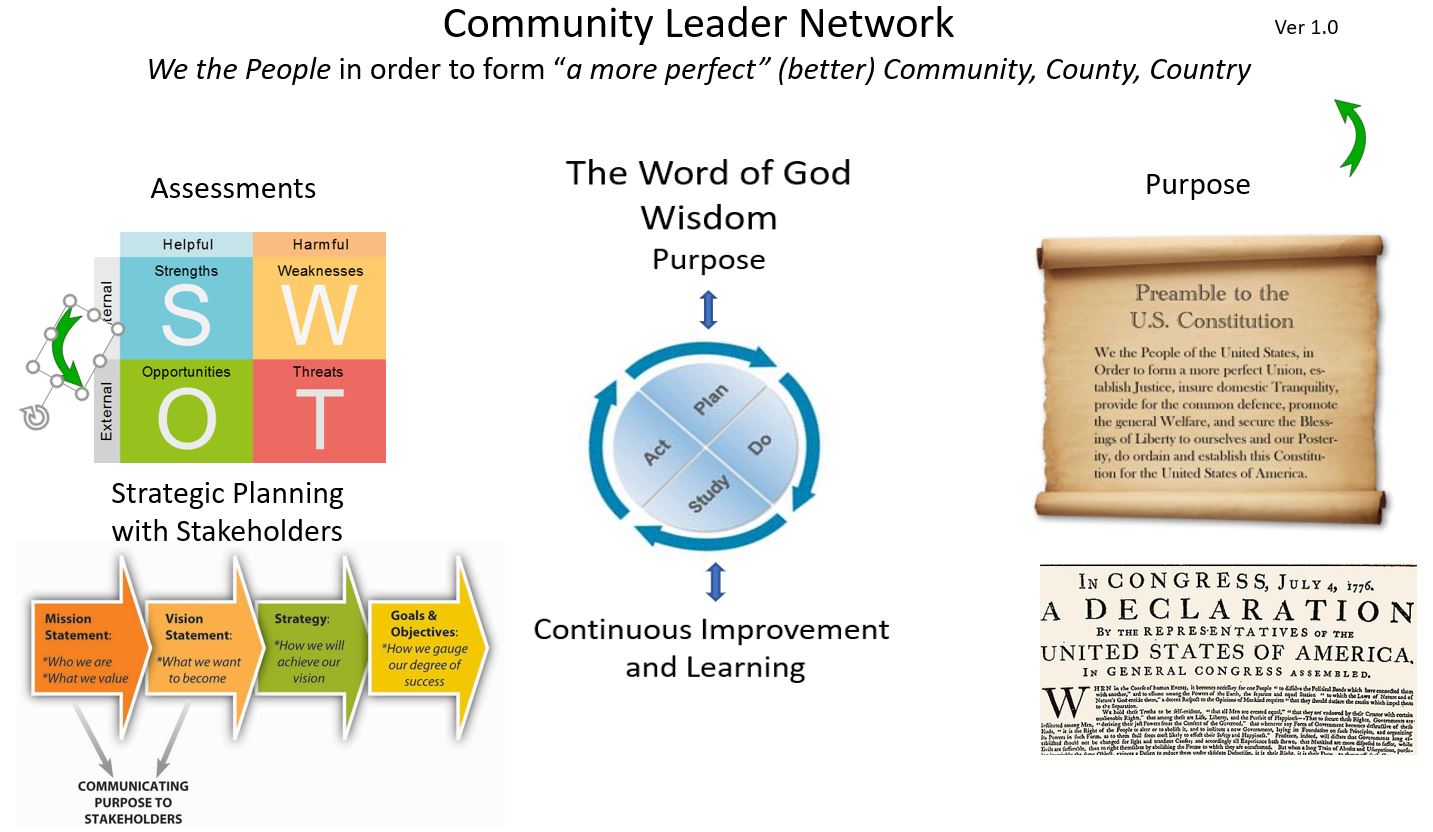
Reference to the BCLN is identified on the BCM Banner. The image below identifies the overall intent. See also: Presentation – Oververview of the Concept.

This concept will provide the context that will be applied in my future posts on the quality of county government. Are we making progress towards a more perfect (better) Brown County? How will we know? What feedback do we need to assess results? What are our priorities?

BCLN Concept Slide 2

Assessing and supporting “systemic” improvements.  Initial ideas  for a County and  Community Capability Maturity Assessment for assessing and improving the capability of 

Initial assessments using CMM-based models usually results in a Level 2 rating which reflects the status quo. Many organization may consider this level of performance “good enough.”  

Incremental improvements and community support could result in a rating of  3 or 4 within a 6-9 month period.  You contininue to maintain and sustain the improvements  and continues to improve.

The Star Spangled Banner and National Anthem


Short History of the Star Spangled Banner and National Anthem

In 1929, “House Resolution 14” was presented to Congress to name “The Star-Spangled Banner” as the official national anthem to the United States.

flag star spangled banner Capture

War of 1812 – Military Leadership

The Star-Spangled Banner (national anthem) was created by Francis Scott Key who witnessed and was inspired by the Battle of Fort McHenry  (Sept 13, 1814). Ft. McHenry was the  last line of defense for Baltimore:  if the fort was captured, then Baltimore would be as well.  With Washington, D.C., burned just a month prior, the capture of Baltimore would mean that the just formed United States would lose two major coastal cities. These cities were financial and political strongholds, and, without them, Britain could claim victory for the entire war.

After a 24-hour bombardment by the British on Ft. McHenry, and a successful defense from  brirtish ground assaults on Baltimore, the Flag still stood. 

The Image: The presented flag from Ft. McHenry resting on an angle with protective lighting at the Smithsonian National Museum of American History in Washington D.C.

Complete version of “The Star-Spangled Banner” showing spelling and punctuation from Francis Scott Key’s manuscript in the Maryland Historical Society collection.

Unum: God, Civics, Quality

e pluibus unum

E Pluribus Unum
 Out of many (states, colonies, interests), One Nation Under God,
With Liberty and Justice for All

Updated (unedited) Aug 7, 2022 flad pledge of allegiance

The Pledge of Allegiance to the Flag – Getting to Unum
Presented and Explained by Red Skeleton

      • I — Me; an individual; a committee of one.
      • Pledge — Dedicate all of my worldly goods to give without self-pity.
      • Allegiance — My love and my devotion.
      • To the Flag — Our standard. “Old Glory”; a symbol of Freedom. And wherever she waves, there is respect, because your loyalty has given her a dignity that shouts “Freedom is everybody’s job.”
      • of the United — That means we have all come together.  
      • States — Individual communities that have united into 50 great states; 50 individual communities with pride and dignity and purpose; all divided by imaginary boundaries, yet united to a common cause, and that’s love of country —
      • of America.
      • And to the Republic — A Republic: a sovereign state in which power is invested into the representatives chosen by the people to govern; and the government is the people; and it’s from the people to the leaders, not from the leaders to the people.
      • For which it stands
      • One Nation — Meaning “so blessed by God.”
      • Indivisible — Incapable of being divided.
      • With Liberty — Which is freedom; the right of power for one to live his own life without fears, threats, or any sort of retaliation.
      • And Justice — The principle and qualities of dealing fairly with others.
      • For All — For All. That means, boys and girls, it’s as much your country as it is mine.

For a general overview and context for the information provided below to include application relevance to Brown County, Indiana, might be helpful to review the main page of my website:  SuccessThroughQuality.

God, Civics, Quality
Foundational Terms and Concepts

Overall Strategic Concept. Reducing variation from the ideal results in better quality and lower cost to the individual and society. “When  American  military  men  approach  some  serious  situation they are wont  to  write  at  the  head  of  their  directive the  words, “overall  strategic  concept.” There  is wisdom  in  this, as  it  leads  to  clarity  of  thought.”– Winston Churchill

Civics (Citizenship): The branch of political science that deals with civic affairs and the rights and duties of citizens. 128 Civics Questions and Answers for the Naturalization Test 2020 version (PDF)

Quality. Excellent Quality is the result of people doing the right things, right. Efficiency is doing things right; Effectiveness is doing the right things.

    • God is Love. God’s Love is Light. God is Perfect. Perfect is the Ideal. Jesus the standard of perfection.
    • Secular Context: Man defines the ideal. In America by Law, We the People (citizens) define the ideal (more perfect). In Science Fiction, the technology defines the ideal.

Perfection. The ideal. All needs are met “Heaven on Earth” (Garden of Eden). No harm being caused to people because their needs are not being met. An https://asq.org/quality-resources/variationacceptable level of variation.

Evil. The opposite of Perfection, Causing harm to others

Variation. The gap between or difference between the ideal and actual situation.

    • An acceptable degree of variation.  Positive Emotions, Love and Happiness, Some needs being met, People are are happy – Lights are on.
    • An unacceptable degree of variation. – Negative  Emotions – Hate, anger… People are sad or depressed?  Lights are off.
    • Variation is reduced through Continual Improvement by the Individual and by Continuous Improvement by a Group.

Actual Situation. Not perfect; unacceptable degrees of variation. The greater variation from the ideal, the higher the cost to the individual and society.

Spiritual (nonsecular)Context:

    • Actions motivated by Love (meeting the needs of others) result in outcomes where everyone wins, or at least, they are not any worse off in the long-term.
    • When you reduce variation (close the distance) from the actual situation to the Ideal, you are nearer to God, His Love, and His Light, because, more needs are being met, and there is less harm on people because of needs not being met.
    • Anyone that has reduced variation has gotten closer to God – His Love and His Light.
      • Common Example. Showing or receiving an expression love – a kind word, hug, kiss, social media post, inspirational movie or song. It could be just a one-time (fleeting) moment or more routine and common. For Mother Teresa, it was “routine.”
      • Joe Kovacs, in his book: Reaching God Speed: Unlocking the Secret Broadcast Revealing the Mystery of Everything, supports the point.
      • Personal Example – Movie. The movie  I can only imagine” tells the story behind the song with the same name. The song  became one of the most  top-selling (Triple
        Platinum
        ) and listened to singles in Christian music history.  The “lryics ” took about 10 minutes to write and the music another 10.  On the Story that created the conditions that led to the  song  – “It took a lifetime.

        • I can relate.  This post (the song), took a little longer than 20 minutes to put together, but “it took a lifetime.”  Like millions of others, I love the song but The Story was the inspiration that led to a breakthrough.
        • Clip from the movie by the actress playing Amy Grant who introduces the songs and the writer/singer- Bart Millard. How Amy Grant Helped Make MercyMe’s ‘I Can Only Imagine’ Top Christian Song.
    • Darkness. Left Behind. People experience the harm caused by increased variation.
    • Conundrum for Christians? “75% of students leave their faith behind during college.” Ratio Christi.
      • Faith:The assent of the mind to the truth of a proposition or statement for which there is not complete evidence; belief in general.”  
      • Given that variation is a constant, “What is being “left” behind?”
Secular Context
    •  Actions include outcomes where some win, some lose, or everyone loses.

Barriers to Improvement: Fear, Motivation, Cognitive Dissonance,  Paradigm Paralysis, acceptance or support for the Status Quo – “The way we always do things around here.”

If you always do what you always did, “on average,” 
you will usually get what you always got. – TJC

References: Quality, Civics, God

Quality Management 

  • Aim of Quality Management: Reduce Variation.
    • W. Edwards Deming: “If I  had  to  reduce  my  message  for  management to  just a  few  words, I’d  say  it all  has  to  do  with  reducing  variation”  (6  Henry  R.  Neave,  The Deming  Dimension  (Knoxville,  TN:  SPC  Press  Inc.,  1990),  p.  57.)

IHI PDSA SOPK

ASQ, The Law of Variation is defined as the difference between an ideal and an actual situation.

    • An ideal situation represents a standard of perfection—or the highest standard of excellence.
    • The ideal is defined by stakeholders, including direct customers, internal customers, suppliers, society, and shareholders.
    • Reducing the variation stakeholders experience is the key to quality and continuous improvement.
    • Variation usually occurs in four separate areas:
      • Special causes
  • According to the law of variation as defined in the statistical process control fundamental text, Statistical Quality Control Handbook:
    • “Everything varies.” In other words:
      • No two things are exactly alike.
      • “Groups of things from a constant system of causes tend to be predictable.”
        • We can’t predict the behavior or characteristics of any one thing. Predictions only become possible for groups of things where patterns can be observed.
      • If outcomes from systems can be predicted, then it follows that they can be anticipated and managed.
      • Systems determine the majority (85%) if not all (100%) of the result.  When you place good people in a flawed system, the system wins most if not all of time.
        • To improve the outcome, improve processes and systems.
        • Top Management (We the People): Work “ON” the system;
        • Citizens (Employees, Children in School, work “IN” the system.

Consequences of Action and Inaction

    • Variation either gets better or it gets worse
    • The Taguchi Loss Function. The more a product deviates from the ideal (nominal, target, optimum), the higher the cost to the customer and society.
    • “Anything less than optimization of the whole system will bring eventual loss to every component in the system” (W. Edwards Deming, The New Economics, p.53)

Transformation vs. Spiritual Conversion

    • “The word Metanoia is more suitable than transformation. Metanoia is a Greek word which means penitence, repentance, reorientation of one’s way of life, a spiritual conversion. Transformation means a change of form, shape, or appearance.” (W. Edwards Deming, The New Economics, 1st Edition, p.53)
      • Transformed leadership starts with a transformed individual (and that means you!), by Timothy J. Clark, Apr. 8, 2013.
      • Putting Deming’s principles into action to transform individuals, communities and organizations. Deming’s Individual Transformed, Part II, by Timothy J. Clark, Apr. 10,2013.
        • Includes a follow-on story (Education) referenced below – See  Deadly Diseases, “Are Grades Effective and Fair.” When I told this story in a seminar and brought up the question about common and special causes, she had a student that represented a “special cause.” She took the right actions that resolved the issue. The child’s mother thanked and hugged the teacher – finally, a great solution for her son.
      • Note. Deming was a devout Christian and supported a secular approach to improvement. The word “metanoia” was the only word I recall coming across in his published work, that referred to a non-secular concept – “spiritual conversion.” His conclusion that improvement “all has to do with reducing variation” was also somewhat obscured. I mention this along with some speculation as to reasons in the article referenced above, Transformed leadership starts with a transformed individual.”  I think I now know (high probability) why and I can certainly relate.  Time will tell.

Civics – Citizenship

  • Constitution of the United States: The Preamble. We the People of the United States, in Order to form a more perfect Union, establish Justice, insure domestic Tranquility, provide for the common defence, promote the general Welfare, and secure the Blessings of Liberty to ourselves and our Posterity, do ordain and establish this Constitution for the United States of America.
    • We the People – Citizens, are “Top Management.” “Top Management” is responsible for working “ON the system ” to improve it;  Other stakeholders work “IN” the system to improve it.
  • Article IV, Section 4. “The United States shall guarantee to every State in this Union a Republican Form of Government, and shall protect each of them against Invasion; and on Application of the Legislature, or of the Executive (when the Legislature cannot be convened) against domestic Violence.”
    • Successfully working towards more “perfect” requires that “We the People” work together to reduce variation.

State of the “Republic” ? 

 The Problem – Represent US

    • “Professors Martin Gilens (Princeton University) and Benjamin I. Page (Northwestern University) looked at more than 20 years worth of data to answer a simple question: Does the government represent the people?”
      • “Their study took data from nearly 2000 public opinion surveys and compared it to the policies that ended up becoming law. In other words, they compared what the public wanted to what the government actually did. What they found was extremely unsettling: The opinions of 90% of Americans have essentially no impact at all.”
    • Media Reaction – BBC News: “Study: U.S. is an oligarchy, not a democracy

      What in the world?”

A System Problem – The Prevailing American Style of American Management

    • What is the world’s most underdeveloped nation? With the storehouse of skills and knowledge contained in its millions of unemployed, and with the even more appalling underuse, misuse, and abuse of skills and knowledge in the army of employed people in all ranks in all industries, the United States may be today the most underdeveloped nation in the world.”  W. Edwards Deming

Quality Management. Provides methods and tools for reducing variation.

    • The 7 Basic Tools of Quality can and have been applied by children and adults to resolve 95% of problems.
    • Scope of Change: Three general options. The greater the change, the higher the risk.
      • Sustain and maintain the current system, e.g. status quo.
      • Incremental Improvement.
      • Radical, Revolutionary, Reengeneer, Redesign.

Cost of Poor Quality (COPQ). In general, can range anywhere from 20-40% of budget or sales on the high end and 5-15% on the low. (Reference: Success Through Quality: Support Guide for the Journey to Continuous Improvement.)

Assessment of System PerformanceCounty/Community Capability Maturity Model (CMM).

    • Assessment Scale: (1 – Low; 5 -High).  An assessment at a Level 2 can be acceptable for many. There is a correlation between a Level and the COPQ.

Getting Started – “Critical Mass” of leaders required? Deming estimated that the number of leaders needed to achieve critical mass could be calculated as the square root of the number of people in the organization. So a critical mass for a hundred-person organization would be 10 people.

God  – Christianity

  • God defines perfection – the ideal. Jesus is the standard of perfection.
  • Perfection is described as all needs being met. This results in no harm to people when their needs are not being met, Heaven on Earth – a perfect (acceptable) degree of variation.
  • Earth and Humanity. Unacceptable degree of variation. People’s needs are not perfectly met; People are harmed by unmet needs.

Consequences of Action and Inaction 

Moral Costs:    “…. there  has  been  an  emerging  convergence  of the  two  ways of thinking  that includes  the  consequences  of action  and  We  can  now  do  great evil  without intending  to.  What we need  today  is  more  awareness,  a  wider recognition of how  vast systems  we  are  caught up  in  can  do  terrible  things  and  how  we  can  contribute  to  evil without even  being  conscious  of it.”  (Harvey Cox,  When  Jesus  Came  to  Harvard,  Making  Moral  Choices Today,  Boston,  MA  Houghton  Mifflin Company,  2004,  p.  245-246.)

Organizations Costs – Seven Deadly Diseases of Management – WED

In the third chapter of Out of the Crisis, titled “Diseases and Obstacles,” Dr. Deming explores, in great detail, the diseases listed below:

1. Lack of constancy of purpose to plan a product and service that will have a market and keep the company in business, and provide jobs.

2. Emphasis on short-term profits: short-term thinking (just the opposite from constancy of purpose to stay in business), fed by fear of unfriendly takeover, and by push from bankers and owners for dividends.

3. Evaluation of performance, merit rating, or annual review.

    • This includes the Destructive Effects of Grades in School – Are-grades-effective-and-fair? by Tim Clark
    • Imagine that grades and individual performance appraisals (deadly diseases) were immediately eliminated and everyone  understood “the why.”  This would quickly eliminate the destructive effects (people being harmed), there would be more joy, increased productivity, learning, and innovation. It would send shock waves throughout the world. It would be like flipping a national light switch from off to ON.

4. Mobility of management; job hopping.

5. Management by use only of visible figures, with little or no consideration of figures that are unknown or unknowable.

6. Excessive medical costs. As reported by Dr. Deming in Out of the Crisis (pages 97-98), executives shared with him that the cost of medical care for their employees was amongst their largest overall expenses, not to mention the cost of medical care embedded in the purchase price of what they purchased from their suppliers.

7. Excessive costs of liability, swelled by lawyers that work on contingency fees.