Brown County – Town of Nashville Trail Study 5-17-2024 for public release
All posts by Tim J. Clark
County Council Meeting Notes, May 20, 2024
Agenda County Council Meeting May 20, 2024
Auditor
-
- The auditor is going to start providing monthly receipts and disbursement reports, which is a positive change. This information helps to determine whether the county is on-plan or off-plan when it comes to managing the budget and achieving savings goals.
- Feb 19, 2024 Council Resolution – Financial Goals
- Health Fund – 1 million
- Rainy Day Fund – 2.5 million
- Feb 19, 2024 Council Resolution – Financial Goals
- The auditor received approval to spend $22, 752.77 on new office furniture. The funds were recovered from the recovery of tax money from individuals who were not eligible for a homestead deduction. The county hires a contractor who receives a percentage of what is collected.
- The auditor is going to start providing monthly receipts and disbursement reports, which is a positive change. This information helps to determine whether the county is on-plan or off-plan when it comes to managing the budget and achieving savings goals.
Highway Department. The superintendent received approval to recruit for 6 vacancies. Money has been budgeted; the superintendent just needed the council to approve an appropriation.
“Sock Factory” Money.” The balance is $228,608.36. Prior conversations by the council discussed transferring this money to the Helmsburg Community Development Corp. Additional research has indicated that the commissioners need to develop an ordinance and establish a new account to manage the funds.
-
- The ordinance is to document the intent of the gift and guide the management of the fund.
- The county acquired the Fore Bare Feet Sock Factory, which it sold in 2014 for $417,000. The funds have been used for a stormwater project in Helmsburg.
Commissioner Meeting Notes, May 15, 2024
Last updated: May 21, 2024.
Commissioner Meeting Notes, May 15, 2024
This post at Brown County Matters.
Open Door (Meeting) Laws. Commissioner Sanders asked for clarity on the distinction between Admin meetings (no public notification required) and Working Session meetings (public notice required). He referenced a quote by Luke Britt, Indiana’s Public Access Counselor (PAC), on the topic. County Attorney Mike Moga confirmed that a meeting to discuss Bond administration would be considered administrative.
As opposed to an Administrative Meeting, a Working Session (public notice required) is used to discuss details on an issue that leads to a decision that must be voted on at a public meeting. Exec Meetings are held on confidential issues that are specified in statutes. The other meetings are the regularly scheduled public meetings held twice a month.
Considerations for a Proposed Ordinance – Off-Road Vehicles (ATV/UTV). 1:14:45. This was first introduced in 2021, reviewed, and the decision made not to go forward. The issue was debated on social media with strong advocacy for and against. Commissioner Pittman stated that the commissioners (Pittman/Wolpert) decided to re-consider the proposal and will hold a public meeting in June. How, when, and at what meeting did Commissioners (Pittman/Wolpert) discuss this ordinance and decide to hold public meetings?
Services as Bond Council and issuers Counsel for Brown County General Obligation Bonds.
It was stated that a vote to approve could not be delayed due to a self-imposed “timeline.”
Commissioners Pittam/Wolpert voted Yes. Sanders abstained and asked questions to include the fact that the county council’s attorney was also being considered as the Bond Council, which may be a less expensive option. Costs – Barnes and Thornburg
-
-
- Fee: Bond Council: $25,000.
- Fee as Issuers Counci: $12,500
- Other admin costs – not to exceed: $750.
-
Grant Writing Support – 6:40 ARa Administrative Resources Association. ARa board voted to accept Brown County as a client. The county pays an annual fee and for additional services that may not be covered in the contract.
The purpose is to provide the capability for the county to apply for grants available from federal, state, and non-profit entities.
Discussion included disclosure by the commissioner assistant Stinson of ongoing work for a 5-year plan that would identify needed projects.
Brown County Town of Nashville – Bicycle and Pedestrian Master Plan. The completed plan was presented for immediate approval. It was stated that the Indiana Department of Health required approval by the end of May – no explanation of this “deadline” was provided. This was the first time I recall this deadline was mentioned. The resolution to approve received a Yes vote by Commissioner Pittman and Wolpert. Sanders had questions and abstained. The vote was contingent on approval at a second (joint?) meeting on May 21, 2024, at 9:00. No mention of how this plan would be shared with the general public before May 21.
A reporter from the Democrat no longer covers county meetings. In the past, issues such as this would be covered and shared with the general public.
The Total Estimated Cost of Trail Expansion was identified as $8,471,100, which reinforced the need for obtaining grants. Application for a READI 2.0 grant is also due by the end of May. It appears this project would be competitive for funding.
Highway Department. (Correction May 20, 2024.) A new bridge inspection company “was not” selected. Janssen and Spaans Engineering, Inc., Columbus, Indiana. Brad Isaacs (Project Engineer/ Project Supervisor) provided a brief presentation on his company’s capabilities, and desire for the work,
County Insurance Carrier. The commissioners selected a new three-year contract with an insurance carrier – Bright and Williamson. Pittman and Wolpert voted yes. Sanders abstained. No discussion as to the financial impact – more expensive, less expensive? What led to the decision to change carriers? Was this discussed in an Executive Session or admin Meeting?
Parks and Rec – Cell Tower Lease $1K a month. The agreement was made in 2019 and has just recently become operational. Commissioners (all 3) voted to approve the agreement
Brown County Community Foundation (BCCF) – More Political?
UPDATE (May 21, 2024) : Per follow-up with Planning and Zoning, The money gifted from the Community Foundation must be spent by the end of the year but there will not be a completed comprehensive plan by the end of the year. They are working on RFP’s now and will get those out once they are completed and approved.
BCCF Board Members and Resumes
BCCF Board members have been attending government meetings with the aim of “building relationships” with elected and appointed officials.
County elected officials allow non-elected officials to determine the excess revenue generated by the Music Center and how these funds will be distributed. The current agreement is 75% to the Foundation and 25% to the county. A proposed change is 50/50.
1:06:46 Brown County Community Foundation (BCCF): Remarks by Board Member Phil McCowan. “Who do I lean on” … to get this done by the end of year?” The foundation provided funding to the Area Plan Commission (APC) to support the development of a County Comprehensive Plan. The “funding” was contingent on the plan being completed by the “end of the year.” The amount provided is $26,000. Was this from a BCCF fund consisting of their receipt from the county of excess revenue from the Music Center (see above)?
Commissioner Pittman. Wolpert, assistant commission Stinson appreciative of the BCCFs involvement. The county’s attorney was on Zoom/phone – no comments on the legality or appropriateness of the county accepting money from a private donor with a contingency.
On a similar issue, when a representative from the Knobstone Hiking Trail Association (KHTA) offered to provide a donation to the county council to help with expenses associated with opening up Indiana Hill RR Crossing, the county council attorney stated that the money could not be accepted with contingencies. An effort was then made by KHTA to create a fund at the BCCF. The BCCF declined to accept the KHTA donation and with the rationale that the issue of re-opening was too “political.”
Background Information:
County Comprehensive Plan. The area plan commission has the responsibility to develop the plan. They are applying for a 60K OCRA grant. Commissioners have to vote to approve the plan. Public meetings are required. The county match is 6k. The current plan was revised in 2011 and consists of 12 pages.
The plan represents the voice of “ALL” the citizens – not just the special interests, as to what they want and do not want in terms of development and quality of life. It provides guidance for Zoning and Special Exceptions and helps prevent “spot” zoning.
I’m Looking forward to seeing if any consultant who is selected to develop the County Comprehensive plan will accept the end-of-year constraint (unlikely).
WIP: Brown County Affordable Home Strategy- Notes
DRAFT – Last Updated Dec 8, 2024
Regional and County Study: The 2024 Indiana Uplands Housing Update provides updated data to help identify workforce housing needs and strategies for advancing housing opportunities in each of the region’s 11 counties. This housing strategy is specifically tailored to the needs and future aspirations of the Indiana Uplands region.
For more information on the original 2019 Housing Study, visit: https://regionalopportunityinc.org/housing/
Dec 3, 2024. Local Habitat chapter envisions more homes, public partnerships in 2025
By Staff Reports -December 3, 2024
Dec 3, 2024. Letter: Prioritizing family-oriented housing availability (as opposed to apartments) Jeremiah Reichmann
Nov 22, 2024. Housing and Another new tech park coming to Ellettsville _ news – Indiana Public Media
Nov 5, 2024. Building dreams, filling county’s affordable housing gap (Brown County Democrat)
Sept 12, 2024. IndyStar. Included for contrast with an urban area that includes a Report.
-
- Carmel has lots of large, pricey homes. A task force outlined a need for modest options.
- Housing Task Force Report
- Carmeltopia: A small city (Carmel) shows a way forward for local Republican politics. (and economic development).
-
Henry Mestetsky, Executive Director of the Carmel Redevelopment Commission, explains how Carmel has used Tax Increment Financing (TIF) to spur large development projects and grow a vibrant, walkable downtown. This 4-part series weaves together architecture, urban planning, local tax policy and awesome before-and-after pictures everyone can enjoy.
- A model that local developers may think can be downsized for one or more areas in Brown County?
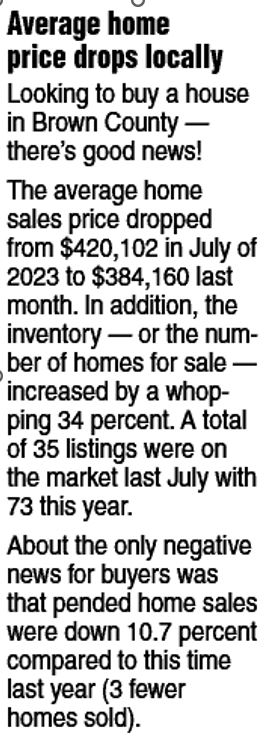
Aug 14, 2024, Brown County Democrat. Housing Sales. “The average home sales price dropped from $420,102 in July of 2023 to $384,160 last month.
In America, “We the People” is the top management team responsible for working together towards “a more perfect union” and community. To accomplish this aim, we need a method. Proven methods and tools introduced through the Brown County Leader Network. (BCLN). BCLN – Overview of the concept
This post is shared on my campaign website :
-
- Housing and School Enrollments. On primary election day on May 7, I visited all the voting locations and had the opportunity to talk with many of the referendum proponents.
- One of the takeaways was that the referendum would help sustain needed staffing and programs but would not address the decline in enrollments that may eventually lead to consolidations and less staff.
- In addition to retaining and attracting students who live in the county but choose other options, increasing enrollment would also involve attracting more families with school-age children to move to Brown County.
- In addition to housing, the referendum and discussions on social media identified opportunities to address questions, concerns, and issues raised by the non-supporters. Addressing these issues through a collaborative assessment and decision-making process could lead to a shared vision and additional community support for the future of county schools.
Context: A Collaborative Decision-Making Process. This post contains an “outline” of a collaborative process to help define the problem and develop solutions. The “process” is flexible and adaptable.
Affordable Housing. The U.S. Department of Housing and Urban Development defines “affordable housing” as housing where the occupant pays 30% or less of the gross income on total housing, including utilities. This definition would apply at all price ranges. A $20 million dollar home would be affordable to some.
Affordable Housing—Redefined? The need for “affordable housing” in Brown County is generally referred to in the context of the need for rental units and housing (starter homes?) for more young families with school-age children. The expected rent/cost is at the less expensive end of the market. The tourism industry also desires housing options for its workforce.
References: “Affordable Housing” Study and Working Groups
-
- July 25, 2024. Nonprofit offers new affordable housing development in Fishers
-
The 2-acre development comprises 11 units. Six are designated for residents who qualify as low income — up to 60 percent of the average income for the area — and five will be offered at market rate.
-
According to information from HAND, a qualifying 60-percent income for a family of four would be about $58,000 a year. A three-bedroom unit at that income level would cost about $1,265 a month, compared to a market rate unit at about $1,900.
-
- 2024 Notes Affordable Housing – includes references to Seymour’s low-income housing projects
- 2021. Brown County RDC Community Invest Corp (Landbank) – For the Record
- 2018 Affordable Housing Discussions – Completed ROI Study
-
ROI – 2024 Indiana Uplands Housing Study Update.
- Housing Study Update 2024 – Brown County
- Figure A.12 illustrates a demand of over 660 units by 2035.
- Over the next several years, greater variety will be needed in the market. Many of the county’s workforce cannot afford to own a home in the county. Therefore, rental options need to be expanded. Between now and 2030, 50% of new units should be in rental configurations.
- Due to the cost of land, materials, and labor, the production of housing priced below $250,000 will be challenging to impossible. The over 220 units in these price ranges will be generated in four different ways:
- (1) Production of ownership options that are not the traditional single-family detached, but duplexes, townhomes, or other medium and higher density configurations that reduce per unit costs. (2) Funding assistance that will offset lot development costs and smaller square footage homes. (3) Rehabilitation of existing housing units. (4) Construction of higher priced units that allow existing households to make the next step up.
- Moderate Market – 200-250K.
- Market: 250-350K.
- High market: over 350K.
- Housing Study Update 2024 – Brown County
- July 25, 2024. Nonprofit offers new affordable housing development in Fishers

The “Burning Platform” (aka – crisis)
-
- Enrollments. Declining school enrollments can lead to consolidations within the county and with surrounding counties. Some residents may welcome this change with the expected lower property taxes, and many will not.
- What are the State’s criteria for consolidating schools?
- Culture. Schools are a vital part of community life.
- Median Home Values. High land and home values make homes unaffordable for people with lower to moderate incomes. Brown County Habitat for Humanity works to serve this market.
- Successful School Referendum (2024): Higher teacher salaries will help retain and attract staff. The referendum does not address the long-term trend of declining enrollments that can lead to fewer staff and schools.
- The referendum strategy was effective and well-financed, but it was also divisive. Many issues and concerns brought up by both sides cannot be resolved on social media. These issues could be addressed, and they may lead to a better understanding of the challenges and opportunities. The “So what?” It’s more difficult for a divided community to support necessary changes that may increase enrollment and avoid school consolidations.
- The options? Support community forums in applying a collaborative assessment and decision-making process that can lead to support for a common vision shared by the community.
- Enrollments. Declining school enrollments can lead to consolidations within the county and with surrounding counties. Some residents may welcome this change with the expected lower property taxes, and many will not.
Concept: Support a comprehensive vision and strategy that may attract more families with school-age children to Brown County. Strategy supported by the County Comprehensive Plan that provides guidance for zoning.
-
- Brown County property owners may be interested in selling land to young families to build homes in the 250K (?) range and lower.
- Property Owners (before selling) reserve the right to review and approve the house design.
- The sale of land can be contingent on a contract to build a home and complete construction.
- Other. A community commitment and vision for attracting young families to the county may inspire a variety of options and strategies.
Income Level. What is there range of the income levels for the target market?
Options:
-
- Community. Brown County property owners choose to sell land for housing to young families with children,
- Brown County Habitat for Humanity – determines eligibility and offers grants and low/no-interest loans to families.
- Regional Opportunity Initiative (ROI) – READI Grants. Grants Include funding from the state, county, private developers, and non-profits. State Stellar Grants also expected to be available in 2026.
- Private Lenders – continue to determine eligibility for those not needing financial support from Habitat for Humanity
- Infrastructure. Given the county’s plans to expand sewer service, developers may have their own plans for leveraging the county’s investment in infrastructure to build more homes.
- Private Developers. New homes are being built but at the higher end of the market.
- “Land Bank.” Justin Schwenk – Democrat Candidate for Commissioner for District 3, is advocating for this option:
- Facebook Post – Brown County Chatter: “My name is Justin Schwenk. I am running for County Commissioner for District 3. I was raised in this community. I have been a Social Studies teacher for 20 years, 8 of which was here in BC. I was also the President of the BC Redevelopment Commission. While there I developed a plan to create attainably priced homes (sub-200k) that would attract young family aged residents through a first time homebuyer program all while respecting our nature environment and minimizing/eliminating the developmental footprint of the county. (ie: I’m not making developments or apartments). We are doing this through redevelopment of vacant and abandoned properties. (Anyone have a vacant, dilapidated house near them?). We even had 1 million in funding earmarked from the state. We had the ordinance drawn up and it was rejected by the commissioners at the time. I would love to discuss it more if anyone is interested in learning more. If I am elected, attainably priced housing and creating demographic sustainability will be among my most important priorities
Context:
-
- Political. Any housing strategy that requires county funding (including matching grants) will require the votes of the commissioners and council. (See Outline – Collaborate Decision-Making Process)
- Available Land. Brown County is the most heavily forested county in the state. Over 50% of the land is owned by the federal and state governments and non-profits. Land can also be placed into classified forest status, which reduces property taxes and development opportunities. Although these facts reduce the property tax base, the terrain, country, culture, and recreational opportunities are why residents choose to stay or move here.
- Bedroom/Retirement Community. Ball State economists identified Brown County as a “Bedroom Community.” Residents choose to live here, and most generate their income outside the county. Many local businesses support this community. The county is also a Naturally Occurring Retirement Community (NORC).
- “A naturally occurring retirement community (NORC) has a large proportion of residents over 60 but was not specifically planned or designed to meet the needs of seniors living independently in their homes.”
- County Tax Policy. The county opted to rely on a high income tax rate (15th in the state) and low property tax rate (among the lowest in the state). This policy (low supply, high demand) contributed to higher prices for land and homes, including the demand for second homes, tourist rentals, and commercial businesses catering to the tourism industry.
- Yearly assessments of residential property indicate increasing property values and the property tax base.
- Demographics. Brown County has one of the oldest demographics in the state.
- Tourism. The county supports the hospitality (tourism) industry. Approximately 3 million tourists a year visit Brown County with the fall season the historical peak
- The tourism industry generates 12.1 million in taxable wages. All county taxpayers generate $550 million in federal adjusted taxable income (AGI). State AGI would be less because of state deductions from income. Brown County’s Economic Engine?
Funding. The county is funded primarily by income and property taxes. Property assessments and incomes have been continually increasing.
-
-
-
- Adjusted Gross Income (AGI) County Residents
-
-

-
- Schools and Enrollment.
- Existing. Several hundred students are enrolled in education options other than Brown County Public Schools. These options include homeschooling and public and private schools outside the county.
- New. Attracting new residents with school-age children interested in attending Brown County Public Schools. Families do not necessarily move to Brown County for jobs and schools. With broadband and work-from-home opportunities, people can choose to live and work almost anywhere.
- Home Designs. Designs that fit within the context and architectural traditions of Brown County.
Costs (Ref: Housing Study Update 2024 – Brown County)
-
- Moderate Market – 200-250K. “Due to the cost of land, materials, and labor, the production of housing priced below $250,000 will be challenging to impossible.”
- Market: 250-350K.
- High market: over 350K.
Size and Options:
-
- Single-family homes -1200 sq ft, 3 bedrooms, 2 baths (average Habitat for Humanity home). Note Habitat organizations throughout the county offer a variety of options and designs.
- Duplexes/Townhomes
- Rental Units
- Other
Construction:
-
- Volunteers – Habitat for Humanity
- Modular Builder (s) – Habitati or individual buyers can contract for services.
- Traditional home builders.
Target Market – young adults, families with school-age children
Financing
-
- Grants for those qualifying via Habitat for Humanity
- Private – for those who do not need a grant but who could afford a home at the 250K (?) less range
Available Land and Zoning
-
- Brown County property owners may be interested in selling land to young families.
- Property Owners could reserve the right to review and approve the house design?
Brown County Zoning – Size of Lots by Zone
UPDATED Brown County Ordinance 10-20-2020

The County Redevelopment Commission (RDC) can facilitate land owners through the bureaucracy for supporting the needed increase in family homes.
-
- Minor Subdivision – 2 lots – 1.5 acre minimum – Minor Subdivision Pkt no calendar
- Major Subdivision – 3 or more lots – 1 acre minimum – Checklist for MAJOR SUBDIVISION-Primary
- PRIMARY RESIDENCE DISTRICTS (Rl) are established to include areas that can be served by water or sewage utility systems, principally along State Highways and at present urban centers.
- SECONDARY RESIDENCE DISTRICTS (R2) are established to include areas that have been subject to urbanization on a scattered pattern, principally along County Highways.
- GENERAL BUSINESS DISTRICTS (GB)
- LAKE RESIDENCE DISTRICTS (LR) are established to include areas that adjoin extensive bodies of water in the county and are suitable for seasonal or permanent residences.
- ACCOMMODATION BUSINESS DISTRICTS (AB) are established to include areas that are close to LR Districts and appropriate to the limited shopping and service needs of those districts.
- FOREST RESERVE DISTRICTS (FR) are established to include land that is for the most part rough terrain and where there is extensive public ownership of forest lands.
- ADU – ADU Ordinance Language
NOTES
Commissioner Meeting Notes. May 1, 2024
Commissioner Meeting Notes. May 1, 2024.
May 1, 2024, Agenda Commissioner Meeting
New Highway Superintendent. The current highway superintendent (Mike Magnor) announced that he will be retiring but will be available through November to support the transition to the new superintendent. The effective date of his retirement is May 3, 2024. Among his accomplishments, Mike was instrumental in ensuring that the county received the grant money from the State’s Community Crossing Grant every year. We received 1.5 million this year, and the county’s match was 500K, which was available in the Highway Department budget.
The newly selected assistant supervisor (Arec Burton) was selected as the new superintendent. The vote by the commissioners was 2 to 1. Ron Sanders voted No and reinforced his commitment for ensuring the new superintendent’s success.
Commissioner Meetings. Commissioner Sanders requested that agendas be documented for every “Admin” meeting and that our legal council review the items. Commissioner meetings include Executive Sessions (agenda items determined by state law), “Admin” meetings, Working Sessions (discussions that can lead to a decision/vote), and Public Meetings (where votes are made on a decision). ANY discussions that lead to a decision must be public. Admin meetings should just be administrative, such as office procedures, issues with vendors, internal coordination challenges, etc.
Repair of Sidewalks. Courthouse, Van Buren Street, and sidewalk to the fairgrounds. An application for a Lilly Gift Grant was submitted for $3.5 million. Those working on the application included representatives from the county (Melissa Stinson), Town (Sandie Jones), Brown County Community Foundation (Alice Susemichel), and ARA (grant writer).
Highway Department Staffing Decisions – 2024 – For the Record

Brown County Highway Department website
Last Updated May 5, 2024.
This post shared at Brown County Matters
Summary: Selection of a New Superintendant and Assistant Superintendent.
-
- The commissioners vote at the beginning of every year to retain the superintendent. The commissioners have always been highly complementary of the services received.
- At Jan 16, 2024, Council Meeting, Mike Magnor’s request to provide funding for an assistant supervisor/superintendent position was not approved by the council (see below).
- In February, two of the commissioners (Pittman, Wolpert) decided to recruit a new superintendent and assistant superintendent. This came as a surprise to both Commissioner Sanders and the Superintendent. There was not an official “Executive Session Meeting” held to discuss the rationale for the decision.
- The two positions were posted on the county website on February 9, 2024—see below. The assistant superintendent position was filled. The person selected (Arec Burton) was then selected as the new superintendent at the May 1 commissioner meeting.
- The former superintendent (Mike Magnor) served in the position for over 9 years and will be vested in the state retirement system with 10 years of service. His resignation became effective on May 3, 2024. He stated that he expected to support the transition through November.
May 5, 2024. Request for Information. I have submitted a follow-up request to confirm the funding decision made at the Jan 16, 2024 Council meeting (see below) and to clarify a couple of issues. If the council did not approve funding, they may need to vote to approve a transfer of funds. The request is submitted by the Auditor.
May 1, 2024. Agenda Commissioner Meeting
(Agenda Posted at Brown County Matters)
-
- Highway Retirement Announcement
- Highway Appointment for 2024
Commissioner Meeting Notes, May 1, 2024.
-
-
The current highway superintendent (Mike Magnor) announced that he will be retiring but will be available through November to support the transition to the new superintendent. The effective date is May 3, 2024.
-
The newly selected assistant supervisor (Arec Burton) was selected as the new superintendent. The vote by the commissioners was 2 to 1. Ron Sanders voted No and reinforced his commitment for ensuring the new superintendent’s success.
-
Personnel Policy. The policy regarding the personnel management of the highway department was changed to exclude the highway superintendent from the recruitment and selection process. This caused some skepticism and confusion within the department as to why the superintendent was not involved in selecting a key position.
Morale and Turnover. A lack of transparency in personnel management can affect the morale of all county employees, who may conclude that a process is biased and unfair and jobs are preselected. This can lead to job insecurity, which can then contribute to turnover.
-
- Management – Commissioners Office Re-Org. The changes regarding the re-org in the commissioner’s office for example, led to an employee being informed her job was being defunded at a public meeting. County employees in public meetings, expressed their criticism of the changes that included allegations of pre-selection.
- Feb 9, 2024. Brown County Matters: Highway Department – New Positions Posted.
-
- Interesting. Was not aware the county is looking for a new highway supervisor — “Incumbent serves as Superintendent for the Brown County Highway Department …: and the council at the last meeting did not vote to fund a “new” Assistant Supervisor position.
Jan 16, 2024. County Council Meeting Notes
I clarified some points after listening to the audio:
-
- Audio – Discussion on Highway Position Funding begins at 1:40:30
- Highway Superintendant. Money removed from the highway budget was replaced.
- Discussion on funding for unfilled positions … including a supervisory position ….
- (The commissioners had discussed adding a new position ..- an assistant supervisor but the position exists – just not filled.
- Discussion on funding for unfilled positions … including a supervisory position ….
- 1:46 37 Magnor- Request to fund 6 positions(4 are existing employees)
- Kemp suggested open positions remain unfunded ..(Fund existing – leave other 2 open and unfunded.) …. Rudd – I thought we did that last time ….
- Judy Powedrill Swift – in salary ordinance but has to be appropriated
- Byrd – questions Kemp’s concerns – Kemp references to organization development issues, and need for business planning.
- Mike Magnor identified additional staffing is needed. Not all 19 positions filled – more efficient without … voluntarily not filled ….
- Redding – asking for clarification on funding sources … 3
- 1:53:99 Rudd – approve funding for 3 existing and one new hire (mechanic) .. Redding asking for clarification …. (unspent money stays in the county). Kemp wants money to accumulate …
- Motion and Second …
Tecumseh Trail – 42 miles

Stopping for a quiet break on Indiana’s Tecumseh Trail (Photo: “Yellowwood Lake – looking north” by sf-dvs is licensed under CC BY 2.0)
Source: Backpack Magazine, The 50 Best Hikes in the U.S., BACKPACKER EDITORS & CONTRIBUTORS
Indiana: Tecumseh Trail
Length: 42 miles
Backpacking opportunities may not abound in Indiana, but that doesn’t mean there aren’t any at all. The Tecumseh Trail provides a perfect weekend outing close to Indianapolis. Only an hour drive from the city, it’s easy to reach on a Friday after work or get an early start on Saturday morning. Best done as a shuttle hike, this well-maintained path winds through dense forest, rolling hills, and quaint towns. The scenery is distinctly Indiana: thickly-forested groves, bridges over stream crossings, and a portion of trail along the shore of serene Yellowwood Lake. Three pristine cabin-style and lean-to shelters provide options for overnighters. Two of the shelters were built in the last two years, and they’re ideally located for splitting the trail in half or turning it into a two-nighter over a weekend. Catch splashy fall foliage in autumn, or visit in the middle of winter to have the trail to yourself.
Brian Ainley travels all around the world to mountaineer, backpack, and climb when he’s not exploring near his hometown of Carmel, IN. He summited Aconcagua in 2020 and has climbed Mt. Kilimanjaro.
Editor’s Note: Indiana’s Tecumseh Trail has been closed since May 2020 from State Road 45 to the parking area south of Beanblossom Creek. The trail is bisected by a railroad crossing. Hikers who cross the tracks or divert to an adjacent road will be trespassing. The Knobstone Hiking Trail Association is working on a solution to reopen the trail.]
Local Efforts to Re-Open the Trail: Part 5 Indian Hill – The Final Season – maybe
-
- 2024_03_13 Remember Indian Hill Closure-Rebuttal-Analysis …. A detailed analysis of the timelines and supporting documentation regarding the lack of a public hearing, a likely violation of open meeting laws, questionable legal advice, and misleading statements by elected and appointed officials.
My position as a candidate for Commissioner is to submit a practical engineering plan for reopening the Indiana Hill railroad crossing that will be approved by INDOT. I will also identify funding strategies and a plan of action for reopening. More info: Re-Opening the Crossing and Road.
Additional Information
Facing a new challenge: Route changes due to railroad crossing closure
Abigail Youmans -October 14, 2021
-
- Brown and Morgan counties have hosted runners in a variety of distance events during the Tecumseh Trail Challenge every year since 2003.
- The trail has been a destination for runners from dozens of states who participate in the DINO (Do INdiana off-road) race, with participation growing to more than 700 in 2010. But now the point-to-point race route has been turned into a loop due to the Indian Hill Road railroad crossing closure.
Tecumseh and Knobstone Trails and Maps
Commissioner Meeting Notes, April 22, 2024, Road and Bridges, Stellar
Commissioner Meeting Notes, April 22, 2024, Road and Bridges, Stellar. (This meeting was moved from April 17, 2024, to accommodate Interim Commissioner Wolpert’s work schedule.)
The post at Brown County Matters.
Agenda – 04.22.24 Agenda Commissioner Meeting
Roads. The county received a 1.5 million community crossing grant, and the Highway Department has the 500K matching funds. Four paving bids were received, and Milestone was selected as the lowest bidder.
The roads to be paved include: Gatesville Road (full length) = 6.448 miles, Bear Creek Road (from State Road 45 to 200 feet north of Bridge #3) = 2.288 miles, Branstetter Road = 0.584 miles, Beech Tree Road = 1.720 miles, Sprunica Road (Sprunica Ridge Road to Upper Salt Creek Road) = 0.878 miles, Total proposed = 11.918 miles (Source Highway Department website).
Bridge 122 – Mt Liberty Road. Milestone was also the lowest bidder on this project. Work is expected to start within 45 days. This work was generated from an emergency work order requested by Mike Magnor and approved by the Commissioners.
Clerk – Digitization of Records. The cost of converting manual records to digital is estimated at 300K. Records will be converted as time and money allows. A mandated timeline was not identified.
Washington Township Board Appointment. Richard Hall who also serves on the Brown County RSD Board, was selected to fill the position.
Stellar 2024. At the joint commission and council meeting on April 16, 2024 which was also attended by the Nashville town manager and Alice Susmichel of the Community Foundation, there was acceptance and agreement for delaying the application for Stellar. This would allow the county and town the needed time to develop a vision and plan for the county. It would also allow time for projects to be identified and prioritized and allow time to get community buy-in and support. This approach would contribute to building trust and confidence in elected and community leadership. The grant may require matching funds, but it is undetermined at this time as to the amount and source. Melissa Stinson’s suggestion to ask the Stellar Committee for an exception to policy “if” there was unanimous agreement by the council and only 2 of 3 commissioners, was unanimously rejected.
Re-Vote. Despite the support for this decision at the joint meeting for a more deliberate and collaborative planning process, interim commissioner Wolpert asked for another vote to apply for Stellar via a letter of intent by the May 1 deadline.
Wolpert misrepresented my position with the likely intent that it may cost me some votes in the election. Once again, Wolpert and Pittman votes Yes, Ron Sander No. Sanders also explained that his vote was also based on conversations with those involved with one or more of the projects, which indicated that there was no unanimous agreement on the scope of one or more of the projects. The Town manager and individuals from the town of Nashville voiced their support for submitting the application. The Town of Nashville can apply for a Stellar Grant on their own but choose not to.
It was “speculated” that a Stellar Grant may not be available in 2026, so we “must” apply this year. No detail was presented regarding what projects were considered priorities and their respective sponsors. No detail was presented on the steps in the application timeline to provide assurance that would allow sufficient time to get community buy-in and support. And, no assurance that if there was not an agreement as to projects, the application would be canceled.
I support the position of Ron Sanders and the agreement reached at the joint commissioner and council meeting. We need to take the time to identify a vision and plan for the county that will lead to community buy-in and support for needed projects. The practice in the county on major projects has been for the few to determine what is best for the community and push it through as fast as possible before there can be any organized opposition. This is a destructive practice. Quality leadership involves taking action that will produce results where everyone benefits. This can be supported through collaborative decision-making processes. An outline of a process is available at BrownCountyLeadernetwork.com
County Council Meeting Notes, April 15, 2024. Helmsburg, Sock Factory Money
Agenda Council Meeting April 15, 2024
-
- Call to Order
- Pledge of Allegiance
- Additions to Agenda or Changes
- Approval of Minutes
- OLD BUSINESS
- No old business
- NEW BUSINESS
- Helmsburg Redevelopment – Sock Factory Money $228,600
- ADDITIONAL APPROPRIATION
- SOLID WASTE – $10,000 to Special Waste; $11,150 to Equipment
- Auditor – $19,511.79 from Fund 1216 for New Workstations replacing the 33-year-old workstations.
Helmsburg Redevelopment – Sock Factory Money
Statement HCDC President Adrian OShea
The council tentatively approved transferring the balance from the sale of the Sock Factory to the Helmsburg Community Development Corporation (CDC (501c3.)
In 2016/2017, citizens in Helmsburg asked the RDC for help with dilapidated housing. Below is the documentation from 2017 including The Helmsburg Economic Development Plan and Economic Development Area (EDA). Link to the “timeline” that tells the Story starting in 2016.
Originally, the RDC needed a structure where we could acquire properties. “This was never needed” — which is a story in itself.
HEADLINE NEWS. Helmburg now has an approved economic plan, economic development area, community development corporation (501c3), and “funding.”
Helmsburg provides a pretty good model for citizens to determine what they want and do not want in terms of quality of life and development. Citizens (top management) in the community led the effort with the county government – elected and appointed officials (employees), “serving” the interests of the citizenry.
RDC Meeting Notes, Apr 16, 2024, TIFs, Nashville USB
Last updated: April 19, 2024
RDC Meeting Notes April 16, 2024 – Tax Increment Financing (TIF) Districts
Apr 19, 2024. This post at Brown County Matters.
Summary of Key Points: The main topic was advocacy for creating Tax Increment Financing (TIF) districts. A TIF district allows the county/RDC to borrow money for infrastructure projects needed to support development. The increase in assessed value as a result of the investment is returned to the RDC to pay off the bond.
TIFs can only be used as a last resort e.g., development in the area would not be possible without government investment in infrastructure.
A proposed TIF is for the old Little Opry Property. Andrew Tilton is requesting around $2 million to run a sewer line to the property. This will help him to lease the property to an apartment developer. The developer might be asked to agree that if the project is not completed, the county is reimbursed.
-
- Background – Nashville Sewer Expansion. The Nashville Utility Service Board (USB) developed a master plan for expanding sewers that includes the Little Opry property. Nashville has not selected this expansion as a priority, and thus, the request for the “county” to fund this part of the expansion as well as other areas in their plan.
Meeting Attendees: RDC Board members: Ross Benson, Sue Lindborg, Bill Cayne, Jon Curry
Tim Clark (re-appointed to the RDC in March). Ross Benson was a candidate for Nashville Town Council in 2023.
Guests included: Robyn Rosenberg Bowman (local GoP /co-owner Tramcore Realty), Kevin Allen/BLN, and Jimmy Tilton.
Agenda RDC Meeting Agenda for Tuesday, April 16 6PM
-
- Handout – 20240416 Sue Lindborg – Indiana Uplands Readi Funding – Projects
- Presentation Material – Bill Cayne
- 2024_04_16 Bill Cayne Evaluating Population Centers for New Development Opportunities
- Melissa Stinson (Commissioner’s assistant) suggested the creation of an “Administrative Working Session” on how to generate a TIF for the project and ensure that the area is not annexed.
- Was this suggestion approved by Commissioner Pittman and Wolpert?
- TIF policies. Note that any discussion among commissioners that leads to a county policy decision must be discussed in public meetings, as required by Indiana Open Meeting Laws. Open meeting laws can be ignored with few consequences.
- Kevin Allen – BLN, also mentioned that a TIF District could be created within 30 days, He is also part of the team promoting this development.
- 20240416 TIF Handbook OCRA Kevin Allen
- 20240416 TIF Gateway Reports Kevin Allen
Overall Observations on the RDC. I’ve participated in or observed RDC since 2016. Each RDC tends to start from scratch as new members are added with varying agendas. It would be helpful to have a series of meetings with former RDC members to discuss and document the past work that has been done, challenges, issues, accomplishments, frustrations, policies, available economic data, and lessons learned. Knowledge of this information may help reduce some learning curves.
Bedroom and Retirement Community. TIFs are effective in counties and cities that have to invest in infrastructure to attract development and jobs and expand their tax base and workforce. In contrast, Brown County has not had to provide these incentives. Hard Truth Hills is a case in point.
-
- The county is funded primarily by income tax and property tax.
- Brown County is a Bedroom Community and a Naturally Occurring Retirement Community supplemented with Tourism. A high percentage of residents choose to live here and commute (or work from home) to other counties that offer higher-paying jobs. What is our economic engine? It’s not tourism. Tourism accounts for $12.1 million in wages, and county citizens who file tax returns account for over $425 million in taxable wages.
Assessed property values and taxes (historical and current) are contained in a database and supported by the County’s GIS system. The information in this system can be used to assess areas experiencing growth, declines, or staying about the same.
If TIFs are a solution in Brown County, what is the problem? What areas in the county should but cannot be developed without an investment in infrastructure by the government?
What are the current trends for revenue growth? What is the expectation for growth? How will areas be identified? What is the criteria for new investment by the county? How will this be funded? What is the current Zoning in the proposed areas? Are residents in the area supportive of the proposed developments? Do the TIF areas align with the County Comprehensive Plan? Given the county’s financial condition, credit rating, and long lead time for reimbursement, is it a viable option for the county?
Meeting Notes
As stated above, the main topic of the meeting was advocacy for creating Tax Increment Financing (TIF) districts. This could allow the county/RDC to borrow money for infrastructure projects needed to support development. The increase in assessed value as a result of the investment is returned to the RDC to pay off the bond.
TIFs can only be used as a last resort e.g., development in the area would not be possible without government investment in infrastructure.
-
- Purdue – The-Use-of-Tax-Increment-Finance. Indiana law now makes clear that TIF is intended to fund infrastructure to promote development that would not occur but for the added infrastructure financed by the TIF revenues. Evidence that the development would not happen but for the establishment of the TIF district must be presented before
the TIF district is approved. TIF is not meant as a source of revenue for responding to ongoing development nor as a substitute for other sources of infrastructure funding. TIF districts are required to expire once the infrastructure bond is repaid. TIF is not meant as a permanent source of revenue for the enacting government.
- Purdue – The-Use-of-Tax-Increment-Finance. Indiana law now makes clear that TIF is intended to fund infrastructure to promote development that would not occur but for the added infrastructure financed by the TIF revenues. Evidence that the development would not happen but for the establishment of the TIF district must be presented before
Barnes and Thornburg – Handbook for RDC and attorneys 2023
-
-
- Before an “allocation area” (often referred to as a “TIF District”) can be created, the Redevelopment Commission must first (or simultaneously) create an Economic Development Area, and then select some or all of the parcels in the Economic Development Area to constitute one or more TIF Districts.
- Example – EDA Paperwork – Helmsburg Helmsburg-EDA-Docs-and-Econ-Plan
- See also: Helmsburg Revitalization – Community Led
- Before an “allocation area” (often referred to as a “TIF District”) can be created, the Redevelopment Commission must first (or simultaneously) create an Economic Development Area, and then select some or all of the parcels in the Economic Development Area to constitute one or more TIF Districts.
-
A proposed TIF is for the old Little Opry Property purchased by Andrew Tilton. He (through his advocates) is requesting around $2 million to run a sewer line from Nashville to the property. This will help him lease the property to an apartment developer. Per Kevin Allen, the developer might be contractually obligated to agree to reimburse the county if the project is not completed. This assumes the developer remains solvent.
Brown County Democrat – Article on the Project
-
- Looking at unused potential: Housing project in works at site of former music venue; government assistance possible, Abigail Youmans -October 12, 2021, Brown County Democrat.
- When the former Little Nashville Opry property was purchased this March many started to wonder what its future held after being vacant for more than 10 years.
- The property has sat vacant since 2009 when the Opry was destroyed by fire. Now the property has a new future as owner Andrew Tilton plans to use it to fulfill a need here: More housing.
- Those working on the project are communicating with county leaders about possible help in the forms of tax abatements, an economic development agreement or tax-increment financing.
- He has been working with is Strongbox Commercial, a real estate development company out of Zionsville. Alyn Brown not only works for the company, but is also a member of the Nashville Utilities Service Board.
- Tilton said that about two days after he purchased the property, he started receiving phone calls then meetings started about three weeks later. “I closed on the property on March 2, shortly after that, the ball started rolling,” he said. “For real estate that’s super fast.”
- Kevin Allen with BLN in Bloomington is the senior site designer involved in the civil engineering of the Opry property. He presented to the Utility Service Board on Sept. 22.
- “We’re looking at every possible way to get (sewer) there,” Allen said. The Utilities Service Board agreed to work with M.S. Consultants to see what possible routes the developers could take.
- Looking at unused potential: Housing project in works at site of former music venue; government assistance possible, Abigail Youmans -October 12, 2021, Brown County Democrat.
Background – Nashville Sewer Expansion. The Nashville Utility Service Board (USB). The USB developed a master plan for expanding sewers that includes the former Little Nashville Opry property. Nashville has not selected this expansion as a priority at this time. And there has been no county public meetings that identified that the county will fund sections of the Nashville sewer expansion.
-
- Nashville Sanitary Sewer Master Plan
- Nashville Utility Services Board (USB):
-
President Pam Gould (term ends 12-31-2026); Vice-President Alyn Brown (term ends 12-31-2027); Secretary Nancy Crocker (term ends 12-31-2027); Jim Cramer (term ends 12-31-2025); Tom Roberts (term ends 12-31-2026)
-
County Comprehensive Plan. A TIF district requires the establishment of an Economic Development Area (EDA). TIF districts and the likely effect on Zoning could be developed and included as an addendum to a new County Comprehensive Plan. This plan identifies what the “citizens” (not developers/local politicos) want and do not want in terms of economic development and quality of life. Any proposed TIF districts can be added as a layer on the county GIS map to help communicate the TIF plan to the citizenry to get community buy-in. This layer can also include what Nashville has identified in its sewer expansion areas.
Individuals in government positions should also disclose any conflicts of interest.
Economic Tax Baseline: RDC – County Property Tax Assessments and Taxes- Database – Notes