What is a business plan?

In my letter to the Democrat that was published with the title: Maple Leaf – ‘Stop Digging’,  I reinforced that the commissioners and council approved this project without reviewing the “complete” business plan at a public meeting.

When inquiries are made regarding the business plan for the Maple Leaf Performing Arts Center project,  local government officials refer you to the “The Plan”  available on the Maple Leaf website. THE PLAN – Maple Leaf Performing Arts Center of Brown County 

This “presentation” is not what is commonly referred to as a professional “Business Plan.”   The basic requirements for a plan are provided by the Small Business Administration —  Write your business plan

A simple example of a business plan for an entertainment venue is available at Example – Music Theater Business Plan  

Maple Leaf Schedule of Cost Breakdowns

For the curious minded, the auditor’s office has a copy of all the loan and contract documents. You can start with “Series 2017A Note Purchase Agreement.  Link to the budget approved by the bank that identifies the “Schedule of Cost Breakdowns-Hard Costs and Soft Costs:  Maple Leaf Hard and Soft Costs

The Maple Leaf Management Group meets Wed, May 9 from 2:30-4:40 at the County Office Building – Salmon Room.  Agenda should include information regarding the BID and compliance with the budget approved by the bank.

The final decision regarding acceptance of the Bid is made by the county commissioners.

Declaration of Interdependence

Interdependence Defined:  the state of being dependent upon one another.

My response to a Facebook post at Brown County Matters regarding a concern for unplanned change:

  • Maple Leaf,
  • Proposed Septic Ordinance,
  • Regional Sewer Board’s request for 270K that they referred to as “seed” money,
  • The Van Buren Fire Department issue to include the emergence of Southern Brown VFD,
  • The “massive” steel bridges for the Salt Creek Trail and eminent domain issues,
  • Increase in “riverfront” liquor licenses,
  • The “Justice Center,”
  • Republican party monopoly on power, and systemic resistance and refusal of elected representatives to involve the citizens in economic, comprehensive and strategic planning.

Good plans would provide the context for all of the above IF SUPPORTED BY THE CITIZENRY. P.S. Policies that lead to increases in taxes do represent an economic hardship for those with fixed and modest incomes (at least 53.1% of the population).

An easy fix: Vote independent of political party. Elect commissioners and councilman that support planning with citizen involvement that will produce results, where we all benefit or at least, are not any worse off.

Suggested Platform and Principles for Independent Voters


Financial Decision Support Model – IU Student Support

A presentation by Indiana University (IU) graduate students from the School of Public and Environmental Affairs (SPEA), Masters In Public Administration (MPA) program was conducted on  May 18, 2018, 6:00 p.m. Salmon Room, County Office Building.  Description of the presentation provided below.

This was the second in what we expect to be a long-term project that will provide citizens and their elected representatives with the information and knowledge needed to make competent financial decisions.  From 2018 thru mid-2021, work was continued by Jomar Floyd (IU student/now alumni) and Tim Clark on a proposal to support financial management and modeling.  Constraints on forward progress included Covid, the county’s implementation of a new financial software system, and a new Redevelopment Commission (RDC) project to collect and analyze  property data contained within the the county’s GIS system.

We are grateful for the support of IU and the SPEA/MPA Program. The 2018 report includes an outreach to the other academic disciplines that help leverage needed resources. It also includes a recommendation to request support from the IU Center for Rural Engagement …  who “works with community partners to design and implement innovative approaches to the opportunities and challenges facing rural Indiana.”

At the county level of government, we can provide the data. But, we are a small a small county. We don’t have the capability, resources or expertise to develop and sustain a model. Other rural counties may be in a similar situation.

July 4, 2018. Brown County Democrat.  IU students discuss how data can guide county’s financial decisions by Sara Clifford. A group of Indiana University graduate students spent last semester studying Brown County’s tax structure and other variables. Their goal was to help county leaders develop tools to forecast how changes in taxes, spending, and the county’s economy will affect taxpayers and local government — a “county financial and decision support model.”

  Description of the 2018 Presentation 

Are county revenues and costs trending up or down?  When will tax increases be needed or can we reduce taxes?  What will be the financial impact of the projected declines in population? What might be the financial impact of any economic development plans? Will development strategies lead to increased revenue from property and income taxes?

2018 Project. Graduate students from Indiana University’s School of Public and Environmental Affairs (SPEA), Master’s Public Administration (MPA) program, will be providing a presentation on a prototype for a Brown County Financial Decision and Support model. This model forecasts revenue and expenditure and estimates the effects of changes that the tax structure will have on revenue and expenditures. The first step is developing a forecast model for Brown County’s two largest revenue sources –  Local Income Tax and Property Tax.

The presenters are Jake McVeigh, Jomar Floyd, and Chase Burton. In addition to Jomar and Chase, the database management team consists of Kristen Hurns and Sara Dobbins.  The students were supported by Professors Duncan Denvil and Roger Morris.

2017 Project.  This project is a follow-on project that builds on the findings and recommendations identified in an analysis conducted by a 2017 Graduate SPEA/MPA class. Students Liza Bartlett, Daniel Lopez, and Drew Sherman developed their report and presented their finding to members of the Redevelopment Commission (RDC), county council and the public:  Report: Local taxes, job options need further scrutiny.

A better model for assessing economic sustainability is critical for providing Brown County with the feedback needed to assess the effectiveness of community and economic development plans. This project was supported by the RDC and community members Tim Clark and Brandon Harris.

More Information

Residents scrutinize Maple Leaf processes

Excellent article in today’s Democrat:  “Residents scrutinize Maple Leaf processes.”  Thank you, Sherrie Mitchell, for representing us and asking the tough questions on behalf of county citizens!  And thank you Bill Austin for providing your observations and recommendations on the process!

A few of the many quotes that caught my attention:

About the project:

“… having an independent review of the county-owned concert hall project before bids to build it are opened makes sense. There is insufficient transparency, and too much dependence on one person, and lack of oversight. I don’t want my name to be included as being the oversight when I am not. … I was supportive, and am supportive if it’s done right.” – Bill Austin, who resigned as a member of the Maple Leaf Building Corp and is a former County Commissioner.

About responsibility:

The “position” of the commissioners and council is that “they do not view the innkeeper’s tax as local taxpayer dollars.” Per president of the County Council, Keith Baker – “ The county doesn’t control those dollars; the CVC controls those dollars. … Those are dollars collected by the tourists for use by the CVC to market tourism and Brown County. … It’s not a county deal, or I would be grabbing it and using it for roads.

By statute, the county DOES control those dollars!  Maple Leaf couyld not have been approved withough the vote by commissioners and council.

The FACTS:

Indiana Code – IC 6-9-14 Chapter 14. Brown County Innkeeper’s Tax, allows for the collection of revenue from the innkeeper’s tax.   The county auditor is responsible for managing the funds and providing financial oversight as required by the State Board of Accounts.

The statute establishes a Convention Visitors Commission (CVC).  The commissioners and council appoint CVC members and can remove them at any time.  The council by statute is responsible for “reviewing and approving ” the CVC budget.  (The CVC contracts with the Convention Visitors Bureau (CVB) to market tourism).

If we had an effective comprehensive plan, the priorities for investments with revenue from the innkeeper’s tax to promote tourism would be included in the plan. Development of the comprehensive plan – by statute, requires the input from citizens at public meetings.  CVC members should be appointed based on their support for the plan. The Council is responsible for reviewing and approving the budget to ensure compliance with the plan.

The commissioners and council are elected officials. Per the U.S Constitution, they serve the citizenry.

The “status quo” has been that the expenditures of revenue from the innkeeper’s tax is being done without alignment with the county comprehensive plan.  Further, financial oversight by the council has been inadequate. For instance, they do not hold the CVC to the same standards they expect from county departments during the annual budget review and approval process.

Citizens have the responsibility to provide the needed oversight and to elect representatives that take action that results in benefitting all citizens and not just special interests.

The CVB was chartered in 1984. There has been no savings and the CVC/CVB still rents space for a visitor’s center.  Again, the CVB reports to the CVC who reports to the Commissioners and Council who work for “We the People.”

In summary, who controls the expenditure of revenues from the innkeeper’s tax? Correct answer? The citizens!

Questions to ask candidates for County Council about the CVC.


Council Meeting – April 16, 2018

At the county council meeting tonight, the council received a general update from Kevin Ault of the Convention Visitors Commission (CVC). Questions to ask candidates that are running for election/re-election to the council:

Are you aware that Indiana Code (IC 6-9-14-4) requires the CVC to “annually prepare a budget … and to submit it to the county council for its review and approval”? Please explain the process to include identifying how citizens can obtain copies of the approved budget.

Are you aware that the CVB has an annual audit conducted by Blue and Company and the CVB also files an annual information report (990) to the IRS? Should these reports be reviewed as part of the annual review and approval process? If not, why not?

Are you aware that the improper transfer of funds would be considered a class D felony? Does the scope of the annual audit of the CVB include a review of internal controls?

Has a new CVC budget been prepared that includes the impact of Maple Leaf on the CVC/CVB budget? If not, why not? If so, where can citizens obtain a copy of the budget?

Maple Leaf – Fast-Track Process

The Maple Leaf Music Venue and Performing Arts Center is to be a Brown County, IN government-owned and managed venue.  It is a 12.5 million dollar facility. The money is borrowed by the county.  Any profits plus revenue from the Brown County innkeepers tax is used as collateral.  Taxpayers are paying for start-up costs that have included an initial  $30K legal bill.

Fast-Track Process

April 9. 2017. Commissioner Diana Biddle and Councilman Keith Baker attend a presentation conducted by innkeeper and CVC Member Barry Herring that introduces a concept for the Maple Leaf Performing Arts Center.  Both Biddle and Baker embrace the project and lead efforts to get the support of their colleagues on the commission and council.

June 20, 2017. A group led by local innkeepers propose a government-owned and managed performing arts center (music venue) at the Brown County Playhouse.

August 22, 2017. Request for Zoning Change, Area Plan Commission, Recommend approval by the Commissioners.

September 6, 2017.  9:00 am Commissioner Meeting. Zoning approved. It was stated that the approval was for zoning and not the project and that public meetings would be held regarding the desirability of the project.

The only official public meetings that our commissioners and council held on this $12.5 million county owned and managed music venue were to approve the project. 

November 15, 2017. Commissioners approve the project.

November 20, 2017. Council approves project.

Dec 20, 2017. Commissioners pass a final resolution approving the project.

SUMMARY –  Extracted from the following article: Dec 27, 2017. GUEST OPINION: The role of process in the future of Brown County. The Maple Leaf Performing Arts Center (MLPAC) project and the process used to fast-track approval may represent a turning point for the future of the county.  

  • In April 2017, owners of hotels and inns, who are also appointed to the Convention and Visitors Commission (CVC) and Convention and Visitors Bureau (CVB) decide to use the revenue collected from the innkeeper’s tax to invest in an asset that will promote tourism. The Innkeeper’s Tax is a pass-through tax paid by the party renting the overnight accommodations.
  • CVC members are appointed by the county commissioners and council. The CVB is a non-profit organization established to manage tourism related promotion on behalf of the CVC.
  • CVC/CVB members decided on a music venue and performing arts center and also determined the size, location, scope, cost (12.5 million), and overall governance plan for the facility. Given that this investment is expected to result in overnight stays, their businesses will directly benefit from the investment, and the asset values of their establishments will likely increase.
  • Initially, county citizens were told that revenue from the innkeeper’s tax would be used to pay the principal and interest on the mortgage for the venue. Any profits were to be used for community and county infrastructure priorities.  The final terms of the deal are that profits would be used to make the mortgage payment and the revenue from the innkeeper’s tax would only be used if profits were not sufficient to make the payment.
  • A common perception in the county that was reinforced by the president of the county council, may be that the revenue from the innkeeper’s tax is “their (CVC) money.” This inaccurate perception may have contributed to a lack of transparency over the years regarding the management and expenditure of these funds.  This revenue, per statute, is a county asset. Commissioners and Council (elected by citizens) appoint CVC members who are subordinate to the citizens and their elected officials.
  • The approval of a 12.5 million dollar loan using the revenue from the innkeeper’s tax as collateral was approved by the commissioners on Nov 15 and the county council on Nov 20. The commissioners approved another resolution approving the project on Dec 20. In case of default, the venue would become the property of the bank, and per the county council president and the county financial consultant, county taxpayers would not be obligated to assume the liability.
  • No public meetings expressly focused on this important project were scheduled by the commissioners or council before their meetings to approve the project. The League of Women Voters of Brown County offered to facilitate a public meeting to address citizen questions, concerns, and issues regarding the project. Members of the CVC, the CVB and the informal team working on the Maple Leaf project declined to participate, as did several key elected officials.
  • The editor of the only newspaper in the county – The Brown County Democrat, did recuse herself from being the primary reporter because of a conflict of interest — her husband serves on the CVC. The Democrat welcomed opposing opinions in Guest Columns and Letters to the Editor.

More information and references: Maple Leaf Project – For The Record

Does the County function as an oligarchy?

Professors from Princeton University and Northwestern University respectively looked at more than 20 years worth of data to answer a simple question: Does the government represent the people?  Their conclusions identified that “The opinions of 90% of Americans have essentially no impact at all.” This study led to headlines in the international and national media that either suggested or declared that the U.S. was functioning as an oligarchy.
Oligarchy is a form of power structure in which power rests with a small number of people.” (Wikipedia)

If you review the fast-track process that was applied to approve the Brown County government owned and managed $12.5 million Maple Leaf Performing Arts Center (MLPAC), what would you conclude:

Does this approach model the actions of a republic (resentative democracy) or an oligarchy?

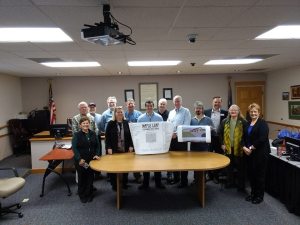
Photo OP of the Maple Leaf Project Team with Congressman Trey Hollingsworth (R). The photo was taken in the Salmon Room, County Office Building.

Specific Maple Leaf team members include: Diana Biddle (R) – County Commissioner and Maple Leaf Management Group); Keith Baker (R) – President County Council; Darren Byrd – County Council,  Maple Leaf Management Group; Barry Herring –  Maple Leaf Management Group, Conventions Visitors Commission (CVC); Bruce Gould – Maple Leaf Management Group, Convention Visitors Bureau (CVB);  Susanne Gaudin (R) – Maple Leaf Building Corporation, Republican Board Member, Brown County Election Board;  Mark Bowman, Chair, County Republican Party;  Robyn Rosenberg Bowman (R) – President, Maple Leaf Building Corporation.

* CVC members appointed by the commissioners and council. The CVB is contracted by the CVC to market tourism.

A question to Benjamin Franklin following the Constitutional Convention of 1787: “Well, Doctor, what have we got, a republic or a monarchy?” With no hesitation whatsoever, Franklin responded, “A republic, if you can keep it.

More Information and Context:

Maple Leaf – Stop Digging

Letter to the Editor – Brown County Democrat – “Maple Leaf – Stop Digging” – Publication date moved to May 2, 2018. Letter titled: ‘Stop Digging’ on performance venue.

There is wisdom in the metaphor that states that if you find yourself in a hole, stop digging. The Democrat’s article published April 18, 2018, “Maple Leaf bid opening pushed back” continues to reinforce the challenges, consequences, and issues regarding the process and decisions that were made regarding this project.

The fast-track process applied to develop a government-owned and managed venue lacked transparency and the needed checks and balances to ensure citizens that the Commissioners and Council performed their due diligence.  Project originators and leaders who proposed this project included innkeepers that have a conflict of interest. An independent feasibility study was not done on their behalf to provide objectivity and to validate the concept, financial projections, and risks.

Further, Commissioner and Council approved the project and refused to hold public meetings to obtain citizen input regarding the desirability and concerns with this project. The Commissioner and Council also did not review the complete business plan at a public meeting before voting to approve this project. Representatives from the commissioners, council and the Maple Leaf project also refused the League of Women Voters offer to facilitate a community conversation to address citizen’s concerns and questions.

It’s not too late to stop this project. Identify lessons learned and market the project to the private sector. Brown County has the third highest debt per person in Indiana. We do not need more risk and more debt.

This project was forced on the community. If this venue is built and does not live up to expectations, it will likely lead to more conflict and divisiveness. It may also motivate action towards selling this venue at any cost with innkeeper revenue being used to cover any outstanding liabilities.

The county’s application for a State Stellar grant included a series of new projects that were identified without wide-scale community involvement. Community opposition led to the county’s non-selection for the grant. The hard feelings slowly faded away but are not forgotten locally or within the state.

If Maple Leaf is not reconsidered, the opposition could likely grow, and social media campaigns may discourage any company from wanting their name associated with this venue.

Ongoing opposition and conflict may also discourage visitors from attending events and visiting Brown County which can lead to a reputation that the county is a place to avoid. Advocates of this project have the option of raising private capital and financing this venue with their resources.

Tim Clark
Brown County


County Debt Levels

The “Debt Comparison Report”  as of Dec 31, 2016, provided by the State identifies that Brown County has the 3rd highest total debt per capita in the State.

Since separate legal entities (building corporations) were created to manage the Jail and now Maple Leaf, curious to know if the debt for these facilities figures into the total debt per capita calculation.

The contract for the Maple Leaf land purchase was in 2017. The contract for the Maple Leaf bank loan signed in 2018.

Reference:

See also:

  • GUEST COLUMN: A study of tourism and economic sustainability By TIM CLARK, guest columnist Economic impact studies of tourism in Indiana and Brown County reinforce the benefits of sustaining a tourism industry. However, tourism, by itself, has not and cannot provide a sustainable economic future for Brown County.
  • Per capita defined: equally to each individual; per unit of population; by or for each person