All posts by Tim J. Clark
Protected: Philosophy and Theory
Brown County Governance – Govt and Non-Govt
Governance – Government and Non-Government
There is only one incorporated town in the county and that is Nashville.
The Helmsburg Community Development Corporation (510c3) is a non-government citizen-led group created to help improve the quality of life within Helmsburg (village/hamlet). Citizens created their own economic plan and economic development area. A great example of what other unincorporated communities within the county can accomplish. History and timeline.
List of Government Units with the authority to tax – / Governance
Are taxes trending up or down?
Brown County Government / Commissioners and County Council
Brown County Townships / Township Trustee and Board
- Hamblen
- Jackson
- Van Buren
- Washington
Nashville Civil Town / Town Council
Brown County School Corporation / School Board
Brown County Public Library / Library Board
Hamblen Township Fire Protection District – District Board
Brown County Solid Waste District – District Board
Cordry-Sweetwater Conservancy District – District Board
Lake Lemon Conservancy District – District Board
Reference: Department of Local Governments Finance (DLGF )
- 2020 Brown County Budget Order – Issued December 13, 2019
Government Entities that can Charge for Costs of Services:
- Regional Sewer Districts (RSDs). Can mandate sewer hooks and establish monthly rates.
- Gnaw Bone
- Helmsburg
- Brown County
- Nashville – not listed as an RSD but has the power to set rates and costs for services within the town.
Conservatory District – Cordry-Sweetwater

Oct 27, 2020. BCD: Lakes board OK’s new assessment amount by Suzannah Couch CORDRY-SWEETWATER — Cordry-Sweetwater residents will notice an additional number on their tax bills next year after the conservancy district’s board of directors
Oct 6, 2020. BCD. Lakes board reduces assessment amount: Residents sought to work on changes with county By Suzannah Couch . CORDRY-SWEETWATER — The Cordry-Sweetwater Conservancy District Board of Directors has decided not to charge residents more than $900 a year for each lot …
Sep 23, 2020. BCD. What’s it worth to live in the lakes area? Conservancy district board explores assessment… Suzannah Couch. CORDRY-SWEETWATER — More than 150 residents attended a conservancy district board meeting last week to express concerns about an assessment that could have …
Protected: APL 510 Session 4
Critical Thinking – Arguments, Fallacies, Rhetoric
“Critical thinking is the process of reaching a decision or judgment by analyzing, evaluating, and reasoning with facts and data presented.”
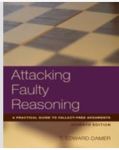
Book Excerpts: T. Edward Damer. Attacking Faulty Reasoning: A Practical Guide to Fallacy-Free Arguments, 7th Edition”, Boston, MA
A system for building a “good argument.”
Five criteria of a good argument: These five categories deal with:
- the structural demands of a well-formed argument,
- the relevance of the argument’s premises,
- the acceptability of the argument’s premises,
- the sufficiency of the relevant and acceptable premises to support the conclusion of the argument, and
- the effectiveness of the argument’s rebuttal to blunt the force of the strongest criticisms against the argument or the position it supports.
Fallacy.
- “A fallacy is broadly defined as an error in logic and also to a mistaken or false belief.”
- ” A fallacy is a violation of one or more of the five criteria of a good argument.”
Fallacies are categorized by the criterion of a good argument that they violate. The sixty named fallacies treated in the book are organized in Chapters 5 through 9 by the criterion violated, with one chapter devoted to each criterion. An extended discussion of each fallacy explains and illustrates exactly how the fallacy violates the criterion in question.
- Damer Glossary of Fallacies
- Damer Intellectual Code – Basic rules of intellectual behavior that support the development of good arguments.
- Common Critical Thinking Fallacies. Critical thinking is the process of reaching a decision or judgment by analyzing, evaluating, and reasoning with facts and data presented. However, nobody is thinking critically 100% of the time. Logical reasoning can be prone to fallacies. … A fallacy is an error in reasoning. When there is a fallacy in the reasoning, conclusions are less credible and can be deemed invalid.
- Common Fallacies – Exercpts – Indep Voters of Brown County IN
Additional Information – Rhetoric – Dr. Mark Foreman. Rhetoric and rhetorical devices can subtly impede critical thinking. “Keywords:”
- Rhetoric – “the art of persuasive writing and speaking. The purpose is to persuade others to adopt a belief.”
- Rhetorical Force. “The attempt to persuade someone to adopt a belief based on the psychological or emotive responses one has toward the idea.”
- Common Rhetorical Devices – Euphisms and Dysphemisms, Weaselers, Downplayers, Stereotypes, Innuendo, Loaded Question, Ridicule/Sarcasm, Hyperbole, Proof Surrogates.
Why Thinking Like an Open-Minded Scientist Is Good for You
Counterarguments A counterargument involves acknowledging standpoints that go against your argument and then re-affirming your argument. This is typically done by stating the opposing side’s argument, and then ultimately presenting your argument as the most logical solution. The counterargument is a standard academic move that is used in argumentative essays because it shows the reader that you are capable of understanding and respecting multiple sides of an argument.
Protected: APL 510 Session 3 Discussion
Contractor Listing Ordinance

- License – Required for any work performed when there is a Building Permit issued. Fee is $25.00. Violations are $500.00 per day.
2020 County Elections – Voting for a candidate (s)
I’m an independent that leans conservative and I am not involved with the local republican party.
I do regularly attend government meetings and post notes from the meetings on the Facebook Group Brown County Matters and in opinion columns in the Brown County Democrat. I also share what I learn in posts at Independent Voters of Brown County IN.
I also volunteer with the Brown County Leader Network that supports a planning, fact, and process based approach for guiding improvement.
Status Quo? In Brown County, my observations are that if you have an idea and know the right people, you can get government support and funding for your project. A problem with this approach is that pushing a solution without making the case as to “the scope and extent of the problem” can result in pushback and lack of community support. But given the monopoly on political power within the county, this pushback can be ignored and supported by appointments to boards and commissions of people that will behave as expected – no surprises. This leads to the non-selection of people that question policy and fewer people volunteering to serve. This then contributes to the perception that things are controlled by the “Same Ten People” (STP). The sad part is that individuals that volunteer and spend an inordinate amount of time on what they think is (and it might be) a good project, are applying processes and working within a system that might not produce the best results and receiving the positive recognition from the community that they deserve.
The Democratic Candidates for County Commissioner and Council have identified their 2020 platform. One of their points was calling for the dissoluton of the Brown County Regional Sewer District (BCRSD) Board and a counter-response.
- Sep 29, 2020. BCD. Letter: In response to call to ‘dissolve’ sewer district board. To the editor: Your Aug. 5 edition published a letter to the editor titled “Local Democrat Party candidates adopt platform.”
- Oct 13, 2020. BCD, Letter: Sewer district is ‘a solution in search of a problem’ by Kevin Fleming
The Republican candidates have not published their platofrm which may imply their support for the status quo as described above.
Given the political divisiveness within America at the national level, what effect might this have on COUNTY (local) elections? Will there be more straight-ticket voting or more scrutiny of the positions of individual candidates regardless of party affiliation? Higher or lower voter turnout? More non-votes (leave selection blank) for one or more candidates?
(I will be posting a comparison of 2020 election results results with past years).
 Independent Voters of Brown County IN