25-RZ-02 Brown County Board of Commissioners – Reversing the Tilton Rezone

Last updated: June 18, 2025  

Docket Number: 25-RZ-02 BROWN COUNTY BOARD OF COMMISSIONERS, PETITIONERS
The petitioners requested approval for rezoning property owned by William Jacob
Capital, LLC, from General Business (GB), Floodplain (FP), and Floodway (FW) to
Secondary Residential (R2), Floodplain (FP), and Floodway (FW). The property is
located to the south and west of 279 West Main Street, Nashville, in Washington
Township.

IC 36-7-4-602 Zoning ordinance; procedures for adoption of ordinances,
amendments, and map changes.

The Commissioners can require the Plan Commission to initiate the petition. The petition
does not need to come from the owner. The plan commission prepares the legal notice.

The proposal may be initiated either:

    •  (A) by the plan commission; or
    • (B) by a petition signed by property owners who own at least fifty percent (50%) of the
      land involved.
    • (Under the advisory planning law or the area planning law, any participating
      legislative body may also initiate the proposal and require the plan commission to
      to prepare it.)

Citizens (non-landowners) can request a change through their legislative body or through the plan commission. They cannot initiate a petition. 

Zoning. There are only a few counties in Indiana that have chosen not to have zoning. Brown County is not one of them.  The County Comprehensive Plan guides zoning decisions. This document is in the process of being revised and updated.

Introduction: Description of the projects and controversy: UPDATE: RV request on Tilton property to be heard Dec. 18, Brown County Democrat

This post was shared at Brown County Matters  

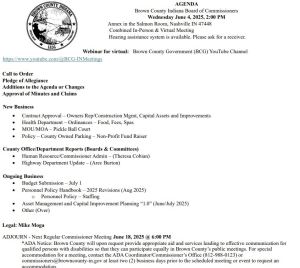
    • CHANGE – Agenda, Commissioner Meeting, May 21, 2025. We had to move the rezoning decision to June 18, 2025, at 6:00 p.m. due to a miscommunication on public notification requirements.
    • The first commissioner meeting, scheduled for June 4, 2025, at 2:00 p.m., is generally reserved for administrative-related topics. The evening meetings are reserved for major decisions, allowing more people to attend.
    • Legal. Regarding the re-zone decision back to the previous version, a link is provided in the comments that provides a timeline of the process to including the supporting documentation and audio.
    • APC meetings include the APC’s attorney. In addition to the APC attorney, the County attorney was also consulted throughout the process and coordinated with the APC attorney to help ensure all actions met procedural and legal requirements.

Timeline – Agenda, Reports, Minutes, Audio – Available at: https://www.browncounty-in.gov/AgendaCenter  

    • Oct 22, 2024,  APC First Meeting – Request for more details (site plan) was voted on and tabled.  Minutes of the Meeting to include comments from those in favor and those opposed to the projects being presented.
    • Nov 19, 2024, APC – 2nd Meeting – 4 to 3 vote Not to Recommend Approval to the commissioners, 150 signatures in opposition, max attendance and participation at the public meetings  Audio of the Meeting
      • Docket Number: 24-RZ-02 JIMMY TILTON, PETITIONER – CONTINUED FROM OCTOBER 23,2024. The petitioner requested approval for rezoning from Secondary Residential (R2), Floodplain (FP), and Floodway (FW) to General Business (GB), Floodplain (FP), and Floodway (FW). The properties are located to the south and west of 279 West Main Street, Nashville, Indiana within Washington Township.  Minutes of the Meeting.
    • Dec 4, 2024, Commissioner Meeting – Approved 2 to 1. Yes Vote – Pittman and Wolpert, Sanders voted No.  Commissioners declined to table the vote to consider the changes being made to the County and Nashville Comprehensive Plans.  After the property is re-zoned, the proposed projects are reviewed by the Board of Zoning Appeals (BZA). The BZA did not approve either project. The projects  provided the basis for the zoning change.
    • Jan 2, 2025,. Lawsuit filed challenging the zoning decision to include the legal action (Motion to Intervene) filed on Jan 17 on behalf of Jimmy Tilton.  At this point, the discussion on the issue between the commissioners and Jimmy Tilton are ceased. Summary_as of May 22,2025 MyCase_Rezoning. The case was extended pending the decision by the commissioners.

    • Jan 3, 2025  – New Commissioners hold Executive Session. 
         
    • Jan 16, 2025 – New Commissioner Petition to Reverse Re-Zoning.
      • Memorandum to the APC – Petition to Re-Zone.  This information was also provided to the Brown County Democrat and the information was published on January 20 (link to article below).   It identifies the intent and basis for the petition.
      • Docket – Commissioner Petition – Moved from Feb 5 to March 5, 2025. A “docket” refers to the official record or list of items scheduled for consideration by the APC, Board of Zoning Appeals (BZA), or legislative body.
      • APC Application for Hearing.  This form/information was used by the APC to develop the formal/legal notification letter that was sent via certified mail to 99 residences.  Re-Zone, Certified Letter mailed to 99 homes (March 5, 2025)
        • Note: Page 1 of the form identified the owner as William Jacob Capital, LLC. I mistakenly signed page 3, which is just for all the owners of record, not the individual submitting the petition. This issue was reviewed by the APC, which determined that it was not an issue or grounds for dismissing the petition. All the APC members understood I was not an owner.  Jimmie Tilton also confirmed this point in his comments at the meetings.
        • The county attorney also reviewed the issue.
        • The fact that Jimmy Tilton was not directly notified of the petition was an oversight. This issue was also addressed by the APC attorney, who described that Tilton’s attendance at the APC meetings met the notification requirement. Tilton was also present at the Mar 5, 2025, Commissioner Meeting. 
    • Jan 20, 2025  Brown County Democrat: Commissioners aim to reverse Tilton property rezoning, lighted sign ordinance, By Dave Stafford.
    • Jan 29, 2025, Board of Zoning Appeals (BZA) Meeting – PRD, Travel Trailer Park DENIED.  These projects were provided as the justification for the zoning change.
      •  
    • Mar 5, 2025. Commissioner Meeting. Commissioners vote (2 to 1), reinforcing the petition to reverse the zoning change. Sanders and Clark voted yes, Patrick voted No.
    • March 11, 2025 Brown County Democrat: Voiding Tilton rezoning advances, Staff Reports.  (Article incorrectly identified that the commissioner meeting was held on Mar 12, not Mar 5).
    • MAR 25, 2025. APC Meeting   – Decision Tabled – moved to April 22, 2025.   APC members requested additional info from the commissioners.  Discussion reinforced the need for understanding and improvement of the process. Audio of the Meeting.
  • April 22, 2025, APC Meeting – Presentation – Review of the process.
  • June 18, 2025, Commissioner Meeting – Vote to Rezone back to the previous version.  The discussion and vote were rescheduled from May 21, 2025, to the second Commissioner Meeting on June 18, 2025, at 6:00 p.m. due to miscommunication on the public notification requirements.
    • The first commissioner meeting (June 4, 2025, at 2:00 pm) is generally used to cover administrative-related issues.  Major decisions are held during the second meeting to allow more citizen participation.
  • May 21, 2025. Commissioners vote Wednesday on rezoning Tilton farm, By  Dakota Bruton, Brown County Democrat


Budgets, Fund Accounts and Descriptions

2025 Approved Budget Dec 17, 2024.  Brown-241217-2025-Budget-Order

Standard Chart of Accounts for Indiana Counties : Rogers_chart_of_accounts_instructions_

Statutory Funds, Numbers, “Some” Descriptions, References to Indiana Code: Fund-Descriptions-08_01_21

List Fund Numbers and  Descriptions: Pulaski-County-Funds-Descriptions-and-Guidelines

State Board of Accounts – Fund Types (Categories) and Fund Numbers SBOA-AIM-Budget-Wrkshp-05_2021-

Mar 6, 2025. Presentation – Reedy Financial GroupPrimary Funding, Sources for Local, Governments, , Educational Work Session, Brown County, March 6th, 2025

Budget Process Review – ICC Annual Conference 2024  Budget Process

SBOA:  Funds Sources and Uses Caldwell-Fund-Source-and-Use-2022-ILMCT-corrected

    • Motor Vehicle Highway (MVH & MVH Restricted)
    • Local Road & Street (LRS)
    • Cumulative Capital Improvement (CCI)
    • Rainy Day
    • Riverboat
    • Public Safety

Restricted Funds in Indiana Government

In the context of Indiana’s state and local governments, restricted funds are revenues earmarked by law for specific purposes. For example, the Motor Vehicle Highway (MVH) Restricted sub-fund is designated for construction, reconstruction, and preservation activities related to roadways. Expenditures from this fund must align with these specified activities to ensure compliance with state regulations. WikipediaIndiana Government

Additionally, Indiana’s fund accounting system requires that these restricted funds be tracked separately to maintain transparency and accountability in public spending.

Key Takeaways

    • Purpose-Specific: Restricted funds must be used solely for the purpose specified by the donor or legislation.

    • Legal Compliance: Misuse of restricted funds can lead to legal consequences and undermine public trust.

    • Modification Protocols: Any changes to the restrictions on these funds typically require donor consent or legal approval, ensuring the original intent is honored.

SBOA: MVH-CRP-definitions-ver-V

    • Items identified under the heading of Construction, Reconstruction, and Preservation (CRP) would be considered in compliance with expenditures allocated to the MVH Restricted sub-fund.
    • CRP activities are defined as expenses for work performed by internal forces or outside contractors that result in a new or improved roadway – paved or unpaved, including capacity enhancements. Activities result in the structural improvement of a roadway improving its ability to support vehicle traffic. Costs include personnel, material, and equipment expenses.

Mountain Tea State Forest

Gov. Holcomb establishes two new state forests in Morgan, Brown counties, Lydia Gerike Indianapolis Star, Aug 15, 2020.

    • Mountain Tea State Forest is a 1,153-acre area in Brown County, Indiana. It was previously part of Yellowwood State Forest. The forest is used for recreation such as hiking, hunting, wildlife viewing and mushrooming. The majority of the property was previously owned and managed by the Nature Conservancy. The DNR is planting 60,000 to 70,000 trees in Mountain Tea and Ravinia as part of its program to plant 1 million trees by 2025.

DNR: Mountain Tea State Forest, Pumpkin Ridge Road, Nashville, IN 47448

Mountain Tea State Forest currently encompasses more than 1,153 acres, 705 acres of which was deeded to the State of Indiana in 2013. The deeded portion was locally known as a part of the Mountain Tea property and was previously managed by The Nature Conservancy. The land was acquired by the State of Indiana with the assistance of the U.S. Forest Service through the Food, Agriculture Conservation, and Trade Act of 1990, aka the Forest Legacy Program. The Forest Legacy Program was developed to help protect intact forest lands from conversion to non-forest uses while still allowing for sustainable timber management and recreational use. An additional 490 acres was acquired by the state in 2009 through purchases from private landowners.

Historical aerial photography suggests that, before government acquisition, the valleys and ridgetops were farmed and the side slopes were grazed. The ridgetops are composed of old field mixed hardwoods. The side slopes are mostly composed of mixed hardwoods and oak-hickory communities known to occur within the Brown County Hills natural region.

The city of Nashville lies roughly 6.4 miles west, and Columbus is roughly 10 miles east.

Mountain Tea State Forest is one planting location for the Division of Forestry’s ForestIN program, an effort to plant a million trees by 2025.

Activities

Although no permanently established recreation areas are present, there are still several recreational opportunities.

Hunting is permitted on State Forest property, and this area also offers opportunities for off-trail hiking, mushrooming, and wildlife viewing.

LMI By Census Track

HUD: Community Development Block Grants (CDBG)  Low-and Moderate-Income (LMI) Data

    • Demonstrating Area Benefit to Low and Moderate Income Persons
    • Estimates are provided at three income levels: Low Income (up to 50 percent of the Area Median Income (AMI)); Moderate Income (greater than 50 percent AMI and up to 80 percent AMI), and Medium Income (greater than 80 percent AMI and up to 120 AMI). HUD publishes the margin of error (MOE) data for all block groups.

 This information is referenced at Brown County Matters  

To qualify for OCRA planning grants, the Low to Moderate Income level (LMI) has to be at 51% or higher.  An OCRA validated county income survey in 2017 identified a LMI level of 53.1% that qualified us for a 40K Economic Development Strategic Planning grant. The survey cost around $4.500 and was conducted by an OCRA-approved grant administrator and validated by an approved economist.

When we inquired this year about conducting another income survey, OCRA reviewed the Census Track Data and said we would not be eligible, given the “actual” LMI level of 40.4%.

GDP – County Economic and Income Base

2025 Economic Strategy – Best Bets :

      • Housing
      •  Recreation
      •  Wholesale
      • Production
      • Retail

LMI Drop from 53.1% to 40.4 %

Indiana Office of Community and Rural Affairs (OCRA) – Facebook Page   Exciting News from Brown County! 

Brown County has achieved a significant milestone in its economic development journey! The county’s low- to moderate-income index has decreased dramatically from 53.1% in 2017 to 40.4% in 2024, showcasing remarkable progress and financial growth.  

This accomplishment is a testament to the hard work and dedication of local leaders, community partners and stakeholders committed to enhancing economic opportunities and quality of life for residents.

At a recent meeting, facilitated by OCRA’s Northwest Community Liaison Gerry White, discussion focused on strategic planning and leveraging grant opportunities to further build on this success. This includes utility upgrades, housing improvements, and community engagement to continue moving Brown County forward.

Congratulations to everyone involved in making Brown County a thriving and prosperous community! 🎉

Copy of Brown County Census Tract Information(ACS 2016-2020 LMI Data) Sorted

LMI Copy of Brown County Census Tract Information – History (2011-2015, 2016-2020, Percent Change. (Excel Spreadsheet will donwload).

    • Updated LMI spreadsheet with numbers from 2011-2015. The Comparison sheet shows how census tracts’ LMI percentages have changed from one 5-year estimate to another. There are now 3 more block groups/census tracts that are being used, so I went ahead and removed these for now.   
    • The LMI in 2017 was 53.1% determined through an OCRA required sampling/survey methodology.  The 2015 data set does not include a Margin of Error (MOE) which likely supported approval for a survey instead of reliance on census data.  
    • The current MOE is  +/- 4.5%. 
  • The OCRA 2017 Income Survey did not consider census tracts.  It was based on a random sample of around 600 residences. 
  • Based on census-tract data,  the county’s overall LMI status has not changed very much between 2011-2015 (42.29%) and 2016-2020 (40.40%).  The information may be useful for identifying which census tracts are losing/gaining low-income residents.  


APC Meeting Notes Apr 22, 2025, Re-Zone and Comprehensive Plan

APC Agenda April 22 2025

Post at Brown County Matters.

Audio of the meeting.  The APC declined to stream the meeting on the County’s YouTube channel.

History. Last November, the APC voted 4 to 3 not to recommend the zoning change. Those not recommending the change included Kara Hammes, Jane Gore, Randy Jones, and Dave Hardin (Surveyor).  Those recommending the change included Andy Voils, Carol Bowden, Kyle Deckard. 

At their Apr 22, 2025 meeting, the APC voted 3 to 3 on the petition from Commissioners Clark and Sander to re-zone the property back to its original status.  Kara Hammes was absent.  The APC then unanimously voted not to provide a recommendation to the commissioners.  

The 3 votes supporting the petition to reverse the zoning were from Jane Gore, Randy Jones, and Carol Bowden. Bowden previously voted for the change.   Those supporting the current zoning included: Andy Voils, Kyle Deckard, and the new surveyor, Tim Allen.

In addition to the original vote by the APC not to recommend the zoning change, the Board of Zoning Appeals also did not approve either of the proposed projects that were the basis for the zoning change.  The BZA determined that the proposal for the Private Recreational Development (PRD) was too vague. They also identified that a Travel Trailer Park is not allowed in a Flood Plain District.  Jimmie Tilton then withdrew the project before the BZA voted on the issue.

The commissioner’s petition to reverse the zoning change supports the original recommendation from the APC and the vote by the BZA. 

Brown County Comprehensive Plan

America and the Exodus

Post at LinkedIn. 

America and the Exodus., The Free Press.  The story of Passover is not just a Jewish one. Our founding fathers were profoundly inspired by it. So was Cecil B. DeMille.

Why, asks Sacks, did Britain and The story of Passover is not just a Jewish one. Our founding fathers were profoundly inspired by it. where France and Russia failed?

    • The explanation is surely complex but much—perhaps all—turns on how a society answers the question: who is the ultimate sovereign, God or man?. . . . For the British and American architects of liberty, God was the supreme power. . . . For the French and Russian ideologists, ultimate value lay in the state. . . when human beings arrogate supreme power to themselves, politics loses its sole secure defense of freedom. . . . Societies that exile God lead to the eclipse of man.
    • The Renaissance, Nelson notes, reflected the pagan inheritance of antiquity and generated an approach to politics that was secular in character, whereas following the Reformation, “Christians began to regard the Hebrew Bible as a political constitution, designed by God himself for the children of Israel.” Liberty, Nelson argues, took root in the political Hebraism of the English-speaking world.

Area Plan Commission (APC) Meeting Notes Mar 25, 2025 – Tilton Re-Zone

APC AGENDA Mar 25, 2025

Background: Voiding Tilton rezoning advances, March 11, 2025, Brown County Democrat

This post at Brown County Matters

APC Members were unaware that a citizen, including commissioners, could petition the APC to reverse a zoning decision.  

Summary.  In Nov 2024, the APC voted not to recommend approval by a vote of 4 to 3. The previous commissioners voted to approve 2 to 1. The Board of Zoning Appeals did not approve either of the projects proposed.  Residents sued the county to reverse the zoning decision. Two of the new commissioners submitted a petition to reverse the zoning decision in Jan 2025. The lawsuit was extended pending the final decision by the APC and Commissioners. 

The vote was tabled (delayed) until the April 22, 2024 meeting. APC members asked the commissioners for additional comments related to the guidance provided in IC 36-7-4-603.

This section is referenced by the Planning Director when introducing the proposed change to APC members.  Note that the “legislative body” consisting of elected officials (commissioners) are responsible for listening to all the citizens and making the best decision for the county. 

Other – IC 36-7-4-603, Reasonable regard for the following by the Plan Commission and legislative body

(1) the comprehensive plan;  Brown County Comprehensive Plan (PDF)
(2) current conditions and the character of current structures and uses in each district;
(3) the most desirable use for which the land in each district is adapted;
(4) the conservation of property values throughout the jurisdiction; and
(5) responsible development and growth.