Eco-devo: TIFS and Tax Abatements: Indiana Policy Review

Economic Development (eco-devo)

“The Indiana Economic Development Corporation (IEDC) is a shadow government. – Micah Beckwith

 Note: Brown County has not had to entice residential and commercial development through tax abatements and Tax Increment Financing (TIF) Districts.  Hard Truth Hills is a  recent example.  Local investors also acquired and developed the properties sold by the late Andy Rogers, creating jobs and increasing the tax base. 

Indiana Policy Review.  About Us

Our mission is to marshal the best thought on governmental, economic and educational issues at the state and municipal levels. We seek to accomplish this in ways that:

    • Exalt the truths of the Declaration of Independence, especially as they apply to the interrelated freedoms of religion, property and speech.
    • Emphasize the primacy of the individual in addressing public concerns.
    • Recognize that equality of opportunity is sacrificed in pursuit of equality of results.

Purdue – The-Use-of-Tax-Increment-Finance.

    •  Indiana law now makes clear that TIF is intended to fund infrastructure to promote development that would not occur but for the added infrastructure financed by the TIF revenues. Evidence that the development would not happen but for the establishment of the TIF district must be presented before the TIF district is approved. TIF is not meant as a source of revenue for responding to ongoing development nor as a substitute for other sources of infrastructure funding.

The Cult of Eco-Devo

FOR SEVERAL YEARS NOW I have searched for the perfect apothegm or story to describe Indiana’s economic-development policies — you know, the ones that build stadiums and mixed-use apartment complexes, renovate entertainment and shopping districts and such, all promising growth by shifting other peoples money around with tax-secured bonds, tax increment financing, grants and rebates.

 See if you can guess which best fits a typical municipal economic-development group.

    • The Creative Generation — This is the pioneering group that generates new ideas, art and innovations, laying the foundation for the community.
    • The Mimic Generation —  The subsequent generation follows in the footsteps of the creative generation, replicating and imitating its achievements but not producing anything radically new or original.
    • The Failed Generation — The final generation is unable to sustain the vitality of the first or false optimism of the second, leading to eventual fiscal collapse.

Congratulations, you guessed right. It is the mimic generation that goes through the motions of creating economic growth but without innovation or productivity or any market test. The next generation, if Spengler is to be believed, will be the failed generation that must pay for all the notes and bonds on those grandiose projects that never fulfilled their promise.

Lucas Oil Stadium: A Big Hole in the Roof

IT WAS AN OUTRAGEOUS admission: Officials do not know the exact cost of the subsidized Lucas Oil stadium, specifically that part assigned to the retractable roof.

It was a rare glimpse into how eco-devo is done — behind closed doors, using other people’s money, ostensibly for a popular cause. 

The conclusion: “Cross-sectional studies comparing cities with teams to similar cities without teams find no evidence of extra economic growth or income associated with a team. Other studies that tracked cities over time as they gained new teams also came up empty: if anything, a new franchise can act as a slight drag on economic growth.”

Half Past the Month: That Crony Capitalist Elephant

AN ELEPHANT HAS ENTERED THE ROOM of Indiana’s economic-development officialdom. Nobody wants to talk about the growing amount of research challenging its policy formula. It costs a lot and it doesn’t seem to work. An adjunct scholar of the Indiana Policy Review last month described it in the inverse. He told a group of Indiana businessmen and Read the full article…

    • An adjunct scholar of the Indiana Policy Review last month described it in the inverse. He told a group of Indiana businessmen and opinion leaders they would be better off without any official economic-development effort whatsoever. Rather than provide an economic advantage over competing cities, he says it has merely facilitated a “race to the bottom.” (1)

Cummins: More Eco-Devo, a Citizen’s Lament

“Hotel Coming to Site of Old VCSC Building” — Terre Haute Tribune, July 26, 2024 by Ryan Cummins I write to you about another in a long list of eco-devo (economic development) scams, a particularly obscene one. That it is presented as a straight news story in a humdrum manner is even more disheartening. But then, I don’t expect Read the full article…

Penticuff: TIF Seekers Are Getting Shameless

By David Penticuff Our “Haves” are again turning to our “Have Nots” for monetary help through tax increment financing. Central Indiana Ethanol (CIE) is asking my city to expand its Tax Increment Financing (TIF) district to include the former Omnisource property, which CIE purchased last year, in order to finance a project already underway at Read the full article…

Backgrounder: TIF Data Held Close to the Vest

“Something worth doing is worth measuring.” — Dr. John Crawford, Fort Wayne City Council by Ken Davidson Over the course of the past three years, obtaining information on Tax Increment Financing (TIF) districts has been made difficult and in some ways impossible. In 2016, shortly after articles appeared in the quarterly Indiana Policy Review, the Read the full article…

Keating: Tax Abatements and TIFs

The following is based on comments made at a foundation luncheon April 12, 2018, in Fort Wayne. by Barry Keating, Ph.D. Jerry Brown was elected governor of California in 1974 and again in 1978 before busying himself as mayor of Oakland. Californians in 2010 apparently wanted to return to the days of “Governor Moonbeam,” as Read the full article…

Market versus Government Failure

Economists argue that “market failure” is the main reason for the government; they argue that private markets do not build roads, provide clean water, eliminate sewage and enforce the law. We need government to do these things. These economists are correct. Each of these appropriate roles for the government was detailed long ago at Wabash College in Crawfordsville by Dr. Milton Friedman when he presented a set of talks later published as “Capitalism & Freedom.” Friedman listed just three areas of appropriate government action:

    • The government needs to act as a rule-maker and enforcer;
    • The government should provide public goods (e.g., roads, bridges);
    • Finally, the government should sometimes operate paternally (e.g., for children who cannot fare for themselves).

These three areas Friedman detailed were appropriate for government action because markets had no incentive to provide these goods and services. It was the government’s duty to step in and see to their provision. But the government, according to this argument, should not provide goods and services whenever there is an incentive for the market to act.

Business Leadership Silent on TIF

by Fred McCarthy We found it interesting that the local Chamber of Commerce, which in theory represents the business community, has volunteered to help a governmental agency more easily increase the tax burden on the business community. It comes as no surprise for in recent years we do not recall the Chamber ever questioning tax Read the full article…

Op-Ed: A TIF Scandal in Marion

by David Penticuff Fifty years ago the great character actor Strother Martin uttered what could be the epitaph for the relationship of my city council and the city administration. It was in the movie “Cool Hand Luke.” Martin, who played a prison warden, knocked prisoner Paul Newman, wearing chains, down a tall hill after Newman’s character Read the full article…

Backgrounder: A TIF Comes Home to Roost

by Craig Ladwig There were howls of anguish when a proposal was made to change municipal bidding practices in Indiana to limit the influence of campaign donations. One mayor called the plan disrespectful. A development official took umbrage that anyone would use the word “corruption” in connection with his city. Today, though, David Penticuff of the Read the full article…

Backgrounder: The TIF Sales Pitch Is Wearing Thin

by David Penticuff Loren Matthes, a partner at Umbaugh and Associates, spoke at a Wednesday at our local council meeting about the financial predicament of our city. In calm fashion, for the first time in a year and a half of working on our city’s budget problems, an Umbaugh official spoke in public about our Read the full article…

Backgrounder: TIF for (all of us) Dummies

by Martina Webster Hoosiers, we just paid our fall property tax installments back in November. Do you know how they were calculated? Where did your government come up with that number? And are property taxes really worse than the alternatives? The first thing you may not know is your home is assessed based on its Read the full article…

Op-Ed: TIF Merely ‘Chases’ the Economy

by Martina Webster In my county we have an issue with tax increment financing (TIF). As of 2014, almost 20 percent of our property taxes go into multiple TIF funds instead of the appropriate taxing units. Our school districts, libraries and general funds lose millions every year to the specially carved out TIF districts, which Read the full article…

Backgrounder: BSU Researchers Critical of TIF

by Craig Ladwig A group of researchers at Ball State University last week released another critical assessments of Tax Increment Financing (TIF). The authors, Dr. Michael Hicks, Dr. Dagney Faulk and Srikant Devaraj, join Tom Heller, writing in the current issue of The Indiana Policy Review, in casting doubt on this enigmatic tax policy. The Read the full article…

McCarthy: The Enduring ‘Gift’ of TIF

by Fred McCarthy They say insanity is doing the same thing time after time and expecting different results. And citizen ignorance plus lethargy adds to the insanity by accepting rosy financial fantasies and outright lies. A recent front-page story in the Indianapolis Star, with artwork, is headed “A project expands.” It concerns, of course, another Read the full article…

White paper: TIF – It’s not Working the Way We Were Told It Would

The foundation’s white papers are intended to make scholarly research on Indiana issues more widely available to policy analysts and researchers. White papers represent research in progress and are published to invite comment and discussion as preparation for their submission to academic journals and other professional publications. The authors are solely responsible for the content Read the full article…

A Legislator Demystifies Tax Increment Financing

(For the use of the membership only) by Greg Walker For decades, Indiana has utilized tax increment financing (TIF), an instrument by which future property-tax revenue is captured to pledge for borrowed funds for capital investment. It nonetheless remains controversial. We need to ask why. Debt, or leverage, is a simple idea, and businesses employ this decision Read the full article…

Economic Development: Indiana’s Wobbly TIF Law

DRAFT COPY FOR MEMBERS ONLY:  NOT FOR PUBLICATION, QUOTATION OR DUPLICATION   Editors: The author earned his bachelors in economics at the Wharton School and a masters in regional science, both from the University of Pennsylvania. Prior to his move to Indiana, he was principal and founder of regional analytic sciences in Seattle, Washington. Heller’s Read the full article…

Keating: A Critical Review of TIF and Abatement

by Maryann O. Keating, Ph.D The Wall Street Journal recently listed penthouses available for sale at $2.1 million or more at Philadelphia’s “most prestigious address.” Units were designed by an award-winning architect and are located in a fully staffed building with five-star concierge services. Each sale includes a 10-year tax abatement. In March of this Read the full article…

Heller: Indiana’s Favor-Ridden TIF Districts

by Thomas Heller Tax Increment Financing (TIF), a widely misunderstood economic-development tool in Indiana, operates something like a bank. TIF districts make investments in local public improvements (roads, etc.) hoping to attract follow-on investment from private companies. Often these improvements are financed by borrowing — that is, issuing bonds to be paid off by the Read the full article…

TIFs: Mr. Daniels, Meet Mr. Brown

Well, he’s back. Jerry Brown, after a stint as mayor of the City of Oakland, is once again governor of California. This time, however, the ultra-liberal governor has something to teach Indiana. For this is a different Jerry Brown; now he’s attempting to cut $1.7 billion from the state budget to correct a deficit that Read the full article…

Backgrounder: The Unspoken of Abatements

by David Penticuff A councilman took our newspaper to task this week for criticizing the council on its apparent lack of curiosity regarding the granting of property-tax abatements. It turns out we were wrong in that regard. Council members have a lot of information about the tax abatements they vote to grant. They just don’t Read the full article…

Keating: The Folly of Tax Abatements

by Barry Keating, Ph.D. The tallest and most prominent building in South Bend is the Chase Tower. The tower is also known for inoperable elevators and a crumbling façade; the occupancy rate is about 50 percent. The Summit Club, once located on the tower’s top floor, was considered the most elite restaurant in town. Now Read the full article…

Keating: The King’s Hawaiian Example

by Barry Keating, Ph.D. Edinburgh isa town in Bartholomew County. It is part of the Columbus, Indiana, metropolitan statistical area. An astounding event took place in Edinburgh this past month: A firm engaged in building a new plant failed to ask for a tax abatement! Such behavior is unusual; new businesses of every variety routinely request tax Read the full article…

Budget Hearing Notes, July 24, 2024, 8:30 a.m. to 6:00 p.m.

County Council Budget Hearing Notes, July 24, 2024, 8:30 a.m. -6:00 p.m.  I’ll be posting the audio recordings  at a later time.

This post at Brown County Matters

Agenda – Budget Hearings, Wednesday July 24, 2023

Attendance by the public: I have been attending the hearings for years. The other attendee this year was Patrick Nledlander, a Republican candidate for the council.

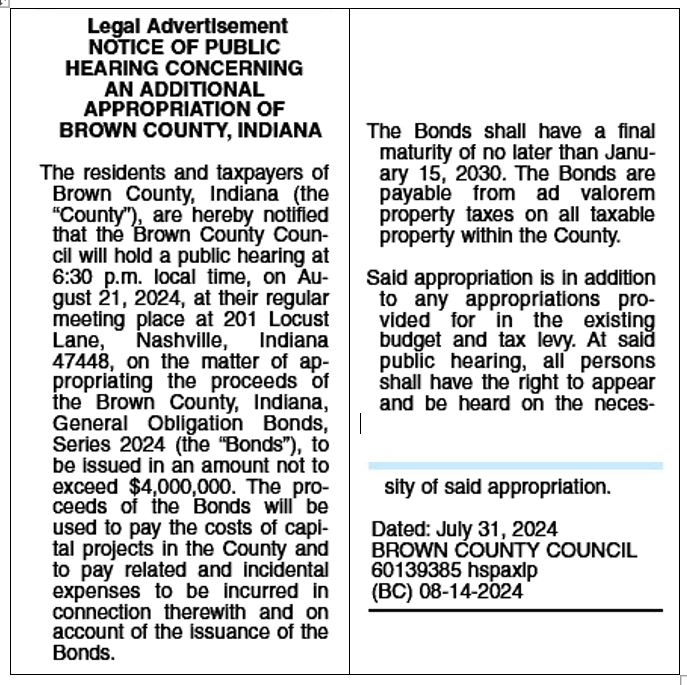
Review Process. The council selected a new financial advisor last year. He supplemented the budget submissions by the departments with with additional detail. It will be another few weeks before final approval, and we have an idea as to what can be funded and how. New also this year was the need for the departments to identify their capital improvements that might be able to be funded with the money from the General Obligation (GO) bond. The council will be voting to approve the limits and terms of this bond at their next meeting.

Taxes. Borrowing money via a bond for infrastructure is paid for by a property tax and is a recurring event.  The amount borrowed started off at 2 million/2 years, then 3 million/3 years, and now the amount to be borrowed is not to exceed 4 million.  The length has yet to be decided – likely longer than “4” years. When we borrowed 3 million, the interest rate was less than 1 percent so it could be claimed that borrowing an extra million would be “tax neutral” – the existing tax would not go up.

Convention Visitors Commission (CVC).  There were several members of the public attended the last session –which was the presentation of the budget by the CVC. This budget identifies how the revenue from innkeepers tak (1.3 million) is to be spent.  This was the first year I can recall that the CVC budget received any scrutiny, and council members sought to understand the financial relationship between the county, the CVC/CVB,  and the Maple Leaf Management group. The county financial adivsior suggested that a flowchart would be helpful to understand the process.

Reduced CVB Funding. THE CVC has identified its intent to reduce funding for the CVB. The CVB is a non-profit created (in 1984?) to market tourism to include managing the visitors center. A building they bought.  The CVC objected to the purchase and the possibility that the mortgage would be paid for with the revenue from the innkeepers’ tax.  This issue was discussed at the Joint meeting of the commissioners and council:

CVC Budget – Review and Approval. The county council – “by statute”, reviews and approves the CVC budget. Any change in the budget and funding of the CVB would need to be reviewed and approved by a majority vote of the county council.  Commissioners and Council appoint members to the CVC. I do not recall what the appointment process is for members of the Maple Leaf Management  Group. This is a 7-member board that includes a representative from the council – Darren Byrd, and a  Commissioner  – Jerry Pittman.  The Maple Leaf Management group determines the distribution of the excess revenue from the Music Center.

County Financing for Private Development. A short discussion on the council’s non-binding intent to provide county matching funds (3.4 million est. ) for the development of the Little Opry/Apartment Building project.  Funds would be used to finance the extension of sewers in the area, which is in Nashville’s sewer district.  I am not aware of any current plans by  Nashville’s Utility Service Board (USB) to fund sewer expansions in the area.

The property is owned by the Tiltons, who will lease the property to a developer.  The idea is for 1-2 bedroom apartments leased at market rates (1,500 a month). Tax abatements and revenue from increases in taxes as a result of the development were identified as possible options.

A Tax Increment Financing District (TIF) has also been mentioned as a possible source of revenue for funding the costs of infrastructure. This topic was also discussed at the Joint Session references above.

TIFs and Legal Council. The topic of TIFs was mentioned —a meeting was held on the topic with the RDC president, the financial advisor, and an attorney from Barnes and Thornburg. During the commissioner presentation, it was mentioned that the RDC should be funded with 10K to help cover legal expenses to support economic development funding strategies, including TIFs.

NEW.   Establishing TIF districts to support economic development is NEW to Brown County but common in other counties.  Nashville has established TIFs that have not resulted in an influx of capital. TIFs are used to fiancé the infrastructure needed to attract businesses and jobs, increase school enrollments, housing, shopping, etc. Carmel and Fischers have used TIFs and other incentives to maximize their development.

Purdue—The Use of Tax–Increment Finance. Indiana law now makes clear that TIF is intended to fund infrastructure to promote development that would not occur without the added infrastructure financed by the TIF revenues. 

    • Evidence that the development would not happen but for the establishment of the TIF district must be presented before the TIF district is approved. 
    • TIF is not meant as a source of revenue for responding to ongoing development nor as a substitute for other sources of infrastructure funding. 

Commissioner Meeting Notes, July 17, 2024.

This post and comments at Brown County Matters. Includes a comprehensive assessment in opposition. 

07.17.2024 Agenda Commissioners

AUDIO of the Meeting  

1:16 A Traffic Signal (Stoplight) is going to be installed at the east entrance of the State Park.  The goal is to have it operational by the end of September.  Previous plans were for a roundabout. Onsite plan meeting: July 31, 2024, 10am State park entrance. 

ORV Ordinance was passed.  Pittman and Wolpert voted Yes. Ron Sanders was the No Vote.

    • The schedule for the public meeting and approval was within a 30-day window. This was not considered fast-tracking.  Public Meetings were held on June 24 and 25. The first reading was July 10 (moved from July 3)  followed by the second reading and final vote on July 17.
    • The meeting was well attended by supporters – who filled the room.
    • References were made to discussions at public meetings in previous years on the topic.  References to any coverage of these meetings in the Democrat were not referenced.

3.0  minutes: – Opening Comments.

    • 6:35 and 19:15. Two citizens voiced their opposition. One of these was a former EMT, who just heard about the meeting earlier in the day. 
    • 21:03. Ron Sander, Opposes the ordinance and acknowledges it would probably be passed.  The concern is with non-residents and challenges everyone to be good stewards.  Ron provided an explanation for his position to include a repeal next year if necessary.
      • Note:  If there are significant issues to include reports by the Sheriff’s office and Conservation officers,  amendments would likely be a first step. Ordinances in other counties have restricted some roads from ORV access. This option is included in the ordinance  Section 5.1.  
    • 29:24  – Pittman on Complaints followed by a resident providing an example (30:15)
    • 33:30 Pittman is in favor of the ordinance but would expect future commissioners to support a repeal if it becomes a mess that’s not controllable.  He does not expect this to happen. 
    • 40:00 – Motion and Vote to Approve.

1:21 Highway Superintendent Update.

Tourism Marketing and Music Center Management

Tourism Marketing and the Music Center Management. Meeting notes from the July 17, 2024, Joint Session of Commissioners and Council.

This post at Brown County Matters.

An interesting discussion on management and oversight of the revenue received from the innkeepers tax to include marketing.  Included the argument for keeping the venue vs selling, and distribution of revenue.

AUDIO JWS 2 CVC/CVB Discussion. (50:28).  Discussion started by Councilman Rudd

Link in the comments to a Summary of the issues, roles, responsibilities, and a way-ahead.

Summary

The revenue from the innkeepers’ tax is passed through the Convention Visitors Commission (CVC) – a five-member board, to the Convention Visitors Bureau – CVB (a 501c3), to market tourism. The CVB also operates the Visitors Center. The discussion was held on the issue of accountability, marketing responsibilities, and the future of the CVB.

Elected officials – commissioners and council, have historically had a “hands-off” policy when it came to providing oversight on the management of the revenue from the innkeepers tax. They appoint members to the CVC.  In 2023, the tax brought in approximately 1.4 million. Prior to the Brown County Music Center (BCMC), revenue from the tax was around 700k.

Without Vision….The commissioners have never developed a vision for tourism that would include the types of tourism that were desired by Nashville and the county.  A vision would help provide some guidance on funding priorities and outcomes. A vision could be included in the County Comprehensive Plan.

The council asks few if any questions on how the revenue from the innkeepers tax is going to be spent (by law, they are to review and approve the CVC budget). The CVC budget generally just shows the transfer to the CVB and now the BCMC.  How the money was spent by the CVB and what was accomplished was not published or expected from the elected officials.  Accountability is delegated to the CVC.

Historic Change. The revenue from the innkeepers tax was used as collateral to borrow the 12.5 million to build the brown County Music Center (BCMC).  (The original proposed name for the venue was Maple Leaf.

The Maple Leag Building Corp (3-member board appointed by the commissioners) owns the building. The Maple Leaf Management Group (a 7-member board with a commissioner and council rep) provides oversight on the management and operations of the BCMC.

The BCMC Management Group includes members who are also on the CVC.  The CVC wants to discontinue the relationship with the CVB and transfer the responsibility for marketing tourism to the Maple Leaf Management Group. A significant change that prompted the discussion.

The BCMC Management group through an Admin Agreement, determines the distribution of the excess revenue from the BCMC. The original distribution was 75% to the Community Foundation and 25% to the County. it was recently changed to 50/50.

Future of the BCMC?

On the future of the BCMC, I am running for commissioner, District 3.  My position is to hold public forums to get input from the community regarding the future of the Music Center which would result in community support and understanding regarding the best options.

Commissioner  Sanders identified the option of selling the Music Center in his campaign. This position is supported by those who believe that owning and operating a music venue is not the responsibility of the government.

I am not aware of any other commissioner or council member who does not support keeping the venue. Discussions have emerged as to who should be making the decision on the distribution of excess revenue from the Music Center.

Citizens. “We the people” are top management, responsible for providing oversight on the performance of elected and appointed officials.

The Forums would include presentations that would include the following:

    • The Convention Visitors Commission. (CVC).
    • The Convention Visitors Bureau. (CVB).
    • Commissioners
    • Council
    • Maple Leaf Bldg Corp
    • Maple Leaf Management Group.

Joint Working Session Notes, July 17, 2024 – 9-noon

This post at Brown County Matters

July 17 Combined Work Session

Agenda

    • CVC – best means of using taxes collected by the CVC to benefit the county
    • The Opry Apartments Project was recently selected as a finalist within the Uplands region for consideration for Blight and Redevelopment funding from Lilly Endowment Inc. (within the READI 2.0 program). A commitment of public match dollars is required as part of the next step by the end of July.
    • Sheriff Jail Collection Fund Bill 14
    • 7-15 Additional Appropriations
    • Impact of thawed levy and certified shares on BC Solid Waste District
    • Review/Sign the CIP Ordinance
      • Computer Upgrades
    • Budget review of submitted Form 1 information
    • Any additional items pertinent to the budget and operation of the county
    • July 24, 2024. 8:00 – 5:30 Budget Hearings

PART 1

AUDIO JWS 1 OPRY APARTMENT PROJECT – The Tilton Little Opry Apartment project applied for funding under the Indiana  READI 2.0 Initiative. The Eli Lilly Foundation added 185 million for blight remediation and redevelopment.  The Opry/Apartment project managers were asked to provide additional information to be considered for funding.  The county will be required to provide matching funds.  The council agreed to submit a letter of interest in supporting this project but there is no obligation a this time.  The source of the matching funds (3.4 million) is initially identified as tax abatements (1.8 million) and revenue from the County Economic Development Income Tax (EDIT) – $1.6 million.

PART 2  Tourism Marketing and Music Center Management

PART 3  AUDIO JWS 3 Budget, Bond, Misc.

County Council Meeting Notes, July 15, 2023, Firefighters

AUDIO of the Meeting

Agenda #3 County Council Meeting July 15, 2024

20240715 Council Agenda New Business

    • Additions to the agenda:
      • Sheriff – Dept – Brand Stogsdill – Raises
      • Auditor and other Elected Officials/Department Heads – Raises

Of interest: House Bill 1454 (2023) ….. (DLGF Bill – Amendment) “Provides that part of the tax revenue that is allocated to public safety may be distributed to certain township fire departments, volunteer fire departments, fire protection territories, or fire protection districts. “

Volunteer Firefighter Association

    • Local Option Income Tax – Must be passed by the County Council. Allows an increase in income taxes from  .01% to .05%.    “Example: 50K salary – $36.00 a year”    (???)
      • How distributed? Based on real property value less farm ground
    • 2-year Sunset – must be re-voted
      • Has to be adopted by January –  Requires two public meetings
    • State reduced income tax rate to 2.9 
    • PowerPoint Presentation

Statute:  Indiana-htc-hb-1454-enrolled-05042023 pg 120-121

Brown County Income Tax Rate: .025234

Commissioner Meeting Notes, July 10, 2024 – ORV First Reading

This post at Brown County Matters.

07.10.2024 Agenda Commissioners

1:01:43 — Update by the Highway Superintendent. Includes an explanation of the status on vehicles to include the work truck he drives. This discussion was preceded by a discussion by Ron Sanders and the topic of erosion control. 

AUDIO Commissioner Meeting   Includes discussion of a First-Reading of the ORV Ordinance

The ORV Ordinance was read into the record. The Second and Final Vote is scheduled for July 17, 2024, at 6:00 pm.  Commissioners Pittman and Wolpert support the ordinance “as-is.”  Commissioner Sanders does not. He is receiving more opposition to the ordinance and will share what he received with the other commissioners.  Commissioner Pittman stated they will continue to welcome input via phone or email but indicated his intent to pass the ordinance as-is.  Email: commissioners@browncounty-in.us 

If you have questions or concerns about the ordinance, suggest sharing this with the commissioner via the email address and at the meeting on July 17, 2024.  This becomes part of the record. 

    • Start : 12:30
    • Tim J. Clark 13:53 – 22:47 –  Why the rush?  I provided a copy of my statement to the commissioners and auditor and was provided the time to read it into the record. Clark ORV Statement July 10 2024.  Key points:
      • The use of ORVs “cannot” be limited to residents only which significantly broadens the scope of the ordinance and possible effects.  Suggestions:

      • Postpone the first reading.  Spend a few more hours requesting more information and sharing this via the county website and public meetings.

      • Improve communications via the Democrat newspaper, provide online presentations, and leverage social media to help ensure residents are not surprised when they see ORVs on the roads.
      • Before a first reading, hold another public meeting to share what has been learned and identify the next steps, including making any needed revisions. 
    • 22:47. Resident. Sharing his negative experiences with ATVs racing in his neighborhood and the Noise. Commissioner Pittman said we have no noise ordinance and there is no law against the loud noises that ATVs will cause. Pittman stated motorcycles are loud also.
    • 25:08. A resident expressed concern that ATVs will impact the peace and quiet in his area and likely lead to a change of plans to build a new home. He referenced the possible impact of a drop in real estate values if ATVs are seen as a problem in the area.
    • Another resident asked questions about licensing and concerns about ATVs riding in groups. This is not allowed. Reference to a limit of 2 at a time.
    • 29:36. Ron Sanders. He is receiving more information in opposition to the ordinance via email and phone calls and will share the information with the other commissioners.  He is opposed to the ordinance and wants more information.  He received inaccurate information on the ordinance from an advocate. He believes the process is being fast-tracked. He is researching the risk from an insurance standpoint from possible future lawsuits; he will keep working on getting information over the next week prior to a second vote on July 17.  He referenced we will have two new commissioners in January, and identified tabling the ordinance as an option that can be considered.
    • 33:14 – Rebuttal by Commissioners Pittman and Wolpert on the allegation of fast-tracking. They referenced previous conversations (over 2 decades) in the county on the topic but referenced no documentation or other evidence supporting their recollections. No action was ever taken.   Commissioners held no public meetings in 2021 when this issue was raised in an article in the Democrat and on Social Media. A justification given was that more residents have ORVs.
    • 36.33 – 53:28. Commissioner Wolpert read the entire ordinance into the record.   
    • 53:28. Commissioner Pittman stated they will continue to welcome input via phone or email.  Email: commissioners@browncounty-in.us

Residential Building Permits


Building Permits — Building Permit Information 2022 – page 4 Residential Building Plan Requirements
 
“Among” the indicators for assessing the growth of a bedroom community is the trend on residential building permits. I pulled data from Stats Indiana.edu developed a median run chart for the years 1990-2023.
 
Residential Building Permits 1990-2023
 
The chart identifies three interesting periods of time – 1990-2003, 2004-2010, and 2011-2024. I developed a separate chart for 2011-2024 that indicates a positive trend in permits. On the three different periods of time, the housing market Crash was in 2008.
 
Residential Building Permits 2011-2023

The “So what?” The data just provides a baseline. Another important chart would be the trend in median home values. Once you have a baseline, the next step is to determine if there is a problem. If so, and new solutions are implemented, a final step is determining if the change resulted in an improvement.
 
IndyStar Median Home Values 47448 2016-2024

Working towards that more perfect county? How are we doing?

I came across an article that identified the “ Best- & Worst-Run Cities in America (2024). Ft. Wayne is listed as the best in Indiana. 

The authors of the assessment used 36 relevant metrics to assess categories across six key categories: 1) Financial Stability, 2) Education, 3) Health, 4) Safety, 5) Economy, and 6) Infrastructure & Pollution.

The “So what?”  The design of our system of government was to enable “We the People” (Top Management) to work towards “a more perfect Union.”   Regarding the term perfection, legendary football coach Vince Lombardi remarked: “Perfection is not attainable, but if we chase perfection we can catch excellence.” 

As representatives of “Top Management”, how would we define a more perfect (excellent) county?  What feedback would be used to assess if needed changes are resulting in improvement?  

 A few years ago, the state, via the Office of Community and Rural Affairs (OCRA), identified and supported the use of Community Performance Indicators (CPI) to support local assessments.  The term “Performance” was later replaced with “Vitality” before the initiative was abandoned.

    • I completed an initial CPI assessment in 2016, which included the decline in school enrollment from 2006 to 2016.
      • A little history – A Letter I wrote in 2016 regarding the first referendum in response to a letter written by David Shaffer – then School superintendent.  The reference to declining enrollments and affordable housing led me to volunteer at the Redevelopment Commissioner (RDC).  

This  CPI assessment was used to support our successful application for a Hometown Coillaboreatiuve Initiative (HCI grant.  This led to the creation of the Brown County Leader Network (BCLN), which includes methods and tools that support continuous improvement.

Regarding the county’s economic base, the following post identifies some strategies for development: