All posts by Tim J. Clark

Mt Tea State Forest: Upgrade Pumpkin Ridge Rd. For the Record

Last updated 3/6/2026

Article on the opening of Mt Tea State Forest by Sara Clifford, Brown County Democrat: 
 ‘Primitive recreation’: New state forest opens in Brown County.  A Google search identifies a variety of articles on the different features and options for visiting Mt. Tea.

Status on the Mt. Tea . Upgrade of the Pumpkin Ridge Rd has been provided on the Commissioner Meeting Agenda and Minutes starting in May 2025. Meetings are also streamed on YouTube at Brown County  Indiana Government Meetings.

Project Summary Pumpkin Ridge Rd Rev 2026_02_03 presented by Tim Clark at the Feb 4 meeting and summarized at the Feb 18, 2026 meeting.

Additional Information regarding Project Management – 8-minute videoTimeline being updated!!!

  • This Video presentation was intended to occur afterthe commissioners signed the Agreement.  The previous commissioners (Jerry Pittman was President of the Board of Commissioners at the time) initiated the project in 2022. Funding requested in 2023.  If Pittman were reelected in 2024, he may have voted to sign the agreement in March of 2025 if not sooner.   

  • The 22-foot paved road at 30 MPH was not acceptable. INDOT agreed to minimize the design to a standard that INDOT would still approve and fund. The road was reduced to 18 feet at 25 MPF, and with less land being needed. The project just needs the land and the right-of-way to allow the county to upgrade and maintain the road. We have the option of paved or gravel. Paved being less expensive to maintain over the long run. We also asked for a Gantt Chart to provide a little more detail on the decisions that would need to be made during the phases. 

  • As you can see from the video, the required studies can identify constraints and options, and there will be opportunities for stakeholders to shape the plan.  

  • The “feasibility” of allowing access from Salt Creek Road will be considered as part of the planning process. Funding may be another issue: 
    • Funds were available to DNR from INDOT for projects requiring improving access via an upgraded road to a recreational area. (Cooperative Recreational Access Road fund).  Access via Salt Creek Rd., if feasible, would require a different funding source – if available.
    • Mt. Tea borders Salt Creek Road on the west. Accessing the site from the west via Salt Creek Road would have required a different funding source to obtain permits and funding (if possible) for a new road and bridge through a floodway.
2026

Mar 11, 2027.  Letter to be published on Commissioner Clark and Patrick’s response to the decision to sign an agreement with INDOT. 

Mar 4, 2026. Brown County Democrat.

Mar 2, 2026. Updated – Project Schedule (Gantt) – Mountain Tea SF Access – INDOT DES 2301274

Feb 24, 2026. Brown County Democrat article on the Feb 18, 2026, meeting.

Feb 20, 2026. Brown County commissioners approve Pumpkin Ridge Road project despite community pushback WFIU | By Isabella Vesperini, Published February 20, 2026 at 1:38 PM EST.

Feb 18, 2026.  Vote on the County’s Agreement with INDOT on upgrading Pumpkin Ridge Rd.

Feb 12, 2026. Updated posted at Brown County Matters.

  • Upgrade to Pumpkin Ridge Road and improved access to the 1,100-acre Mt Tea State Forest. The Commissioner’s Vote on the Agreement with INDOT is planned for the Feb 18, 2026, meeting at 6:00 p.m.
  • INDOT’s original plan was not acceptable and was scaled back to meet the minimum standards INDOT would support and fund. This change required an additional survey, completed in January, followed by on-site meetings (Jan 24) with the property owners. 
  • The following link (to this post) provides a timeline and additional information on the project. It included the recent Brown County Democrat article covering the project update from the December 4, 2026, Commissioner Meeting.

Feb 11, 2026. Brown County Democrat article on the Feb 4, 2026 Meeting:

Feb 4, 2026, 2:00 p.m.  Commissioner Meeting. Agenda to include an update on the upgrade to the Pumpkin Ridge Rd.  A vote on the plan and agreement may be taked at the Feb 18, 2026 Commissioner Meeting at 6:00 p.m.

Jan 24, 2026 On-Site Meeting.  Commissioners Clark and Patrick, along with the INDOT project team and John Seifert, director of the division of forestry for the DNR, met with property owners to review the plan discussed at the Nov 12 meeting, walk the road,  discuss construction limits, review options for a temporary road to be used during construction, and consider less-invasive drainage-related solutions.  

  • John Mueller asked for assurance regarding the intent for Mt. Tea State Forest. John Seifert provided a documented response:  DNR Letter Mr. Mueller 1-28-2026
  • On the fears expressed regarding eminent domain, Commissioners and INDOT reaffirmed that the only land acquisition needed is to improve and maintain the road. Temporary easements will be needed during construction.  

Jan 20, 2026.  Letter  to the Editor: Resident starts petition to stop Pumpkin Ridge Road work By Guest Contributor *Jason Dickmeyer.

Jan 13, 2026. Public presses commissioners on budget changes, Mt. Tea Road Plans. By Courtney Hughett

  • Brown County Commissioners met Wednesday afternoon, Jan. 7, to approve routine business and hear extended public comment focused on unexpected budget changes and the proposed Pumpkin Ridge Road project tied to access near Mt. Tea State Forest.
  • Misleading. Image showing the road at 22 feet with 2-foot shoulders was the original concept.  The proposed change is 18 feet with 2-foot shoulders.
  • Commissioner Sander is not the Vice President of the Board of Commissioners. 

Jan 7, 2026 Commissioner Meeting. Public presses commissioners on budget changes, Mt. Tea road plans By Courtney Hughett -January 13, 2026

  • Bob Klee, a property owner on Pumpkin Ridge Road, spoke at length about how the proposed project could affect his land. Klee said he and his wife own 47 acres along the road, along with an additional 146 acres purchased from the Nature Conservancy. He said much of the proposed road corridor borders his property and asked the county to physically stake construction boundaries so landowners can clearly see potential impacts rather than relying solely on maps.
  • Commissioners reiterated that no final decision has been made on the project and that it remains tabled while information is gathered, including on-site staking and landowner meetings.

Jan 2, 2026 Letter to the Editor: Pumpkin Ridge resident shares his letter to commissioners, by John Mueller

  • I am proposing an alternative option to improve access to Mt. Tea SF. DNR can develop improved access to Mt. Tea from their own land that connects to Salt Creek Road. 
2025

Nov 19, 2025. Pumpkin Ridge road, bridge troubles, winter prep fill commissioners’ agenda By  Courtney Hughett December 3, 2025

  • Under ongoing business, commissioners revisited the Pumpkin Ridge Road access project to Mt. Tea State Forest, which drew the road’s residents to a Nov. 12 working session. Commissioner Clark said INDOT and its engineer, CMT, have now developed a more modest road design with a smaller footprint and lower design standard than what is normally required, in response to residents’ concerns. Because it does not meet the usual standard, INDOT will have to grant a formal design exception.

Nov 12, 2025. Commissioner Meeting – Public Work Session.   Residents slam $8 million MtTea access road: ‘This is unacceptable’ … Brown County Commissioners again heard strong opposition to the proposed …

Sep 17, 2025. Commissioners debate Music Center’s future, delay ordinance, give updates on projects By Courtney Hughett -September 23, 2025

  • Commissioners and residents again debated INDOT’s proposals for widening Pumpkin Ridge Road to improve access to Mount Tea State Forest. Options presented included asphalt or gravel designs up to 22 feet wide. Commissioner Tim Clark said nothing is final and promised a “drive-through” with landowners to see what would be acceptable.

  • Several property owners voiced concerns about losing land, road widths, and the possibility of eminent domain. Clark emphasized cooperation, saying, “I can’t imagine taking anybody’s land when it comes to this particular road.” Residents argued the expansion benefits DNR more than locals and urged a county-only gravel fix to keep INDOT out. Clark said the board already voted in July not to approve the contract until citizen concerns are addressed.

Sep 3, 2025. Roads, windows, and Mt. Tea: Commissioners tackle crowded agenda
By Courtney Hughett -September 9, 2025

  • The Brown County Commissioners spent much of their meeting Wednesday, Sept. 3, revisiting the proposed access road into Mt. Tea State Forest from Pumpkin Ridge Road, an idea that has drawn concern from nearby residents.

  • The idea to pave Pumpkin Ridge Road first surfaced in 2022, by former commissioners and the DNR, and state funding was requested in 2023. In 2024, the state provided money for a high-level concept study. That study listed the project at around $7 million, but Commissioner Tim Clark stressed that number was only a rough, “worst-case” placeholder and not a final cost. The commissioners voted twice, in May and July, to delay moving forward so more community input could be gathered.

  • At a public meeting on Aug. 20, about 15 speakers voiced their opposition. A

Sep 5, 2025. Some Brown County homeowners like their one-lane gravel road, oppose state’s pricey upgrade,  WFIU | By Isabella Vesperini Published September 5, 2025 at 9:44 AM EDT  5, 2025.   

Sep 3, 2025 Commissioner Meeting. Presentation – Concerns and Key Points form the Aug 20, 2025 meeting.  Comm Mtg Mt Tea Presentation 2025_09_03 0800

Aug 27, 2025. The Wide Road, By Courtney Hughett, Brown County Democrat

Aug 26, 2025. Commissioners hear hours of debate on Mt. Tea State Forest access plan
By Courtney Hughett 

  • The Brown County Board of Commissioners spent most of their three-hour meeting, Wednesday, Aug. 20 on the state’s proposal to improve access to Mountain Tea State Forest via Pumpkin Ridge Road. According to Commissioner Tim Clark, this project was initiated by the former commissioners and DNR in 2023 when they made a formal request to then-Indiana Governor Eric Holcomb asking for funding for improved access to the state forest. The current commissioners didn’t hear more about the project until earlier this year, per Clark.

Aug 20, 2025. Facebook BCM Notes from Commissioner Meeting. 

Notes from Commissioner Meeting, August 20, 2025, 6:00 p.m. The major topic was the proposed plan by INDOT to improve access to the Mt. Tea State Forest by expanding the Pumpkin Ridge Road to two lanes.
 
The meeting is available for viewing on our County Government YouTube site. (Starts at the 11:45 mark.)
 
    • Background: INDOT first developed the concept and cost estimate in 2022. The Brown County Commissioners in 2023 joined with DNR to request funding from the governor. We found no reference yet in any meeting minutes on this decision. There was no county activity on the project in 2024.
    • In March 2025, the commissioners were informed of the proposed project and introduced it to the public at the May 21, 2025 commissioner meeting and again on July 16, 2025.
    • In the Mar/Apr timeframe, INDOT took action to update the draft plans from 2022. They mailed a Notice of Survey, and a postcard to residents informing them that a survey was going to be conducted and that there would be public meetings. Some residents did not receive notifications and were surprised to see the surveyors. This led to the perception that the project was underway. The INDOT assumption for the public meetings was that the commissioners would first sign an agreement that would start the project and the public meetings.
    • Commissioners received a revision of the agreement on August 18 and began identifying the necessary changes. One change is that the county will not provide INDOT with eminent domain authority. “IF” the project is to proceed, commissioners will have as many public meetings as needed to get the buy-in from the community.
    • Options could include doing nothing, supporting modest improvements to the road, keeping it gravel, narrowing the road to less than 22 feet, and not paving. It is unlikely there will be 100% agreement on every aspect of the project among all the stakeholders.
    • If and once a course of action is selected, the next step is to ensure that the county has oversight and decision authority throughout the process to ensure the plan agreed to by the county is being respected and does not deviate significantly from the plan. Some aspects of the process INDOT has to follow is not flexible due to federal and state requirements.
 
An update from the meeting will be provided at the next commissioner meeting. I also included a link to the times and supporting documentation in the comments.

Posts at Brown County Matters (BCM)

DRAFT: INDOT Local Public Agency (LPA) agreement as of 8-18-2025. LPA is the Brown County Commissioners.  (Change to itren 14 adding: “and approval”). Further changes are expected.

Brown County GIS — Graphic Overlay of Pumpkin Ridge Road to include Property Owners.

Mountain Tea State Forest
— 
Mountain Tea State Forest – Map
Description

INDOT Contact with Residents: NICK BATTA PE | Crawford, Murphy & Tilly | w 317.492.9162 | m 317.409.0665  Indianapolis Group Manager

Along with the usually Notice of Survey, the attached postcard was also sent to residents beginning in March and AprilMountain Tea Postcard rev2

July 16, 2025.  Commissioners Paving project decision tabled, INDOT proposal draws concerns

June 19, 2025. Executive Session – Commissioners, DNR, INDOT, Project Managers. No decisions are made at an Executive Session.

May 21, 2025Tornado response, job description dispute and paving project dominate Brown County Commissioners’ meeting By Courtney Hughett -June 2, 2025

  • A proposed $6.5 million INDOT project to upgrade Pumpkin Ridge Road, that runs between Hoover Road and Mountain Tea State Forest, into a two-lane paved road sparked criticism from a resident who said it would unnecessarily disrupt his peaceful, rural property.
  • The commissioners said they have heard from a lot of residents regarding this project and will be meeting soon with DNR and INDOT to find out why this project was chosen. They said they don’t really understand the thought process behind it either, since this plan originated at the state level. The state is paying for the upgrade, with no money required by the county, but the commissioners are concerned that once they okay it, the county loses control of the process. The commissioners assured Dickmeyer that there will be public hearings held prior to any plans being finalized.

May 7, 2025Commissioners approve bids, discuss railroad closure, Pumpkin Ridge Road plan By Courtney Hughett, 

A proposed $6.5 million INDOT project to upgrade Pumpkin Ridge Road, that runs between Hoover Road and Mountain Tea State Forest, into a two-lane paved road was tabled after Commissioners Sanders and Tim Clark raised concerns about the project’s impact on local homeowners, some of whom may be unaware of potential eminent domain action.

“This work may affect the peace of the residents who moved out there for a reason,” said Commissioner Sanders.

Though Commissioner Patrick voted against tabling the matter, the majority agreed to delay approval until more public input could be gathered. INDOT must hold public hearings, but it was noted that once commissioners approve the project, control shifts to the state, limiting county input. Commissioners Sanders and Clark were not comfortable with this.

Mar – May. Project Discussions, Contract Review

Mar / Apr 2025INDOT Contact with Residents: NICK BATTA PE | Crawford, Murphy & Tilly | w 317.492.9162 | m 317.409.0665  Indianapolis Group Manager

    • Along with the usual Notice of Survey, the attached postcard was also sent to residents beginning in March and AprilMountain Tea Postcard rev2

Mar 5, 2025. Copy of Draft Design Letter and other documents provided to commissioners Aug 9, 2022. 

2023

April 10 “2023.” DNR Letter to Eric Holcomb requesting authorization to improve road/

Unknown when funding was approved.

2022

Aug 9, 2022 Draft Design Letter for project

2020

Aug 26, 2020. ‘Primitive recreation’: New state forest open in Brown County by  Sara Clifford.

  • Brown County’s newest state forest doesn’t have campsites, or water spigots, or even marked trails right now.

    What it does have is more than 1,150 acres of space to get away from everything but butterflies, bugs, deer, and the occasional jet from Camp Atterbury running practice drills overhead.

    Mountain Tea State Forest in Brown County and Ravinia State Forest in Morgan County were officially dedicated as state forests on Aug. 14 — the first new state forests in 67 years, though Mountain Tea was already a little-traveled part of Yellowwood.

    State forests are named for their dominant geographical feature, said Indiana Department of Natural Resources spokesman JB Brindle. This was named “Mountain Tea” because that was already the name of the ridge that runs through this forest.

    [sc:text-divider text-divider-title=”Story continues below gallery” ]
    Gov. Eric Holcomb and other dignitaries celebrated a ribbon-cutting ceremony on Aug. 14 at Ravinia State Forest, near Paragon. It has 17 parking areas and more than 16 miles of trails cut through its 1,500 acres.

    Mountain Tea, off Hoover Road and Pumpkin Ridge Road east of Nashville, is still more of a work in progress.

    “It is truly primitive recreation,” said John Seifert, director of the division of forestry for the DNR.

    The acreage has been owned by the DNR for six or seven years, but it hasn’t been used much because hardly anybody knew about it, Seifert said.

    It was a part of Yellowwood State Forest, but is not connected to the popular Yellowwood tract that contains the campgrounds and Yellowwood Lake west of Nashville.

    It will still be under the management of Yellowwood until it’s developed further, Seifert said.

    In the fall or winter — provided that the DNR’s annual open house goes on as it normally does — the DNR will be looking for public input about what that development should be over the next few years.

    “It could be a year; it could be 10 years,” he said about the timeline for adding more features, like trails.

    “We’d like to actually expand that forest and create a bigger, larger footprint if we could in the future.”

    More than 700 acres of Mountain Tea were formerly managed by The Nature Conservancy before the state acquired them in 2013 with the assistance of the U.S. Forest Service through the Forest Legacy Program. The other acreage was purchased from private owners in 2009, according to a press release from the governor’s office.

    “It was obvious that most people didn’t know it was there, so that was the intent of actually creating a separate state forest so that people understood that it is an entity of its own and should develop and create its own opportunities,” Seifert said.

    “Nobody could really find Mountain Tea unless you were living next to it or you knew a little more about state ownership,” he said. “This way, we’ll be able to develop it and create a little more of its own website and promote it independently of Yellowwood State Forest.”

    It’s still not all that easy to find now, as there is no county road sign marking Pumpkin Ridge Road where you turn off Hoover Road, and there’s no sign indicating that Mountain Tea State Forest is down that way — yet.

    More signs will be posted, Seifert said. “We didn’t want to put the signs up and create trail routes yet until the governor had made his announcement, so now, that stuff will all be in the works. So, there will be signs off the main road and to the county road back to the place.”

    The forest property stretches between Pumpkin Ridge Road and Salt Creek Road over wooded ridges and valleys.

    Currently, a “welcome” sign sits at the dead end of Pumpkin Ridge Road where the state forest property begins. A parking area there is large enough to hold about four cars.

    Near that entrance, the two old roads branch off into the woods. They are not to be used by any motorized vehicles or horses, or even bicycles right now, just two-footed visitors, Seifert said.

    Trails likely will be built branching off the two main roadbeds. The roads are hikable now, but visitors are likely to run into knee- to waist-high weeds in places. That’ll change when the area gets more traffic, Seifert said.

    There are no signs on the roads telling visitors what is where, and in several places, the roads branch off onto other offshoots which aren’t marked on the DNR’s map of the property.

    “Try not to go out there right away; give us a couple months to get things sorted out and signs put up, because right now, people might say, ‘What the heck is this place?’” Seifert said.

    He added that the DNR hasn’t sought or received input yet on what the best use of the property should be, so he doesn’t want people to be disappointed if they go out to Mountain Tea expecting to see something more along the lines of an established state forest property.

    This property, like other state forests in Indiana, will be “actively managed,” Seifert said. Evidence of past timber harvests can be seen in various places along the road. Resource management surveys of parts of the land from 2013 and 2014 said that timber from Mountain Tea also was harvested prior to the state acquiring it.

    Both Mountain Tea and Ravinia are planting sites for the governor’s Million Trees program, an effort to plant one million trees by 2025, a press release from the governor’s office said. This year, more than 16,000 new trees were planted at Mountain Tea and 38,000 were planted at Ravinia.

    Activities allowed on other state forest lands, like hunting and fishing, will be allowed in season at Mountain Tea, Seifert said.

    The DNR planned to update its website with information about both new state forests within the next week or two, he said.

    [sc:pullout-title pullout-title=”What we saw at Mountain Tea” ][sc:pullout-text-begin]

    Before I called John Seifert at the DNR to talk about Mountain Tea State Forest, my husband, Derek, and I spent about two hours hiking a little over 4 miles of the property, using the map that appears with this story.

    If you’re trying to get there from Hoover Road, note that there is no longer a road sign that says “Pumpkin Ridge.” If you’re not familiar with where Pumpkin Ridge intersects with Hoover, use your GPS; it should be marked. (And yes, you do have some cell service out there.)

    Pumpkin Ridge is narrow, gravel and pretty rutted at the beginning. It can look like you’re on someone’s driveway, but it is really a public road. You will see “no trespassing” signs on both sides of the road in several places, and an appliance and some car parts hanging in trees, but keep going straight; the state forest property is at the end of the road.

    Look for the “welcome” sign, where there’s a parking area big enough for about four cars.

    Once you go over the cable barrier, you’ll see an old gravel road that branches in two.

    Going straight will take you along a ridge to a wide, power line right-of-way, and eventually to the southern edge of the property, according to the map.

    We went right, which will lead you past a sturdy, newer-looking cabin and lean-to. Those belonged to the former property owner, who carried in his own water and a generator. Seifert said the DNR is not sure yet what to do with those structures, as running utilities could be complicated and expensive.

    There are no directional markings on the roads that we could find, except for a tree at the top of a ridge where the path forked and we didn’t know which way to go. Look left and you’ll see that tree, which has elevation marked on it. Turn left there, bear right when the path forks again, and at the bottom of a steep, mossy hill is a quiet, 1.2-acre lake with a covered deck where fishing — but no swimming — is allowed.

    We actually went straight past this tree the first time instead of turning left and ended up at the power line right-of-way, which is marked on the map. The map makes it look like the road ends at the lake, but that is not the case. Derek pulled up AllTrails and checked it against the DNR’s map to figure out, by elevation, which other offshoots we probably should try to find the lake, and we finally did.

    Look out for tall grass, some downed limbs, and seed ticks. I must have hit a nest of them somewhere.

    Unlike Yellowwood or Brown County State Park, what you’re really unlikely to see out here is any other people, which, as a person who craves space and quiet, I appreciate.

    — Sara Clifford
 

2026 – Managing Revenue from the Innkeepers Tax

Last updated – Aug 18, 2025   

Posts at Brown County Matters (BCM)

Discussion – County Council Work Session, Aug 12, CVC Budget – Starts at 2:40:45

IC 6-9-14 Chapter 14. Brown County Innkeepers’ Tax. How to change?  The County identifies the desired changes and requests support for these changes from our legislature (House and Senate).  Indiana’s Legislative Services Agency (LSA) makes the final changes to the statute in preparation for a vote by the legislature.   It can help to have a lobbyist support the changes. Unclear why any changes that have been approved for other counties would not be approved for application in Brown County.

Tourism can also be broadly defined to include costs for services critical in supporting visitors and tourism, such as 911 services, for example. 

County Council Working Sessions: (This information posted  at BCM)

Who Decides? 

New Revenue and Big Decisions for the County Council and Voters – 4 council seats are up for election in the 2026 primaries. Citizens will have the opportunity this year to question and challenge how the revenue from the innkeepers’ tax should be spent in 2026 and beyond. The council is required to hold a public hearing on the budget – date – TBD

    • The four open seats: District 1 (Gary Hewett), District 2 (Darren Byrd), District 3 (Joel Kirby), and District 4 (Jim Kemp)
    • 2026 proposed CVC Budget for the Revenue from the Innkeepers Tax
      • Discussion on the topic: Quality of Life Committee – For the Record 
        • As Brown County prepares to begin state collection of its new 3 percent innkeepers’ tax, members of the Quality of Life Innkeepers’ Tax Steering Committee held a wide-ranging discussion on July 23 about how the revenue should be managed, monitored, and allocated in the years to come.

At this point, it appears that the County Council could approve 5% for tourism, and 3% could be transferred to the county. This would help cover some of the costs associated with tourism and/or provide funding for projects that more county citizens can enjoy.

For context, voters can think of themselves as jurists. What are the arguments for and against a decision? Is the position supported with an understanding of all the facts and available evidence?

Additional context below. The link is to the articles on the topic in the Brown County Democrat by Courtney Hughett.

What’s new?  The County Council’s increase of the innkeeper’s tax from 5 to 8% may help dispel the assumption that the revenue from the innkeepers’ tax must be spent solely “to promote the development and growth of the convention and visitor industry in the county.”    Other counties have been spending the revenue in various areas that are not specifically defined, including quality of Life (could include public safety?), parks, historic preservation, and economic development (infrastructure).

Economic Driver? Another myth is that “tourism” is the economic driver for the “county.” Our county is funded primarily by residents who do not have a financial interest in tourism. Tourism brings in around $21 million in gross income, and county residents contribute over $511 million of taxable income (gross minus deductions). The county is funded primarily by income and property taxes.

Inadequate Plans.  RepresentativeUnfortunately, the belief that tourism is the main economic driver guided the proposed 2025 revisions to the County Comprehensive Plan, as well as the 2019 Economic Development Strategic Plan. Neither of these plans was approved by the Commissioners.  Neither had wide-scale community input, involvement, and support.

Convention Visitors Bureau. (CVB). The CVB is a contractor. Other counties do not have a CVB. Their visitor center is staffed by county employees, who are funded through revenue from the innkeepers’ tax. The CVB renovated and purchased the Visitor Center. How is this financed? The CVC can also contract with a marketing company.

Background – Funding. The state is primarily funded by Sales and Income taxes. The state allows an innkeeper’s tax (that the county manages) to help promote tourism and increase sales tax. The state expects the counties to cover all the costs associated with tourism, including sheriff and emergency services (such as accidents, medical, and fire), justice center costs related to arrests, prosecutions, incarceration, probation, and necessary infrastructure (such as water, wastewater, safe roads, and bridges).

Collateral. Revenue from the innkeepers’ tax was used as collateral for the loan to build the Brown County Music Center (BCMC). When the Little Opry burned down in 2009, the private sector showed no interest in building another venue. In 2017, hotel and other tourism business owners determined that a music venue could be sustainable with the support of  taxpayers and volunteers.

Delegating Responsibility? County elected officials delegated their responsibility to citizens for managing the venue to non-elected officials. This management group can also help determine profit and allocate the excess revenue. On profitability, the options can range from booking only the most profitable acts as opposed to opting for break-even by offering as many shows as possible. The break-even option would help attract most visitors who may reserve hotel rooms and frequent the other tourism-related venues. Note that if 100% of the innkeepers’ tax was budgeted to the BCMC, this would reduce operating expenses and increase the distribution to the county.

Profits? The management group, through an Administrative Agreement, also determined that 75% of the profits (if legal) may be allocated to the Community Foundation and 25% to county taxpayers. The county taxpayers, not the Foundation, assume the financial risks of the venue. As a result of the economic decline due to COVID, federal taxpayers provided a $2.7 million subsidy, and county taxpayers another $239K.

Community Foundation leaders have defended their share of the profit. The Foundation manages 18 million in funds, and its goal is to reach as much as 30 million by 2030.

The management group consists of 7 members (originally, it was 5). Members include one representative from the county council (Darren Byrd) and one from the board of commissioners (Ron Sanders). Sanders, representing the commissioners’ position, proposed this year that 100% of the excess revenue be returned to the county. His motion was not supported by any other member, including Council Representative Darren Byrd. Bryd has stated he supports a 50/50 distribution, with his justification, ironically, being a lack of confidence in how the county or future council members would spend the money.

The Administrative Agreement was approved by the Building Corp Board (3 members), the Conventions and Visitors Commission (CVC) (5 members), and the management group, which consists of 7 members. This group must vote on changes to the Admin Agreement. This Admin Agreement can be terminated by the commissioners, with the council having approving authority over any changes (if any) to the financial agreements. 

    • Building Corp Members. Robyn Rosenberg Bowman, Mike Laros, Matt Gray.
    • CVC Members: Kevin Ault, Jim Schultz, Lance Miller, Andy Szakaly, Jimmie Tilton.
    • Management Group.
      • Kevin Ault, Co-president, appointed by the CVC.
      • Barry Herring, Co-president, member at-large, appointed by Maple Leaf Board of Directors
      • Jim Schultz, Secretary, appointed by the CVC.
      • Bruce Gould, Vice President, appointed by the CVB Board
      • Ron Sanders (commissioner appointment) – “Elected”
      • Darren Byrd (council appointment) – “Elected”
      • Diana Biddle, member at-large, appointed by Maple Leaf Board of Directors.  Was on the board of commissioners that approved the current agreements.

Accountability, Costs, Trust, Priorities.  Note that one of the justifications provided for the 75/25 split was that there was little trust in voters electing candidates who could determine the best use of the money. Thus, there was a perceived need for more capable and objective decision-making. The county has millions of dollars in unfunded requirements, with the major portion being for bridges and roads. Additional funds could also be used to cover the risk of rising employee health insurance costs and to make the needed increases to the Rainy-Day Fund. Other costs associated with tourism mentioned above include sheriff and emergency services (medical, accidents, and fire), provided to the state park and county, as well as justice center costs related to arrests, prosecutions, incarceration, probation, and necessary infrastructure — such as water, wastewater, safe roads, and bridges.

Indian Hill Railroad Crossing. The cost to re-open the railroad crossing on Indian Hill Road to current standards has been estimated at $1.9 million.   

Fiduciary Responsibility.

    • CVC appointees include 3 from the council and two from the commissioners. They are bonded and have a fiduciary (legal) responsibility for managing the revenue from the innkeepers’ tax.
    • Question: Do Council members, commissioners, and CVC members (all bonded) have a responsibility to help ensure that the revenue is efficiently and effectively managed? How will they know? What are the expectations of the voters?
      • What is required to remove a CVC member for “cause”?

Wild West?  What is the constraint on how the revenue from the innkeepers’ tax can be spent?  General categories identified for spending include “Quality of Life”  and “Economic Development.” These can be and are broadly defined by the counties.  The county, through the CVC, can also enter into contracts with both private and non-profit groups.   

The identification and prioritization of priorities, as well as the management of the revenue, becomes the wild west in terms of spending and priorities. Tippecanoe County has been referenced as providing the most detailed information on how the revenue would be allocated.

IC 6-9 ARTICLE 9. INNKEEPER’S TAXES; OTHER LOCAL TAXES. 

Tippecanoe County is among the most specific of counties in terms of revenue distribution.  Note that there are no specific definitions for the categories of spending that include Economic Development, Historic Preservation, Projects in the State Park, and Quality of Life.  

    • Ch. 7. Tippecanoe County Innkeeper’s Tax
    • Ch. 14. Brown County Innkeeper’s Tax

Economic Development Funding for private ventures?   The council has considered a proposal to fund an apartment project where the landowner wanted to lease the property and pass on the costs and risks associated with development to the county taxpayers. The hope was that eventually an increase in revenue from income and property taxes would provide a return on the county’s investment.  Note that one of the most successful commercial developments in Brown County is Hard Truth Hills.  They did not ask for any taxpayer support. 

The county has attracted commercial developments without having to provide tax subsidies or tax increment financing (TIF). 

Additional Information

Quality of Life Committee – For the Record

Last updated: Feb 21, 2026

History. Collection of the Brown County Inkeepers’ tax began in 1984. By statute, it is managed by the 5-member Convention Visitors Commission (CVC). The county council is responsible for reviewing and approving the CVC budget.   The Conventions Visitors Bureau (CVB), a non-profit, is a contractor to the CVC. Historically, the council would approve the CVC budget, which was nothing more than a pass-through.  CVC members have and continue to have a fiduciary responsibility to ensure the efficient and effective use of revenue. Reports on how the CVB spent the money are in its IRS Form 990. A 990 does not include performance-related reporting and accountability.

Supporting Initiatives.

Quality of Life “Committee”? With the increase in the Innkeeper’s tax from 5 to 8%, a “Quality of Life” committee was established to gather community input on how the revenue should be spent.

Other Options other than a “Committee”?  Counties like Tippecanoe updated their statutes to include a “Quality of Life” category as they define it.  This could include funding for public safety that provides the foundation that supports a tourism industry. Public Safety would include police, fire, ambulance/medica, and emergency services.) The tourism industry in Brown County would likely suffer if it were perceived that the county could not adequately provide for public safety.   

  • This option was not explored. The justification presented to the legislature for the tax increases was the desire to spend the money on public safety. This was rejected. However, as noted below, in Tippecanoe County, a county can define “quality of life” and what it chooses to fund.  
  • Indiana General Assembly (IGA). C 6-9 ARTICLE 9. INNKEEPER’S TAXES; OTHER LOCAL TAXES. Note that the statutes reference the purpose of the tax:  “ to promote the development and growth of conventions and visitation in the county.  

Feb 10, 2026, Quality of Life Board establishes committees to distribute innkeepers’ tax by  Dakota Bruton, Brown County Democrat

  • The Quality of Life Board finalized information and parameters for multiple committees at the Wednesday, Feb. 4 meeting, where they also touched on establishing term limits for board members and setting a future schedule.
  • Quality of Life Chair John Elliott presented a draft SOP (Standard Operating Procedure) to the entire board that members of the executive committee put together. He said that the draft is a test of the concept to see “if we’re comfortable with operating procedures specific to the exec. committee, not the whole board, then we will do something similar for grants committee, and so on.”
  • Proposed terms were considered and listed by the executive committee for review by the entire board. The approved terms include three-year terms for Kevin Ault, Pam Gould, Kevin Patrick, Scott Rudd and Brian Tadlock; two-year terms for Darren Byrd, John Elliott, Sandie Jones, Sue Lindborg, Jimmy Tilton and Glenn Elmore; and one-year terms for Gary Huett, Lyn Letsinger-Miller, Penny Scroggins, Clint Studabaker, Stephanie Tadlock and Amy Oliver. All members would be eligible for reelection after these initial terms. “For those of you who have terms of two years or one year, it doesn’t mean that we want to get rid of you,” Board member and Executive Committee member Jimmy Tilton said. “One year might have the most longevity because if you get booted out after one year, you get three more.”

Aug 6, 2025.  Committee’s discussion of tourism tax shifts toward oversight, by  Courtney Hughett.

    • As Brown County prepares to begin state collection of its new 3 percent innkeepers’ tax, members of the Quality of Life Innkeepers’ Tax Steering Committee held a wide-ranging discussion on July 23 about how the revenue should be managed, monitored and allocated in the years to come.
    • IC 6-9 ARTICLE 9. INNKEEPER’S TAXES; OTHER LOCAL TAXES. Examples from other Indiana Counties. 

July 23, 2025Committee debates pros, cons of forming EDC, July 23, 2025 by Courtney Hughett

The Brown County Quality of Life Innkeepers’ Tax Steering Committee met again Wednesday morning, July 9 to continue shaping a plan for how to use millions in new
innkeepers’ tax revenue, with a focus on economic development, tourism infrastructure
and long-term sustainability.  Much of the meeting centered on the future formation
of an Economic Development Corporation (EDC) for Brown County, a nonprofit organization that would pursue outside funding, manage local projects and support both quality-of-life
improvements and tourismdriven initiatives.

bcdemocrat.com › Local News.
 

Local officials and community members gathered Wednesday evening, June 12, for the second “Quality of Life” committee meeting for the innkeepers’ tax to hammer out details of a proposed three percent increase. If approved, the increase would bring the county’s innkeepers’ tax rate from 5% to 8%, starting July 1. Innkeepers’ tax is collected by lodging businesses from overnight stays.

The meeting was attended by committee members Brian Tadlock, Stephanie Tadlock, Lyn Letsinger-Miller, Darren Byrd, Scott Rudd, Jimmy Tilton, Patty Frensemeier, Amy Oliver and Pam Gould. Several others joined in the audience, including local vacation rental owners and nonprofit representatives.

 
June 10, 2025. New group wants to improve “Quality of Life” for Brown County residents, visitors  By   Courtney Hughett,  – June 10, 202

Making Sense of the Numbers – When is a change significant?

Post at LinkedIn.  Process Behavior Charts (aka – SPC).

Process behavior charts allow us to determine when it is economical to take actions to improve a process and when a process should be left alone. This is achieved through the calculation of process limits.

Acting as boundaries between the two types of variation—common causes of routine variation and assignable causes of exceptional variation—process limits separate potential signals from likely noise. They define how large or small a value must be before it represents a departure from the historic mean.

But what happens when we fail to use process behavior charts as the basis for action? What happens when noise and signals are confused for each other?

Failure to discriminate between the two types of variation using process behavior charts leaves improvement efforts susceptible to TAMPERING.

TAMPERING occurs when common causes of routine variation (noise) and assignable causes of exceptional variation (signals) are confused for each other. This confusion is also described as the TWO TYPES OF MISTAKES.

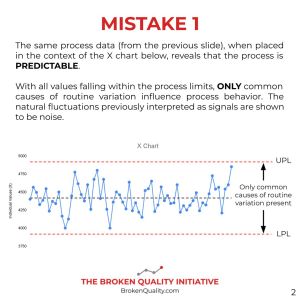
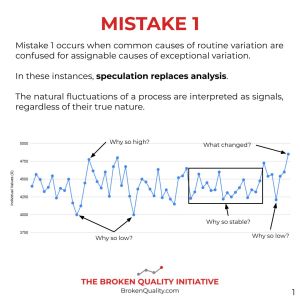
MISTAKE 1 occurs when common causes of routine variation are confused for assignable causes of exceptional variation. Slides 1 and 2 provide an example.

Without the context of the process limits, the natural fluctuations exhibited by the process shown on Slide 1 are interpreted as signals. But the same process, when placed in the context of the X chart on Slide 2, proves to be influenced by ONLY common causes of routine variation—that is, it is PREDICTABLE. Improvements to this process will be realized ONLY through fundamental process changes.

MISTAKE 2 occurs when assignable causes of exceptional variation are confused for common causes of routine variation. This mistake is most often the product of using a specification-based approach to understand process behavior. Slides 3 and 4 provide an example.

All of the values on Slide 3 fall within the specification limits. As a result, it is assumed that no actions need to be taken. However, the same process data, when placed in the context of the X chart on Slide 4, reveals that multiple values fall OUTSIDE the process limits. This process is thus characterized as UNPREDICTABLE. Improvements will be realized by ELIMINATING the assignable causes.

Making either mistake—tampering—is consequential. Process behavior charts help avoid this by discriminating the values in a dataset as either part of the noise or an obvious signal. They allow us to characterize process behavior as either PREDICTABLE or UNPREDICTABLE, and to respond accordingly.

Want to learn more about variation? Visit BrokenQuality.com.

Additional Information

Don Wheeler – Three questions regarding change – DJW225

    • The Ideal –  Why? What do you want to accomplish? 
    • The Methodology- How?  By what method will you accomplish your objective?
    • The Judgement – Did the change result in improvement? How will you know when you have accomplished your objective?

Suicide Rates in Brown County

Last updated: July 21, 2025  16:23

County health officials are prioritizing suicide prevention after recent state data reported Brown County had the highest suicide rate in the state for the years 2018-2022.”   (Determined by the crude rate)

IDoH calculates suicide rates using two different calculations.

1. The Crude Rate is used for a total count over five years.  Using the crude rate, Brown County had the highest rate in Indiana (2018-2022).  The rate is determined by dividing the number of suicide deaths for Brown County residents by the population size and then multiplying by 100,000. Age-adjusted rates take into account the variability of ages across counties.

2. A stable/reliable rate is calculated IF the count of suicides in a year is greater than 20.  (The Brown County count per year has been under 20).   In 2023, the five counties with the highest stable rate of suicide were Grant (35.2), LaPorte (27.3), Howard (26.4), Madison (24.9), and Vanderburgh (23.6)

  • The “Count” for 2019-2023: “50%” drop from 2022-2023 – See below – Test your knowledge of variation.
    • 2019: 6
    • 2020: 4
    • 2021: 4
    • 2022: 10
    • 2023: 5 

 Suicide prevention takes on urgency, By Staff Reports –Brown County Democrat, April 15, 2025

    • “County health officials are prioritizing suicide prevention after recent state data reported Brown County had the highest suicide rate in the state for the years 2018-2022. “
    • Brown County. Suicide Rate. 5 Year Rate (per 100,000 persons): 35.2
      County Ranking: #92,  *5-year crude rate (per 100,000 persons). This metric is calculated by dividing the number of deaths attributed to the act or instance of taking ones own life voluntarily and intentionally (suicide) divided by the number of residents in the county.”
      Ref: in.gov/healthfirstindiana/county-health-scorecard/
    • “The county now has a suicide and fatality overdose review team that studies cases with the intent of reducing future preventable deaths. Additionally, the county has been distributing suicide prevention kits.”

Statistical Methods. Regarding statistics and methodologies, the intent is to transform data into actionable information that supports better decision-making.  One of the seven basic tools in quality that is used to determine if a change is resulting in improvement is a Run Chart. Generally, you need about 20-25 data points. Indications of a change would include 7 consecutive data points in a row going up or down, or seven consecutive data points above or below the median. 

Variation – Statistical Literacy. Test your knowledge of variation?  Most everyone gets the wrong answer.  It took me a few years to fully understand the theory. Kids have a faster learning curve.   It has also been estimated that a lack of understanding of common and special causes of variation results in a situation where 94%  of improvement actions yield no improvement. (For example, how many New Year’s Resolutions result in a permanent and fundamental change?)

Crude Rate Calculation

County Health Scorecard – Brown County –  Suicide 5-Year Rate (per 100,000 persons) County Ranking: 35.2 – Highest of the 92 counties 

    • The Health First Indiana Scorecard online shows crude rates, which means age distribution in counties (see below)  is not taken into account.   Crude rate is chosen because all other measures on the scorecard are crude rates and cannot take age into consideration. The scorecard currently displays data for the years 2018-2022. Brown County had more than 20 deaths in that 5-year timespan, therefore the rate is stable (reliable).
    •  *5 year “crude rate” (per 100,000 persons). This metric is calculated by dividing the number of deaths attributed to the act or instance of taking ones own life voluntarily and intentionally (suicide) divided by the number of residents in the county.
One-Year Rate

IDoH:  Fatal Overdose and Suicide Report, 2023.  When using the oneyear rate calculation, Brown County does not have the highest rate in the state.

    • “Age-Adjusted Rate:”  Suicide Fatalities by County of Residence
      • In 2023, the five counties with the highest stable rate of suicide were Grant (35.2),
        LaPorte (27.3), Howard (26.4), Madison (24.9), and Vanderburgh (23.6)
      •  Between 2022 and 2023, the number of suicide deaths increased in 44 counties and
        decreased in 35 counties. Fifteen counties had no change (See Appendix E  below).

        The Indiana Suicide and Overdose Report, where Brown County isn’t identified as having one of the highest rates,  is because it is only looking at the year 2023 (not a combined year like the county scorecard)  and is also age-adjusted. This provides a more accurate comparison between counties since rural counties tend to have a higher proportion of older populations.  Brown County saw 5 deaths in 2023 which is below 20, therefore considering it unstable/unreliable and why the “U” is in the Table E.1 below. 

“Can America Survive Without Christianity?”

Can America Survive Without Christianity? Bari Weiss, The Free Press.  Author Jonathan Rauch joins Bari on Honestly to discuss how the success of liberal democracy depends on a healthy Christianity to support it—and if Christianity falters, America will falter too.

    • On where the church fell short: …  JR: The biggest gap—and I say this as a secular person who cares about governability—is that while the church has done a decent job of forming people in the image of Jesus in private life—family, community, disaster relief—it has failed to teach how to be like Jesus in public life.

There’s been almost no “discipling” around politics and social media. 

  • Christianity, Citizenship, Quality Management. Raising awareness on the interrelationship between Christianity, Citizenship, and Quality Management.
    • Genesis 1:  “In the beginning, God created the heavens and the earth.” And there was variation.  Successfully reducing variation results in more needs being met and less harm being caused to individuals as a result of unmet needs. 

Catholics and Patriotism. Can people devoted to a perfect God also be devoted to an imperfect country?  

    • During the Cold War, the Knights of Columbus and veterans’ organizations called on Congress to add “under God” to the Pledge. When President Dwight D. Eisenhower attended a service in honor of Lincoln’s birthday, he heard the Presbyterian Rev. George Docherty sermonize: “To omit the words ‘under God’ in the Pledge of Allegiance is to omit the definitive factor in the American way of life.” He added, “An atheistic American is a contradiction in terms. If you deny the Christian ethic, you fall short of the American ideal of life.” On Flag Day in 1954, Congress—with Eisenhower’s signature—added the words “under God” to the Pledge.

Gary Varvel: Independence Day 2025

    • Unfortunately America today is not what the Founding Father’s envisioned. We are the home to a great number of people who hate the red, white and blue. They proudly wave the flag of their home country in their mostly “peaceful protests” of our country.

      I recently asked the question, how did this happen to our country? How did our house get so divided?

      The answer is: We slowly destroyed the Spiritual foundation of our house.

The Face of Battle: Some things never change

Excerpts: Things Worth Remembering: How Warriors Prepare, H.L. McMaster, The Free Press

Yet the person from whom I gained the most insight into battle never served a day in the military. John Keegan was born in London in 1934, meaning he was too young to fight in the Second World War. He was then afflicted with orthopedic tuberculosis at the age of 13, which left him unable to join the British Army, despite his deep interest in military service from a young age. Instead, he became a military historian, delving deeply into the human and psychological dimensions of combat. My copy of his 1976 book, The Face of Battle, is replete with underlined passages and marginal notes.

It was my impending responsibilities as an officer that led me to study more purposefully, knowing that the seriousness with which I studied might save lives.

I read the book in 1984, just before graduating from West Point. It is a study of three pivotal battles that occurred centuries apart in the same patch of land in Europe: the battles of Agincourt (1415), Waterloo (1815), and the Somme (1916). Keegan reveals how technology, from the longbow to gunpowder to the machine gun, changed the face of battle. But what struck me the most was Keegan’s observation about what did not change across those five centuries. I memorized the following passage from the book’s conclusion:

What battles have in common is human: the behavior of men struggling to reconcile their instinct for self-preservation, their sense of honor and the achievement of some aim over which other men are ready to kill them. The study of battle is therefore always a study of fear and usually of courage, always of leadership, usually of obedience; always of compulsion, sometimes of insubordination; always of anxiety, sometimes of elation or catharsis; always of uncertainty and doubt, misinformation and misapprehension, usually also of faith and sometimes of vision; always of violence, sometimes also of cruelty, self-sacrifice, compassion; above all, it is always a study of solidarity and usually also of disintegration—for it is toward the disintegration of human groups that battle is directed.

The technology of battle has changed a great deal in the last hundred years, yet Keegan’s description of close combat would resonate with Ukrainian soldiers in the trenches of Pokrovsk, Israeli soldiers hunting Hamas in the rubbled neighborhoods of Gaza, and U.S. Special Operations forces raiding the remnants of ISIS in the rugged hills of northeastern Syria.

I read it just prior to becoming a young officer, and it convinced me that soldiers’ confidence—in their skills, in their leaders, and especially in one another—was the essential bulwark against fear and that emotion’s debilitating effects.