County Council Special Meeting Notes, Dec 30, 2024, A Way Ahead
This post at Brown County Matters.
-
- Agenda: Digital billing system, pay grade changes, additional appropriations (briefed two times previously), Salaray ordinance, and contract with a new financial advisor.
- Audio – link below). I encourage you to listen to the Audio of the meeting and just take a few notes to capture your questions and concerns. This will be a good meeting to review in a year to assess our progress in making the needed systemic changes within the council and commissioner’s office relative to finance and budgeting.
- Council Leadership. Councilman Kemp has a financial background and began his service with the council in 2023. He has spent the time needed digging into the numbers, working to understand the system, and sharing what he has been learning. A way ahead includes focusing on goals that involve maintaining $2.5 million in the rain day fund and $1 million in the health insurance reserve fund, keeping expenses at least 15% under projected revenues, and providing quarterly and annual budget updates.
- Commissioners Office. The commissioner’s office can develop the needed management reports and internal controls to increase the visibility of risks associated with contracts, leases, and capital improvements. The status can be included on meeting agendas. The goal would be to improve financial sustainability and prevent financial surprises. Consultants have identified it may take us 10 years to work our way out of the financial mess. We should have a better idea of the depth of the challenge within a year to 18 months.
- As a new commissioner, I plan on continuing to share what I am learning on social media to include “Matters” that may be incorporated into E-books. In a self-governing Constitutional Republic, “We the People” can hold our elected officials accountable, but we retain the responsibility for results. Better outcomes are achieved through improvement in processes, systems, and citizen participation. The improvement concepts and methods included within the Brown County Leader Network can be re-introduced to encourage more citizens to help improve quality within our government and community.
- Challenges. I am not underestimating the challenges. Making the needed improvements to the status quo is typically resisted by those with a personal or political interest in maintaining that status quo. Transparency and communication can help address this challenge. It is a proven fact that successfully improving quality results in outcomes where everyone benefits or at least, is not any worse off in the long term. Everyone wins with optimization.
County Council special meeting set Monday
Budget Guidance Salary Changes – Salary changes must be submitted prior to June 15
Meeting Clarification – Three Types: (Requires 48 hours (business days) public notification
-
- Regular Meeting – provides the most flexibility for decision-making
- Special Meeting (working session). Any actions resulting in a decision must be advertised in advance
- Executive Session. Agenda items dictated by statute
2025 Budget. The County Council failed to vote to review and approve. Estimated budget deficit is around 600K.
The Council failed to approve salary ordinance changes in 2024. Council to approve The 2025 Salary Ordinance will be approved in Jan.
Salary, pay scales, staffing. Waggoner, Irwin, Scheele (WIS) & Associates were contracted to re-structure and standardize salary schedules. In the interim, Departments (Health Department, Prosecutor, Clerk, Treasurer) are/have been receiving approval for salaries and staffing changes.
Financial Advisor. Council has the responsibility to contract for a financial advisor and plan on contracting with Reedy Financial Services – Government Finance Specialists at $175.00 per billable hour.
Digital Billing System. Was rejected – does not interface with the current accounting system.
Deficits. In 2024, the county was projecting about a 1.4 million deficit. Fortunately, about 2.3 million were found. County ended up 10K in the black.
Deficits. In 2025, estimated at around 600K.
End of year Transfers. Commissioner’s office identified the need to transfer approximately 700k to pay the required bills. This was briefed to the council on two prior occasions. Without a transfer, the county will show account deficits in 2025. Council voted to approve with one member voting No. A second reading (vote to approve) will be on Jan 9.
“…there is actually no such thing as atheism”
This is Water by David Foster Wallace (Full Transcript and Audio), The Free Press
I submit, is the freedom of a real education, of learning how to be well-adjusted. You get to consciously decide what has meaning and what doesn’t. You get to decide what to worship.
Because here’s something else that’s weird but true: in the day-to-day trenches of adult life, there is actually no such thing as atheism. There is no such thing as not worshipping. Everybody worships. The only choice we get is what to worship. And the compelling reason for maybe choosing some sort of god or spiritual-type thing to worship–be it JC or Allah, be it YHWH or the Wiccan Mother Goddess, or the Four Noble Truths, or some inviolable set of ethical principles–is that pretty much anything else you worship will eat you alive. If you worship money and things, if they are where you tap real meaning in life, then you will never have enough, never feel you have enough. It’s the truth. Worship your body and beauty and sexual allure and you will always feel ugly. And when time and age start showing, you will die a million deaths before they finally grieve you. On one level, we all know this stuff already. It’s been codified as myths, proverbs, clichés, epigrams, parables; the skeleton of every great story. The whole trick is keeping the truth up front in daily consciousness.
Worship power, you will end up feeling weak and afraid, and you will need ever more power over others to numb you to your own fear. Worship your intellect, being seen as smart, you will end up feeling stupid, a fraud, always on the verge of being found out. But the insidious thing about these forms of worship is not that they’re evil or sinful, it’s that they’re unconscious. They are default settings.
How Intellectuals Found God – by Peter Savodnik
Commissioner Meeting Notes, Dec 27, 2024, 2-4 pm
This post at Brown County Matters
Dec 23, 2024. Commissioners set special meeting Friday, By Dave Stafford -December 23, 2024
12 27 2024 Agenda Commissioners
Claims. End-of-year claims and transfers totaled over 10 million. Commissioner Wolpert remarked that the counyy has issues paying timely. Note I will be providing more information on finance, accounting, and budgeting-related issues over the next year.
Board Appointments. It was acknowledged that since 2018, appointments to boards and commissioners were made by the newly elected commissioners in January. Despite this precedent, outgoing commissioners Pittman and Wolpert appointed two people to the Convention Visitors Commission (CVC) and one to the Redevelopment Commission. The new commissioners can rescind the appointment to the RDC, but the individuals appointed to the CVC must be asked to submit their resignations if there are other candidates to be considered.
Unlike the Council, the commissioner appointments were not published in the Democrat. Consequently, fewer people applied.
It is expected that some appointments will be made at the Commissioner meeting scheduled for Jan 8, 2025, at 2:00 p.m.
New Ordinance Appointments. Commissioner can appprove an ordinance documenting the precedent that appointments be made in January. And an ordinance can always be repealed.
DLZ Contract for Jail. The Jail air conditioning units will be replaced at a cost of around 700-1 million. The commissioners signed a contract with DLZ to manage the project. The previous commissioners, at the request of councilman Gary Huett, also signed a contract with individuals designated as an “Owners Representative.” The justification was that such a person could save the county costs on managing projects. In this case, DLZ was hired to provide the technical management services.
Meeting Calendar for 2025. No change on meeting schedules – the first Wed at 2:00 and the 3rd Wed at 6:00. The new commissioners may opt to have both meetings at 6:00 to allow more people to participate. This may add additional labor costs for county employees that are required to attend including personnel from IT and the Auditor’s Office.
Dec 25, 2024. 2025 County Council Appointments
Dec 18, 2024. County Council Appointments
-
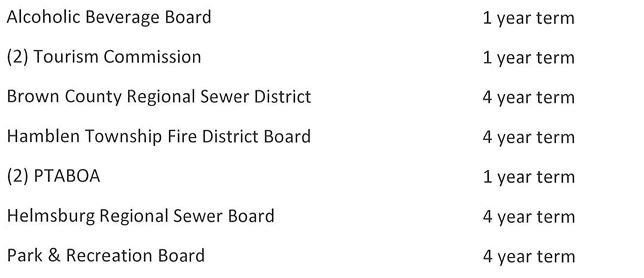
- Alcoholic Beverage Board (one-year term)
- Property Tax Board of Appeals (one-year term)
- Brown County Redevelopment Commission (two positions, one-year term)
- Brown County Regional Sewer District (four-year term)
Final Statements – Commissioners Pittman and Wolpert expressed their final words regarding their service to the county. Jerry Pittman was first elected to the Council in 2011 and served two terms as commissioner. Wolpert was voted out of office as commissioner in 2008. He was appointed (7 of 11 precinct committee votes) in 2023 to fill a vacancy left by Chuck Braden.
Combs Road – Proposed Re-Opening – Forest Service Response – For the Record
Combs Road is an unmaintained county road. Gates at both ends of the road prevent vehicular traffic.
Dec 18, 2024. Commissioner Meeting – Agenda – Discussion – Re-Opening Combs Road
-
-
AUDIO of the Meeting. 00:14:35 — Discussion on Combs Road.
-
Dec 18. 2024. Commissioners leave Combs Road closed after residents object by Dave Stafford.This Post at Brown Couty Matters (1.3K+) views
-
- Dec 17, 2024. Forest group: ‘Crisis’ brewing if Combs Road is reopened, by Dave Stafford
- “This disastrous, wrong-headed idea is being railroaded through by lame-duck Commissioners who lost reelection this year and will no longer serve on the Board in just a matter of weeks,” the Indiana Forest Alliance said on its website.
- Dec 17, 2024. Forest group: ‘Crisis’ brewing if Combs Road is reopened, by Dave Stafford
Oct 18, “2004.” Ordinance for temporary closure of unmaintained parts of Combs Road
Dec 17, 2024. IndyStar. Brown County plan to reopen road threatens wilderness, advocates say
by Karl Schneider
-
- Protecting the forest:Proposal would double size of Charles C. Deam Wilderness area in Hoosier National Forest
Dec 16, 2024. Email – Mike Chaveas, US Forest Service
EMAIL: From: Chaveas, Michael – FS, IN
Sent: Monday, December 16, 2024 3:57 PM
To: pittmanj@browncounty-in.us; wolpertb@browncounty-in.us; SandersR@browncounty-in.us
Subject: Combs Road and Hoosier National Forest
Commissioners Pittman, Wolpert and Sanders;
I am writing regarding your consideration of reopening the Brown County section of Combs Road to allow OHV (off-highway vehicle) use. I briefly spoke with Commissioner Wolpert on the phone two weeks ago, which was when I initially was made aware that this action was being considered, and we have received numerous calls from members of the public to our offices on this topic recently. I have since had the opportunity to look into the history of this road and its surroundings. I understand that Combs road is a county road and it is therefore within the authority of the Brown County government to make any decisions about reopening it to motorized traffic. In order to assist you in making an informed decision, I wanted to provide some history of damage done in this area and share concerns we would have with any change in status.
According to our files, Brown County Board of Commissioners passed an Ordinance for temporary closure of unmaintained parts of Combs Road (10-18-04-01) on October 18, 2004, which implemented a closure to vehicular traffic (see attached). The ordinance states that the Forest Service favored closing the road “to prevent misuse, damage to and pollution of forest property, and injury and property damage to those who might otherwise use the roads, and the Board of Commissioners finds that closing the above-stated roads is in the public interest and economic interest of the county”.
This section of Combs Road and its surroundings had a long history of OHV use leading to a “braided trail” with many off-shoots, mud pits, etc. As a result, the adjacent Hoosier National Forest property was severely damaged, and the water quality of local streams, and likely Monroe Lake, were negatively affected. I am attaching some photos here that were taken in that era to give you a sense of the damage that had been done.
Our records also indicate that in 2005 the Forest Service conducted major rehabilitation of Combs Road including reshaping and installing culverts and ditches to reduce erosion and improve water quality. These measures, along with the concurrent closure to vehicles, has allowed the area to reestablish protective vegetation, thus reducing its negative impacts to water quality and wildlife habitat. We have concerns that reversing the road closure would lead to new damage, as was experienced previously.
Current policy and the Hoosier National Forest Land and Resource Management Plan does not allow for OHV use on the national forest. Due to the extensive past use and damage to the road, and the illegal crossings onto adjacent national forest property, we cannot be certain of where the land ownership boundaries currently lie, and therefore where the legal route of this road is in all parts. A professional survey would be necessary prior to motorized vehicle use, and any associated road maintenance, if it were to be once again allowed and authorized by the county to ensure the avoidance of any damage to the national forest lands.
I appreciate your attention to these details as you make your decisions regarding this county road.
Mike Chaveas
Forest Supervisor
Forest Service
Hoosier National Forest
facebook.com/HoosierNF
Caring for the land and serving people
Photos


County Council Meeting Notes, Dec 16, 2024 – Financial Situation, New Revenue
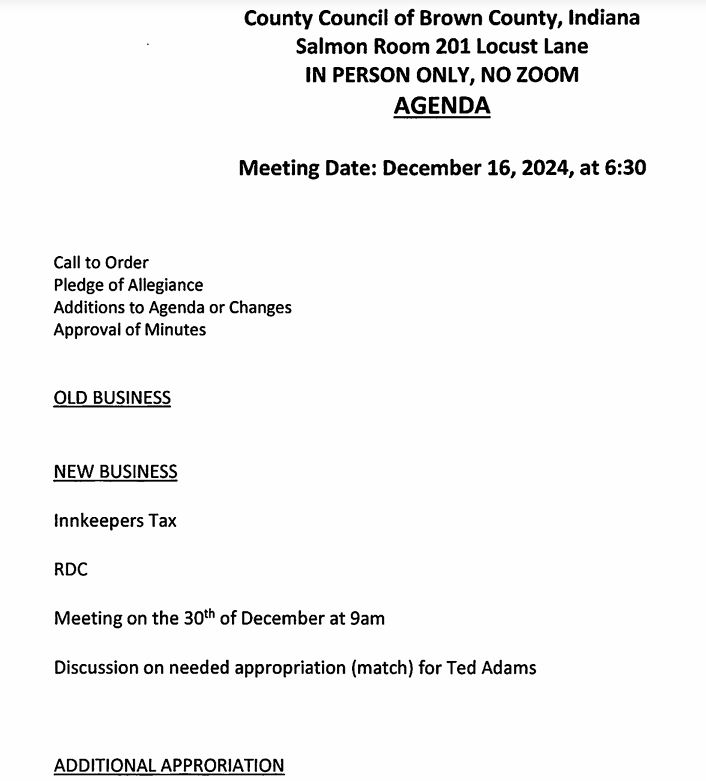
Agenda County Council December 16, 2024 (Also below)
-
- Addition to the agenda: Health Department request/discussion on personnel staffing changes and salary adjustments
-
- 00:21:30 Jim Kemp – Status of County Finances. Case for Change
- 00:34:30 Scott Rudd. New Sources of Revenue, Priorities, Pros and Cons.
FYI: The 8 Steps for Leading Change
Finance and Budgets. In the State government, this is a budget year, and the budget is developed for two years. There are indications that the new governor will be working to reduce property taxes, thus reducing revenue to the county. To make up for a shortfall, the state may be allowing counties to increase taxes to make up the deficit. Brown County is maxed out on raising income taxes and is constrained in raising property taxes due to the caps – 1% on residential and 2% on commercial.
County Financial Outlook — 2025-2026. Not looking good. Councilman Kemp projects that given the current assessment of revenues and expenses, we may have around a $700-800K budget deficit in 2025 and 2026 respectively. This does not factor in unanticipated expenses related to health insurance and unexpected capital improvement repairs and replacements. In a near worst-case scenario, deficits would have to be covered by reducing employees and benefits. A higher deficit was projected last year and a crisis averted when new revenue was discovered.
New Sources of Revenue
-
- PERF (Retirement System). The county contributes matching funds to the employee pension system, but when an employee leaves before being vested, the state retains the money. How much of this money can the county get back?
- State Park Gate Fee. This may be the first time in 20+ years that the county’s request for a gate fee at the State park may be approved. This could range from 50 cents to a dollar, which may bring in $200-350K a year. This would not apply to those with an annual pass.
- Innkeepers tax. The legislature can allow the county to raise the innkeepers’ tax from 5 to 8 percent. If so, it is then up to the county to accept or reject the increase. The council voted to support this option. An increase could bring in 700-750K a year. The priority would be public safety.
- The purpose of the innkeepers tax is to help promote tourism BUT counties have the option for how best to determine how the money can be spent. In our case, this would be defined in Chapter 14, Brown County Innkeepers Tax (IC 6-9-14-1).
- The soonest the county could receive additional funds would be Jan 2026 or July 1, 2025 if the county’s request was approved.
- BCMC – Distribution – Excess Revenue. Although not mentioned at the council meeting, Commissioners have the responsibility to determine the distribution of excess revenue from the Music Center. The current distribution is 75% to the Foundation and 25% to the county. The “Council” also influences the amount of excess revenue that may be available. The council reviews and approves the budget for how the revenue from the innkeepers’ tax can be budgeted.
Economic Development District (EDD). The county has the option to join with Monroe and Owen County to develop an EDD. This would provide the opportunity to apply for federal grants. This should make for some interesting conversations. Topic to be discussed at the next council working session.
Commissioner Meeting Notes, Dec 18, 2024, 2:00 pm
Last Updated Dec 20, 2024
Dec 24, 2024. Local soap opera nears a dramatic finale by Dave Stafford, BCD
Agenda – Below
This post shared at Brown County Matters
AUDIO of the Meeting: 00:14:35 — Discussion on Combs Road.
Combs Road Re-Opening – No Change. It will remain in unimproved status and can still be used by citizens. A “Petition to Close” will be needed to permanently restrict the road from any vehicle use.
-
- Dec 18, 2024. Commissioners leave Combs Road closed after residents object By Dave Stafford -December 18, 2024
- This article and comments are posted at Brown County Matters.
- Indiana Forest Alliance – Brown Co. Commissioners Plot Combs Creek Disaster
-
- Since there has been maintenance on the trails, the gate will remain and would require a majority vote by the commissioners to remove it. Commissioner Sanders and Pittman stated they were not in favor of removing the gate. No support from the ORV group to open. Sheriff did not support opening.
- Reasons for closing: Crime, trash, remoteness of the area hampered emergency services, weapons fire, 4pm to 4am observed as popular times for parties in the area. It was a popular spot for jeeps and 4-wheelers, which contributed to the erosion, ruts, and unsafe conditions that led to the road being closed.
- Combs Road – Proposed Re-Opening – Forest Service Response – For the Record
- Indiana Forest Alliance – Brown Co. Commissioners Plot Combs Creek Disaster
- IFA – Dave Seastrom
-
Board Appointments. The vote was tabled until the next meeting scheduled for the last week of the year. Date TBD.
Economic Development District. Councilman Scott Rudd received support from the two outgoing commissioners for joining Owen and Monroe County to establish an Economic Development District (EDD). The intent is to increase eligibility for federal grants.
Nov 15, 2024. County Website: Brown County Boards and Their Members
Highway Superintendent Report Dec 18, 2024
Notes: County Comprehensive Plan. Regarding the proposed Combs Road re-opening, this kind of proposed change that led to a fierce backlash can be prevented through a better County Comprehsiece Plan, which is currently under development. This is the plan that allows citizens the opportunity to identify what they want and do not want in terms of change that is protected through zoning and ordinances.
The plan will help identify the criteria to be considered before making a change. In the case of Combs Road area, preservation, natural beauty of the land, quiet space for mushroom hunting, hiking, walking, and bicycling were all identified of being of high value to citizens. This was in opposition to the desire by Commissioner Wolpert to promote Off-Road Vehicle (ORV) use and destination tourism in the Story and Elkinsville area. The ORV Group in Brown County that supported the development of the county ORV ordinance did not support re-opening Combs Road for ORV use.
A common complaint is that over half of our land is non-taxable due to government ownership. On the flip side, this is what has always attracted residents to the county which is our major source of tax revenue.
It will be interesting to see how many if any, Republicans in elected positions within the local party and in government elected positions speak up in support or in opposition to one or more of the agenda items.
Local party officers include the Chair, Vice Chair, Secretary, and Treasurer. The central committee also includes the 11 precinct committeemen. Vice committeemen can also speak up. New elections for officers are in March 2025 and are voted on by the precinct committeemen and their vices.

2025 Economic Strategy – Best Bets
Dec 5, 2024. A New Path for Brown County. A Hypothesis for a Modern Plan for growth and Economic Development in Brown County, Indiana, By Chris Schneider – December 5th, 2024
Dec 28, 2016. What are best bets for future of local economy _ Brown County Democrat
-
- Best Bets per the data:
- Housing
- Recreation
- Wholesale
- Production
- Retail
- The Hometown Collaboration Initiative (HCI) is intended to “engage a diverse mix of local people who are willing to explore new ways to strengthen their community” under the theme of leadership, economy or placemaking, and then undertake a “capstone project” in one of those areas.
- When communities apply for grants, more points will be awarded to those that have completed such programs, Biddle said. Terrell said the HCI process could get more residents involved and invested in their community’s future.
- “I’ve been coming to this community for years, and you have phenomenal potential,” he
said.
- Best Bets per the data:
2017. Brown County Leader Network. The county, through the RDC, applied for the 10K Hometown Collaborative Initiative (HCI) Grant and was selected. The state kicked in 5K and the county 5K. The unanimous selection for the Capstone Project was “Leadership.” We initially started to develop a project on “local foods” but quickly learned that we did not have the capability to undertake the project. We then shifted to creating a Leadership Network that include proven methods and tools that can be applied in support of any project.
-
- Overview of the Concept
- Covid led to a pause …
- The BCLN supports projects in any area, including: “Placemaking, Leadership, and Economy.”
2025 – Opportunities to leverage the Brown County Leader Network (BCLN) in support of a variety of initiatives – Comprehensive Planning, Housing, Economic Strategic Planning (A New Path), Financial Management and Budgeting ….
-
- To Do: Re-establish a Core Team and initiate new projects.
- Budget: Approximately 8k.
Proposed On-Site Septic Ordinance – 2024
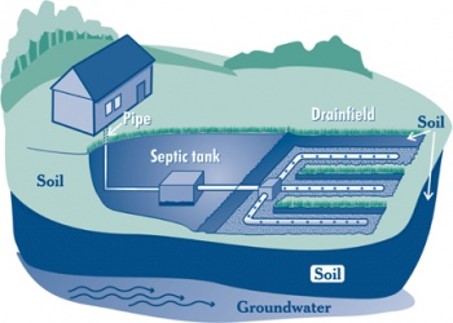 PROPOSED 2024 On-Site Septic Ordinance (Attachment to the email)
-
- Dec 7, 2024 Post on the proposal on Brown County Matters referencing an article in the Democrat
- Dec 6, 2024. County health board to consider adopting state septic ordinance
By Staff Reports -December 6, 2024 - Dec 12, 2024. This post at Brown County Matters
- Background Information
From: Stinson, Melissa A. <stinsonma@browncounty-in.gov>
Sent: Thursday, December 12, 2024 2:58 PM
To: Moga, Mike <Mike.Moga@btlaw.com>; Pittman, Jerry <pittmanj@browncounty-in.gov>; Wolpert Blake <Abearsloth@aol.com>; Sanders, Ron <sandersr@browncounty-in.gov>; Cobian, Theresa <cobianta@browncounty-in.gov>
Cc: Day, Michael <daym@browncounty-in.gov>; Elmore, Thomi <elmoret@browncounty-in.gov>; Matern, Michelle <MMatern@health.in.gov>; Rose, Cynthia <rosec@browncounty-in.gov>; Rountree, Catherine <rountreec@browncounty-in.gov>; Zimmerly, James <zimmerlyj@browncounty-in.gov>; Oestrike, Norman <oestriken@browncounty-in.gov>
Subject: Adoption of the State of Indiana Septic Codes / Brown County Health Departments new Adoption
Hello
Attached is the On-Site Sewage System Ordinance that was passed by the current Brown County Health Board.
The Board will bring this before the Brown County Commissioners on December 18th at the Commissioners Meeting for 1st. Reading.
This Ordinance will then need to be sent before the State of Indiana Review Board, once approved by the IDOH it will be returned to the Brown County Commissioners for Final Reading and a vote.
Your attorney is added to this email thread for his review.
Thank you, Have A Blessed Day!
Melissa Stinson-Waddell
Administrator of the Brown County Health Department
E-mail: stinsonma@browncounty-in.gov
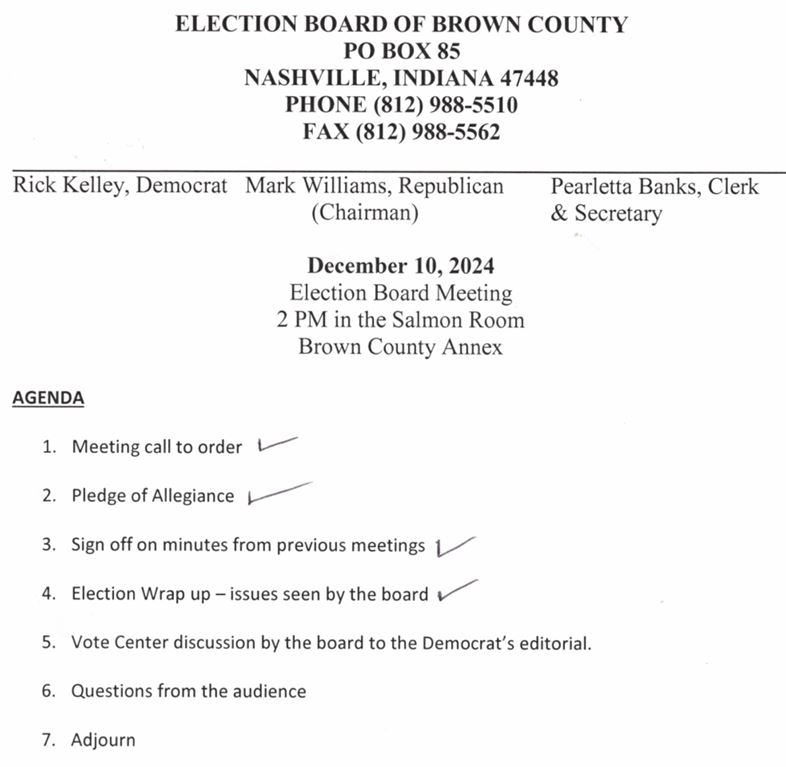
Election Board Meeting, Dec 10, 2024, 2:00 p.m. Voting Centers

Dec 18, 2024. Voting locations reviewed by Dave S Stafford Brown County Democrat
-
- 32:02 Vote Centers
Key Points:
-
-
Kudos to all the election workers!
-
Early Voting. Over half of the citizens voted early. About 100 ballots could not be counted due to mistakes in the processing. The cramped spaces at Eagle Park may have contributed to the problem. A larger space may mitigate the problems. The CRC may be an option, but security would be needed to ensure separation between voters and the pre-schoolers. (Off-year presidential elections do not require 28 days of early voting).
-
Voting Day Issues. Some voters showed up at the wrong voting locations and chose to complete provisional ballots knowing their vote would not be counted.
-
Voting Centers. Voters (despite their precinct or district, can choose to vote at any voter center. 87 of 92 counties have opted for Vote Centers.
-
Location: The idea is to have 5 voting centers – with 4 being at the schools and one possibly at the Church of the Lakes. Schools would be Van Buren, Nashville, Spearsville, and Helmsburg. State law requires the schools to accommodate this option. Children could be given an e-learning day.
-
Equipment. Additional equipment would be needed. The clerk received a grant to cover the expense.
-
Approvals. The Election Board must approve the change to voting centers. Commissioners have a final vote.
-
Convenience? About half of the voters traveled to Eagle Park to vote early. There are currently 9 voting locations (two precincts are combined at the same location) for the general election, and voters must vote in their precincts. Any voter could vote at any of the five proposed Voting Centers.
-
 Independent Voters of Brown County IN