Health Insurance Policies – Coverage for part-time employees

Policies:  Reference to coverage for part-time employees, commissioners and council

Update as of Feb 9, 2024 

    • There are two Part-Time Employees taking our insurance.
    • There are nine elected officials taking our insurance.   
    • No (zero)  Commissioners and Two (2) council members.

 Part-time employees must work 20 hours a week.

Commissioner Meeting Notes Feb 5, 2024.  Music Center, Fire Districts, Appointments

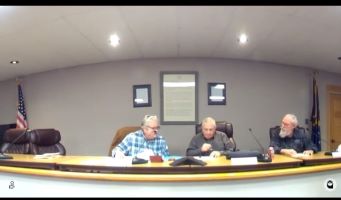
commissioner meeting picture 341x200

Last updated Feb 6, 2024 – 1300 hrs
Commissioner Meeting Notes Feb 5, 2024.  Music Center, Fire Districts, Appointments

Audio of the Meeting and Agenda 

Disclosure. I am running against Jerry Pittman in the Republican primary for Commissioner, District 3.  I believe in a fact-based decision-making process involving all the stakeholders that will be affected by a decision. I also believe in maintaining the documentation that supports the decision. I  am opposed to decision-making through improvisation – where a few keywords are used to fabricate a story justifying a decision that is not supported by the evidence.

Fire Districts?  This was interesting. Jerry Pittman expressed his support for Fire Districts. He thinks the fire district in Hamblen Township is a model for the county. Currently, township trustees provide funding and the VFDs elect their own leadership. Townships have taxing authority.

Fire District – Legal Action and Costs $$$$. This issue of fire districts was very contentious a few years ago – Wolpert was a commissioner and voted for fire districts and was not re-elected.  There was pushback and legal action from the community, new commissioners, and the VFDs, and the case eventually was settled by the Indiana Supreme Court.  History: Fire Districts Brown County

Eclipse. County zoning does not allow primitive camping for financial gain. Our EMA Director, Chad Jenkins wrote an assessment of the situation: “Total Solar Eclipse Event,(TSE)  2024 Threat and Hazard Analysis with Risk Assessment” 2024 TSE Risk 012624

Gnaw Bone Regional Sewer District. Board member Dave Hess identified his intent to retire from the board after 15 years and has been asking for help over the past year from Commissioner Pittman and the BCRSD. He is finally getting the needed support and had to cut short his convalescence from a medical procedure to attend the meeting.

On the call for help, the BCRSD could have provided immediate assistance but they wanted to first know the condition of the plant and maintenance/repair needs.

Kevin Allen of BLN has been selected to provide engineering support.  The county’s legal counsel stated that the commissioners can appoint new board members for vacancies for a county elected office exceeding 30 days (IC 3-13-7-2). The Gnaw Bone RSD has approval from  IDEM to opt for the option of customers “electing” board members as opposed to appointments from elected officials.

Gnaw Bone RSD – Future?  Per Pittman, future management of the RSD is up in the air – sell it, remain an independent board, let the BCRSD manage it?  Gnaw Bone has two packaged Sewer Plants – one is 24 years old and the other is 14.

Costs per Customer.  To keep costs down (60.00 a month)  Gnaw Bone RSD board members were a “working” board where members performed maintenance and responded to calls. This made it nearly impossible to recruit new board members and could not be sustained.  Customers owe these board members their thanks and gratitude. 

Helmsburg RSD.  The cost is 92.50 a month.  Helmsburgs RSD board members are appointed by commissioners/council and have received funding to build a new plant to replace their aging plant. They contract for maintenance.  Helmsburg developed its own economic plan that identifies what the community wants and does not want in terms of development and quality of life. They also created their own 501c3 – Community Development Corporation. More info: Helmsburg Revitalization – Community Led. 

Music Center – Disposition – Options.

Barry Herring and Derek Clifford were re-appointed to the Convention Visitors Commission (CVC). The CVC develops the budget for how revenue from the innkeeper’s tax can be spent. Typically, the Convention Visitors Bureau (CVB) is given most of the money but other non-profits can receive funding if they support tourism.  The County Council reviews and approves the CVC budget.

Ron Sanders is advocating for public meetings to discuss the idea of selling the venue.  Barry Herring expressed his opinion that it might be hard to sell, the venue is performing as promised, and excess revenue is being returned to the county.  I support public meetings and allowing citizens to express their opinions as to the options. These meetings also provided the opportunity for fact-gathering.   Pittman offered his comments – keep as-is for now (status quo).  Pittman is on the Music Venue Management group but attends very few meetings.

Authority – Elected Officials.  The council and commissioners (elected officials) had to approve building the music center. I have seen no documented opinion from the county’s legal counsel that they cannot also vote to sell.  Further, I have seen no documented legal opinion that non-elected officials have the power to determine the distribution of excess revenues. Further, I have seen no documented legal opinion that elected officials can delegate their responsibility for decisions regarding this venue to unelected officials. The local Republican  Party has always been a vocal advocate and supporter of this venue -and supports the hands-off policy taken by our elected officials. Ron Sanders is the exception – he was not the preferred candidate of the local Party.

Options for the Music Center – include:

(1) Sell it. The premise is that the County Government should not be in the music business. Sell it at a profit, collect the property tax, and use the money to fund needed capital improvements. This “government-owned and operated music venue” will always be opposed by those expecting a limited role from the government.

(2) Status quo – continue to allow non-elected officials with business acumen, to manage the venue and decide how best to determine and then distribute excess revenue. A proposed change for distribution is 50% instead of 75% of the excess revenue be given to the Community Foundation and the remainder to the county.

(3) Win/Win?  Voters and Elected officials take responsibility with input from the non-elected officials. 100% of excess revenue is returned to the county and can be used for infrastructure needs such as capital improvements. Elected officials can document their intent for the funds via a Resolution. If capital improvements are a priority, funds can be used to reduce/eliminate the need for the county to borrow money where loans are repaid through a property tax increase. In other words, the excess revenue can support a property tax decrease. 

By law, the County Council reviews and approves how revenue from the innkeepers’ tax will be spent. Their decision can also determine how much excess revenue can be returned to the county.

Board Appointments.  I was re-appointed to the Redevelopment Commission last year (unanimous vote by Sanders, Pittman, and Braden). I was “not” re-appointed this year. Sanders votes Yes and Pittman and Wolpert No.  Jerry Pittman said the decision was not and would never be “political” – good to know 😊

I was working on a follow-up project to analyze our property tax base to determine trends and provide baseline data. We have about 15 years of data.  Newer technologies make it easier to collect and analyze the data. The idea for the project started when I was appointed to the RDC in 2016 and 2017.

Before being appointed, I developed an assessment of the sustainability of the county’s economic base using indicators developed by the state called Community Vitality Indicators (CVI). This led to the need to get more information on leading indicators of economic health. The goal of the RDC Project was to develop a financial decision support model. This would allow projections on revenues, expenses, and tax rates, to better anticipate potential deficits and allow time for corrective action needed to avoid problems.

This information would have helped prevent last year’s budget debacle.  I worked with IU/SPEAs Graduate program and supported two student-led projects.  The third project would have included gathering income and property tax data.

I was not re-appointed to the RDC in 2018 (I challenged the fast-track process being used to approve the music center project).  I think 2017 was the last year the RDC published the required annual report. More information is provided in the link.

If interested:

Council Working Session Meeting Jan 31, 2024, 9:00- 5:00 …. a long day

bcd council meeting jan 24 2024Last  updated: Feb 5, 2024

Council Working Session Meeting Jan 31, 2024, 8:00- 5:00. A long day.  (Audio to be posted by the council). The meeting started at 9:00 am.

Disclosure:  I am running against two-term incumbent Jerry Pittman for Commissioner, District 3, in the May Republican Primary.

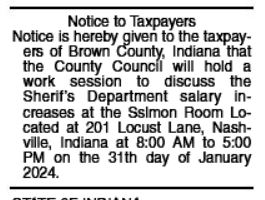
This was a follow-up meeting and advertised as a County Council Work Session. the purpose was to discuss “the Sheriff Department’s salary increases.”  (Just looked it up – The meeting announcement was posted in the Jan 24, 2024 edition of the Democrat, Legal Section).

Update: This was a county “council” working session meeting which means no formal vote on a decision could be made. The purpose of a “working session” is to gather and discuss information that may lead to a decision (vote) at a council meeting.  The Commissioners can attend a council working session but as observers.  Commissioner Pittman participated in the meeting and discussed, and provided information regarding the capital improvement plan and a proposed new bond despite any opposition from the public regarding the amount. No specifics yet  (just general ideas and estimates) on proposed projects and estimated costs.  Ref: Indiana Public Access Counselor

No Money. The Sheriff had notified the council on at least three previous occasions, that they would continue to lose personnel (deputies, jailers, dispatchers) if they could not provide competitive salaries. Several hours were spent discussing needs and options. The council could find NO money in the budget to sustain a salary increase.  This is expected to lead to more turnover. The risk to the county of an under-staffed Sheriff’s department was not discussed. Less personnel does create more payroll money that can be used to fund the higher salaries.  This option has been identified as a strategy for the county.

A Way Ahead.  The county’s new financial advisor/consultant was present as was the council’s new attorney.  These are needed and critical resources that may help the county recover from years of overspending, financial mismanagement, and lack of due diligence.  It is expected to take years to recover.

Illegal meeting?  Two Commsiooners (a quorum) also attended (Wolpert, Pittman), and their admin assistant did most if not all the talking on their behalf. The meeting was not announced as a “joint meeting.” Nor was there a separate commissioner meeting announcement.  Their attendance may have been in violation of Indiana’s Open Meeting Laws. I have filed an inquiry with the public access counselor. The “council’s” attorney who was present at the meeting did not comment on the situation.  She declined to offer commissioners advice when it came to an administrate vote. The commissioner’s attorney was not present at the meeting.

General Obligation (GO) Bond.  In addition to the discussion on the sheriff’s salaries, several hours were spent on financial planning and budgeting. This included brainstorming (which was curious) a capital improvement plan (1) and discussions on a new bond (debt). The three million dollar bond expires at the end of this year and was financed with an interest rate of around  1 percent or less.  Council wants the new debt to be “revenue neutral” which means they can claim that your taxes will not change.  But with higher interest rates, the amount borrowed may need to be less.. Or, the length of the loan may need to be extended from 2-3 years to 10 or more?  The county does impose a property tax to finance the bond.   Note the county has to borrow money for capital improvements that include the repair and replacement of infrastructure. Infrastructure can include software leases, office equipment, vehicles/

Capital Improvement Plan. Until this year, county elected officials – commissioners and council have REFUSED to demand and support the development of a capital improvement plan and budget. The motivation was likely because the required funding would compete against other favored funding priorities and has contributed to our financial train wreck.

The financial advisor suggested using an “owner/rep” to help collect estimates on repair/replacement projects.

The lack of a plan was a consistent recurring audit finding by the State Board of Accounts (SBOA) which county officials can and do often ignore. It is up to the voter to elect citizens who will do the right things.

Financial Goals:

    • Target fund balances at 15%
    • Develop Five-year Capital Improvement Plan and Budget
    • Establish a Health Insurance Reserve Fund

(1). Commissioner Sanders.  Newly elected commissioner Ron Sanders has been working this year on developing the capital improvement plan.  Commissioner Pittman publically criticized Sanders for not being at the (illegal?) meeting.

The commissioner’s office is dysfunctional – Sanders was not the preferred candidate of the local GOP who has a monopoly on political power, and who prefers that the admin assistant (secretary of the local GoP) take more of an active administrator-type role in running the county.

New Work Session? Capital improvement planning and budgeting needs its own working session meeting.

Financial Report.  Councilman Kemp provided a budget/expense report ($15.00) where he shared his research into our budget and challenges. The council’s financial advisor helped in explaining the needed  “government context to include the difference in terms and concepts between the private and public sectors. The 1782 the most important document.

The council legal rep also clarified that county budgeting is different than a household budget.  Such as rate relocations.

Jail Capacity. Currently 44 inmates with the capacity of holding 117. The option of housing more out-of-county inmates was discussed – the conclusion was that costs exceed revenues. This is a revenue stream for other counties.

Salary Increases – All Employees. Further, the council identified that any salary increases would need to be across the board.   If there is no new revenue, increases in salaries have to come from available funding, Options would include hiring freezes, re-organizations, contracting out, et.al.  When losing/cutting personnel and using available payroll money to fund higher salaries, the risks need to be identified.  Any reduction in personnel needs to be supported through a “workload analysis/”

$$ Music Center Admin Agreement $$. Commissioner Pittman stated that “unelected” officials granted their permission for our “elected” officials to reduce the excess revenue distribution from 75% to the Foundation and 25% to the county to a 50/50 arrangement.

I have asked Commissioner Sanders to request county attorneys to publish their opinion on this Admin Agreement. Why isn’t the county receiving a 100%?  Note that the Council can approve a distribution of innkeepers’ tax revenue to any area in the county that supports tourism – arts and crafts, history, preservation, sports, wellness, solar eclipse et.al.

Payment instead of Property Taxes (PILOT). The Music Center does pay the county $54K to compensate the county for the loss in property tax revenue that we would receive if this was a privately owned venue.  Council members discussed that the tax should be higher and the assessor agreed to re-assess the property as she would for a privately owned commercial property.

Zoom Votes. Councilwoman Swift-Powdrill attended the meeting via Zoom. She can vote as long as she can be seen –  which she could be. And, the state allows only one vote per elected office per year when not physically present. The Council voted to table any decision on the sheriff’s request.  Note: Woking sessions are used to understand an issue (s). Votes to approve/disapprove a policy decision MUST be made at a regular meeting.

Revenue from the Innkeepers Tax – History, Opportunities, Public Input

we have big decision

Last updated Jan 31, 2024

Revenue from the Innkeepers Tax – History, Opportunities, Public Input

Question: With more revenue coming in from the innkeeper’s tax, is now a good opportunity for the commissioners and council to hold public meetings to ask for citizen input on how best this revenue should be invested?

Options
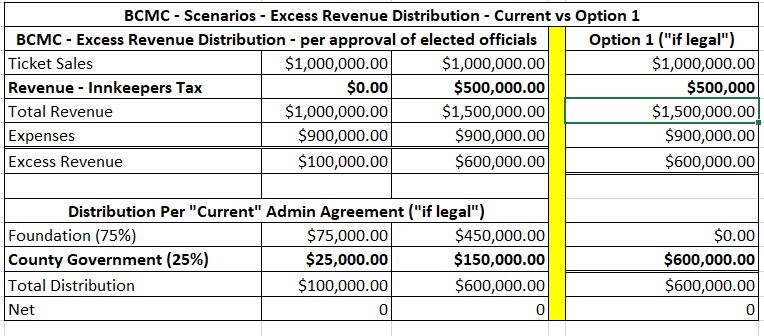
20240130 excess revenue scenario

Innkeepers Tax Revenue – Discrepancies – Working to understand the differences. UPDATE from the Treasurer – today Jan 30, 2024, 4:30 pm.

    • 2021 $1,221,412.15
    • 2022 $1,161858.25
    • 2023 $1,327512.15
    • Innkeepers Tax Report 12-31-23 Provided by the BCMC Management Group
      • 2020: $821,438.58
      • 2021: $1,221,412.15
      • 2022: $1,161,858.25
      • 2023: $1,327,512.15
    • Innkeepers Tax Revenue Trends (source: Treasurer – corrected)
      • 2017: $829,687.66
      • 2018: $865,890.34
      • 2019: $891,179.53 (BCMC opens)
      • 2020: 821,438.58  (COVID)
      • 2021 $1,221,412.15
      • 2022 $1,161858.25
      • 2023 $1,327512.15

By law (and Govt 101), revenue from the innkeeper’s tax is a county asset.  However, a former long-serving councilman remarked that the revenue belonged to the tourism industry.

At the vote to approve the Music Center project, he stated that “It was their money.”  He has since retired from the council but the attitude remains. The County Council is legally required to review and approve how these funds are spent. Unfortunately, they still take a hand-off approach and may only meet the minimum standard required by law.

BCMC Management Board. Regarding the Music Center, a 7-member board –1 county council rep, 1 commissioner rep, and  5 unelected members determine how the revenue will be used to fund the Music Center and how excess revenue from the BCMC will be distributed. Per the current admin agreement, 75% of any excess revenue (“if legal”) will be donated to the Community Foundation and 25% to the county.

Costs of Tourism. County taxpayers are expected to pick up the cost of tourism-related expenses that include sheriff, ambulance, and emergency service to the State park, costs of crime, and accident-related expenses, and county roads. It has been estimated we get about 3 million visitors a year.

Tax Revenue. The county is primarily funded by income and property tax. The “state” is funded primarily by “”sales and income tax. The innkeeper’s tax helps generate sales tax revenue for the state.  Regarding property taxes, all property has to be assessed at least once every four years. Residents’ property can be reassessed every year resulting in citizens paying higher taxes.  Few if any (?) businesses are assessed yearly which can delay the payment of any additional taxes until the 5th year.

History.  Brown County was eligible to start collecting  Innkeeper’s tax revenue in 1984. This is a 5% tax added to the cost of an overnight stay.

Revenue from the tax must be used to promote tourism. In addition to restaurants and hotels, the revenue can be used to promote any type of tourism.  In addition to general categories of tourism such as building a music venue, other categories include Nature tourism (Hiking, walking, camping); Ecotourism (Guided tours focusing on educating, summer camps, outdoor classes); Adventure tourism (biking), Agritourism, History/Heritage, Sports, and Wellness.  Wikipedia also identifies about 25 niche market segments.

CVC/CVB. The law establishes a five-member Convention Visitors Commission (CVC) and allows for the establishment of a non-profit – Convention Visitors Bureau (CVB) to provide marketing services.  CVC members are appointed by commissioners and the council.

The Inneepers collect the tax and the auditor and treasurer manage the funds.  The CVC prepares a budget each year for how the revenue will be allocated. Historically, most if not all of the funds were given to the CVB.  The law requires the County Council to “review and approve” the CVC Budget.

Accountability?  However, once the revenue is transferred to the CVB, county elected officials have no oversight over how the money was spent and the results that were achieved.

Collateral.  Revenue from the Innkeepers tax, with agreements from the tourism industry (CVB),  was used as collateral for the loan (12.5 million) to build the Brown County Music Center (BCMC),  The Music Center would be the priority for funding.   In the 2024 budget, only $200,00 was budgeted for the BCMC.

More Information. Another post with links to the law and agreements. Leveraging Revenue – Innkeepers Tax

By law, revenue from the innkeeper’s tax is a county asset.  However, a former long-serving councilman remarked that the revenue belonged to the tourism industry – “it was their money.”  He has since retired from the council but the attitude remains. The County Council is legally required to review and approve how these funds are spent but still take a hand-off approach.

Regarding the Music Cente, a 7-member board –1 council rep, 1 commissioner rep, and  5 unelected members, determine how the revenue will be used to fund the Music Center and how excess revenue from the BCMC will be distributed. Per the current admin agreement, 75% of any excess revenue (“if legal”) will be donated to the Community Foundation and 25%  returned to the county.

County taxpayers are expected to pick up the cost of tourism-related expenses that include sheriff, ambulance, and emergency service to the State park, costs of crime, and accident-related expenses, and county roads. It has been estimated we get about 3 million visitors a year.

Regarding property taxes, all property has to be assessed at least once every four years. Residential property can be reassessed every year and result in paying higher taxes,  but not all businesses.

Revenue Trends (2021-2023 updated by the Treasurer Jan 24, 2023.

  • 2017: $829,687.66
  • 2018: $865,890.34
  • 2019: $891,179.53 (BCMC opens)
  • 2020: 821,438.58  (COVID)
  •  2021 $1,221,412.15
  • 2022 $1,161858.25
  • 2023 $1,327512.15

History

Brown County started collecting  Innkeeper’s tax revenue in 1984. This is a 5% tax added to the cost of an overnight stay.

Revenue from the tax must be used to promote tourism. In addition to restaurants and hotels, the revenue can be used to promote any type of tourism.  In addition to general categories of tourism such as Music, other categories include Nature tourism (Hiking, walking, camping); Ecotourism (Guided tours focusing on educating, summer camps, and outdoor classes); Adventure tourism (biking), Agritourism, History/Heritage, Sports, Wellness.  Wikipedia also identifies about 25 niche market segments. https://en.wikipedia.org/wiki/Tourism.

The law establishes a five-member Convention Visitors Commissioner (CVC) and allows for the establishment of a non-profit – Convention Visitors Bureau (CVB) to provide marketing services.

The Innkpeers collect the tax and the auditor and treasurer manage the funds.  The CVC prepares a budget each year for how the revenue will be allocated. Hisotoralu, most if not all of the funds were given to the CVB.  The law requires that the County Council review and approve the CVC Budget.

However, once the funds are transferred to the CVB, county elected officials have no oversight over how the money was spent and the results that were achieved.

Revenue from the Innkeepers tax, with agreement from the tourism industry (CVB),  was used as collateral for the loan (12.5 million) to build the Brown County Music Center (BCMC) and agreements were reached that the Musci Center would be the priority for funding.   In the 2024 budget, only $200,00 was budgeted for the BCMC.

My post with links to the law and agreements. Leveraging Revenue – Innkeepers Tax

County Voting System – For the Record

Last updated: Feb 9, 2024  

The kick-off: – See Jan 18, 2024 post below

Feb 6, 2024. Brown County Democrat, League of Women Voters: County lacks preparation, resources for switch, by Dakota Bruton

Feb 2, 2024Post at BCM — Introduction – Community Decision-Making Proces

Feb 1, 2024.   County Clerk – Website – Information presented at the Jan 30, 2025 “Hearing.”

Jan 31, 2021. Brown County Democrat: Voting Center Plan Hotly Debated

Jan 30, 2024. AUDIO – Election Board Meeting. Public Hearing

    • Update:  Not allowing comments from the public or allowing a limited number of comments or a limited amount of time is permissible. (Ref: Handbook of Indiana’s Public Access Laws, Mar 2022.
    • Meeting Notes are posted at Brown County Matters.
    • Note: The overall strategy at this meeting was on moving to Voting Centers and not including the move to the MicroVote machines. These machines would replace the current system of paper ballots and scanners.  At the Jan 18, meeting, a rep from   MicroVote was also on the agenda which included presentations from other county clerks on their positive experience with Voting Centers.
      • MicroVote. Machine voting also records votes on a paper roll.
      • It was also mentioned that there are options for printing a ballot on demand that would eliminate the need for provisional ballots.  These occur when someone shows up to vote at the wrong precinct.

Jan 30, 2024. Received from the County Clerk:

    • BROWN COUNTY VOTING CENTERS
    • Brown County Vote Center Plan-revision 4
    • Per IC 3-11-18.1-3, Sec. 3(b) (2c) The board shall hold a public hearing to present a draft plan for administration of vote centers.(d) After the presentation of the draft plan under subsection (c), the board shall accept written public comments on the draft plan.(e) At least thirty (30) days after the hearing is held under subsection (c), the board shall hold a public hearing to consider the following:(1) The draft plan(2) The written public comments(3) Any other public comment that the board may permit on the draft plan.(f) After consideration of the draft plan and the public comments, the board may do the following:(1) Adopt an order approving the draft plan.(2) Amend the draft plan and adopt an order approving the amended draft plan.The board may adopt the order to approve a plan only by unanimous vote of the entire membership of the board.

      Public comments will be taken during the 30 days following the first public hearing and can be emailed to elections@browncounty-in.us

      Copies of the draft plan will be made available to the public during the public hearing.

Relevant Statutes:

Jan 30, 2024, 5:30 – 7:00  Public Hearing on Voting Centers, 5:30-7:00.

Jan 25, 2024.  Notes – (Updated Jan 28, 2024): Cost –  Lease Agreements with Municipal Asset Management (Golden Colorado-based company).   10-year lease with 6 years to go or two seven (7) year leases to purchase?  Four payments made toward the purchase? A 2024 payment is due Mar 1, 2024. Payments in 2025 and 2026 would complete the purchase (we would own – 4 year old equipment). The two leases each year total about $30,500. Continuing the leases to purchase would be approximately $91,500. To Do:  Get copies of the agreements

RBM and VR System have been paid.

    • VR Systems – Where we obtain the electronic poll books
    • RBM Voting -Where we obtain the voting equipment.

Jan 24, 2024 Sherrie Mitchell — Letter Voting Centers Brown County Democrat eEdition

Jan 23, 2024. Email – Brown County Democrat – outlining the case Jan 23 2024 – Correspondence BCD

Jan 18, 2024. Election Board meeting Notes – Brown County Matters

    • The Democrat’s position, which I support, is to delay a decision until 2026 to allow time for a bi-partisan review and input from the public. In addition to the League of Women Voters, there are conservative groups in the county that make a good argument for paper ballots and fewer to no machines.
    • The common aim “should be” to work to develop a system that gives ALL voters confidence in the integrity and security of the vote.
    • Making a change in our voting system requires a unanimous vote by the Election Board that consists of three members: The clerk, Pearletta Banks (R), Dick Judson (R), and Rick Kelley (D).
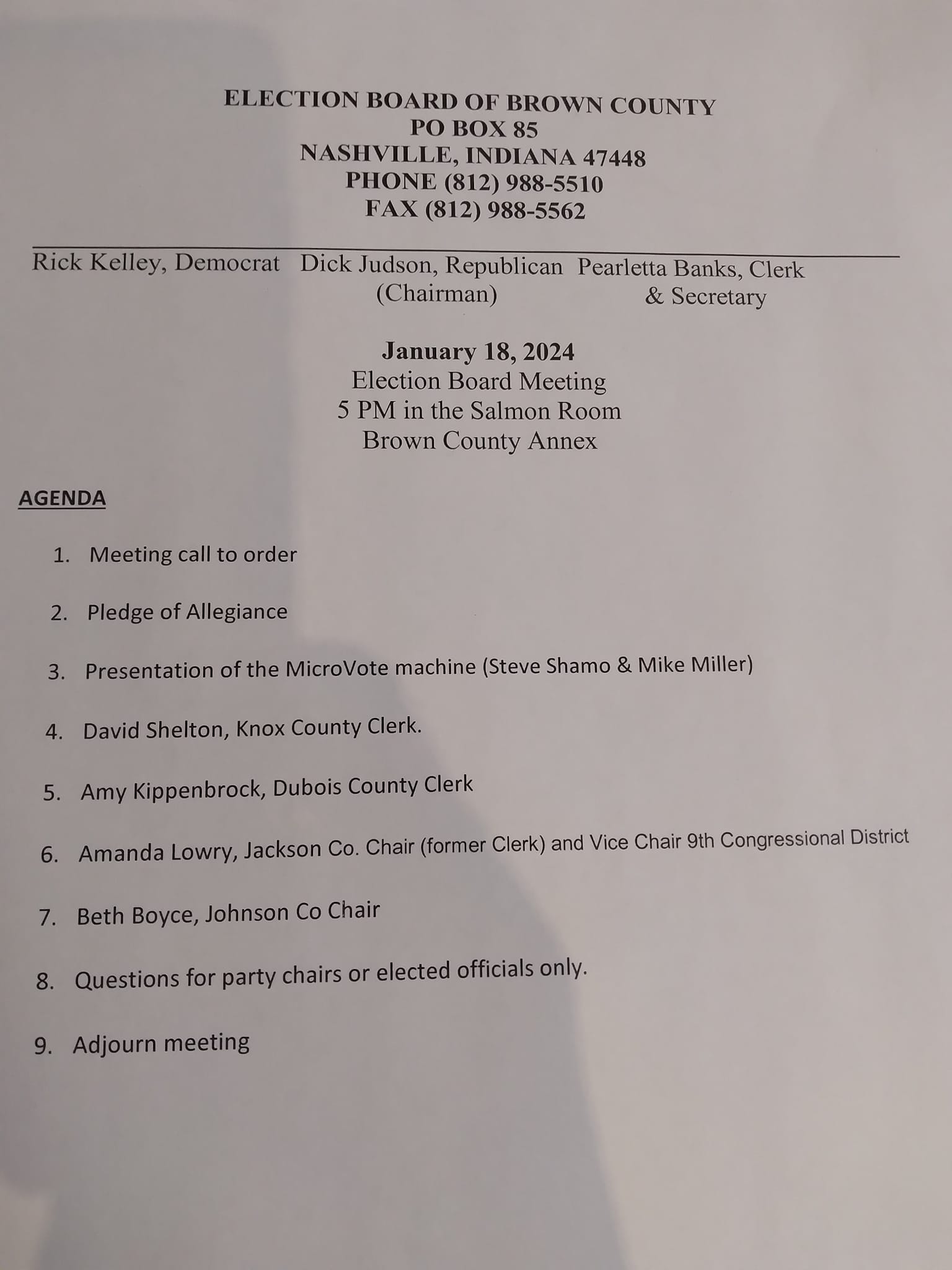
    • Agenda
    • Election Board Agenda Jan 18, 2024

Jan 17, 2024. Jan 17 2024 Letter BCD Democratic Party leader addresses election board

Nov 29, 2023. BCD. League questions election systems, security and vote center planning

Nov 21, 2023. Letter – Brown County Democrat by Shari Frank, LoWV.   Describes the process that led to the justification for the current voting system in Brown County

Legal References

IC 3-11-18.1-3 governs what is required for a county to become a vote center. It does require a public hearing. In additon — IC 3-11-18.1-4, which covers what is required to be in a vote center plan.

IC 3-11-18.1-3Designation of county as vote center county; adoption of vote center order and plan

Sec. 3. (a) A county must comply with this section to become a vote center county.

(b) As used in this section, “board” refers to any of the following:

(1) The county election board.

(2) The board of elections and registration.

(c) The board shall hold a public hearing to present a draft plan for administration of vote centers in the county.

(d) After presentation of the draft plan under subsection (c), the board shall accept written public comments on the draft plan.

(e) At least thirty (30) days after the hearing held under subsection (c), the board shall hold a public hearing to consider the following:

(1) The draft plan.

(2) The written public comments.

(3) Any other public comment that the board may permit on the draft plan.

(f) After consideration of the draft plan and the public comments, the board may do the following:

(1) Adopt an order approving the draft plan.

(2) Amend the draft plan and adopt an order approving the amended draft plan.

The board may adopt the order to approve a plan only by unanimous vote of the entire membership of the board.

(g) All members of the board must sign the order adopting the plan.

(h) The order and the adopted plan must be filed with the election division and must include a copy of:

(1) a resolution adopted by the county executive; and

(2) a resolution adopted by the county fiscal body;

approving the designation of the county as a vote center county.

As added by P.L.1-2011, SEC.3. Amended by P.L.170-2019, SEC.14.

IC 3-11-18.1-4Vote center plan; requirements

Sec. 4. The plan required by section 3 of this chapter must include at least the following:

(1) The total number of vote centers to be established.

(2) The location of each vote center.

(3) The effective date of the order.

(4) The following information according to the computerized list (as defined in IC 3-7-26.3-2) as of the date of the order:

(A) The total number of voters within the county.

(B) The number of active voters within the county.

(C) The number of inactive voters within the county.

(5) For each vote center designated under subdivision (2), the number of precinct election boards that will be appointed to administer an election at the vote center.

(6) For each precinct election board designated under subdivision (5), the number and name of each precinct the precinct election board will administer consistent with section 13 of this chapter for an election that is not being held in each precinct of the county.

(7) For each vote center designated under subdivision (2), the number and title of the precinct election officers who will be appointed to serve at the vote center.

(8) For each vote center designated under subdivision (2):

(A) the number and type of ballot variations that will be provided at the vote center; and

(B) whether these ballots will be:

(i) delivered to the vote center before the opening of the polls; or

(ii) printed on demand for a voter’s use.

(9) A detailed description of any hardware, firmware, or software used:

(A) to create an electronic poll list for each precinct whose polls are to be located at a vote center; or

(B) to manage data in an electronic poll book through a secure electronic connection between the county election board and the precinct election officials administering a vote center.

(10) A description of the equipment and procedures to be used to ensure that information concerning a voter entered into any electronic poll book used by precinct election officers at a vote center is immediately accessible to:

(A) the county election board; and

(B) the electronic poll books used by precinct election officers at all other vote centers in the county.

(11) This subdivision applies to a county in which ballot cards are used at a vote center. For each vote center designated under subdivision (2), whether each ballot card printed will have the printed initials of the poll clerks captured through the electronic signature pad or tablet at the time the poll clerks log into the electronic poll book system printed on the back of the ballot card immediately before the ballot card is delivered to a voter.

(12) The security and contingency plans to be implemented by the county to do all of the following:

(A) Prevent a disruption of the vote center process.

(B) Ensure that the election is properly conducted if a disruption occurs.

(C) Prevent access to an electronic poll book without the coordinated action of two (2) precinct election officers who are not members of the same political party.

(13) A certification that the vote center complies with the accessibility requirements applicable to polling places under IC 3-11-8.

(14) A sketch depicting the planned layout of the vote center, indicating the location of:

(A) equipment; and

(B) precinct election officers;

within the vote center.

(15) The total number and locations of satellite offices to be established under IC 3-11-10-26.3 at vote center locations designated under subdivision (2) to allow voters to cast absentee ballots in accordance with IC 3-11. However, a plan must provide for at least one (1) vote center to be established as a satellite office under IC 3-11-10-26.3 on the two (2) Saturdays immediately preceding an election day.

(16) The method and timing of providing voter data to persons who are entitled to receive the data under this title. Data shall be provided to all persons entitled to the data without unreasonable delay.

(17) In a county in which a majority of votes are cast on optical scan ballot cards, any additional procedures to provide for efficient and secure voting at each vote center, including ballot on demand printing.

Fire-Fighting and Fire Prevention – A Metaphor for County Government

smokey bear only you

Two preferences for Thinking using Fire as a Metaphor

  1. Fighting the fire by taking immediate action to put it out. This takes motivation, skill, courage, and knowledge. The story makes headline news and generates “clicks” on social media.
  2. Preventing the Fire requires the same personal attributes but is not as exciting. Few know about the success of changes that were made that reduced the number of fires. Prevention involves analyzing the root causes of a fire, looking at all the variables and stakeholders, and making the changes needed to prevent or reduce a reoccurrence. This process is referred to as “systems thinking.”    When assessing the results of a change using data, it takes about 7 data points to indicate that the change resulted in an improvement.

For context offering a “system perspective” on Brown County’s sewer expansion project:   BCRSD Sewer Project: Phase 1 Division 1 – Will you be affected?

The challenge is balance. If you are always fighting fires, you always will be.  To paraphrase Ben Franklin,  “An ounce of prevention is still worth a pound of cure.”

The So What?  The desired expansion of sewers in the county was based on what many would consider a one-sided closing argument by the Brown County RSD supported by the commissioners and council.  Did the supporting agencies at the state and federal levels perform their due diligence in approving funding for the project?

Fire Fighting.  Not surprising (very predictable) that there would and will be opposition by property owners who refuse to cooperate and may collectively take legal action regarding easements.

Fire Prevention. I provided “early warning” on this likelihood of opposition for years.  I offered suggestions on better processes for communicating a need and advocated for citizen engagement.  Arguments fell on deaf years.  With a one-party monopoly on political power, “might makes right”  and the “ends justify the means.”  A monopoly is a closed system and can and does morally (right vs wrong) corrupt those who work within it.

The arguments and counterarguments on this project will now be made on social media.  An additional option included Letters submitted to the Brown County Democrat that might include both sides of the debate.   Many people still read the paper just for the letters.   Lettter can be sent to:  newsroom@bcdemocrat.com.

BCRSD Sewer Project: Phase 1 Division 1 – Will you be affected?

BCRSD Sewer Project: Phase 1 Division 1. About 180 potential customers.

Customers started receiving their letters and instructions.  Not surprising that there is immediate opposition that was posted by Jacob Adams at Brown County Matters (public) Brown County Refreshed (private) and Brown County Chatter (private).

The plan for all of Phase I – which would include when and where service will be provided, is not available.

2024 Brown County Regional Sewer  District (BCRSD) Board Members: Mike Leggins(President), Clint Studabaker (Vice President), Richard Hall (Secretary), newest board member – Steve Lngbeen (at-large).

IDEM. Administrative oversight of the BCRSD falls under the Indiana Department of Environmental Management (IDEM). Finances reviews by the Department of Local Government Finance (DLGF).

    • A regional district is an independent local government entity … Decisions about forming new districts are made at the local level. IDEM’s administrative role is to ensure districts are formed according to the legal and technical requirements specified in IC 13-26.”

County Oversight. Board members are appointed by the commissioners and council. The president of the Commissioners is Jerry Pittman. The President of the Council is Gary Huett. Both of these individuals refused to direct the BCRSD to present the BCRSD Strategic Wastewater Plan and Watershed Study at a public meeting. This plan was developed without any public meetings where citizens could provide input. They did post the video presentation on their website.

Internal Controls. Due to their refusal to answer questions about their strategic plan and watershed study, I sent a letter to the governor, state and federal elected officials,  and the USDA Office of Inspector General questioning the adequacy of their internal controls in approving this project.

Legislative Change. It is most likely that addressing the internal control issue will require some changes in state legislation.  For example, the state does not allow county Health Departments to develop septic system-related standards that exceed state standards. A review of new standards is done by a Technical Review Panel.  Yet, county Regional Sewer Districts (RSD) can identify new standards and methods.  Additional Information:  Indiana: Internal Controls – Request for Review – State and Federal

The purpose of internal controls is to help ensure the effective and efficient use of tax dollars and to help prevent waste, fraud, abuse, and mismanagement.  The value of an internal control policy and program is usually unknown at the county level.  Internal controls are the actions that need to be taken to prevent mission failure.

Jan 21, 2024. Copy of the letter I received from a customer. Not included is the satellite image of their property. The mailing included a return envelope, full size, $1.11 stamp.

Jan 19, 2024. A formal request was submitted to the BCRSD for a copy of the names (180) of the customers in Phase 1, Division 1.

Jan 11, 2024.  Formal Request for a copy of the letter sent to the customers, Phase 1, Division 1.

The BCRSD had a copy of the letter at their meeting on Jan 11 but Studabaker (Board VP) directed them not to give me a copy. The rationale was that they did not want me to post before their customers received it. The logic of the delay escapes me. Even though they can provide me the info now, they have 30 days.

If I do not receive the info within this timeframe, I file a formal complaint with the State which gives them another 30 days. I’ve had to go to the State before to get information from the BCRSD.

Commissioner Meeting Notes Jan 17, 2024

commissioner meeting picture

Agenda Commissioners Meeting 2024_01_17

Audio of the Meeting – Length 2 hrs.

This post at Brown County Matters

Agenda Items of Note  

  • Board and Commission Appointments.
    • 1:04:46. I re-applied to serve on the Redevelopment Commission (RDC). Sanders made a motion to accept my re-appointed and Pittman and Wolpert declined to second. They want to interview other candidates that have or may be applying. I’ve been working on a project to baseline our property tax base. Newer technology has recently made this easier and possible.   If I am not re-appointed and elected commissioner, I’ll complete the project.
  • Feb Commissioner Meeting Change:  From Feb 7 to Feb 5, 2024, 2:00
  • 11:42  Helmsburg Regional Sewer Update – Kyle Myers
  • Indian Hill Re-Opening.  Jerry Pittman – Keywords: “still alive, major obstacles, costs and source of funding unknown, logistical considerations in meeting state specs, almost impossible, may have to buy land, may impact Bean Blossom Creek which is controlled by DNR, not sure where this will end up at this time, whatever happens, commissioners made a good effort, more to follow. ”
  • Bond Discussion – In the past to justify the loan, projects were identified by title but not at any level of detail. To his credit, Ron Sanders wants specifics regarding an estimate of costs.  For example, the need for a new prosecutor’s office has been mentioned but no details as to size, cost,  or decision on location. Also, Sanders suggested selling the Music Center may prevent the need to take out another capital improvement loan
  •  Audio – last 10 minutes.  Selling the Music Center – Ron Sanders, pros and cons.  Ron Sanders proposed selling the Music Center as opposed to borrowing money  (2-3 million) for capital improvements. Getting citizen input on the idea of selling the BCMC was a campaign promise.  Ron discussed pros and cons and suggested a public meetings to get input from citizens.  Pittman identified his concern that a private owner could offer events not suitable for Brown County. It was also mentioned by the auditor that a buyer might want an abatement of taxes. The terms of sale can identify that an abatement will not be offered.

County Council Meeting Notes Jan 16, 2024

County Council Meeting Notes Jan 16, 2024

This post at Brown County Matters

Agenda County Council Meeting Jan 16, 2024. A presentation by the Sheriff’s Department (over an hour) was added to the agenda

Audio – County Council Meeting Jan 16, 2024 – Total length: 2: 06:51 https://independentvotersofbrowncountyin.com/wp-content/uploads/2024/01/agenda-county-meeting-jan-16-2023.mp3

    • Election of Officers. Gary Huett was re-elected president. Scott Rudd as Vice president.
    • Appointments – Board and Commission positions
    • 28:00 – 1:37:45 Presentation – Sheriff’s Office
      • This was the “third” presentation by the Sheriff identifying the need for additional funding. The amount he requested was $319, 324. I do not know if this included benefits and other payroll costs.  The shortfall is around 10K per person – deputies, jailers, and dispatchers.
      • There were 21,159 calls to dispatch. The breakdown by categories of these calls was not identified.
      • The decline in the number of law enforcement personnel within the state and nation has led to higher salaries and Brown County is not competitive. For example, we can spend 100K or more to train-up a new deputy who then leaves when they are offered 10K more by another county.
      • There is legislation being “proposed” to provide some reimbursement to counties that lose personnel due to “poaching” by other departments.  Given our lower salaries, we cannot poach from other departments.
      • Other county departments are also underpaid when salaries are compared to surrounding counties and employees feel that they too should be getting increases.
      • The council will be holding a working session to discuss options with the new budget consultant/advisor.
      • The county just does not have the money.  Payroll money is limited which leaves hiring freezes, and staffing cuts as options to provide the money for higher pay.
      • New Revenue?  Eliminating health insurance benefits (around 18K per person) for part-time personnel – including commissioners and council might help.
      • Excess profits from the Music  Center could also be helpful. Currently, 75% of the excess profits are to be given to the Community Foundation and only 25% to the county.  The Music Center Management Group is planning on giving 200K to the Foundation this year and 67K to the county.
        • County personnel may be able to appeal to the foundation to help cover the costs of government.
      • Another option is for more revenue from the innkeeeprts tax to be used to fund the Music Center’s operating expenses which could lead to more excees profits available to county government – 500K to 1 million?  This would require a change in the Admin Agreement.  More info at the following:
    • 1:39 – Scott Rudd – Indian Hill Railroad Crossing.  INDOT treating the re-opening as new which does not require INDOT to provide any funding.   The county is morally obligated to fund this re-opening due to the failure of our commissioners and legal council to perform their due diligence.  Legislation is being proposed to add specific language in a statute to require a public hearing for any railroad crossing.  Commissioners who voted to close the crossing were Jerry Pittman, Diana Biddle, and Dave Anderson. More info at: Link:
    • 1:40:30.  Highway Superintendant.  Money removed from the highway budget was replaced.
      • Funding for new (?) positions was tabled.  This included a supervisory position. The commissioners discussed adding a new position but new a position description has not been approved by the commissioners.
      • Sherrie Mitchell questioned if money was being transferred from funds needed to repair roads and bridges to payroll. Her follow-up with the state board of accounts reinforced that money from the funds could be used to cover an employee’s labor costs to work on a road/bridge repair project.
      • Mike Magnor identified additional staffing is needed.

Updated Notes – May 2, 2024.

    • Audio – Discussion on Highway Position Funding begins at 1:40:30
    • Highway Superintendant.  Money removed from the highway budget was replaced.
      • Discussion on funding for unfilled positions … including a supervisory position ….
        • (The commissioners had discussed adding a new position ..- an assistant supervisor but the position exists – just not filled.
    • 1:46 37 Magnor- Request to fund 6 positions(4 are existing employees)
      • Kemp suggested open positions remain unfunded ..(Fund existing – leave other 2 open and unfunded.) …. Rudd – I thought we did that last time ….
      • Judy Powedrill Swift – in salary ordinance but has to be appropriated
      • Byrd – questions Kemp’s concerns – Kemp references to organization development issues, and need for business planning.
    • Mike Magnor identified additional staffing is needed. Not all 19 positions filled – more efficient without … voluntarily not filled ….
    • Redding – asking for clarification on funding sources …  3
    • 1:53:99 Rudd –  approve funding for 3 existing and one new hire (mechanic)  ..    Redding asking for clarification ….  (unspent money stays in the county). Kemp wants money to accumulate …
    • Motion and Second …

2024 Election – Campaign Priorities and Notes- For the Record

we the people declaration and flag

2024 – Tim J. Clark for Brown County Commissioner, District 3
Updated Jan 12, 2024, 10:00 am.

In America, We the People are “Top Management” and must start acting like it. The responsibility of elected officials is to serve all the citizenry and not just the special interests of one or more individuals or groups.  Citizens are responsible for holding our elected and appointed officials accountable for achieving the desired results.  What do we expect? How will we determine that change results in improvement?

This timeline will likely get pretty long. The intent is to identify challenges and what can be done to make some small changes that will lead to significant improvements. Just managing a simple financial and capital improvement plan would have saved us a million or two and hundreds (if not thousands) of hours spent “fire-fighting” and scrambling to find money to fund important initiatives.  Improvements would have also prevented the downgrades of our credit rating.

Jan 12, 2024. Challenges and opportunities – #2 – Critical Thinking.  Our justice system represents our collective process for critical thinking. Citizens (jurists) have the responsibility to understand both sides of an argument, the counter-arguments, the facts, and the evidence, ask clarifying questions, and then make a decision as to yes or no, guilty or not guilty.  The decision can be appealed where additional citizens can weigh in to help ensure the integrity of the system. Poor decisions by county government can lead to outcomes that may take years (if ever) to correct.

    • Example – Poor Decision – Closing the Indian Hill Railroad Crossing.  About 30 minutes of deliberation, no due diligence, no public hearing, no notification to residents that would be the most affected, and over 3 years and counting to correct. Additional information. Part 4: Closure RR Xing, Indian Hill Rd – Petition to Re-Open
    • One-Sided Closing Arguments. Too often in county government, a one-sided closing argument is made in support of a decision, and any challenges or counter-arguments by citizens are ignored. (see monopoly on political power – below).
    • School Referendum – Round 2 – Background Information.
      • 2022 General Election.  The failed school referendum in 2022 represented a one-sided closing argument based on anecdotes (without context) and emotion.  The challenges and concerns that citizens had with this referendum were expressed on social media including Brown County Matters, Brown County Refreshed, and Brown County Chatter.   My post on the topic:
      • 2023 Primary Election.  The schools have submitted a petition for the referendum to be included in the May primary ballot. I have seen little to no evidence that citizens’ concerns and challenges were considered.  A “survey” (not statistically valid) was designed to attempt to identify community support for the referendum. Note that primaries get a fraction of the vote
      • The Case?  The school has been losing enrollment since 2009.  What is the capacity of the existing schools?  Do we have more staff and infrastructure than we need? If so, doesn’t this reduce the amount of funds available for teacher salaries and programs?  The superintendent informed me last year that no schools would be closed. Why? Who made this decision?  And, if there is a good reason, let people know so they can make a more informed decision.  Counting on lower voter turnout and encouraging advocates to vote in mass for the referendum does not gain community support.

Jan 12, 2024. Challenges and opportunities – #1 –  Monopoly and Performance

    1. Monopoly on Political Power. A one-party monopoly on political power leads to a “closed system” where input from those outside the system is not needed or wanted.  A closed system can contribute to the moral corruption of those who work within it. A closed system cannot produce the best results for the citizenry.
    2. Capability and Performance.  On a scale of 1-6 with 5 being the best, Brown County Government can be assessed at around a 2 which can be described as “It works.”  The cost of poor quality in such a system can range from 20-40% of the budget.  Additional information:  County and Community Capability Maturity And Potential

Jan 12, 2024Campaign Priorities. – Transparency, Accountability, Improvement.

  1. Transparency.
    • The business of government. Post all agendas, minutes, audio/video of all commissioner meetings on the government website. Encourage all other boards and commissions to do the same. Summarize the minutes into a yearly report and share the report with citizens.  The minutes help capture all the good work that is being done in the county.
    • Citizen Input. Citizens will not be prevented from asking questions and challenging policy.
    • Open Meeting Laws. Comply with Indiana’s Open Meeting Laws. Any meeting (working session)  where there is a quorum (2 of the 3 commissioners present) will be posted and the public notified.
      • Elected officials can ignore open meeting laws. Decisions made at illegal meetings can be canceled IF the non-compliance is caught within a 30-day window. Otherwise, the decision becomes policy.
  2. Accountability. 
    1. Financial Plan – Goals, Objectives, Results.  Support the development and management of a county financial plan with a focus on the commissioner’s budget to include the capital improvement plan and budget.  Identify goals goals and objectives. Provide updates on results.
      • Two other important plans:
        • Road Improvement Plan.  Identifies the status of all roads, the plan for repairs and paving, and associated funding.
        • County Comprehensive Plan – Updates. The purpose of the plan is to clearly identify what citizens want and do not want in terms of development, zoning, and quality of life. Our 12-page 2011 plan is vague and insufficient.
    2. Citizen Internal Control Program – Checklists. Key Point: Identify what is required by statute for offices, departments, boards, and commissioners to perform their respective missions; develop a checklist of what must be done to prevent mission failure.
      1. Encourage and support and implementation of a Citizen Internal Control Program at the county level.  This offers one of the better tools for improving efficiency  (doing things right) and effectiveness (doing the right things). Controls also help to prevent waste, fraud, abuse, and mismanagement.
      2. The policy started with the federal government and has been adopted by the states.  A good overview of the federal program – GAO – Green Book.
      3. Challenge to Indiana’s internal control policy and program as it relates to the Brown County Regional Sewer District (BCRSD) sewer expansion project.
      4. The focus of Indiana’s State Board of Accounts (SBOA) regarding internal control is on the financial aspect.  Oversight of operational effectiveness and efficiency is left up to the voters.
  3. Support and encourage continual improvement.  Celebrate successes and look for those opportunities where little changes can contribute to significant improvements.
    1. Brown County Leader Network (BCLN). Includes a self-help support guide including methods and tools that support assessments, decision-making, planning, and project management.
    2. BCLN – Overview of the concept.


Jan 11, 2023.
Submitted the forms to the county clerk to run for Brown County Commissioner, District 3. The seat is now held by Jerry Pittman. Forms required: CAN-2, CAN-12, CFA-1. Forms are available from the clerk and from the Indiana Secretary of State (SoS) office.