All posts by Tim J. Clark

County Council Meeting Notes, April 15, 2024. Helmsburg, Sock Factory Money

Audio

Agenda Council Meeting April 15, 2024

    • Call to Order
    • Pledge of Allegiance
    • Additions to Agenda or Changes
    • Approval of Minutes
    • OLD BUSINESS
    • No old business
    • NEW BUSINESS
    • Helmsburg Redevelopment – Sock Factory Money $228,600
    • ADDITIONAL APPROPRIATION
    • SOLID WASTE – $10,000 to Special Waste;   $11,150 to Equipment
    • Auditor – $19,511.79 from Fund 1216 for New Workstations replacing the 33-year-old workstations.

Helmsburg Redevelopment – Sock Factory Money

Statement HCDC President Adrian OShea 

The council tentatively approved transferring the balance from the sale of the Sock Factory to the Helmsburg Community Development Corporation (CDC (501c3.)

In 2016/2017, citizens in Helmsburg asked the RDC for help with dilapidated housing. Below is the documentation from 2017  including The Helmsburg Economic Development Plan and Economic Development Area (EDA). Link to the “timeline” that tells the Story starting in 2016.

Originally, the RDC needed a structure where we could acquire properties.  “This was never needed” — which is a story in itself.

HEADLINE NEWS. Helmburg now has an approved economic plan, economic development area, community development corporation (501c3), and “funding.”

Helmsburg provides a pretty good model for citizens to determine what they want and do not want in terms of quality of life and development.  Citizens (top management) in the community led the effort with the county government – elected and appointed officials (employees), “serving” the interests of the citizenry.

RDC Meeting Notes, Apr 16, 2024, TIFs, Nashville USB

Last updated: April 19, 2024 

RDC Meeting  Notes April 16, 2024  – Tax Increment Financing (TIF) Districts

Apr 19, 2024. This post at Brown County Matters.

Summary of Key Points:  The main topic was advocacy for creating Tax Increment Financing (TIF) districts.  A TIF district allows the county/RDC to borrow money for infrastructure projects needed to support development. The increase in assessed value as a result of the investment is returned to the RDC to pay off the bond.

TIFs can only be used as a last resort e.g., development in the area would not be possible without government investment in infrastructure.

A proposed TIF is for the old Little Opry Property.  Andrew Tilton is requesting around $2 million to run a sewer line to the property. This will help him to lease the property to an apartment developer.  The developer might be asked to agree that if the project is not completed, the county is reimbursed.

    • Background – Nashville Sewer Expansion. The Nashville Utility Service Board (USB)  developed a master plan for expanding sewers that includes the Little Opry property. Nashville has not selected this expansion as a priority, and thus, the request for the “county” to fund this part of the expansion as well as other areas in their plan.

Meeting Attendees: RDC Board members: Ross Benson, Sue Lindborg, Bill Cayne, Jon Curry
Tim Clark (re-appointed to the RDC in March).  Ross Benson was a candidate for Nashville Town Council in 2023.

Guests included: Robyn Rosenberg Bowman (local GoP /co-owner Tramcore Realty), Kevin Allen/BLN, and Jimmy Tilton.

Agenda RDC Meeting Agenda for Tuesday, April 16 6PM

Overall Observations on the RDC.   I’ve participated in or observed RDC since 2016. Each RDC  tends to start from scratch as new members are added with varying agendas.   It would be helpful to have a series of meetings with former RDC members to discuss and document the past work that has been done, challenges, issues, accomplishments, frustrations,  policies, available economic data, and lessons learned. Knowledge of this information may help reduce some learning curves.

Bedroom and Retirement Community. TIFs are effective in counties and cities that have to invest in infrastructure to attract development and jobs and expand their tax base and workforce. In contrast, Brown County has not had to provide these incentives.  Hard Truth Hills is a case in point.

    • The county is funded primarily by income tax and property tax. 
    • Brown County is a Bedroom Community and a Naturally Occurring Retirement Community supplemented with Tourism.  A high percentage of residents choose to live here and commute (or work from home) to other counties that offer higher-paying jobs.  What is our economic engine?  It’s not tourism. Tourism accounts for $12.1 million in wages, and county citizens who file tax returns account for over $425 million in taxable wages.

Assessed property values and taxes (historical and current) are contained in a database and supported by the County’s GIS system.  The information in this system can be used to assess areas experiencing growth, declines, or staying about the same.

If TIFs are a solution in Brown County, what is the problem?   What areas in the county should but cannot be developed without an investment in infrastructure by the government?
What are the current trends for revenue growth?  What is the expectation for growth?  How will areas be identified?  What is the criteria for new investment by the county?   How will this be funded?  What is the current Zoning in the proposed areas?  Are residents in the area supportive of the proposed developments?  Do the TIF areas align with the County Comprehensive Plan?  Given the county’s financial condition, credit rating,  and long lead time for reimbursement, is it a viable option for the county?

Meeting Notes 

As stated above, the main topic of the meeting was advocacy for creating Tax Increment Financing (TIF) districts. This could allow the county/RDC to borrow money for infrastructure projects needed to support development. The increase in assessed value as a result of the investment is returned to the RDC to pay off the bond.

TIFs can only be used as a last resort e.g., development in the area would not be possible without government investment in infrastructure.

    • Purdue – The-Use-of-Tax-Increment-Finance. Indiana law now makes clear that TIF is intended to fund infrastructure to promote development that would not occur but for the added infrastructure financed by the TIF revenues. Evidence that the development would not happen but for the establishment of the TIF district must be presented before
      the TIF district is approved. TIF is not meant as a source of revenue for responding to ongoing development nor as a substitute for other sources of infrastructure funding. TIF districts are required to expire once the infrastructure bond is repaid. TIF is not meant as a permanent source of revenue for the enacting government.

Barnes and Thornburg – Handbook for RDC and attorneys 2023

      • Before an “allocation area” (often referred to as a “TIF District”) can be created, the Redevelopment Commission must first (or simultaneously) create an Economic Development Area, and then select some or all of the parcels in the Economic Development Area to constitute one or more TIF Districts.

A proposed TIF is for the old Little Opry Property purchased by Andrew Tilton. He (through his advocates) is requesting around $2 million to run a sewer line from Nashville to the property. This will help him lease the property to an apartment developer. Per Kevin Allen, the developer might be contractually obligated to agree to reimburse the county if the project is not completed. This assumes the developer remains solvent.

Brown County Democrat – Article on the Project

    • Looking at unused potential: Housing project in works at site of former music venue; government assistance possible, Abigail Youmans -October 12, 2021, Brown County Democrat.
      • When the former Little Nashville Opry property was purchased this March many started to wonder what its future held after being vacant for more than 10 years.
      • The property has sat vacant since 2009 when the Opry was destroyed by fire. Now the property has a new future as owner Andrew Tilton plans to use it to fulfill a need here: More housing.
      • Those working on the project are communicating with county leaders about possible help in the forms of tax abatements, an economic development agreement or tax-increment financing.
      • He has been working with is Strongbox Commercial, a real estate development company out of Zionsville. Alyn Brown not only works for the company, but is also a member of the Nashville Utilities Service Board.
      • Tilton said that about two days after he purchased the property, he started receiving phone calls then meetings started about three weeks later.  “I closed on the property on March 2, shortly after that, the ball started rolling,” he said. “For real estate that’s super fast.”
      • Kevin Allen with BLN in Bloomington is the senior site designer involved in the civil engineering of the Opry property. He presented to the Utility Service Board on Sept. 22.
      • “We’re looking at every possible way to get (sewer) there,” Allen said. The Utilities Service Board agreed to work with M.S. Consultants to see what possible routes the developers could take.

Background – Nashville Sewer Expansion. The Nashville Utility Service Board (USB). The USB developed a master plan for expanding sewers that includes the former Little Nashville Opry property. Nashville has not selected this expansion as a priority at this time.  And there has been no county public meetings that identified that the county will fund sections of the Nashville sewer expansion.

County Comprehensive Plan.  A TIF district requires the establishment of an Economic Development Area (EDA).  TIF districts and the likely effect on Zoning could be developed and included as an addendum to a new County Comprehensive Plan.  This plan identifies what the “citizens” (not developers/local politicos) want and do not want in terms of economic development and quality of life.  Any proposed TIF districts can be added as a layer on the county GIS map to help communicate the TIF plan to the citizenry to get community buy-in.  This layer can also include what Nashville has identified in its sewer expansion areas.
Individuals in government positions should also disclose any conflicts of interest.

Economic Tax Baseline:  RDC – County Property Tax Assessments and Taxes- Database – Notes 

RDC – County Property Tax Assessments and Taxes- Database – Notes

Last updated: April 18, 2024.

Sources of Revenue. Our major sources of revenue are from income taxes and property taxes. We can access our property assessments and taxes by area, type of property, trends, etc.

Our county GIS system includes assessed values and taxes paid but maintains only 5 years of data. https://brownin.wthgis.com/

This data comes from the auditor, the assessor, and the treasurer. The software system used is Government Utilities Technology Service, Inc (GUTS).  https://www.g-uts.com/about/

This data is now available on the “Cloud” and we can get access to more than 5 years (maybe 15) of data using an Application Programming Interface (API).  We would need access to analytic software to query the data to discover trends in assessed values by areas and types of properties.  An API, or Application Programming Interface, is a set of rules or protocols that enables software applications to communicate with each other to exchange data, features, and functionality.

It may be possible to get support from graduate students at IU. They have access to software called Tableau. IU supported two previous RDC projects.

To get access to the data, we received  permission (a memo) from the commissioners, treasurer, auditor, and assessor.  Below is the email correspondence from Eric Goodnight from G-UTS.

If we want to target an area for development, access to the data would provide a current baseline. This helps identify the expected results (increases in the tax base)  you expect from strategies like a TIF.

Email Correspondence

Brown – Property Tax Analytics (from Brown RDC
Grant Goodnight <grantg@g-uts.com>
Wed, Dec 27, 2023, 11:56 AM

Hey Tim,

I hope you’re doing well and had a Merry Christmas. I recently received your request and had a chance to review it this morning. Back in August, Kevin Patrick reached out to us, and I sent him the attached list of available Adhoc views, which you can access using both our Adhoc reporting tool and our API. Let me provide you with more details about these tools.

Before we dive into the technical aspects of obtaining the data, I want to note that the data you’re looking for belongs to our customers, specifically the Commissioners and office holders (Auditor, Treasurer, and Assessor). We’ll need written authorization from them, granting the RDC access before we can permit anyone to connect to the live data.

Regarding your request, it appears that some of the information you seek may already be part of the assessment trending process, which I believe Nexus handles for Brown County (although I’m not entirely certain). Some of the elements you’ve mentioned could potentially be gathered during this process, but I’m not entirely sure about your specific goals.

Our PVDNet platform offers various ways to extract data, allowing you to use your preferred analysis tool. First and foremost, we have an Adhoc reporting tool that enables you to create reports from a comprehensive set of views (please see the attachment). These views cover almost every critical data element within the system. You have the flexibility to generate full reports within the tool or export raw data for analysis in another tool.

I also wanted to mention that Brown County is scheduled to transition to our cloud platform within the next month. Once this transition is complete, they will gain access to our web API (PVDNet API), which includes an Adhoc endpoint. This integration will make it easier to connect to the same views available through our Adhoc reporting tool, streamlining your data analysis process.

To sum it up, the first step is to verify with the Assessor whether the data you require is already a part of the trending process. If it isn’t, then the RDC would need to request authorization from the relevant parties to access the data. Once authorization is secured, our Adhoc reporting tool and the upcoming PVDNet API should make it straightforward to analyze the data using your preferred tool. If you can provide us with specific data requirements, we’d be glad to recommend any relevant reports or data sources.

If you have more questions or need further assistance, please feel free to reach out.

Best regards,
Grant

Grant Goodnight
President
P: 765.481.2851 | F: 765.535.5044
grantg@g-uts.com | http://www.g-uts.com | LinkedIn

=====================
From: tjclark2036@gmail.com <tjclark2036@gmail.com>
Sent: Friday, December 22, 2023 8:01 PM
To: ‘Greg Jordan’ <gregj@g-uts.com>
Subject: RE: Brown – Property Tax Analytics (from Brown RDC)

Hi Greg,

On the “analytics”, this would include software that makes it easier to query the data and produce some pretty good visuals of the information (see links below).

For instance, within Brown County, what areas are seeing the most and least assessed values and property taxes stratified by property types, townships, “neighborhoods”, etc. Trend data on this information would also be helpful and would allow us to assess the impacts of development strategies.

I assume G-UTS maintains our historical data.

IU/SPEA students have offered to provide support if they could get access to the data. I think they have access to Tableau which is what the Kelly School of Business at IU uses. We also got contacted by a company that offered analytic-type support.

Those offering support said that they just need the “API.”

What would it take for the county to get access to the API?

Tim

List of software

10 Best Predictive Analytics Tools and Software of 2023
https://www.techrepublic.com/article/best-predictive-analytics-tools/

The Best Data Visualization Tools Of 2023
Combined (Commissioner and Council) Work Session Agenda, April 16, 2024 Sustainability Plan (200 pages)

Council members present: Huett, Rudd, Byrd, Kirby, Swift-Powdrill. Kemp. Commissioners Office: Melissa Stinson, Jerry Pittman.

Tuesday, April 16, Combined Work Session Agenda

Agenda April 16, 2024:

Stellar will not be available in 2025 but will in 2026.  Agreement that the county needed to be better prepared in identifying needs that could be supported with a longer term vision and strategy  . Melissa Stinson’s suggestion that Brown County ask for an exception to the unanimous vote by commissioners rule was rejected by all.

Per Melissa Stinson, DNR is interested in providing some funding for the Salt Creek Trail and Indiana Hill. The prosecutor’s office may be eligible for “blight” related funding, and INDOT may be interested in making sidewalk-related repairs in front of the courthouse.

Brown County Community Foundation – Alice Susemichel

    • Grant and other Funding Opportunities report 
    • Stellar 
    • READI 2.0. Uplands (Sewer Issues)
    • Regional with Owen County
    • Lilly GIFT grant with Community Foundation
    • ARA
    • Cook

·Development of the Capital Improvement Plan

    • Review of feedback from departments on CIP needs
    • Five-Year Financial Plan 
      • Three year budget plan
    • BINDER of BROWN Co Sustainability 04 15 24 gjb
    • Projects on the CIP list include replacing the jail A/C units – about 1 million.

Review of county budget items:

    • Benefits – Perf, 457, 401a (Jim, Melissa, Judy meet) report
    • Law Enforcement financial concerns – report
    • Prepare for Dept. Heads Luncheon – Budget Guidance sheet
    • Any other pertinent budgetary concerns

Helmsburg – Balance Sock Factor Money.  Adrian OShea – President, Helmsburg CDC  to work with council attorney Susan Bevers on the details.

·2025 Budget Timeline:

    •  April 16. 9 – 11:30 Work Session
    • April 16. 11:30 – 1.   Luncheon – Dept Heads –
    •  May?     Work Session
    • June 30 – Form 1’s due, or use last years budget
    • July 17 9-12  Work Session to review Form 1’s
    • July 24  9-4.  Intake session from each dept – all day
    • Sept 16.
    • Oct 21 Budget Adoption Reading
    • Work Session to review dept budgets
    • Future monthly meeting dates

Commissioner Meeting Notes, April 3, 2024

Agenda Commissioner meeting Apr 3 2024

Audio of the Meeting:

Infrastructure Repairs/Replacements.

    • Jail AC Units.  Commissioner Sanders proposed funding a partial replacement of the Jails AC Units versus all at once. This would result in a more immediate response if one or more of the aging units fail.  The complete replacement (around a million) will require a capital improvement loan.
      • Specification, Request for Proposals, Project Management. Discussions included contracting for these services. DLZ quoted 64K.
    • Budget Deficit?  The county’s financial advisor identified that balances in the general fund may be needed to pay operating expenses.
    • Capital Improvement Loan.  County has to routinely borrow money to fund infrastructure costs.  The current loan will be paid off this year.  And a new loan will be needed. The goal is to make it tax-neutral. Given the old loan was for 3 million/3 years and was at an interest rate of less than 1%, staying “tax neutral” will require less money to be borrowed or pay back over an extended timeframe. 
    • In addition to the Jail  AC units, building new prosecutors’ offices was identified as a priority.   Requirements identified included making it “bulletproof.”   

Vacancy – Washington Township Board. The commissioners will be advertising the vacancy. The Chair of the Democrat Party did not identify a replacement. This allows the commissioners to make an appointment – independent of political party affiliation.

Sherrif

    • Turnover.  Sheriff Stogsdill briefed that they continue to lose staff to surrounding counties.  Mentioned they may need to reduce coverage on shifts.
      • Will the council approve changes to the salary ordinance that would allow the Sheriff to use available payroll dollars to increase the salaries of existing personnel?
      • What is the risk to citizens of reduced staffing?
    • Leasing Vehicles.  Sheriff bought one new vehicle and is leasing three more. He identified that “purchasing the vehicles” would be less expensive. This is a change from a former commissioner who believed leasing was less expensive.

Bike Signs.  Mike Magnor is continuing to research the issues.  Alyn Brown of Brown County Mountain Biking suggested a phased strategy and priorities based on bike traffic and safety issues.  Bike Sign Proposal 2024_03_03

    • The law in Indiana is that cyclists can use the whole lane and that motorists are required to pass when they can do so safely and when they can do so with 3’ of clearance. It doesn’t matter if there is a center line or not.
    • Commissioners are not being asked to change any laws or make any special allowances.  These laws already exist and are in place.
    • The request is to add signage to let motorists know the laws and make them aware that cyclists are on the roads.

Solar Eclipse.   Plans are in place.  The Governor did declare an “emergency” that facilitates cooperation among states.

Bridge 122 Mt. Liberty Road.  Beams had to be replaced and approval for additional repairs have been approved by the commissioners.

School Size and Performance

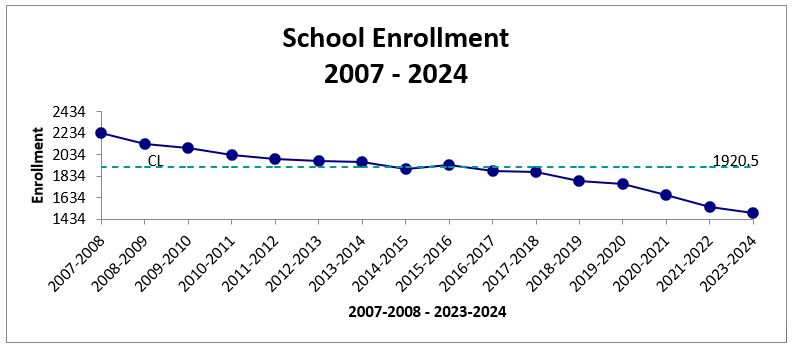
Brown County Schools Enrollment 2007-2024

Students in Indiana’s smallest schools struggle as enrollment continues to decline
A new statewide study fuels ongoing discussions around rural school consolidation.
BY: CASEY SMITH – JANUARY 5, 2024 7:00 AM

    • A report released Wednesday by Ball State University’s Center for Business and Economic Research shows that students enrolled in school districts with less than 2,000 students scored lower on state-standardized exams and lack the same amount of access to high-level courses.
    • About 20% of the state’s K-12 students are enrolled in districts of less than 2,000 students, according to study data. Almost 5% of Hoosier kids are in a school district with less than 1,000 students.

School consolidation conversation should focus on fact, not emotion Niki Kelly  OCTOBER 6, 2023

    • It is this focus that the Indiana Chamber of Commerce is bringing to a push for lawmakers to consolidate school districts with fewer than 2,000 students. … It’s not a new idea — it goes back to at least 2017.
    • Previous studies showed that around 2,000 students is the minimum for school corporations in Indiana to support adequate student performance. But more than half of Indiana’s school corporations had K-12 enrollment lower than 2,000 in 2022.
    • In a September letter, Doden said that while the goals of such a policy might have some merit, eliminating “small public school districts through consolidation will be seen as a death knell for the millions of Hoosiers who live in small towns and rural communities.”

      He has instead called for Indiana to adopt an initiative that would redirect 10% of what the state spends on economic development — around $100 million per year — to small towns and rural communities.

      We need a vision for Indiana that reverses the population decline and makes our small cities and towns a destination to live, work and raise a family as opposed to plans that are perceived to give up on them entirely,” Doden wrote. “For far too long, our state has ignored our small and rural communities and had no plan for them, only giveaways to corporations.”

2024 Affordable Housing – Notes

Last updated: Dec 7, 2024

May 29, 2024. StateAffairs.com.  “The number of short-term rentals such as Airbnbs and VRBOs in Bloomington has nearly doubled since 2021, according to The Herald-Times. It is a trend local housing experts caution can drive up the cost of living and stifle options for homeowners and long-term renters during a national housing shortage. “

May 15, 2024.  Home Sales, inventory increase locally, Brown County Democrat

    • According to F.C. Tucker Company’s April real estate stats, the Brown County residential real estate market saw increased home sales

    • Homes sold 31 days, or 37.8 percent, faster than this time last year. That was the greatest increase Tucker saw in all its central Indiana markets.  Available housing inventory increased 12.5 percent, The average home sale price increased 7 percent to $440,796.

      What Is Affordable Housing?, U.S. News and World Report

      • The U.S. Department of Housing and Urban Development defines affordable housing as housing where the occupant is paying 30% or less of the gross income on total housing, including utilities.
      • The phrase “affordable housing” is also colloquially used as a general term to refer to housing assistance for low-income individuals, including housing vouchers or housing designated for residents below a certain income for the area.
      • While 30% of gross income may be considered the baseline to determine whether housing is affordable, many households are forced to spend much more than that for their home and utilities, and they may or may not be receiving housing assistance to cover the high costs. Very low affordability is considered 60%, says Arica Young, associate director of the Bipartisan Policy Center’s Terwilliger Center for Housing, a think tank based in Washington, D.C.
      • In some cases, affordability is even worse. “There are families that spend 80% of their income on housing. … It’s really shocking,” Young says.

Indiana Business Review, INSIDE THIS ISSUE,  Spring 2024   |   Volume 99, No. 1, by Associate Director, IU Center for Real Estate Studies, Closing the gap_ Workforce and housing affordability

    • Available, affordable housing is a necessary component of workforce and economic development.
    • Without it, workers either migrate to other cities in search of a better combination of jobs and affordability; become cost-burdened (de ned as housing costs exceeding 30% of income); or, even worse, experience homelessness or housing insecurity. therefore, affordability impacts the ability of states and municipalities to bring new jobs to an area and retain existing workers. Because economic development is so dependent on workforce availability, the long-term fate of local economies is tied very closely to companies having sufficient workforce and, thus, workers having access to housing in the areas where they work at a price they can afford. However, a gap exists today between the workforce and necessary housing… and it’s growing.

How Muskegon, MI, Is Building Hundreds of Homes on Vacant Lots

    • Like many cities across the United States, Muskegon, Michigan, has a shortage of housing and a surplus of vacant, abandoned lots.

Seymour, IN. Mayor releases information on affordable housing in Burkart Opportunity Zone Agenda By  Erika Malone, March 18, 2024

    • Community packs city hall; many opposed to new development plan Erika Malone  

    • Seymour was one of two other cities invited by the IEDC to work with Brookings Institute to develop place-based strategies to span gaps in health, wealth and opportunity. The other two cities in Indiana were Michigan City and Warsaw.

    • Passion from the community in opposition of this agenda, specifically at the idea of an Immigrant Welcome Center coming to Seymour, was heard through many as Mayor Matt Nicholson tried to explain not just the purpose of the center, but the benefits the agenda could offer the entire county.

    • Lucas said Seymour schools are “busting at the seams” and since 2012, the English-learner student population has increased more than 1,200%. He said the current English-learner student population comprises 37% of the Seymour Community School Corp., with the kindergarten classes being 50% of the school community’s population.
    • Nicholson also said no one associated with the idea of an Immigrant Welcome Center proposed it as a center for attracting illegal immigrants and that Seymour is not a sanctuary city.
      • “This is 10 times what the 5% immigrant percentage of Indiana is and this fact alone is what makes Seymour a de facto sanctuary city,” he said.
    • In the middle of audience communications, council member Drew Storey hand-distributed a resolution that opposed the Burkart Opportunity Zone Agenda. Storey made the motion and council member Jerry Hackney seconded it. The motion passed 5-1 with Councilman Brad Lucas voting against it and Councilman Seth Davidson absent.
    • Seymour, In. A Guatemalan town remakes itself in Indiana. “We’ve become a destination,” says the mayor of a small Indiana town transformed by migration.

    • Low income apartments open in Seymour, but advocates say more needed, By BENTE BOUTHIER, Posted June 21, 2023

    • More affordable housing coming to Seymour Mitchell Banks  


Impaired Waterways and Causes – Septic Systems and Sewers – For the record

Last updated: April 2, 2024 

 Impaired WaterwaysDespite the spin to the contrary, the major cause of E.coli in our waterways is from pastureland – not inadequate or failing septic systems.  This finding regarding pastureland is consistent throughout the state (see below – Water Quality Studies). Any changes that may need to be made will be addressed at the federal and state levels – not the county.  In the area of septic system management,  legislation in 2023 prevents the county from developing any standards that exceed state requirements.  The same standard should be applied to Regional  Sewer Districts  (RSD), e.g., state policy and guidance identify the standard.  

Future of Agriculture in the County?  Is the long-term aim of the County represented by the Brown County Regional Sewer District (BCRSD)  Board, to support changes and increase the regulation (and cost?) on farmers?   If so, why?  Environmental concerns?  Free up more land for development?  Support a false premise for sewer expansion? Other?  

More Funding. Clint Studabaker, VP of the Brown County Regional Sewer District (BCRSD) Board, has proposed that reducing contamination in Brown County impaired waterways should be included as a project to be funded with a Stellar Grant.  Funding for septic system replacement/repairs  (a good thing) was also suggested.  Ref: Stellar 2024 for the Record, March 21, 2024 Commissioner Meeting

Motivation. At the Feb 14, 2024 Brown County Regional Sewer District (BCRSD) Board Meeting, Studabaker reinforced his belief that 100% of Brown County Soils are not suitable for septics.   He reinforced that IDEM has identified impaired waterways in Brown  County and that he intends to ask the USDA  to get involved in supporting the application of better farming and livestock management practices.  He reiterated his belief that Brown County creeks and streams should be safe for recreational use.   BCRSD Board Meeting Notes and Audio, Tues Feb 14, 2023 County Sewer Plan

    • Audio – of the Meeting –  gets a little heated when the scope of the plan is being challenged but reinforces the core beliefs of Studabker on the issues.

Contradictions and Conflict of Interest.  Studabaker was the project lead for the development of the Brown County Wastewater Strategic Plan which includes a Watershed Study.  The conclusions from these studies contradict a belief that failing and inadequate septic systems are the major cause of E.coli in Brown County.  This plan supported the justification of the need for a 39-million-dollar sewer expansion project in Brown County. A supporting effort was the approval of funding for a new (and needed) plant in Helmsburg to process the wastewater. This project was funded for approximately 10 million dollars. I have been a consistent advocate for upgrading the plant in Helmsburg and adding more customers from Lake Lemon who want and need the service.

Checks and Balances on Power. 

    • The BCRSD refused to present their “county” wastewater strategic plan at public meetings.  They decided a video summary would be sufficient.
    • The president of the commissioners, Jerry Pittman, and the President of the Council, Gary Huett, supported the BCRSD decision not to have public meetings.
    • Public Hearing. Citizens were allowed to ask or submit questions at the required public hearing for the proposed sewer expansion project. Questions addressing the justification of need identified in the wastewater strategic plan and watershed study (some of which are identified below), were ignored by the BCRSD and not determined to be relevant.  

BCRSD Watershed Study 2021, Appendix B.

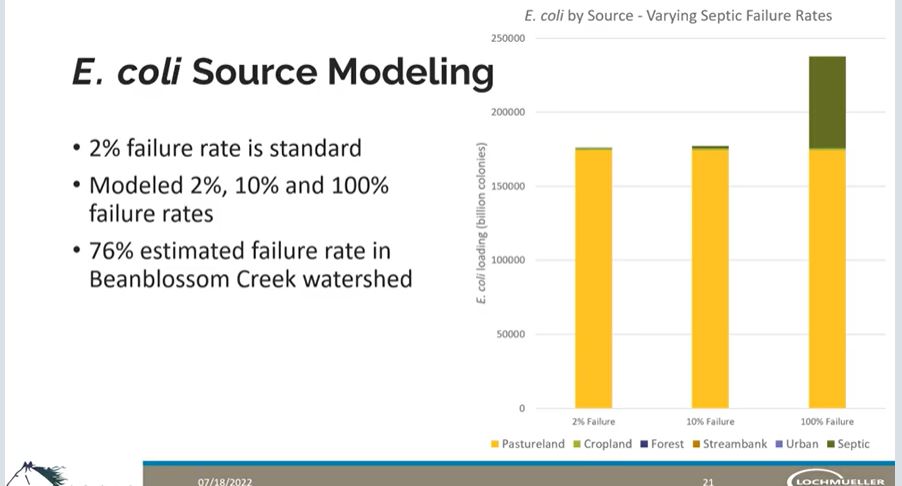
The major cause of E.coli in Brown County waterways (creeks and streams) IS NOT FAILING OR INADEQUATE SEPTIC SYSTEMS.   The major cause is pastureland.   

Appendix B, 2021 Watershed Study (WSS). “Figure 33  details that pastureland loads more E.coli to Brown County Streams than other sources under all modified septic failure modeling scenarios. Only if 100% of documented septic systems are failing do they contribute a significant volume of E.coli to the entirety of Brown County.  When individual sample site drainage is reviewed, the Lake Monroe Watershed loads more E.coli to Brown County Streams than Beanblossom Creek Watershed Streams.”  Note: Figure 33 in the study converted to a bar graph).

BCRSD Best Graph with legend Capture

The Contradiction: 
BCRSD Strategic Wastwater Plan April 2022

“Water quality sampling over the past 15 years reveals a problem with E.coli contamination in Brown County’s waterways.  The primary source of E.Coli has been found from humans. “Failing septic systems are likely contributors to waterway contamination in the county.”  (BCRSD Strategic Wastewater Plan, pg. iv.)

    • The primary source of E.Coli has been found from humans.”   Isn’t this true only if you include “FARMERS” since they are “human” and manage pastureland?
       
    • Failing septic systems are likely contributors to waterway contamination in the county.” 
      • Note the use of the term “likely.”  What is not known  is the number of septic systems that may be contributing to the problem
      • The repeated “spin/myth” in the county has been that failing and inadequate septic systems are the major cause of E.coli. 

Additional Information

Whistleblowers. Unlike at the federal level, the state of Indiana does not have the capability to investigate citizen’s complaints concerning waste, fraud, abuse, and mismanagement.  It is up to the citizens to do their own research and work to ensure that elected and appointed officials are ethical and trustworthy.

List of Imparied Waterways. Indiana Department of Environmental Management (IDEM) List of Impaired  Waterways. An impaired waterway includes what is determined to be an excessive level of pollutants such as E.coli.

Internal Controls.  A request to state and federal officials to review the process for approving wastewater projects: Indiana: Internal Controls – Request for Review – State and Federal.  The needed change will most likely require legislative change.

    • 2024 Campaign Position. Expansion of Sewers –  Eastern Corridor – Helmsburg to Bean Blossom, to Woodland Lake. I support an independent assessment of the justification of the need. Although a septic system may be functional, residents will be forced to hook on to a sewer system and pay a monthly fee. Fees can also be charged during construction. Waivers are only temporary and easements will have to be approved by the residents. The intent is to provide citizens with assurance that the extent and scope of the proposed changes are necessary.  

Water Quality Studies 

On water quality, this conclusion as to pastureland and cropland has been a consistent finding in water quality studies from throughout the State.

E-coli levels in all the 2020 Lake Monroe samples were well below the state standard of 235 CFU/100 ml (CFU = colony forming units of bacteria). …. The South Fork (Jackson County) sub-watershed appears to be the largest contributor of E. coli.

The major cause” of E-coli IS NOT due to the possibility of the failed septic system – it’s agricultural runoff from industries that are in compliance with federal and State laws and regulations. “IDEM said combined sewer overflows, untreated stormwater and wastewater that discharges to nearby streams, rivers and other water bodies were the largest sources of E. coli bacteria, one of the impairments cited to the EPA.”

Mar 31, 2022. Indiana ranks highest in nation for miles of polluted waterways, report finds.

  • “According to the report, a major contributor to water pollution is manure and fertilizer runoff from farms. This causes the concentration of E. coli and nutrients that promote bacterial growth in waterways. “
  • “Watershed Coordinator Maggie Sullivan, who works at the nonprofit Friends of Lake Monroe, said Lake Monroe suffers from nutrient contamination. Lake Monroe also has streams that feed into the lake which have elevated levels of E. coli, but levels in the lake are well below state standards. “Our biggest concern right now is harmful algal blooms,” Sullivan said. 

2023 Courthouse Additions – For the Record

2023- Courthouse Additions – Background

“For the Record:”

Judge Wertz proposed this project last year (2022), and the commissioners committed to funding it. Judge Wertz made a compelling argument and identified a Sally Port as the priority. She also applied for and received grant money to fund planning efforts.

This project was fully vetted by the commissioners and council at several public meetings. There was never ANY opposition to the project from the public.

When the project was first bid last fall, there was only 1 bidder. The project was re-bid and additional bids were received. The lowest bid was selected. There was an allegation that the cost per square foot was excessive but the architect and the contractor selected for the job refuted the claim.

All the rules were followed regarding the bidding and vetting process. There were also last-minute issues with the available funding but this was resolved. Feedback was also positive from the historical preservation experts – no objections to the design of the additions to the historical courthouse.

I attend the commissioner and council meetings and publish my notes at Brown County Matters and at Indep Voters of Brown County IN.

Public Meetings – Allowing Questions – For the Record

Context: 2023 – Post at Brown County Matters
For context: In the fall of 2022, the commissioners and local GoP supported a policy to limit any input or questions from the public. This was covered in the Brown County Democrat. The policy did not make it past the first meeting. Myself and others refused to remain silent and the policy was abandoned.

This year, Commissioner Pittman and Councilman Huett reinforced that technically, they do not have to “Allow” any input or questions from the public. They then identified that citizens may be “allowed” to ask to be placed on the agenda. Approving this request would be at the discretion of the commissioners/council.

Commissioner Pittman did prevent a citizen (Sherrie Mitchell) , who was on the agenda, from asking a question. He also did not allow Sherrie to ask a question while allowing someone else to ask their question.

The council “allows” citizens to ask questions at the start of their meeting BEFORE any of the issues were discussed. This policy is being reconsidered. At their last meeting, this policy was ignored as citizens were “allowed” to ask questions regarding an issue that was on the agenda.

The “2-minute limit” is arbitrary.

Since 2016, I’ve attended over 100 government meetings – citizens asking questions on a topic has never been an issue. There have been a few meetings where things could get a little passionate but a call for order was respected.

Why the recent change in threatening to restrict citizen input is interesting. What’s the problem?