Last updated: April 2, 2024
Impaired Waterways. Despite the spin to the contrary, the major cause of E.coli in our waterways is from pastureland – not inadequate or failing septic systems. This finding regarding pastureland is consistent throughout the state (see below – Water Quality Studies). Any changes that may need to be made will be addressed at the federal and state levels – not the county. In the area of septic system management, legislation in 2023 prevents the county from developing any standards that exceed state requirements. The same standard should be applied to Regional Sewer Districts (RSD), e.g., state policy and guidance identify the standard.
Future of Agriculture in the County? Is the long-term aim of the County represented by the Brown County Regional Sewer District (BCRSD) Board, to support changes and increase the regulation (and cost?) on farmers? If so, why? Environmental concerns? Free up more land for development? Support a false premise for sewer expansion? Other?
More Funding. Clint Studabaker, VP of the Brown County Regional Sewer District (BCRSD) Board, has proposed that reducing contamination in Brown County impaired waterways should be included as a project to be funded with a Stellar Grant. Funding for septic system replacement/repairs (a good thing) was also suggested. Ref: Stellar 2024 for the Record, March 21, 2024 Commissioner Meeting
Motivation. At the Feb 14, 2024 Brown County Regional Sewer District (BCRSD) Board Meeting, Studabaker reinforced his belief that 100% of Brown County Soils are not suitable for septics. He reinforced that IDEM has identified impaired waterways in Brown County and that he intends to ask the USDA to get involved in supporting the application of better farming and livestock management practices. He reiterated his belief that Brown County creeks and streams should be safe for recreational use. BCRSD Board Meeting Notes and Audio, Tues Feb 14, 2023 County Sewer Plan
-
- Audio – of the Meeting – gets a little heated when the scope of the plan is being challenged but reinforces the core beliefs of Studabker on the issues.
Contradictions and Conflict of Interest. Studabaker was the project lead for the development of the Brown County Wastewater Strategic Plan which includes a Watershed Study. The conclusions from these studies contradict a belief that failing and inadequate septic systems are the major cause of E.coli in Brown County. This plan supported the justification of the need for a 39-million-dollar sewer expansion project in Brown County. A supporting effort was the approval of funding for a new (and needed) plant in Helmsburg to process the wastewater. This project was funded for approximately 10 million dollars. I have been a consistent advocate for upgrading the plant in Helmsburg and adding more customers from Lake Lemon who want and need the service.
Checks and Balances on Power.
-
- The BCRSD refused to present their “county” wastewater strategic plan at public meetings. They decided a video summary would be sufficient.
- The president of the commissioners, Jerry Pittman, and the President of the Council, Gary Huett, supported the BCRSD decision not to have public meetings.
- Public Hearing. Citizens were allowed to ask or submit questions at the required public hearing for the proposed sewer expansion project. Questions addressing the justification of need identified in the wastewater strategic plan and watershed study (some of which are identified below), were ignored by the BCRSD and not determined to be relevant.
BCRSD Watershed Study 2021, Appendix B.
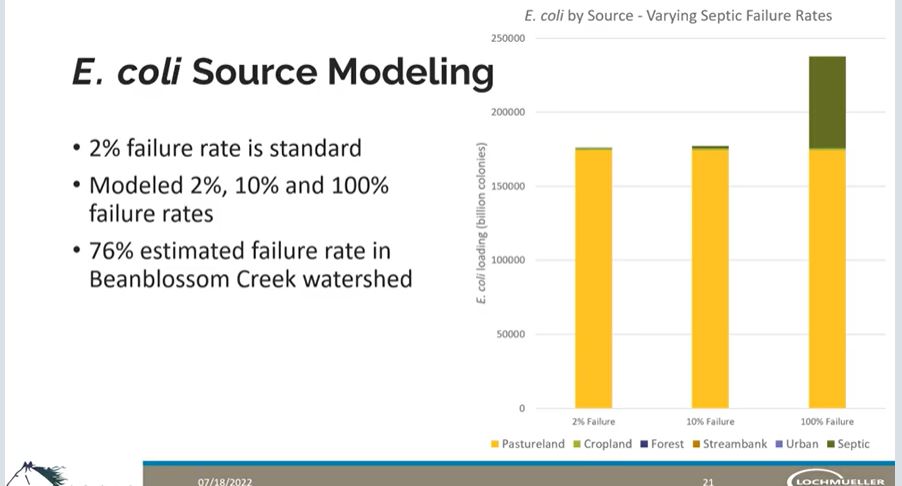
The major cause of E.coli in Brown County waterways (creeks and streams) IS NOT FAILING OR INADEQUATE SEPTIC SYSTEMS. The major cause is pastureland.
Appendix B, 2021 Watershed Study (WSS). “Figure 33 details that pastureland loads more E.coli to Brown County Streams than other sources under all modified septic failure modeling scenarios. Only if 100% of documented septic systems are failing do they contribute a significant volume of E.coli to the entirety of Brown County. When individual sample site drainage is reviewed, the Lake Monroe Watershed loads more E.coli to Brown County Streams than Beanblossom Creek Watershed Streams.” Note: Figure 33 in the study converted to a bar graph).
The Contradiction:
BCRSD Strategic Wastwater Plan April 2022
“Water quality sampling over the past 15 years reveals a problem with E.coli contamination in Brown County’s waterways. The primary source of E.Coli has been found from humans. “Failing septic systems are likely contributors to waterway contamination in the county.” (BCRSD Strategic Wastewater Plan, pg. iv.)
-
- “The primary source of E.Coli has been found from humans.” Isn’t this true only if you include “FARMERS” since they are “human” and manage pastureland?
- “Failing septic systems are likely contributors to waterway contamination in the county.”
- “The primary source of E.Coli has been found from humans.” Isn’t this true only if you include “FARMERS” since they are “human” and manage pastureland?
-
-
- Note the use of the term “likely.” What is not known is the number of septic systems that may be contributing to the problem
- The repeated “spin/myth” in the county has been that failing and inadequate septic systems are the major cause of E.coli.
-
Additional Information
Whistleblowers. Unlike at the federal level, the state of Indiana does not have the capability to investigate citizen’s complaints concerning waste, fraud, abuse, and mismanagement. It is up to the citizens to do their own research and work to ensure that elected and appointed officials are ethical and trustworthy.
List of Imparied Waterways. Indiana Department of Environmental Management (IDEM) List of Impaired Waterways. An impaired waterway includes what is determined to be an excessive level of pollutants such as E.coli.
Internal Controls. A request to state and federal officials to review the process for approving wastewater projects: Indiana: Internal Controls – Request for Review – State and Federal. The needed change will most likely require legislative change.
-
- 2024 Campaign Position. Expansion of Sewers – Eastern Corridor – Helmsburg to Bean Blossom, to Woodland Lake. I support an independent assessment of the justification of the need. Although a septic system may be functional, residents will be forced to hook on to a sewer system and pay a monthly fee. Fees can also be charged during construction. Waivers are only temporary and easements will have to be approved by the residents. The intent is to provide citizens with assurance that the extent and scope of the proposed changes are necessary.
Water Quality Studies
On water quality, this conclusion as to pastureland and cropland has been a consistent finding in water quality studies from throughout the State.
- Lake Monroe Watershed – Link: https://independentvotersofbrowncountyin.com/2022/05/26/lake-monroe-watershed/
E-coli levels in all the 2020 Lake Monroe samples were well below the state standard of 235 CFU/100 ml (CFU = colony forming units of bacteria). …. The South Fork (Jackson County) sub-watershed appears to be the largest contributor of E. coli.
- Indiana Water Quality Link: https://independentvotersofbrowncountyin.com/2022/03/31/indiana-water-quality/
The major cause” of E-coli IS NOT due to the possibility of the failed septic system – it’s agricultural runoff from industries that are in compliance with federal and State laws and regulations. “IDEM said combined sewer overflows, untreated stormwater and wastewater that discharges to nearby streams, rivers and other water bodies were the largest sources of E. coli bacteria, one of the impairments cited to the EPA.”
Mar 31, 2022. Indiana ranks highest in nation for miles of polluted waterways, report finds.
- “According to the report, a major contributor to water pollution is manure and fertilizer runoff from farms. This causes the concentration of E. coli and nutrients that promote bacterial growth in waterways. “
- “Watershed Coordinator Maggie Sullivan, who works at the nonprofit Friends of Lake Monroe, said Lake Monroe suffers from nutrient contamination. Lake Monroe also has streams that feed into the lake which have elevated levels of E. coli, but levels in the lake are well below state standards. “Our biggest concern right now is harmful algal blooms,” Sullivan said.
 Independent Voters of Brown County IN